
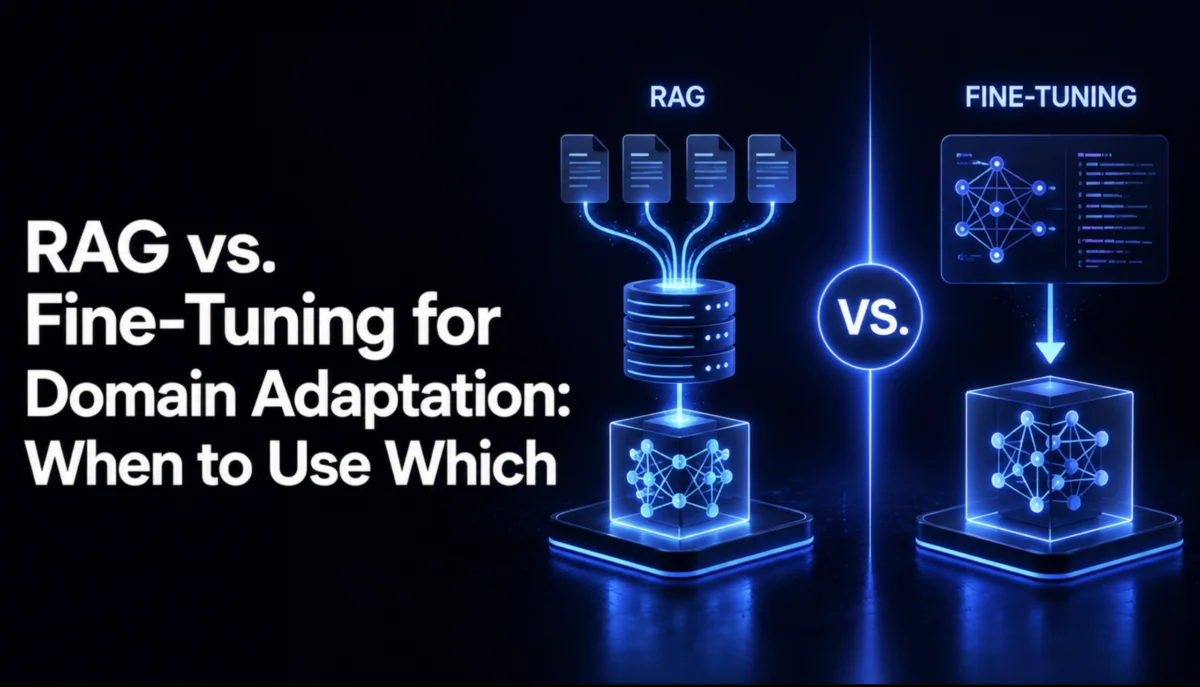

In the rapidly evolving landscape of 2026, the debate surrounding Retrieval-Augmented Generation (RAG) and fine-tuning has moved beyond theoretical discourse into the realm of mission-critical enterprise engineering. While early AI development often framed these two methodologies as mutually exclusive alternatives, current industry data indicates that approximately 60% of high-scale production deployments utilize a hybrid approach. This paradigm shift reflects a maturing understanding of large language models (LLMs): RAG is essentially an information management strategy, whereas fine-tuning is an behavioral optimization tool. Understanding the mechanics of these two systems is no longer optional for technical leads attempting to build robust, reliable, and auditable AI applications.
The Mechanics of Retrieval-Augmented Generation
Retrieval-Augmented Generation functions as an external memory expansion for an LLM. It does not alter the underlying model weights; rather, it dynamically alters the context window at inference time. When a query is submitted, a retrieval engine—typically backed by a vector database or, in simpler implementations, a TF-IDF index—searches a corpus of proprietary documents. The most relevant segments are then injected into the prompt alongside the user’s original request.
This architectural choice is ideally suited for domains characterized by high data volatility, such as technical support runbooks, legal databases, or medical guidelines. Because the model relies on the provided source text, developers can enforce strict grounding, requiring the model to cite specific document IDs for every assertion. This creates an auditable trail, which is a fundamental requirement for compliance-heavy sectors. In practice, RAG turns the LLM into a high-functioning synthesizer rather than a knowledge repository, effectively mitigating the risk of hallucinations by tethering the output to verified source material.
The Behavioral Scope of Fine-Tuning
Conversely, fine-tuning involves the permanent adjustment of a model’s neural weights through supervised training. Using techniques like Low-Rank Adaptation (LoRA) and its memory-efficient variant QLoRA, engineers can optimize a model for specific stylistic or structural outputs without the prohibitive costs of full-parameter retraining. By training on specific input-output pairs, the model learns to internalize complex formatting requirements, tone, and domain-specific vocabulary.
It is a common misconception that fine-tuning is an effective way to "teach" a model new facts. Empirical research suggests that while fine-tuning can improve the retrieval of patterns, it is notoriously unreliable for factual recall. For instance, if a company fine-tunes a model on internal financial reports, the model may adopt the professional tone of those reports, but it will not reliably store specific dollar amounts or transaction details. Consequently, fine-tuning should be viewed as a tool for enforcing consistency, protocol adherence, and specialized syntax, rather than a knowledge base.
Comparative Chronology and Deployment Trajectory
The trajectory of these technologies reflects the rapid professionalization of the AI field. In 2023, the industry was largely experimental, with many teams attempting to "stuff" knowledge into models through massive fine-tuning runs. By 2024, the limitations of this approach became evident, leading to the "RAG-first" movement. Developers realized that maintaining a document database was far cheaper and more scalable than retraining a model every time a single policy changed.
As of early 2026, the industry has entered a phase of integration. Leading AI infrastructure providers have noted that the most successful deployments often follow a specific sequence:
- Initial Deployment (Weeks 1–4): Implementing a basic RAG pipeline to provide the model with necessary factual grounding.
- Evaluation (Weeks 5–8): Identifying behavioral bottlenecks, such as a failure to follow JSON schema requirements or inconsistent tone in customer interactions.
- Behavioral Optimization (Weeks 9–12): Introducing targeted fine-tuning (LoRA adapters) to "fix" the model’s interaction style.
Data-Driven Decision Framework
Deciding between these approaches—or determining when to combine them—requires a clear audit of the problem space. Engineering leaders generally utilize a four-point decision framework to guide their resource allocation:
- Does the information change frequently? If the answer is yes, RAG is the only viable path. Updating a vector database is a near-instantaneous operation, whereas fine-tuning requires a training pipeline and model redeployment.
- Is structural output consistency mandatory? If the downstream system requires a rigid schema (e.g., automated ticket routing or structured data extraction), fine-tuning is necessary to minimize formatting errors that prompt engineering alone cannot eliminate.
- Is traceability and auditability required? If the system must justify its answers with references to source documents, RAG is essential. Fine-tuned models operate as "black boxes" and cannot cite their training data in the same transparent manner.
- Is the domain language unique? If the model struggles with jargon, slang, or proprietary nomenclature that is not widely represented in public training data, fine-tuning will yield significantly better performance than attempting to force the model to learn these patterns via in-context learning.
Case Study: Financial Taxonomy Automation
Consider a financial services firm tasked with classifying thousands of customer complaints daily. The firm has a proprietary taxonomy: BILLING_DISPUTE, UNAUTHORIZED_TRANSACTION, ACCOUNT_ACCESS, FEE_INQUIRY, and CARD_FRAUD_SUSPECTED.
In this scenario, a pure RAG approach often fails because the model may struggle to map nuanced complaints into these rigid categories with 100% consistency. However, a fine-tuned model, trained on high-quality examples of how these complaints should be classified, excels at this task. The model effectively "learns" the taxonomy, leading to higher throughput and fewer errors in downstream ticketing systems. Crucially, the firm does not need the model to "know" new world facts; they need it to "act" according to a specific internal logic. This represents a perfect use case for fine-tuning.
Broader Implications and Future Outlook
The convergence of RAG and fine-tuning signals a move toward modular AI architectures. Instead of relying on monolithic models to solve every problem, developers are increasingly building "composed" systems. In these systems, a lightweight, fine-tuned model acts as an intelligent router or formatter, while a robust RAG pipeline handles the retrieval of high-fidelity information.
Experts in the field emphasize that this hybrid approach is not just a trend but a necessity for production-grade reliability. As AI systems become more deeply integrated into enterprise workflows, the ability to separate "knowledge" from "behavior" will remain the primary differentiator between successful deployments and those that collapse under the weight of maintenance costs and reliability failures.
The consensus among major cloud AI platforms is that the future of enterprise AI lies in this modularity. By offloading knowledge management to retrieval systems and behavior management to targeted adapters, developers can create systems that are simultaneously highly knowledgeable, strictly reliable, and surprisingly cost-effective. Ultimately, the question for 2026 is no longer "RAG or fine-tuning," but rather how effectively a project can orchestrate the two to meet the specific demands of its domain.
