
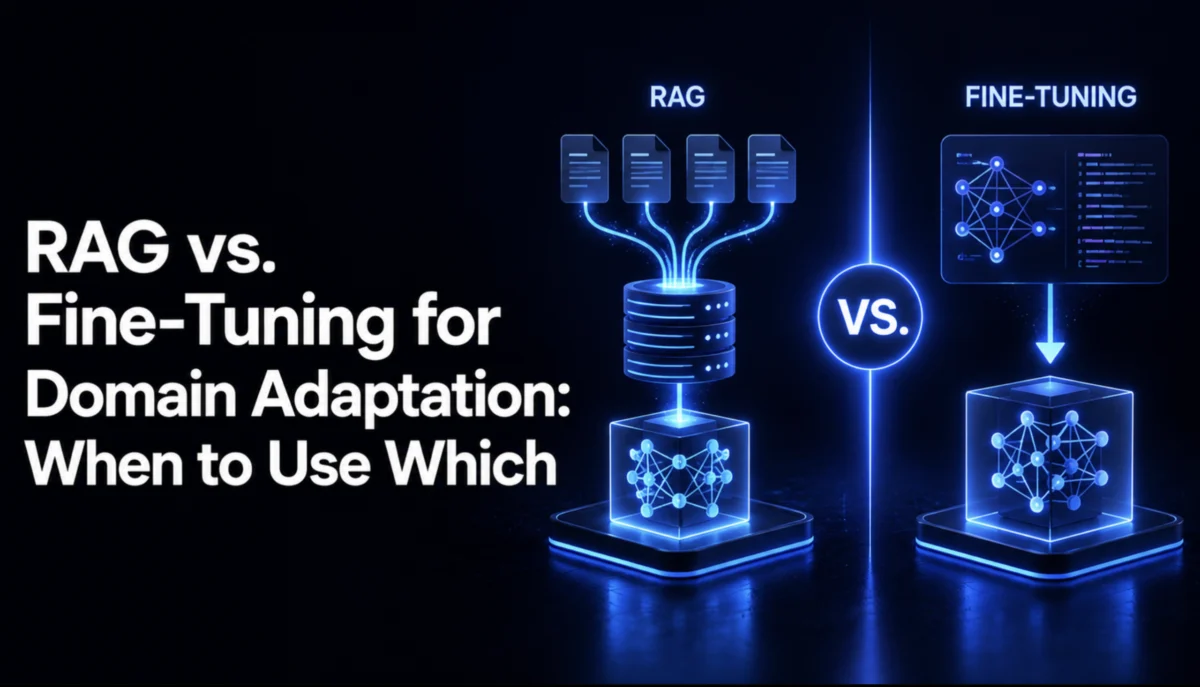

The rapid proliferation of Large Language Models (LLMs) in enterprise environments has forced a critical evaluation of how organizations adapt these systems to proprietary data. For many engineering teams, the decision between Retrieval-Augmented Generation (RAG) and fine-tuning has been erroneously presented as a zero-sum game. However, current industry benchmarks from 2026 suggest that approximately 60% of mature production LLM deployments utilize a hybrid architecture, integrating both methodologies to solve distinct technical challenges. By decoupling the mechanics of knowledge retrieval from the optimization of behavioral patterns, organizations can move beyond the false dichotomy that has long hindered AI infrastructure development.
Mechanical Foundations: Understanding the Divide
To grasp the distinction between these two strategies, one must examine their interaction with the underlying architecture of a Transformer-based model. RAG operates externally, acting as a dynamic reference library. When a user submits a query, a retrieval system—often utilizing vector databases or TF-IDF indexing—scans a repository of documents, extracts the most pertinent information, and injects that context into the LLM’s prompt. The model’s internal weights remain static; it functions as a highly sophisticated reasoning engine that processes the provided data to formulate a response.
Conversely, fine-tuning involves the internal modification of the model’s weight parameters. Through iterative training on specific input-output pairs, the model internalizes stylistic preferences, output formats, and domain-specific vernacular. Modern implementations, particularly Low-Rank Adaptation (LoRA) and its variants like QLoRA, have democratized this process. By training small "adapter" layers—often representing less than 1% of the model’s total parameters—engineers can achieve significant behavioral shifts without the prohibitive costs of full-model retraining.
Chronology of Adoption and the "Knowledge vs. Behavior" Paradigm
The evolution of these tools has followed a distinct trajectory. In the early stages of generative AI, practitioners attempted to force-feed massive amounts of domain-specific documentation into models via training, often resulting in "hallucinations" where the model would confidently invent facts. By mid-2024, the industry consensus shifted toward RAG as the primary mechanism for factual grounding. This was driven by the necessity for auditability, especially in regulated industries like finance and healthcare, where every output must be traceable to a specific, verifiable source.
The emergence of fine-tuning as a specialized tool for behavioral control followed shortly thereafter. While RAG ensures that an AI consultant has access to the correct manual, fine-tuning ensures the AI adheres to the corporate tone, complies with strict JSON schemas for automated ticketing, and rejects out-of-scope requests with the desired level of professional brevity.
Case Study I: RAG in Engineering Operations
Consider an internal engineering team managing incident runbooks and postmortems. These documents are characterized by high volatility; they are updated weekly or even daily as new system failures occur. Attempting to fine-tune a model on this data would be inefficient, as the model would require constant retraining to remain relevant.
In this scenario, a RAG pipeline is the optimal solution. By implementing a system that parses incident reports into "chunks"—often using sentence-boundary detection to maintain context—the team can index these documents for rapid retrieval. The generation phase is then constrained by a strict system prompt that forbids the model from relying on its pre-trained knowledge, forcing it to provide answers supported by specific source citations. This provides an auditable trail, allowing on-call engineers to verify the logic behind a system-generated recommendation at 2:00 a.m.
Case Study II: Fine-Tuning for Structured Output
In contrast, consider a financial services firm tasked with classifying thousands of customer complaints daily into a proprietary taxonomy: BILLING_DISPUTE, UNAUTHORIZED_TRANSACTION, ACCOUNT_ACCESS, FEE_INQUIRY, and CARD_FRAUD_SUSPECTED. This task requires extreme consistency; if the model fails to return a precise JSON object with a specific severity rating, the downstream ticketing systems break.
A system prompt may suffice for simple tasks, but it often fails under high-volume, edge-case conditions. Fine-tuning allows the organization to bake these requirements into the model’s "reflexes." By training the model on thousands of examples of complaints paired with the correct taxonomy and severity score, the model learns the inherent structure of the business logic. This reduces latency by eliminating the need for complex, long-winded system prompts and increases the reliability of the automated pipeline.
Data Validation and Technical Implications
For fine-tuning, data quality is paramount. A single mislabeled example in a small training set can disproportionately skew the model’s performance. Standard practice now mandates rigorous validation scripts that check every label against the predefined taxonomy before the training cycle begins. Furthermore, the use of 4-bit quantization during the training process allows these models to be refined on consumer-grade or mid-tier enterprise hardware, significantly lowering the barrier to entry.
When deploying RAG, the technical focus shifts to the quality of the retrieval index. Whether using traditional TF-IDF or modern neural embedding models, the goal is to maximize the relevance of the context window. The "chunking" strategy—ensuring that information is not severed mid-sentence—is as critical as the LLM selection itself.
A Decision Framework for Production Systems
Determining whether to prioritize RAG, fine-tuning, or both requires a pragmatic assessment of the project’s core requirements:
- Knowledge Updates: If the required information changes daily or weekly, RAG is mandatory.
- Auditability: If the system must cite its sources to maintain trust or regulatory compliance, RAG is mandatory.
- Behavioral Consistency: If the system must strictly follow a specific format, tone, or linguistic pattern, fine-tuning is the superior tool.
- Integration Complexity: If the model must interface with downstream software expecting a rigid data contract (e.g., APIs, databases), fine-tuning provides the highest level of reliability.
Broader Impact and Industry Outlook
The maturation of these technologies signals a shift toward "specialized AI." We are moving away from the era of monolithic, general-purpose models toward a modular ecosystem where general reasoning models are augmented by retrieval layers and specialized behavioral adapters.
Industry analysts observe that as these tools become more accessible, the competitive advantage for organizations will lie not in the choice between RAG and fine-tuning, but in the engineering excellence of the pipeline that combines them. Organizations that view RAG as their "long-term memory" and fine-tuning as their "operational discipline" will be best positioned to deploy reliable, high-performance AI systems. The future of enterprise AI is not a choice between these two methodologies, but a sophisticated integration that leverages the unique strengths of both to create systems that are simultaneously knowledgeable, compliant, and structurally sound.
