
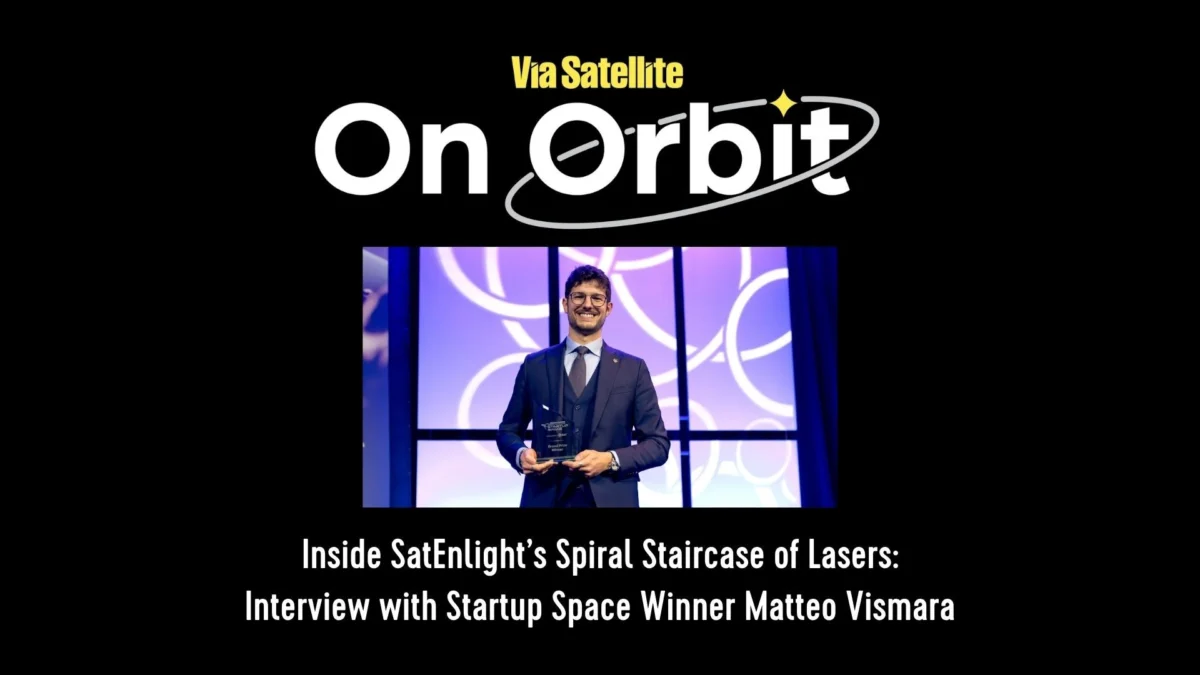

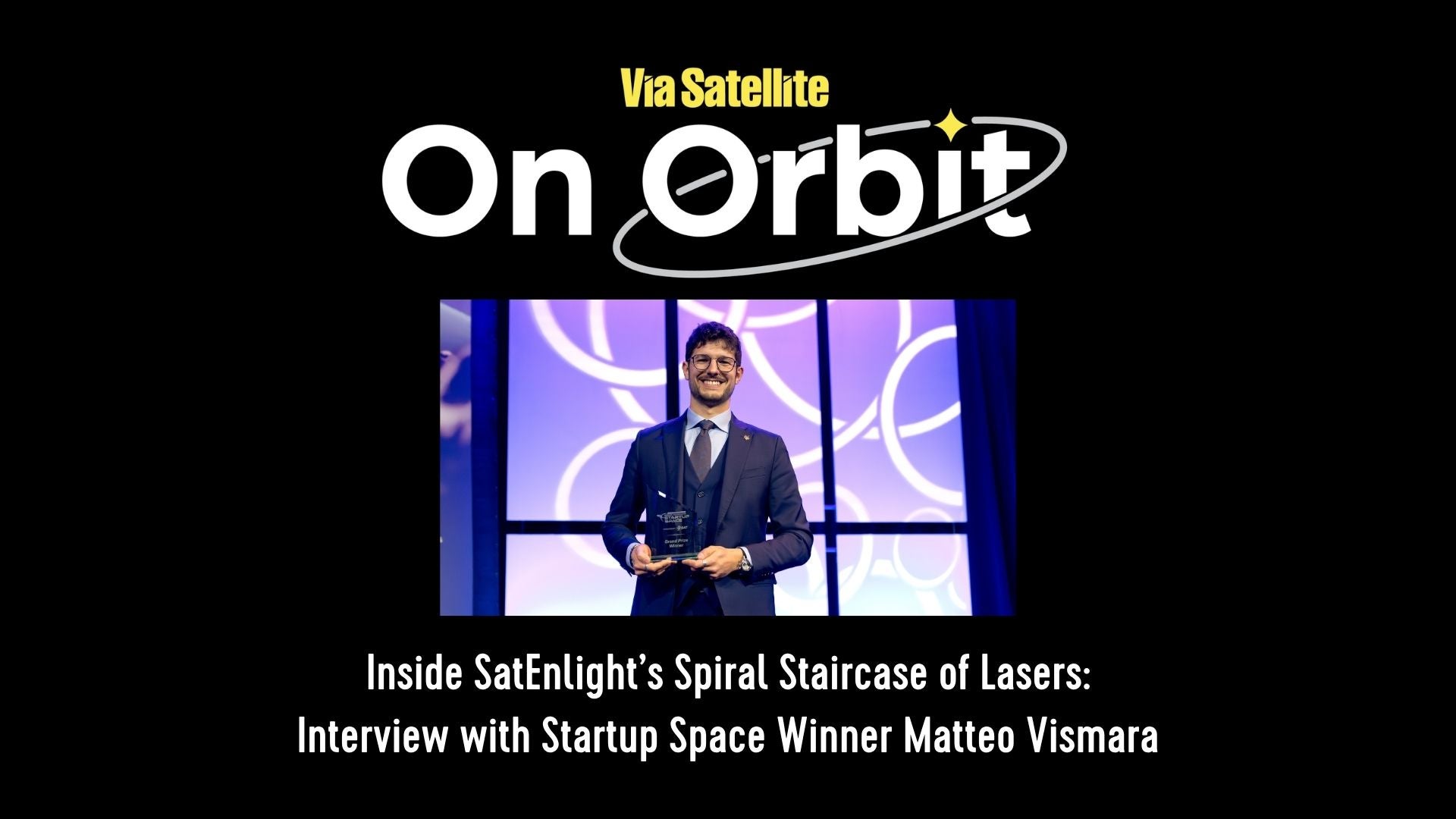
The burgeoning field of satellite communications has reached a critical juncture where traditional radio frequency (RF) spectrums are becoming increasingly congested, driving a global shift toward optical or laser-based communication systems. At the forefront of this technological pivot is SatEnlight, a Milan-based startup that recently secured a significant industry milestone. Matteo Vismara, CEO and co-founder of SatEnlight, was named the winner of the 10th Annual Startup Space entrepreneur pitch contest at the SATELLITE conference, a premier event in the global aerospace sector. The victory highlights a growing interest in SatEnlight’s proprietary optical terminal technology, which utilizes a unique "spiral staircase" arrangement of laser beams to maximize data throughput and efficiency in orbital environments.
The recognition comes at a time when the space economy is transitioning from experimental deployments to large-scale commercial infrastructure. SatEnlight’s core innovation lies in its ability to stack multiple beams on top of one another in a multi-layered configuration. This approach, rooted in advanced physics and high-energy research, offers a potential solution to the bandwidth bottlenecks currently facing Low-Earth Orbit (LEO) and Medium-Earth Orbit (MEO) constellations. As the demand for real-time Earth observation data and global high-speed internet grows, the industry is looking toward startups like SatEnlight to provide the hardware capable of handling terabits of data across the vacuum of space.
The Genesis of SatEnlight: From CERN to Commercial Space
The foundation of SatEnlight is not found in traditional corporate research and development labs but in the halls of one of the world’s most prestigious scientific institutions. Matteo Vismara and his co-founding team developed their optical communication product based on years of rigorous research conducted at the CERN Large Hadron Collider in Geneva. This background in high-energy physics provided the team with a unique perspective on particle behavior and light manipulation, which they eventually translated into a commercial application for the space sector.
Vismara’s transition from academia to entrepreneurship represents a significant trend within the European "Deep Tech" ecosystem. For many researchers at institutions like CERN, the path toward university tenure is a traditional and secure career trajectory. However, Vismara opted to forgo the relative safety of an academic career to address the practical challenges of satellite connectivity. This decision was driven by the realization that the physics of light—specifically the use of orbital angular momentum (OAM) and spatial multiplexing—could be harnessed to revolutionize how satellites communicate with one another and with ground stations.
The move from Geneva to Milan allowed the company to tap into Italy’s storied history in aerospace engineering. Italy has long been a significant contributor to the European Space Agency (ESA) and maintains a robust domestic supply chain for satellite components. By basing SatEnlight in Milan, the founders positioned the company within a hub of industrial excellence, enabling them to bridge the gap between theoretical physics and the manufacturing of flight-ready hardware.
Technical Innovation: The Multi-Layered Optical Terminal
At the heart of SatEnlight’s value proposition is its optical communication terminal. Unlike standard laser communication terminals (LCTs) that typically rely on a single point-to-point beam, SatEnlight’s technology utilizes a more complex architecture. The system arranges beams in a manner that resembles a multi-layered spiral staircase. This configuration is more than an aesthetic choice; it is a method of spatial multiplexing that allows for significantly higher data density.
In technical terms, the "spiral" approach leverages the spatial modes of light to carry distinct streams of information simultaneously on the same frequency. This effectively multiplies the capacity of a single laser link without requiring a proportional increase in power or hardware size. In an industry where "Size, Weight, and Power" (SWaP) constraints are the primary limiting factors for satellite design, SatEnlight’s ability to deliver higher performance within a compact form factor is a major competitive advantage.
Furthermore, the company believes its terminal could help establish new standards for optical transmissions. Currently, the industry is grappling with a lack of interoperability between different laser communication systems. By introducing a terminal that can handle complex, multi-layered beams, SatEnlight is positioning itself to influence the future protocols of the "Space Internet." If successful, their technology could ensure that satellites from different manufacturers and operators can communicate seamlessly, a prerequisite for the fully integrated orbital networks of the 2030s.
Chronology of the Startup Space Victory
The Startup Space pitch contest, now in its tenth year, has become a barometer for the health and direction of the space startup ecosystem. The 2024 competition featured a diverse array of companies ranging from launch providers to orbital debris removal specialists. The selection process involves a rigorous vetting of business models, technical feasibility, and market potential by a panel of expert judges, including venture capitalists and veteran aerospace executives.
The timeline leading to SatEnlight’s victory involved several months of preparation and coaching. During the "On-Orbit" podcast interview with Via Satellite Executive Editor Jeffrey Hill, Vismara noted that a pivotal moment in his preparation came from pitch coaching sessions. A specific piece of advice regarding his slide deck—focusing on visual clarity and the immediate communication of the technology’s "X-factor"—helped him distill complex physics into a compelling business case.
During the final pitch at the SATELLITE show, Vismara successfully articulated the scalability of SatEnlight’s technology. The judges were reportedly impressed by the team’s ability to take CERN-level science and apply it to a pressing commercial need. Winning the contest provides SatEnlight not only with prestige but also with increased visibility among prime contractors and government agencies looking for next-generation optical solutions.
Supporting Data and Market Context
The market for optical satellite communication is projected to experience exponential growth over the next decade. According to market research data, the global laser communication market is expected to grow at a Compound Annual Growth Rate (CAGR) of over 25% through 2030. This growth is fueled by several factors:
- Spectrum Scarcity: RF bands (such as Ku, Ka, and V-bands) are becoming crowded, leading to regulatory hurdles and interference issues. Optical communications operate in the unregulated light spectrum, bypassing these limitations.
- Data Volume: Modern Earth observation satellites generate petabytes of data that exceed the downlink capacity of traditional RF systems. Laser links offer 10x to 100x the throughput of RF.
- Security: Laser beams are highly directional and narrow, making them significantly harder to intercept or jam compared to wide-broadcast RF signals. This makes optical terminals highly attractive for defense and government applications.
SatEnlight’s focus on inter-satellite links (ISLs) places it in a high-demand niche. As mega-constellations like SpaceX’s Starlink and Amazon’s Project Kuiper continue to expand, the need for robust, high-capacity ISLs becomes paramount to minimize latency and reduce reliance on ground stations in remote or geopolitically sensitive areas.
Industry Response and Implications
The reaction from the aerospace community to SatEnlight’s win has been overwhelmingly positive, reflecting a broader confidence in the European space startup scene. Analysts suggest that SatEnlight’s success is a testament to the effectiveness of technology transfer programs that move innovations from basic science research centers like CERN into the commercial marketplace.
"The win for SatEnlight underscores the shift toward high-performance optical payloads as a standard requirement for new constellations," noted one industry analyst following the event. "The fact that a startup can take complex physics and package it into a commercially viable terminal suggests that the barriers to entry for advanced optical comms are shifting from theoretical research to manufacturing scale."
For Italy, SatEnlight represents a successful example of the national "Space Economy" strategy, which aims to foster innovation through investment in high-tech startups. The Italian Space Agency (ASI) has been vocal about supporting domestic companies that can compete on the global stage, particularly in high-growth areas like telecommunications.
Broader Impact on Orbital Infrastructure
The long-term implications of SatEnlight’s technology extend beyond individual satellite missions. By potentially creating a new standard for multi-layered optical transmissions, the company is contributing to the architecture of a truly global, interconnected orbital network. This "Internet in the Sky" will require high-speed "backbone" links similar to the fiber-optic cables that power the terrestrial internet.
If SatEnlight can successfully move from its current prototype and winning pitch to full-scale production and deployment, it could significantly lower the cost-per-bit of satellite data. This would have a trickle-down effect on various industries, including maritime logistics, aviation connectivity, and disaster response, where high-speed data is often a life-saving commodity.
As Matteo Vismara and his team return to Milan following their success in the United States, the focus will now shift to flight heritage. The next major milestone for SatEnlight will be an in-orbit demonstration (IOD) to prove that their "spiral staircase" of lasers can maintain stability and alignment amid the harsh conditions of space. With the momentum of the Startup Space victory behind them, SatEnlight is well-positioned to lead the next wave of optical innovation in the final frontier.
