
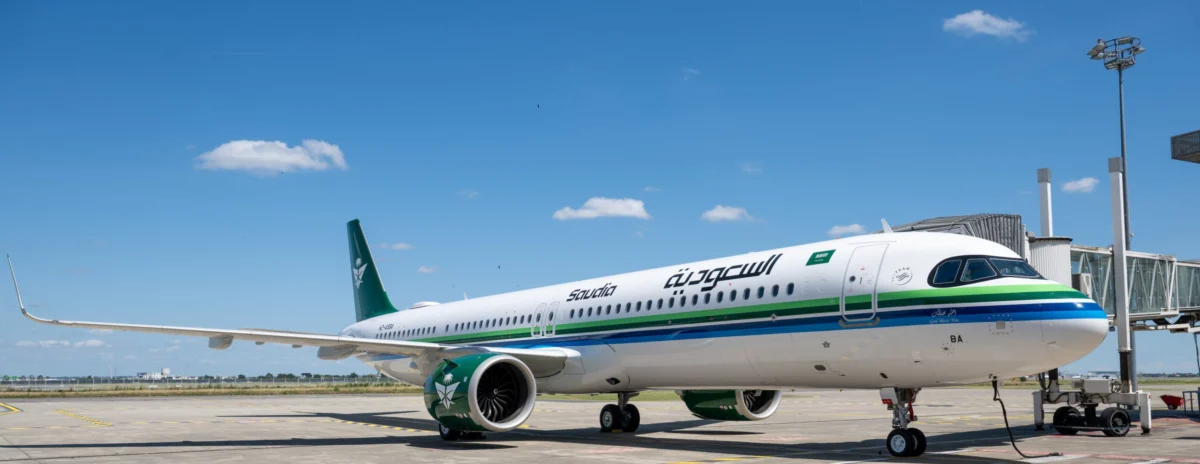

In a landmark development for the global aviation and satellite communications sectors, Neo Space Group (NSG) and Saudia have officially announced the first line-fit activation of the NSG Skywaves In-Flight Connectivity (IFC) service. This technological milestone was inaugurated aboard Saudia’s first Airbus A321XLR aircraft, marking a transformative moment for the Saudi national flag carrier as it seeks to redefine the passenger experience through high-speed, multi-orbit satellite integration. The announcement, made on June 29, underscores a significant shift in how airlines approach narrow-body long-haul operations, combining state-of-the-art aeronautical engineering with cutting-edge space technology.
The implementation of NSG Skywaves is powered by the SES Open Orbits multi-orbit network, a sophisticated architecture that leverages both Geostationary Orbit (GEO) and Medium Earth Orbit (MEO) satellite capabilities. This hybrid approach is designed to eliminate the traditional trade-offs of satellite internet, providing the resilient, high-capacity bandwidth of GEO satellites alongside the low-latency performance of MEO constellations. For Saudia, this means delivering a seamless "office-in-the-sky" or "home-entertainment" experience to passengers traveling across the airline’s expanding international flight corridors.
Technical Performance and Operational Testing
The activation follows an intensive period of operational testing conducted by Neo Space Group’s engineering and operations divisions. These tests were designed to push the limits of the hardware and software stack in real-world flight conditions. The results demonstrated that the NSG Skywaves system can deliver onboard speeds of up to 200 Mbps per aircraft. This throughput represents a quantum leap over legacy IFC systems, which often struggle to maintain consistent speeds when multiple passengers attempt to stream high-definition content or engage in bandwidth-heavy applications simultaneously.
The 200 Mbps benchmark is particularly significant given the A321XLR’s mission profile. As a narrow-body aircraft designed for "Xtra Long Range" missions, the A321XLR will spend extended periods in transcontinental and oceanic airspace. In these environments, reliable connectivity has historically been a challenge. By utilizing the SES Open Orbits framework, the Skywaves service ensures that the aircraft can switch between satellite beams and orbits without interrupting the user session, maintaining high-speed access even as the plane traverses different geographical regions.
The Airbus HBCplus Line-Fit Solution
A critical component of this deployment is the integration method. The IFC service was installed as an Airbus HBCplus line-fit solution. Unlike "retrofit" installations, where connectivity hardware is added to an existing aircraft after it has left the factory, a "line-fit" solution is integrated during the original manufacturing process at the Airbus assembly line. This approach offers several advantages, including optimized aerodynamics, reduced weight, and higher system reliability, as the antennas and internal wiring are part of the aircraft’s fundamental design.
The successful rollout of this service is the result of a complex multi-party collaboration. Neo Space Group acted as the primary service provider and integrator, working in close coordination with Saudia as the end-user. Airbus provided the airframe and the HBCplus platform architecture, while SES supplied the multi-orbit satellite capacity. Additionally, Rave Aerospace played a vital role in ensuring the connectivity system interfaced seamlessly with the onboard In-Flight Entertainment (IFE) screens and passenger personal devices. This ecosystem-based approach reflects the modern aviation industry’s move toward open-standard architectures, allowing airlines more flexibility in choosing service providers without being locked into proprietary hardware.
Strategic Importance of the Airbus A321XLR for Saudia
Saudia’s acquisition of the Airbus A321XLR is a strategic move that places the carrier at the forefront of regional aviation. By becoming the first airline in the Middle East and Africa to operate this specific model, Saudia is positioning itself to capture new market segments. The A321XLR is designed to fly up to 4,700 nautical miles (8,700 km), allowing it to serve routes that were previously only viable for larger, more expensive wide-body aircraft.
For Saudia, this means the ability to launch non-stop flights from Jeddah or Riyadh to distant destinations in Europe, Africa, and Asia with a more fuel-efficient narrow-body fleet. However, longer flight times on smaller aircraft necessitate a superior cabin experience to maintain passenger comfort and loyalty. The integration of NSG Skywaves is the centerpiece of this strategy, ensuring that the "Xtra Long Range" does not result in "extra boredom."
Official Responses and Executive Vision
The leadership at Saudia has emphasized that this technology is not merely an amenity but a core component of their brand identity moving forward. Rossen Dimitrov, Chief Guest Experience Officer at Saudia, highlighted the transformative nature of the service in a formal statement.
"Connectivity is an essential part of modern travel, and providing high-speed internet on our new A321XLR is a key element of the new Saudia experience," Dimitrov stated. "It enables our guests to stay connected, remain entertained, and enjoy a more engaging and seamless onboard journey. It also enables a new generation of connected onboard experiences, allowing guests to enjoy live television and real-time content in ways that were previously not possible, bringing the journey closer than ever to the world beyond the aircraft."
Dimitrov’s remarks point to a broader trend in the industry: the move toward "connected content." By providing 200 Mbps speeds, Saudia can offer live sports, breaking news, and interactive social media integration that functions with the same responsiveness passengers expect on the ground. This capability is expected to be a major differentiator in the highly competitive Middle Eastern aviation market.
Chronology of the Partnership
The journey to this activation has been several years in the making, following Saudi Arabia’s broader "Vision 2030" initiative, which seeks to diversify the Kingdom’s economy and establish it as a global hub for aviation and technology.
- Initial Partnership: Neo Space Group was established by the Public Investment Fund (PIF) to spearhead Saudi Arabia’s commercial space ambitions, identifying IFC as a high-growth vertical.
- Satellite Agreement: NSG entered into a strategic partnership with SES to utilize the O3b mPOWER MEO constellation and SES’s extensive GEO fleet, creating the "Open Orbits" foundation.
- Airbus Integration: Saudia and Airbus finalized the A321XLR order, selecting the HBCplus platform to future-proof the fleet’s connectivity.
- Technical Validation: Throughout early 2024, engineering teams from NSG and SES conducted ground and flight trials to calibrate the hand-over protocols between GEO and MEO satellites.
- Delivery and Activation: In June 2026, the first A321XLR was delivered to Saudia, with the Skywaves service fully operational and validated for commercial use.
Broader Industry Implications and Analysis
The activation of NSG Skywaves on Saudia’s fleet has implications that resonate far beyond the Kingdom. It signals the arrival of the "Multi-Orbit Era" in commercial aviation. For years, the industry was divided between GEO providers (offering global coverage but higher latency) and LEO (Low Earth Orbit) providers (offering low latency but sometimes facing capacity constraints over busy hubs). The SES Open Orbits model, utilized by NSG, suggests that a hybrid approach—incorporating MEO—might be the most robust solution for airlines.
MEO satellites, such as SES’s O3b mPOWER, operate at an altitude of approximately 8,000 km. This is much closer to Earth than GEO (36,000 km), significantly reducing the "ping" or latency that causes delays in video conferencing and cloud gaming. By combining this with GEO’s massive broadcast capacity, Saudia can offer a service that is both fast and reliable, even when flying over the middle of the ocean or high-traffic air corridors.
Furthermore, this development reinforces the role of Saudi Arabia as a rising power in the space economy. Neo Space Group’s ability to deploy such a sophisticated service on a major international carrier demonstrates that the Kingdom is successfully transitioning from a consumer of space technology to a provider and integrator.
Future Outlook: Scaling Across the Fleet
The delivery of the first A321XLR is only the beginning of Saudia’s fleet modernization program. The airline has a significant backlog of aircraft on order, many of which are expected to feature the NSG Skywaves system. As the service matures, industry analysts expect Saudia to explore further innovations, such as personalized content delivery based on passenger profiles and the integration of IoT (Internet of Things) sensors to monitor aircraft health in real-time via the Skywaves link.
For the passengers, the era of "airplane mode" being synonymous with "offline" is rapidly coming to an end. With 200 Mbps speeds and multi-orbit reliability, the cabin of a Saudia A321XLR effectively becomes a high-speed node in the global digital network. As other airlines watch the performance of this line-fit activation, the pressure will mount for carriers worldwide to match the connectivity standards now being set in the Middle East.
In conclusion, the collaboration between Neo Space Group, Saudia, Airbus, and SES represents a successful convergence of aerospace and satellite technology. By prioritizing high-speed, low-latency connectivity from the factory floor to the flight deck, Saudia is not just flying passengers to their destinations—it is keeping them connected to their worlds at 35,000 feet.
