
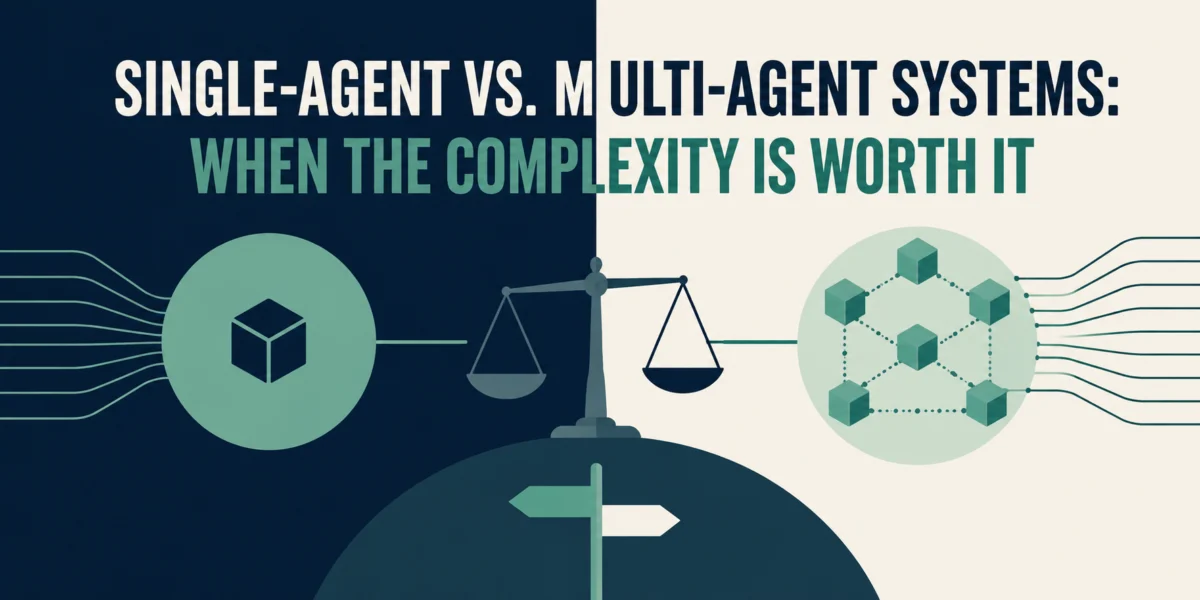

The evolution of artificial intelligence has reached a critical juncture where engineers must decide between deploying monolithic, single-agent architectures or distributed, multi-agent frameworks. This decision represents more than a mere technical preference; it is a fundamental choice that dictates the operational efficiency, cost structure, and reliability of an organization’s digital infrastructure. As AI adoption accelerates across enterprise sectors, the industry is witnessing a clear divergence in how these systems are architected to solve complex, real-world problems.
The Rise of the Agentic Paradigm
To understand this architectural split, one must first define what constitutes an "agentic" system. Unlike a standard large language model (LLM), which functions primarily as a request-response engine, an agent is an autonomous entity capable of decision-making, tool utilization, and sequential action. The core functionality of an agent is rooted in a recursive loop: it receives a goal, selects an appropriate tool from an available repertoire—such as web search, code execution, or database querying—observes the outcome, and modifies its subsequent actions to converge on a solution.
This shift toward agentic workflows began in earnest around 2023, as developers moved beyond basic chatbot interfaces to build systems capable of performing discrete tasks. The industry currently finds itself in a "complexity trap," where the allure of multi-agent systems—touted for their ability to simulate human-like collaboration—often leads teams to bypass simpler, more robust single-agent solutions.
The Case for Single-Agent Efficiency
A single-agent architecture concentrates all decision-making authority within one model instance. This configuration is often the most pragmatic starting point for development. By consolidating tools—such as search, data retrieval, and document drafting—into a single agent, developers create a "generalist" system that can manage a broad spectrum of enterprise tasks, including customer support triage, automated reporting, and data extraction.
From an engineering perspective, the single-agent model offers distinct advantages. First, latency is significantly lower, as there is no need for inter-agent communication or complex task orchestration. Second, the cost is predictable and lower, as the system avoids the token-heavy overhead of multiple model calls and inter-agent handoffs. Finally, debugging is simplified; developers can trace a single conversation history and a single decision path, making it significantly easier to identify where a process went wrong.
The Complexity Tax of Multi-Agent Frameworks
In contrast, multi-agent systems function like a digital agency. An orchestrator agent manages a team of specialized sub-agents, each equipped with its own distinct persona, system prompt, and limited toolset. While this approach allows for the execution of tasks that would be impossible for a single actor, it imposes what industry experts describe as a "complexity tax."
The implementation of multi-agent systems introduces several critical challenges:
- Compound Latency: Sequential workflows, where Agent A must finish before Agent B can start, create significant time bottlenecks.
- Economic Scaling: Every agent in the network consumes tokens. In large-scale systems, this leads to an exponential increase in operational costs.
- Failure Propagation: In a single-agent system, an error is localized. In a multi-agent framework, a flawed output from an early-stage agent can cascade through the entire workflow, resulting in "hallucination drift" that is difficult to isolate.
- Orchestration Overhead: Maintaining state and shared memory across multiple agents requires sophisticated middleware. Designing protocols for when an agent should hand off a task or declare it complete is a significant engineering hurdle.
Strategic Justification for Multi-Agent Architectures
Despite the added complexity, multi-agent architectures are becoming standard for high-stakes applications where specific conditions are met. Research indicates that organizations are increasingly adopting these frameworks in four distinct scenarios:
1. The Adversarial Critic Workflow
Large language models often exhibit "confirmation bias" in their own output; they struggle to identify their own errors. By introducing a secondary "critic" agent, systems can establish an adversarial loop where the output is rigorously stress-tested for logical gaps or security vulnerabilities. This is particularly prevalent in software development, where one agent writes code and another performs static analysis or unit testing.
2. Tool-Set Specialization
Performance degradation is a common phenomenon when a single agent is overloaded with too many tools. If an agent is tasked with both high-level strategic research and low-level database manipulation, its accuracy in selecting the correct tool often declines. Separating these into specialized agents—one for information gathering and one for technical execution—sharpens the decision-making surface of each model.
3. Parallel Execution Capabilities
When tasks are independent, multi-agent systems provide a clear performance advantage. For instance, if an AI is required to synthesize data from three different market sectors, a single agent would process them sequentially. A multi-agent system can initiate three separate sub-agents to conduct these tasks in parallel, reducing the total wall-clock time for the final report.
4. Context-Specific Guardrails
In regulated industries like finance or healthcare, an agent may need to maintain a strict, formal tone when interacting with a user, while simultaneously using a more technical, unfiltered persona for internal data processing. Multi-agent systems allow developers to isolate these personas, ensuring that safety guardrails are applied effectively without compromising the agent’s analytical utility.
Decision Heuristics: A Framework for Engineers
To decide between these architectures, engineering teams are increasingly using a simple heuristic based on human workplace dynamics. If a professional could complete the task at a single desk, using one computer, without the need to switch software or change their "hat" (perspective), then a single-agent architecture is almost certainly sufficient. If the task requires the collaboration of distinct departments—such as a lawyer, a coder, and a researcher—then a multi-agent architecture is likely the more robust path forward.
Industry Implications and Future Outlook
The current trend toward multi-agent systems is not merely a technical fad; it is a response to the growing maturity of AI workflows. However, the most successful implementations in the current market are those that follow an "emergent complexity" philosophy. Companies that start with a single agent and only introduce additional agents when specific failure modes emerge—such as poor tool selection or inability to self-critique—tend to build more resilient systems.
Looking forward, the industry is moving toward standardized orchestration frameworks that mitigate some of the "complexity tax." Tools that manage shared memory and state across agentic teams are becoming more accessible, effectively lowering the barrier to entry for complex, multi-agent deployments.
Ultimately, the choice between single and multi-agent systems should be governed by the specific requirements of the objective. The most efficient systems are rarely the most complex; they are, instead, the most precisely engineered for the problem at hand. As the field matures, the standard for success will shift from "how many agents are involved" to "how efficiently and reliably does the architecture deliver the intended outcome." For developers, the mandate is clear: start simple, observe the failure points, and scale the architecture only when the problem complexity necessitates a team-based approach.
