
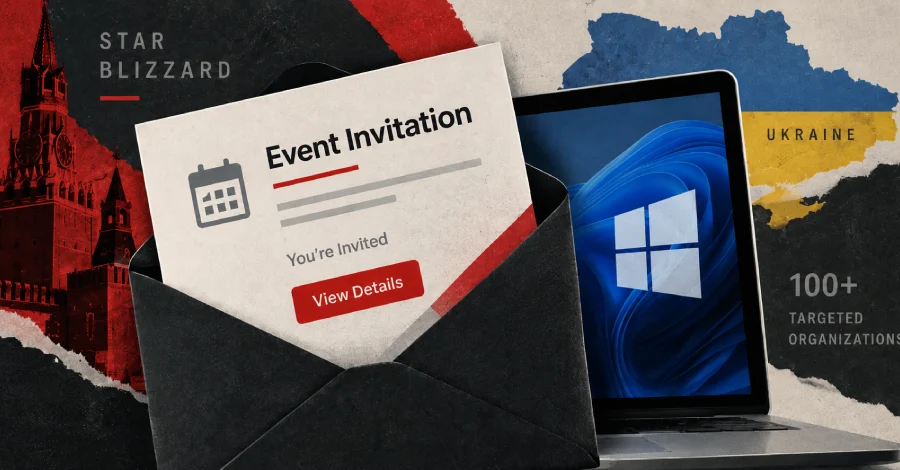

The Russian state-sponsored threat actor known as Star Blizzard has significantly ramped up its cyber-espionage operations throughout 2026, leveraging highly deceptive event-themed phishing campaigns to infiltrate high-value targets across the United States and the United Kingdom. Microsoft’s security intelligence division has confirmed that this sophisticated actor, which international security agencies link to Center 18 of Russia’s Federal Security Service (FSB), has successfully compromised more than 100 organizations since the beginning of the year. The group, which has historically specialized in credential theft through social engineering, has evolved its tactics to deploy persistent backdoors on Windows systems, signaling a transition from mere information harvesting to deep-system infiltration.
The Evolution of Star Blizzard’s Modus Operandi
For years, the collective identified as Star Blizzard—also known as ColdRiver or Callisto—relied on a "low and slow" approach. Their primary objective was the theft of sensitive email correspondence by masquerading as trusted associates or colleagues. By carefully cultivating relationships with their targets, they would eventually send malicious links designed to capture login credentials. However, the 2026 campaign cycle demonstrates a departure from this passive data-stealing model.
The current strategy involves a multi-stage infection chain that begins with a classic lure: a high-profile, professional-looking invitation to a conference or policy roundtable. By invoking the prestige of influential organizations such as Chatham House or the Atlantic Council, Star Blizzard creates a sense of urgency and legitimacy. This social engineering component is augmented by a refined technical pipeline that transitions from innocuous email exchanges to the execution of complex, hidden Windows tasks designed to maintain long-term, stealthy access.

A Chronology of Escalation: 2026 Campaign Timeline
The shift in operational tempo began in earnest in January and February. During this period, the group focused heavily on Ukrainian infrastructure, deploying fake tax audit notices and emergency water shutdown warnings to users of the Ukr.net email service. These early lures served as a testing ground for the group’s updated delivery mechanisms.
By March, the sophistication of the operation reached a new zenith. Microsoft reported a series of campaigns targeting individuals associated with the Atlantic Council. In one notable instance, the attackers attempted to pivot from standard Windows-based espionage to mobile device exploitation, sending targets a link to "DarkSword," an exploit kit designed for Apple’s iOS. Although the efficacy of this particular exploit remains under investigation due to the swift removal of the malicious infrastructure, its deployment highlights the group’s ambition to bridge the gap between desktop and mobile surveillance.
Throughout the second quarter, the group standardized its Windows infection chain. By leveraging compromised WordPress and cPanel websites—a strategic move away from free email providers like Proton—Star Blizzard established a more professional and harder-to-block command-and-control (C2) infrastructure. By the time of the June attacks against Ukrainian civil society groups, the "RedFlick" technique had become the group’s hallmark, utilizing legitimate Windows system components to hide malicious activity in plain sight.
Technical Analysis: The RedFlick and CosmicPulse Lifecycle
The core of the current threat lies in how Star Blizzard bypasses traditional security perimeters. The infection sequence is consistently initiated through a LNK file disguised as a PDF document. When a user interacts with this shortcut, it triggers a series of silent, background commands.

These commands are designed to pull a Windows Installer (MSI) package from a remote server. This package, in turn, establishes three distinct scheduled tasks on the victim’s machine. These tasks are deliberately named to mirror legitimate network components, effectively blending into the system’s normal operational logs. The tasks perform critical functions for the adversary:
- System Enumeration: The first task exfiltrates the victim’s hostname and username to the attacker’s C2 server, providing the operators with a roadmap of the compromised environment.
- Persistence via WebDAV: The second task facilitates a connection through the WebDAV protocol, allowing the attacker to interact with the file system as if it were a remote folder, providing a persistent and flexible foothold.
- Execution via Control Panel: The third task hijacks the Windows Control Panel (control.exe) to initiate the final stage of the attack.
This final stage delivers "CosmicPulse," a Python-based backdoor. Previously identified in various forms as NOROBOT or BAITSWITCH, CosmicPulse allows the attackers to execute arbitrary code, steal files, and monitor user activity. The use of Python provides the group with significant agility, as they can modify the backdoor’s functionality in real-time to evade signature-based detection.
The Broader Strategic Context
The implications of these campaigns extend far beyond the immediate technical compromise. Star Blizzard’s targeting of think tanks, NGOs, and government entities connected to Ukrainian policy suggests a concerted effort to influence international decision-making and gain early insight into diplomatic strategies.
Security analysts point to the fact that the FSB-affiliated group is not merely interested in tactical military data, but is increasingly focused on the "soft" intelligence held by policy influencers. By monitoring the correspondence of experts at organizations like the Atlantic Council, the Russian state can effectively map out the geopolitical landscape, anticipate Western sanctions or support packages, and identify key figures for further social engineering or influence operations.

Moreover, the shift toward using hacked WordPress sites demonstrates that Star Blizzard is willing to invest in its infrastructure to sustain long-term campaigns. This resilience makes the task of "defanging" the group particularly difficult for incident responders. While blocking a single IP address—such as the 103.160.59[.]97 domain noted in recent investigations—may provide temporary relief, the group’s ability to cycle through compromised domains ensures that the threat remains persistent.
Defensive Posture and Recommendations
In response to the surge in activity, cybersecurity agencies and Microsoft have issued urgent guidance for organizations operating in the geopolitical sphere. The primary recommendation is a shift toward a "zero-trust" approach for email attachments, regardless of the apparent sender.
Defenders are urged to monitor for specific indicators of compromise (IoCs), such as:
- Scheduled Task Anomalies: Auditing the Windows Task Scheduler for entries that use standard system naming conventions but originate from unrecognized, remote file paths.
- LNK File Scrutiny: Implementing policies that restrict the execution of LNK files that point to external network locations or suspicious MSI installers.
- Network Traffic Analysis: Monitoring for outbound connections to WebDAV-enabled servers or unusual traffic patterns emanating from the
control.exeprocess.
Furthermore, Microsoft recommends that organizations utilize their Defender XDR threat analytics platforms to review specific response actions. Because Star Blizzard’s tactics rely heavily on exploiting the trust users place in official-looking communications, security awareness training remains a critical, albeit incomplete, defense. Employees must be conditioned to verify the origin of "urgent" event invitations through out-of-band communication channels, such as a phone call or a direct message to a known contact within the supposed host organization.

Conclusion
The evolution of Star Blizzard from a group of credential-stealing phishers into a sophisticated, malware-deploying threat actor marks a significant maturation in Russian cyber-espionage capabilities. By refining their delivery methods—moving from simple phishing to the complex, multi-staged RedFlick execution chain—they have demonstrated a commitment to maintaining long-term access to sensitive information.
As the geopolitical situation remains volatile, it is highly probable that Star Blizzard will continue to adapt its lures and technical payloads. For the targets of these campaigns, the challenge is not just to defend against a specific malware strain, but to counter a persistent, intelligent adversary that is constantly recalibrating its tools to exploit the human element of security. The ongoing persistence of domains like secure-dns-hub[.]com serves as a stark reminder that the threat is not merely a historical record of past attacks, but an active, ongoing effort to undermine the security of organizations working at the forefront of international policy.
