
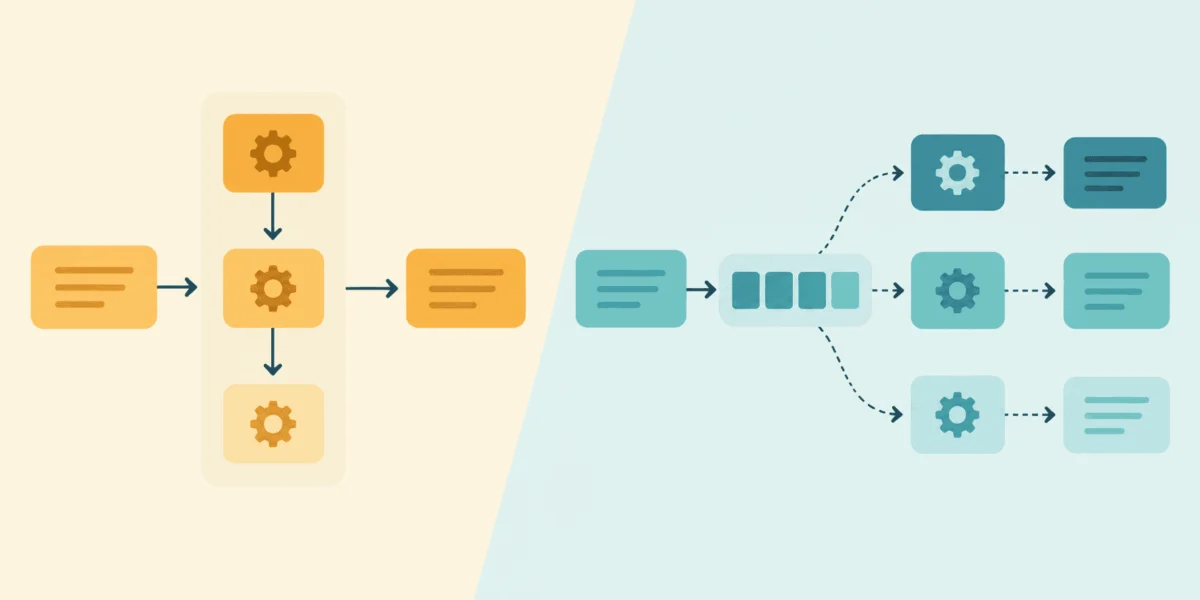

The rapid maturation of Large Language Model (LLM) frameworks has democratized the creation of autonomous agents, yet a significant "deployment gap" persists between experimental Python scripts and production-grade AI systems. As organizations shift from proof-of-concept prototypes to mission-critical agentic workflows, the architectural choice between synchronous and asynchronous execution patterns has become the primary determinant of system stability, scalability, and user experience. While synchronous models offer simplicity for low-latency tasks, the inherent unpredictability of multi-step agent reasoning often necessitates a transition to asynchronous, event-driven architectures to prevent system-wide failures.
The Evolution of the Agentic Workflow
The rise of agentic AI—systems capable of tool usage, multi-step planning, and autonomous iteration—has fundamentally altered the demands placed on backend infrastructure. In early 2023, most LLM applications functioned as simple request-response pairs, where a user query was met with a direct, near-instantaneous output. However, the current landscape of "agentic" applications, characterized by complex reasoning chains and external tool integrations (such as web searching, code execution, or database querying), has introduced variable latency that standard request-response cycles are ill-equipped to handle.
Data from recent industry benchmarks suggests that complex agentic workflows can take anywhere from 10 to over 100 seconds to complete, depending on the number of tool-use cycles. This duration far exceeds the standard timeouts imposed by common cloud infrastructure components, such as the 29-second limit on AWS API Gateway or typical load balancer thresholds. Consequently, developers are forced to choose between the simplicity of blocking synchronous execution and the robust, distributed nature of asynchronous processing.
Synchronous Execution: The "Wait and See" Paradigm
Synchronous execution follows the traditional request-response model, where the client sends a request and remains in a blocked state until the agent returns a finalized answer. This architecture is structurally analogous to a standard web API call.
In a synchronous agent, the execution thread manages the entire reasoning loop: the LLM processes the initial input, evaluates the need for a tool, executes that tool, incorporates the output, and continues until a final response is generated. This approach is highly effective for tasks with deterministic, low-latency requirements, such as basic Retrieval-Augmented Generation (RAG) pipelines where the retrieval process is rapid and predictable.
However, the primary weakness of this pattern is its fragility. In a production environment, if an agent is tasked with a multi-step research operation and the LLM takes 40 seconds to process the chain-of-thought, the connection between the client and the server will likely time out. This not only results in a failed user request but also causes the waste of significant compute resources and API tokens, as the server-side process often continues running in the background despite the client having already disconnected.
Transitioning to Asynchronous, Event-Driven Architectures
As agents become more sophisticated, the necessity for asynchronous execution—often described as "fire and forget"—becomes critical. Under this paradigm, the client submits a task and receives an immediate acknowledgment, typically in the form of a job_id. The actual heavy lifting is offloaded to background workers that retrieve tasks from a message broker, such as RabbitMQ, Redis, or Apache Kafka.
This transition reflects the broader shift in distributed systems engineering. By decoupling the submission from the execution, developers gain several distinct advantages:
- Resilience to Latency: Since the client is no longer waiting for the execution to finish, the actual processing time of the agent is irrelevant to the initial HTTP response.
- Checkpointing and Fault Tolerance: In an asynchronous setup, the system can checkpoint the agent’s state at each step of the reasoning loop. If a worker node crashes, the job can be resumed from the last checkpoint rather than starting from the beginning.
- Human-in-the-Loop (HITL) Integration: Asynchronous workflows facilitate complex interactions where an agent may need to pause and wait for user authorization before proceeding, a process that is functionally impossible in a blocked synchronous thread.
Comparative Infrastructure Requirements
The architectural overhead required for asynchronous systems is significantly higher than that of synchronous ones. While a synchronous agent can often be deployed as a simple containerized service or a serverless function, an asynchronous agent requires a comprehensive infrastructure stack.
This stack typically includes:
- Message Brokers: To handle the queuing of tasks and ensure they are processed even if the primary API layer is under heavy load.
- State Stores: Databases such as PostgreSQL or MongoDB are required to track the status of jobs, store intermediate reasoning steps, and maintain long-term memory for the agents.
- Monitoring and Observability: Because the execution is decoupled, developers must implement robust polling mechanisms or webhook listeners to inform the frontend of task updates, requiring a more complex observability suite to track job progress across the entire system.
Strategic Implications for Production Deployments
The architectural decision between these two patterns should be guided by the complexity of the agent’s task. Engineering teams should adopt a tiered approach to deployment. For straightforward query-response tasks where the total round-trip time is guaranteed to be under 10 seconds, synchronous execution remains the preferred choice due to its lower operational complexity and reduced maintenance burden.
Conversely, for agents designed to perform code refactoring, comprehensive data analysis, or multi-agent debate, the transition to asynchronous architecture is an inevitable requirement for long-term production stability. Organizations that fail to implement these patterns face the "brittleness trap," where agents appear to work during local development but consistently fail under the unpredictable network conditions and high traffic volumes of a production environment.
Future Trends in Agentic Infrastructure
Looking ahead, the industry is moving toward "hybrid-async" patterns, where APIs may provide an immediate synchronous response for quick, cache-based answers while transparently switching to an asynchronous queue for more intensive, long-running tasks. Furthermore, the development of specialized frameworks that natively handle state checkpointing and queue management is expected to lower the barrier to entry for asynchronous systems.
As agentic AI moves into the enterprise, the focus is shifting from "how to build the agent" to "how to scale the agent." The infrastructure supporting these systems is becoming as important as the models themselves. Architects and engineers must now treat the agentic lifecycle—planning, tool execution, state persistence, and communication—as a distributed system problem, prioritizing reliability and fault tolerance over the ease of local execution. In doing so, they ensure that the intelligence of the agent is matched by the robustness of the platform that delivers it.
