

The rapid maturation of Large Language Model (LLM) frameworks has democratized the creation of autonomous agents, yet a significant chasm remains between functional local prototypes and robust, enterprise-grade production deployments. As developers transition from experimenting in Jupyter notebooks to architecting systems capable of handling thousands of concurrent users, the underlying execution pattern becomes the primary determinant of system stability. Understanding the trade-offs between synchronous and asynchronous architectures is no longer an optional skill for software engineers; it is a fundamental requirement for building reliable AI infrastructure.
The Architecture of the Deployment Gap
In the current AI landscape, the "deployment gap" refers to the failure of many systems to account for the inherent non-determinism and latency of LLMs. Unlike traditional software services, which typically resolve in milliseconds, agentic workflows involve multi-step reasoning loops, external tool invocations, and API calls that can take anywhere from several seconds to several minutes to complete.
Industry data suggests that latency in agentic systems is primarily driven by three factors: the "time to first token" (TTFT) for LLM inference, the execution time of external tools (such as web scrapers or database queries), and the recursive nature of agent planning loops. When these factors are combined with standard cloud infrastructure—such as AWS API Gateway, which enforces a strict 29-second timeout—the result is often a cascade of 504 Gateway Timeout errors. This fragility underscores the necessity for a shift toward more resilient architectural paradigms.
Synchronous Execution: The Request-Response Paradigm
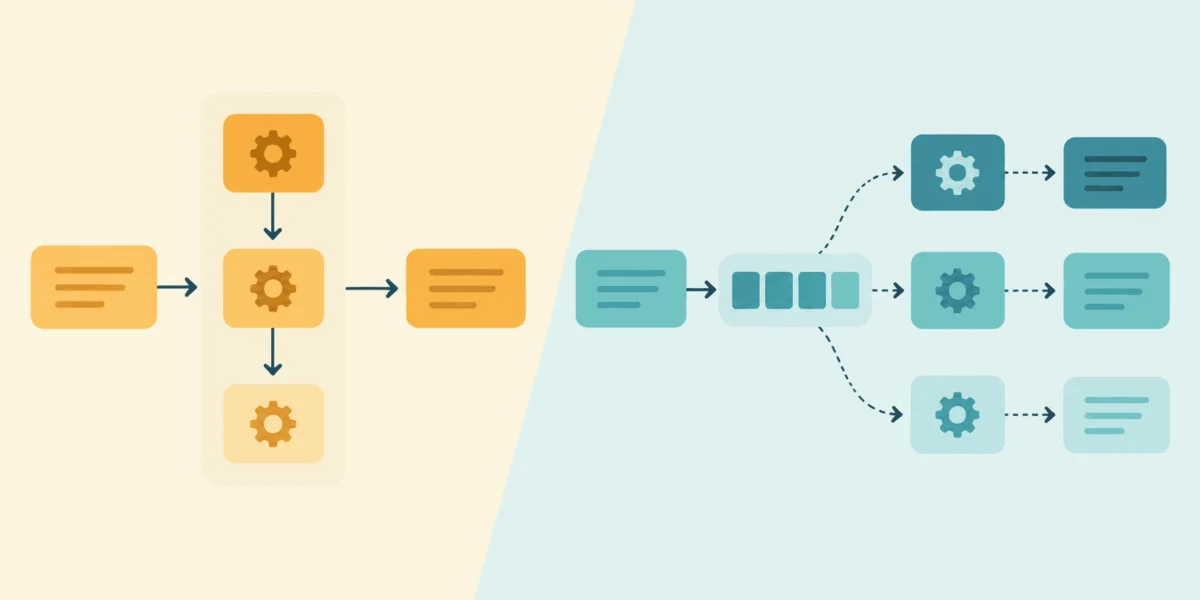
Synchronous execution, often characterized as a "wait and see" approach, mimics the traditional web request-response cycle. In this model, the client sends a request to the agent and keeps the connection open until the agent returns a final answer. This pattern is functionally intuitive and mirrors the way simple REST APIs operate, making it a natural starting point for many development teams.
Architecturally, the synchronous pattern is highly efficient for low-latency tasks. It reduces the complexity of the backend by eliminating the need for message queues or persistent state stores. For instance, in a Retrieval-Augmented Generation (RAG) pipeline where the agent is simply fetching documents and summarizing them, a synchronous call is often sufficient. However, as agent complexity increases, the blocking nature of the synchronous thread becomes a liability.
If an agent requires multiple iterations of "thought, action, and observation," the total execution time scales linearly with the number of steps. If a single tool call takes five seconds and the LLM requires three steps to reach a conclusion, the client is forced to wait fifteen seconds. In high-traffic environments, this blocks worker threads, exhausts server memory, and creates a bottleneck that can lead to catastrophic system failure under load.
The Evolution of Asynchronous Event-Driven Systems
To resolve the constraints of synchronous models, enterprise AI architects are increasingly moving toward asynchronous, event-driven designs. This paradigm, frequently referred to as "fire and forget," decouples the initial task submission from the execution process. By leveraging message brokers such as Redis, RabbitMQ, or Apache Kafka, organizations can ensure that the agentic workload is processed independently of the user interface.
The chronology of an asynchronous agent job typically follows this lifecycle:
- Submission: The client sends a request and immediately receives a unique Job ID.
- Queueing: The request is serialized and placed into a message broker.
- Processing: A fleet of background workers polls the broker, picks up the task, and executes the agentic loop.
- Persistence: Throughout the process, the agent periodically checkpoints its state to a database (such as PostgreSQL or MongoDB), allowing for fault tolerance.
- Notification: Once the task reaches a terminal state, the result is stored, and the client is notified via polling or a webhook.
This architecture offers a significant advantage in terms of scalability. Because the system is no longer waiting on a single request-response cycle, it can handle spikes in traffic by dynamically scaling the number of worker nodes. Furthermore, this approach provides inherent resilience; if a specific worker node fails during an agent’s execution, the state is preserved in the database, allowing a secondary worker to resume the process without re-executing previous steps.
Comparative Analysis: Infrastructure Requirements
The transition from synchronous to asynchronous execution requires a shift in infrastructure investment. Synchronous systems are lightweight and require minimal overhead. Conversely, asynchronous systems necessitate a robust backend ecosystem:
- Message Brokers: These serve as the backbone of the communication layer, managing the distribution of tasks among worker nodes.
- State Stores: Because the process is decoupled, there must be a central repository for "agent memory," tracking progress and intermediate tool outputs.
- Monitoring and Observability: In an asynchronous environment, tracking a task becomes more difficult. Systems must implement telemetry tools to monitor job statuses, error rates, and queue depths.
Despite the added complexity, industry analysts argue that the investment is justified for any application involving long-running processes. For example, in automated legal document review or large-scale data synthesis, the cost of an asynchronous failure-recovery system is far lower than the cost of a failed user experience caused by request timeouts.
Engineering Perspectives and Best Practices
Leading AI platforms have begun to codify these patterns into their SDKs. Many modern frameworks now provide native support for "async" methods, allowing developers to define agent functions that can be awaited within an event loop.
From an engineering standpoint, the decision-making framework for selecting an architecture should be based on the "Expected Duration Metric." If a task consistently completes in under three seconds, the overhead of an asynchronous architecture—the latency of message queuing and database writes—may actually degrade performance. In such cases, a well-optimized synchronous pipeline is preferable.
However, if the task involves non-deterministic agent loops, external API integrations, or multi-step reasoning, the risk of blocking a thread is too high. In these instances, the asynchronous pattern serves as an architectural insurance policy.
Future Implications for Agentic AI
The push toward asynchronous architectures is fundamentally changing how AI is integrated into the software stack. We are moving away from treating LLMs as simple "chat widgets" and toward treating them as complex, background-running agents that function similarly to microservices.
As we look toward the future, the integration of these patterns will likely be abstracted further by "Agent Orchestration Platforms." These platforms promise to manage the complexity of queues, state management, and retry logic, allowing developers to focus on prompt engineering and tool development. Nevertheless, the underlying principles—knowing when to block and when to decouple—will remain the hallmark of senior systems architecture.
Ultimately, the goal of any production-grade AI system is reliability. By adopting a nuanced approach to execution patterns, organizations can move past the limitations of simple script-based execution and build agents that are as resilient and scalable as the traditional software services upon which the modern internet is built. The transition to asynchronous patterns is not merely a technical upgrade; it is the maturation of AI from an experimental novelty into a stable, enterprise-ready utility.
