
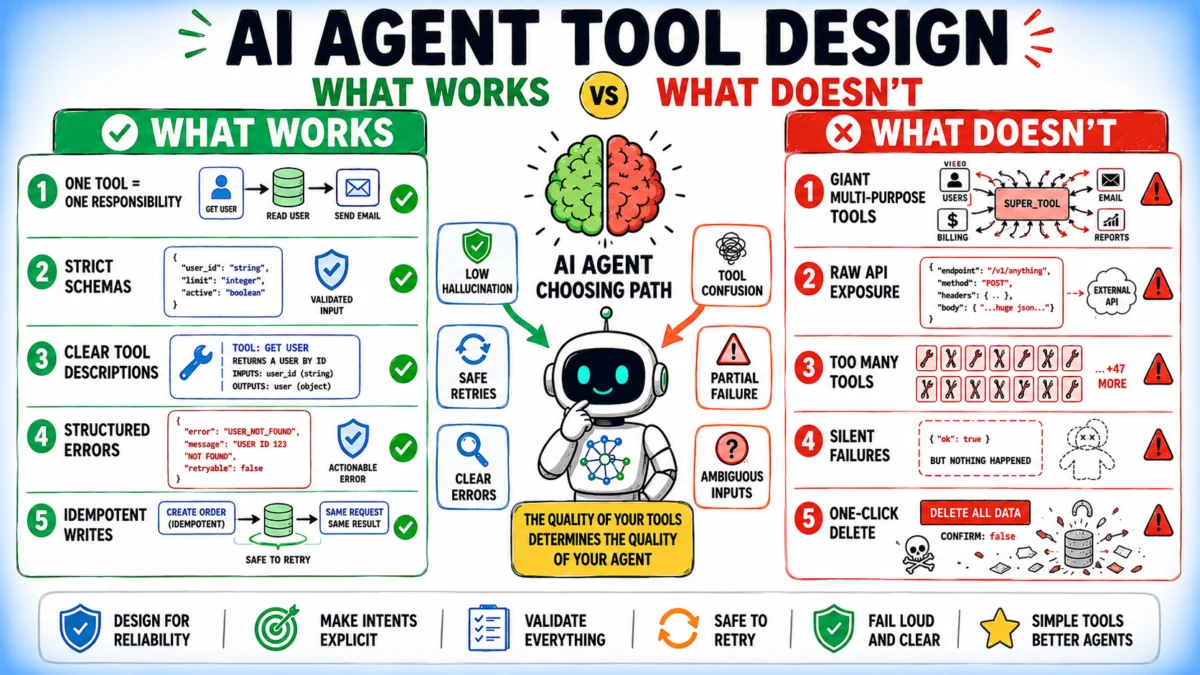

In the rapidly evolving landscape of artificial intelligence, the efficacy of AI agents is increasingly recognized as being less about the sheer capability of the underlying language models and more about the meticulous design of the tools they interact with. Most observed failures in AI agent operations – such as selecting the incorrect tool, passing malformed arguments, or mishandling operational errors – often appear to be model-centric mistakes. However, a deeper analysis reveals that the root cause frequently lies not in the model’s reasoning shortcomings, but in the inadequacies of the tool’s interface itself. A model can only operate and reason effectively based on the information it receives, which is fundamentally shaped by the tool’s interface: its name, description, parameter schema, and error handling mechanisms. When these foundational elements are unclear, incomplete, or inconsistently structured, failures become a predictable consequence rather than an accidental occurrence.
The advent of AI agents, designed to autonomously perform complex tasks by chaining together various tools and interacting with diverse systems, marks a significant leap in AI application. From automating customer service and data analysis to managing critical infrastructure, these agents are poised to revolutionize numerous industries. However, their widespread adoption hinges on their reliability and safety, which are directly impacted by the quality of their tool integration. Problems like vague naming conventions, ambiguous instructions, inconsistent data schemas, poorly defined parameters, and inadequate error handling significantly increase the probability of agent misbehavior. While more powerful and sophisticated language models can mitigate some of these errors, they cannot reliably compensate for a fundamentally flawed interface. This article delves into the critical design patterns that foster robust AI agent performance and highlights common pitfalls to avoid, emphasizing that understanding the why behind design failures is as crucial as knowing what constitutes best practice.
Foundational Principles for Effective AI Agent Tool Design
The journey towards building reliable AI agents begins with a commitment to clarity, precision, and robustness in tool design. Adopting established software engineering principles and adapting them for the unique interaction paradigm of large language models (LLMs) is paramount.
1. One Tool, One Responsibility: Enhancing Clarity and Control
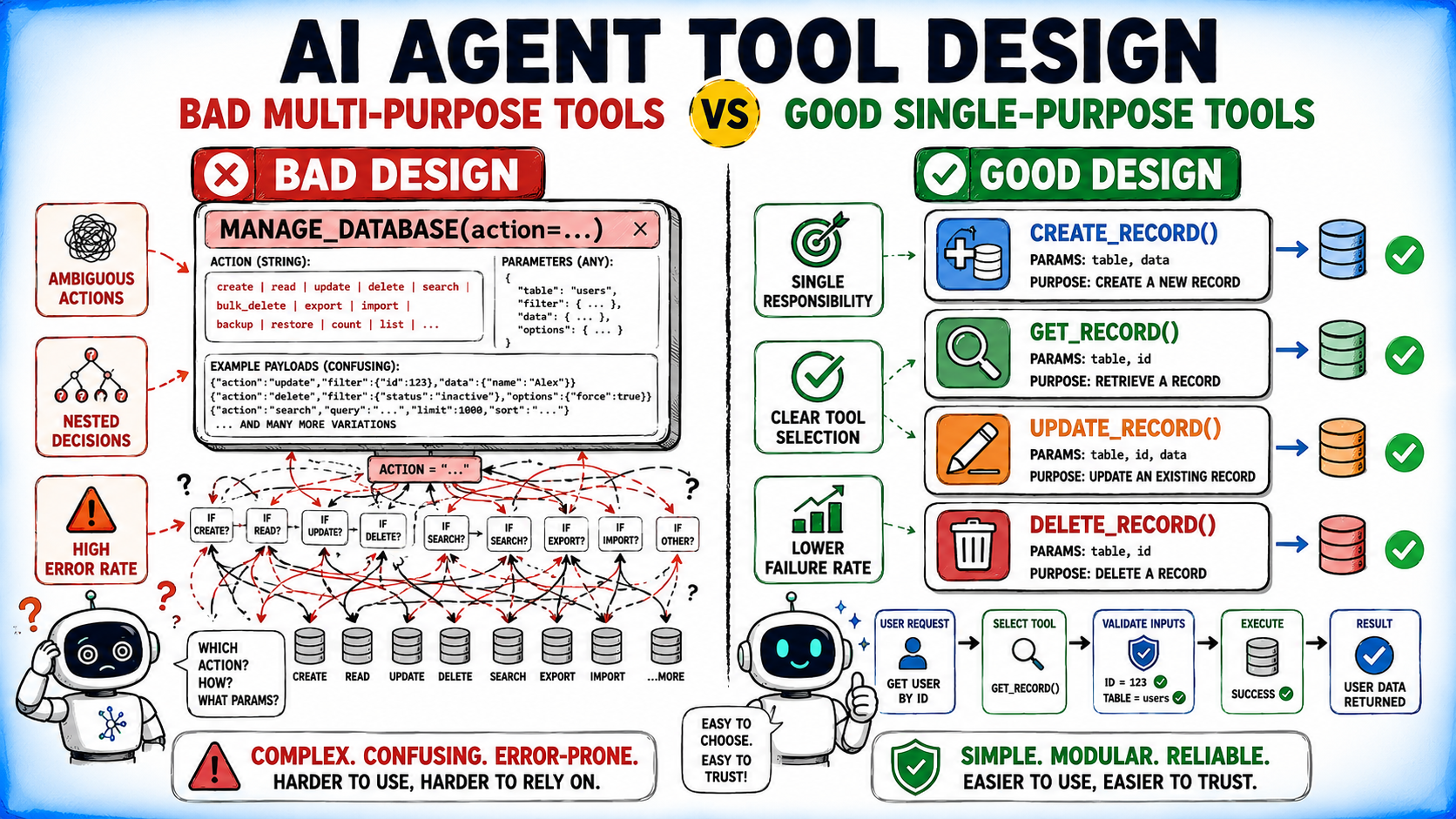
A cornerstone of effective tool design for AI agents is the principle of single responsibility. In most agent systems, each tool should encapsulate a single, clearly defined operation. The practice of creating multi-behavior tools that rely on an action parameter (e.g., manage_customer(action="create")) forces the model to first determine the intended mode of operation before it can even address the primary task. This introduces an unnecessary layer of cognitive load and increases the potential for misinterpretation.
By contrast, dedicated single-purpose tools (e.g., create_customer, get_customer, suspend_customer) provide the agent with an unambiguous function. This design pattern not only simplifies the model’s decision-making process but also offers significant benefits in terms of debugging, error handling, and observability. When a tool has a singular purpose, its behavior is easier to predict, and any failures can be more directly attributed and rectified. For instance, if create_customer fails, the issue is clearly localized to customer creation logic, not a broader, more complex manage_customer function with multiple modes. While this is a general guideline, specific domains like shell commands or calendar applications might benefit from a constrained multi-action interface where the action space itself is an intrinsic part of the underlying abstraction, but these are exceptions rather than the rule.
2. Schemas That Preclude Invalid States: Guiding Model Reasoning
In tool-calling agents, the model meticulously constructs tool call arguments by interpreting the provided schema. Therefore, robust and explicit schemas are indispensable. Leveraging strong typing, enumerations (enums), and validation rules (e.g., min_length, max_length, pattern for regular expressions) within the schema helps guide the LLM towards generating valid inputs and prevents it from hallucinating arguments that might seem plausible but are logically incorrect.
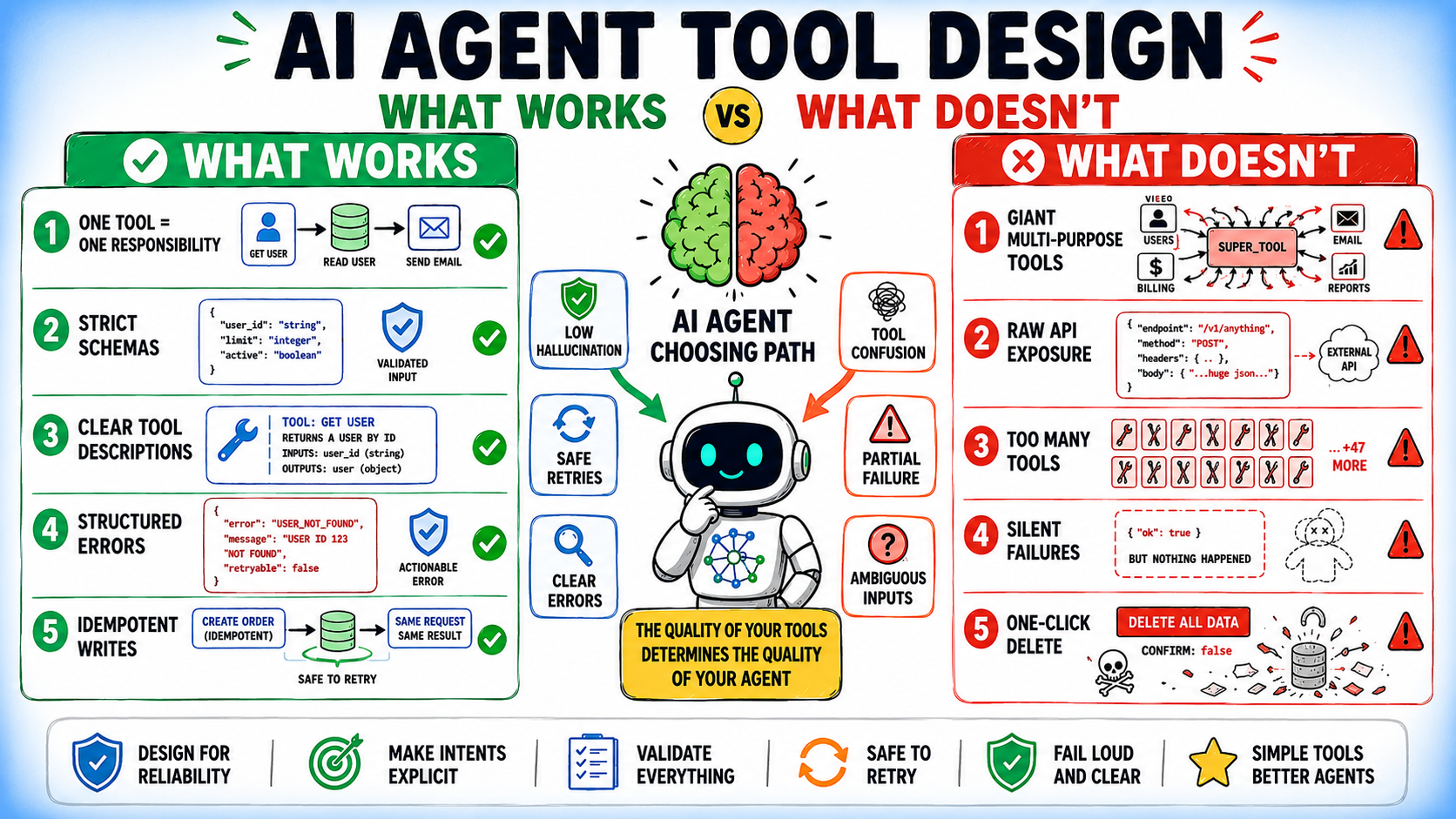
For example, using an Enum for a priority field (e.g., LOW, MEDIUM, HIGH) entirely eliminates the possibility of the model generating a non-standard priority string like "urgent" or "critical." Similarly, specifying min_length and max_length for a title field, or a strict ISO 8601 pattern for due_date, ensures that inputs conform to expected formats and constraints. This proactive validation shifts error detection to the tool boundary, preventing cryptic downstream failures that are harder to diagnose and recover from. Industry standards like Pydantic in Python are widely adopted for defining such explicit and robust schemas, significantly enhancing the reliability of tool arguments constructed by agents.
3. Descriptions Defining Scope and Boundaries: Preventing Misdirection
Tool descriptions serve as critical model-facing documentation, dictating when and how an agent should utilize a particular function. Beyond merely explaining what a tool does, effective descriptions must also explicitly delineate its scope and, crucially, when not to use it. Many common tool descriptions fall short by only detailing the "happy path," leaving the agent to infer boundary conditions, often leading to selection errors.
A robust description for a search_documents tool, for instance, would not only state its purpose ("Search for documents in the knowledge base") but also clarify its scope ("Use this when the user asks about company procedures, product specs, or documented workflows") and its limitations ("Do NOT use this for real-time data – use get_live_data() instead"). Without such disambiguation, the model might infer scope solely from the tool name, increasing the likelihood of selecting the wrong tool, especially when multiple tools have partially overlapping functionalities. Clear boundaries from other tools are vital for reducing model ambiguity and enhancing tool selection accuracy, a sentiment echoed by leading AI researchers who highlight the importance of "disambiguation through contrast" in agent prompting.
4. Structured, Actionable Error Returns: Enabling Agent Resilience
When a tool encounters a failure, the agent’s subsequent actions are heavily dependent on the nature of the error message. An unhandled exception or a raw stack trace, while useful for human developers, provides little actionable information for an LLM, often leading to noise-driven follow-up behavior or unproductive retries. Conversely, a structured error return empowers the model to branch its reasoning and attempt intelligent recovery.
A well-designed error format should explicitly communicate not just what failed, but also provide guidance on potential next steps. Incorporating fields such as error_code (machine-readable for branching logic), message (human-readable description), recoverable (a boolean indicating if a retry is feasible), and suggested_action (a clear directive for the agent) allows for significantly more resilient agent behavior. For example, a RECORD_NOT_FOUND error with recoverable=True and a suggested_action to "Use list_users() to get valid user IDs" enables the agent to self-correct. Without such structured feedback, models often retry non-retryable errors indefinitely or abandon recoverable tasks prematurely, leading to inefficient or failed workflows.
5. Idempotent State-Changing Operations: Ensuring Data Consistency
Any tool designed to mutate system state – be it creating a record, sending a message, or initiating a financial transaction – must be designed to be idempotent. In real-world scenarios, agents may retry operations due to transient network failures, or the LLM loop might inadvertently issue a second call if confirmation of the first never arrived. Non-idempotent operations in such contexts can lead to undesirable duplicate side effects, such as double billing a customer or sending multiple identical emails.
A robust solution involves requiring an idempotency_key for every write operation. This unique key, often a hash derived from the operation’s parameters and a timestamp, allows the tool to detect and ignore duplicate requests, returning the original result without re-executing the action. This pattern is fundamental in distributed systems and crucial for maintaining data consistency and operational integrity in AI agent deployments, especially in sensitive domains like finance or critical data management.
Common Pitfalls and Their Consequences in AI Agent Tool Design
Just as there are best practices, certain anti-patterns consistently undermine the reliability and efficiency of AI agents. Recognizing and avoiding these pitfalls is critical for successful agent deployment.
1. Thin Wrappers Around Unfiltered APIs: A Recipe for Overload
One of the most common shortcuts, and consequently a frequent source of production failures, is creating thin wrappers directly exposing raw REST APIs as agent tools. APIs built for human developers often present an overwhelming amount of detail, with responses packed with hundreds of fields when only a handful are relevant to the agent. They typically rely on pagination, use opaque internal IDs, and return error codes that demand deep domain knowledge to interpret.
Exposing such unfiltered APIs to an LLM leads to excessive token consumption as the model sifts through irrelevant data. It also forces the agent to handle low-level concerns like pagination or constructing complex API paths, distracting it from its primary task. A purpose-built wrapper, on the other hand, abstracts away these complexities, handling pagination internally, projecting only necessary fields, and mapping raw API errors to structured ToolError formats. This approach creates an "agent-friendly abstraction layer" that is both efficient and robust, preventing the agent from being bogged down by unnecessary operational details.
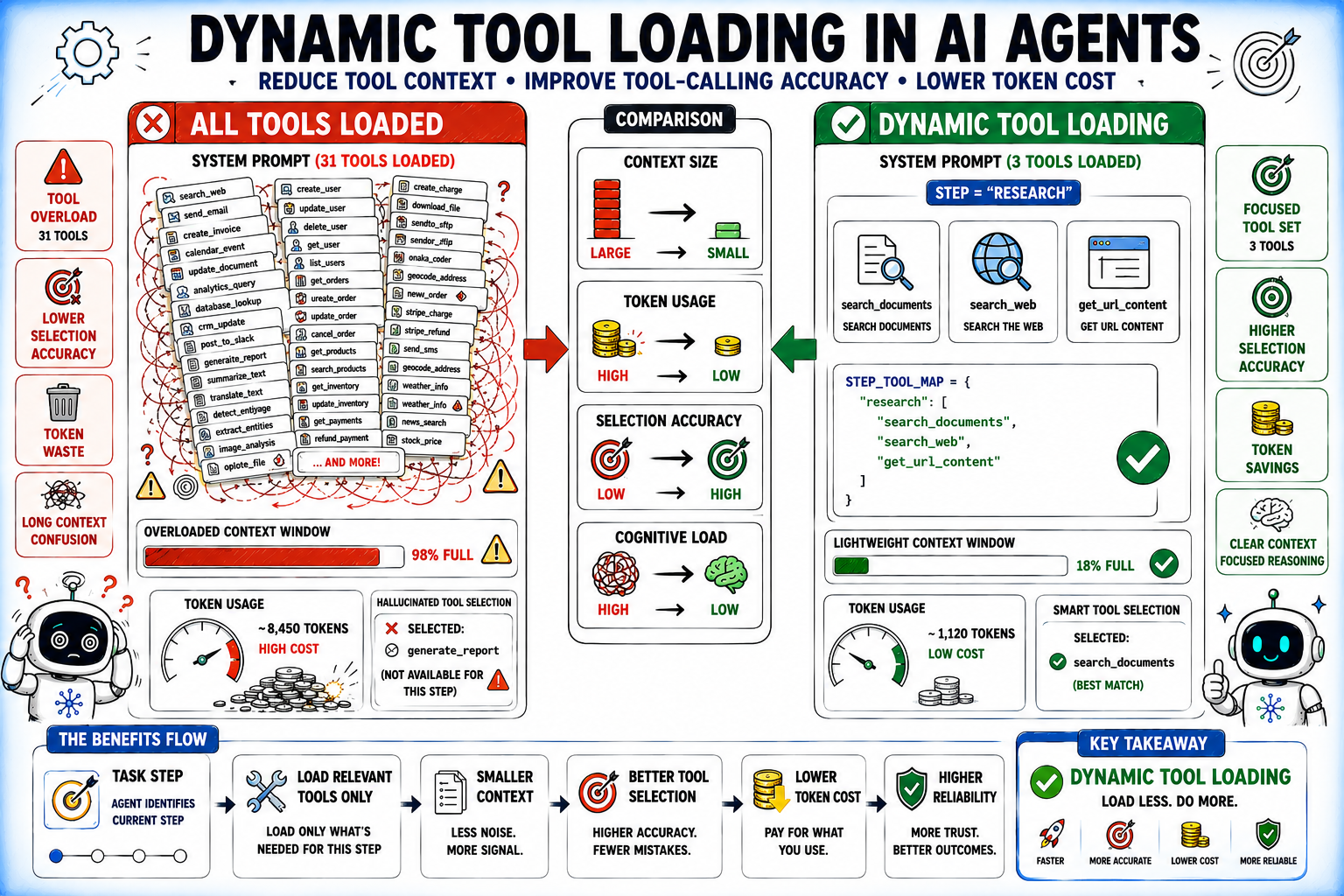
2. Loading All Tools Into Every Context: The "Context Window" Bottleneck
A significant challenge in scaling AI agents is the degradation of accuracy as the tool catalog grows. Research, such as the 2025 LongFuncEval study, has demonstrated that tool-calling performance drops substantially with increasing tool catalog size, even in models with vast context windows. Loading every available tool into every system prompt not only consumes valuable token budget before any task content is processed but also introduces unnecessary cognitive burden on the LLM, making tool selection more error-prone.
Dynamic tool loading offers a compelling solution. Instead of presenting the agent with the entire toolset, only a small, contextually relevant subset of tools is exposed at each step of an agent’s workflow. This can be achieved by mapping tools to specific workflow stages (e.g., "research" tools for a research phase, "write" tools for a content generation phase) or by employing semantic search to identify relevant tools based on the current task. This strategy significantly improves tool selection accuracy, reduces per-call token costs, and optimizes inference speed, making agents more efficient and reliable in complex environments.
3. Silent Partial Success: Masking Incomplete Operations
Partial success occurs when a tool completes only a portion of the requested work but returns a response that falsely indicates full success. This dangerous anti-pattern arises when tools suppress internal failures and only report the successful elements, leaving the agent with an incomplete or misleading view of the system state. For example, a bulk_create_tasks tool that silently swallows exceptions for failed task creations and only returns the IDs of successfully created tasks will lead the agent to believe all tasks were created.
The consequence is that the agent proceeds with incorrect assumptions, potentially leading to downstream errors, data inconsistencies, or user frustration. To mitigate this, tools should explicitly report both successful and failed items within their return structure. A BulkCreateResult object, for instance, could include created_ids, failed_items (with reasons for failure), and a partial_success flag. This explicit reporting mechanism provides the model with actionable information, allowing it to retry failed items, report partial results to the user, or adjust its workflow accordingly.
4. Overlapping Tool Names and Descriptions: Confusion and Inefficiency
When multiple tools perform semantically similar functions or have ambiguous names and descriptions, the agent is forced to engage in complex reasoning to decide which tool to use for a given task. This ambiguity wastes tokens, increases inference time, and is a significant source of tool selection errors. Common examples include separate tools for search_users and find_users, or create_document and new_document.
The problem is not merely lexical; it points to a deeper design flaw where tool functionalities are not sufficiently distinct. If a tool’s description requires referencing other tools to clarify its purpose (e.g., "unlike X, this one…"), it indicates a design problem. Tool sprawl – an abundance of tools with overlapping scope – leads to unreliable agent behavior in enterprise deployments. Rigorous auditing of the tool catalog and a commitment to creating semantically distinct tools, each with a unique and clear purpose, are essential for maintaining agent clarity and efficiency.
5. Destructive Actions Without a Confirmation Gate: A High-Risk Vulnerability
Any tool that initiates an irreversible action – such as deleting records, sending messages to real users, or executing financial transactions – requires a structural two-step confirmation mechanism. Relying solely on an in-prompt "are you sure?" query is insufficient and highly susceptible to agent errors or malicious prompting. A staged approach introduces an explicit confirmation boundary, significantly reducing the risk of accidental or unauthorized execution.
The safest pattern involves separating the staging of a destructive action from its execution, requiring a short-lived, single-use confirmation token between the two steps. For instance, a stage_deletion tool would prepare the deletion, generate a temporary token, and return it to the agent. The agent would then only call confirm_deletion with this token after explicit user approval. This design ensures that the model cannot complete a destructive operation in a single, unchecked reasoning step. Furthermore, robust implementations demand additional safeguards such as strict session binding and replay protection to prevent token reuse, leakage, or cross-session execution, thereby reinforcing the intended safety boundary.
AI Agent Tool Design Decisions: A Strategic Overview
The table below summarizes key design considerations for building effective AI agent tools, contrasting beneficial practices with common pitfalls:
| Design Area | Works | Doesn’t Work |
|---|---|---|
| Tool Scope | Single responsibility per tool | Action-parameter tools (e.g., manage_db(action="create")) |
| Schema | Tight: enums, validators, typed fields | Loose: free strings, untyped dicts |
| Descriptions | Include scope boundaries and when not to use | Happy path only |
| Write Operations | Idempotent with idempotency keys | Fire-and-forget, no retry safety |
| Error Returns | Structured: error_code, recoverable, suggested_action |
Unhandled exceptions or untyped strings |
| Tool Count | Dynamic loading per step | All tools in every context |
| API Wrapping | Purpose-built wrapper with agent-facing schema | Unfiltered API exposure |
| Partial Success | Explicit partial_success field in return |
Silent exception swallowing |
| Destructive Actions | Two-step staging + confirmation | Single-call delete/send/execute |
| Tool Overlap | Semantically distinct, audited before deploy | Similar names and descriptions competing |
Broader Implications and Future Outlook
The meticulous design of AI agent tools transcends mere technical best practices; it is foundational to the broader adoption, safety, and ethical deployment of autonomous AI systems. By focusing on robust interfaces, developers can build agents that are not only more efficient and reliable but also more predictable and auditable. This shift in focus from solely enhancing model capabilities to meticulously crafting the agent-tool interface represents a maturation in AI engineering. It moves AI agent development closer to established software engineering principles, where clarity, modularity, and error handling are paramount.
As AI agents become integrated into increasingly complex and sensitive domains, the implications of poor tool design amplify. Security vulnerabilities, unintended data modifications, and erosion of user trust are direct consequences of neglecting these design principles. Conversely, well-designed tools foster greater agent autonomy, reduce the need for constant human oversight, and unlock new possibilities for AI-driven automation. The ongoing research and development in areas like dynamic tool discovery, formal verification of tool interactions, and agent observability frameworks further underscore the industry’s recognition that the future of AI agents lies not just in smarter models, but in the intelligent architecture of their operational environments.
