

The artificial intelligence sector is currently navigating an era of unprecedented acceleration, frequently characterized by industry analysts as the most significant industrial revolution of the modern age. As AI adoption transitions from experimental phases to core architectural integration across global enterprises, the demand for compute power has reached a critical inflection point. Leading frontier model providers are reporting record-breaking financial metrics, reflecting this surge. Anthropic has achieved an annualized revenue run rate (ARR) of approximately $47 billion, while OpenAI follows closely with an ARR of roughly $30 billion. Meanwhile, Google’s Gemini ecosystem has seen its processing volume explode to over 3.2 quadrillion tokens per month as of May 2026—a sevenfold increase year-over-year.
Despite these staggering growth figures, the trajectory of AI development is increasingly dictated by physical and logistical constraints rather than software innovation alone. Industry leaders, including Broadcom CEO Hock Tan, have signaled that customer demand for AI infrastructure remains insatiable, with projections extending through at least 2028. To mitigate these pressures, organizations like OpenAI have pivoted toward hardware design, developing proprietary AI accelerators such as "Jalapeño" to maximize throughput while minimizing power consumption and silicon footprint. However, the broader market remains mired in a series of systemic bottlenecks that threaten to throttle the pace of innovation.
The Foundry Monopoly and Packaging Constraints
At the heart of the AI compute shortage is a concentrated manufacturing ecosystem. Taiwan Semiconductor Manufacturing Co. (TSMC) remains the primary architect of the AI revolution, producing nearly all high-end AI chips for the world’s data centers. This near-monopoly stems from TSMC’s mastery of advanced process nodes and its sophisticated packaging capabilities, specifically Chip-on-Wafer-on-Substrate (CoWoS). TSMC’s strategic importance is reflected in its financial outlook, with revenues expected to quadruple between 2023 and 2028. The company recently adjusted its 2030 global semiconductor market forecast to $1.5 trillion, up from an earlier estimate of $1 trillion, with AI expected to account for 55% of that total.
The primary hurdle within the foundry space is not just the fabrication of silicon wafers but the "advanced packaging" required to integrate multiple chiplets onto a single substrate. TSMC CEO C.C. Wei has cautioned that demand for these services will likely outstrip supply for the foreseeable future, despite aggressive capital expenditure on new facilities in the United States and Taiwan. To alleviate some of this pressure, TSMC has begun outsourcing portions of its CoWoS workflow to secondary providers like ASE and Amkor. Furthermore, the industry is looking toward next-generation solutions such as Chip-on-Panel-on-Substrate (CoPoS) and glass core substrates to improve wafer utilization and reduce costs.
While Intel and Samsung are striving to establish themselves as viable alternatives to TSMC, the barrier to entry remains high. Rumors suggest that Google has placed significant orders for Tensor Processing Units (TPUs) with Intel or Samsung to diversify its supply chain, and political figures have suggested that Apple may eventually utilize Intel’s domestic foundries. However, as of 2026, TSMC remains the bottleneck through which all major AI roads must pass.

The Materials Crisis: Lithography and Ajinomoto Build-up Film
Even the most advanced foundries are subject to the constraints of their own equipment and materials suppliers. ASML, based in the Netherlands, remains the sole provider of the Extreme Ultraviolet (EUV) lithography machines necessary for sub-5nm chip production. While ASML has managed to maintain a steady delivery schedule, the sheer volume of equipment required for global fab expansions is a constant concern for planners.
A more obscure but equally critical bottleneck is the supply of Ajinomoto Build-up Film (ABF). Produced almost exclusively by Japan’s Ajinomoto, this specialized insulating material is vital for connecting GPU dies to High-Bandwidth Memory (HBM) stacks. By 2026, Ajinomoto raised prices by 30% due to a projected supply gap of more than 20% expected by 2027. Without this specific film, the most advanced GPUs in the world cannot be assembled, highlighting the fragility of a supply chain dependent on single-source materials.
The Memory Wall: High-Bandwidth Memory Shortages
As AI models grow in complexity, the speed at which data can be moved between the processor and memory has become a primary performance metric. This has placed an enormous strain on the manufacturers of High-Bandwidth Memory (HBM). The DRAM market, once a crowded field, is now dominated by a triumvirate: SK Hynix, Samsung, and Micron. These companies have seen their market capitalizations soar past the $1 trillion mark as they struggle to keep up with the requirements of Nvidia, AMD, and the hyperscale cloud providers.
The manufacturing of HBM is notoriously difficult, involving the vertical stacking of 8, 12, or 16 DRAM dies connected by through-silicon vias (TSVs). Because the DRAM industry has historically been prone to "boom and bust" cycles, manufacturers have been hesitant to over-invest in capacity. This caution, combined with the 5-year development cycle for new processes, has created a persistent deficit. To secure supply, AI firms are increasingly entering into long-term strategic agreements, often involving significant upfront cash payments. For example, Anthropic recently signed a major supply deal with Micron to guarantee its HBM allocation through the end of the decade.
The Power Crisis: Data Centers and the Energy Grid
Perhaps the most daunting bottleneck is not found in the silicon, but in the power grid. Amazon CEO Andy Jassy has identified energy availability as the single greatest constraint on data center expansion. The current generation of AI clusters requires massive amounts of electricity, and local utility grids are often unable to scale capacity at the necessary speed.
In response, hyperscalers are becoming energy companies in their own right. Microsoft and Chevron have partnered on a 2.7GW power generation project in the Permian Basin, utilizing natural gas directly at the source. Other companies are exploring "Virtual Power Plants" (VPPs). A consortium involving Tesla, Sunrun, and Google’s Renew Home has begun a program to tap into residential battery storage systems during peak demand periods to support data center operations.

The infrastructure required to manage this power—transformers, high-voltage breakers, and gas turbines—is also in short supply. GE Vernova, a leading supplier of turbines, has reported being sold out through 2029. Furthermore, community resistance to data center construction is rising. In regions like Texas and California, concerns over rising electricity costs and water usage for cooling systems have led to political friction. While industry proponents argue that data centers use less water than traditional agriculture, the public perception of AI as an "energy hog" remains a significant hurdle for site selection.
Optical Interconnects: The Next Frontier of Connectivity
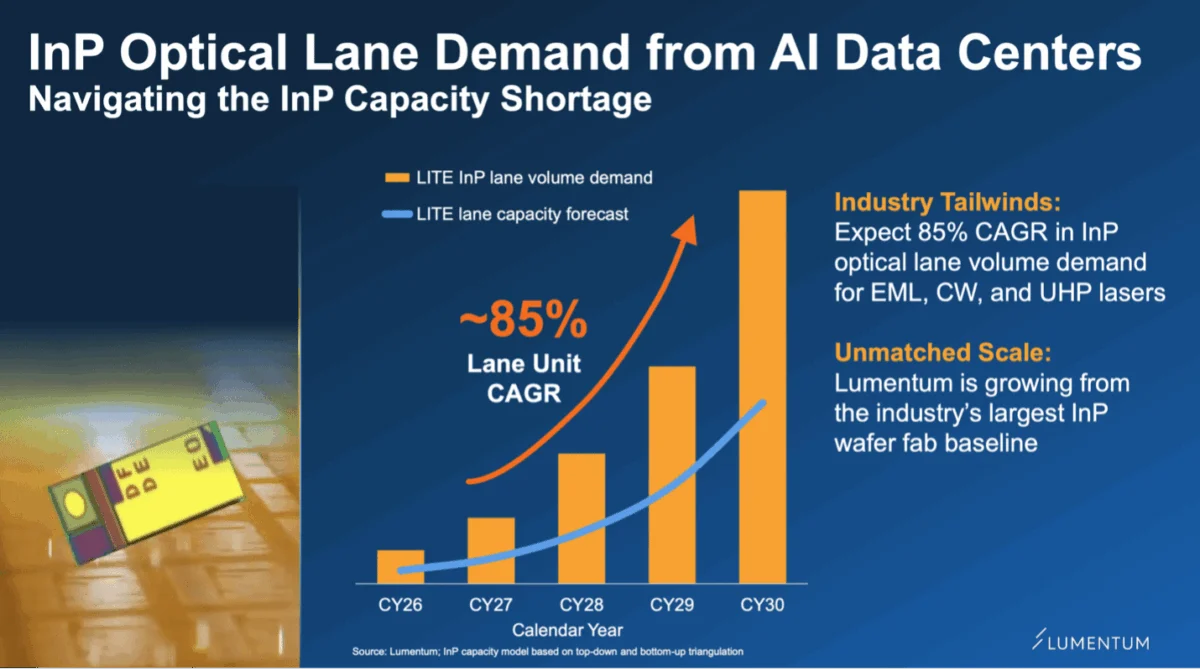
As data centers grow, the traditional copper wiring used to connect servers is being replaced by optical links. Lasers are now essential for the "scale-out" links between switches and the emerging "scale-up" Co-Packaged Optics (CPO) that integrate light-based communication directly onto the chip. This shift has turned laser manufacturers like Lumentum and Coherent into pivotal players in the AI ecosystem, with both companies seeing their market caps increase tenfold within a single year.
Nvidia recently invested $2 billion into these suppliers to secure its roadmap through 2028. While laser manufacturing (using Indium Phosphide) is currently sold out, it is considered the most manageable of the big four bottlenecks because the capital expenditure required to build new InP fabs is lower than that of silicon foundries. Nevertheless, until these new facilities come online in late 2027, the availability of optical transceivers will remain a "yellow light" for data center architects.
Geopolitical Fragility and the Path Forward
The concentration of the AI supply chain in East Asia introduces a layer of geopolitical risk that cannot be ignored. With TSMC’s primary operations located in Taiwan and 80% of HBM production occurring in South Korea, the entire global AI economy is situated in regions subject to significant regional tensions. A disruption in either location would not merely slow AI growth—it would bring it to a virtual standstill.
The rapid expansion of AI is a testament to human ingenuity, but it has also exposed the limits of global manufacturing and infrastructure. The transition from "early-stage learning" to "industrial-scale deployment" has stressed every link in the chain, from the raw chemicals used in ABF to the high-voltage transformers in the Permian Basin. While the industry is responding with unprecedented investment and technological workarounds, the era of "compute on demand" has been replaced by an era of strategic rationing and long-term infrastructure planning. Keeping the AI revolution on track will require more than just better algorithms; it will require a fundamental reshaping of the global industrial base.
