
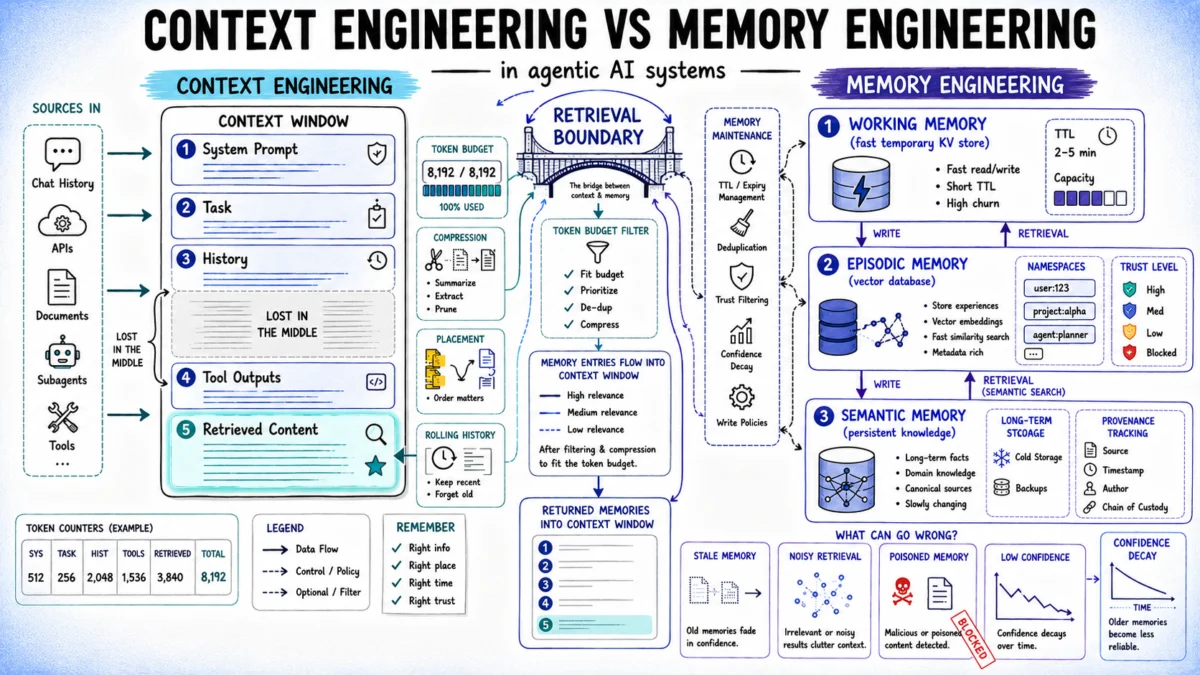

As artificial intelligence agents transition from isolated tasks to intricate, multi-session workflows, a pervasive challenge has emerged: the degradation of performance due to mismanagement of information. This includes constraints being overlooked mid-task, irrelevant data resurfacing unexpectedly, and context from previous steps improperly influencing current operations. These failures, often difficult to trace to a single component, underscore the critical need for sophisticated information management strategies, primarily through two distinct yet interconnected disciplines: context engineering and memory engineering. While frequently conflated or overlooked during development, understanding their individual roles and their synergistic interaction is paramount for building robust, reliable, and scalable AI agents capable of sustained, intelligent behavior across real-world workloads.
The Rise of Agentic AI and Its Information Challenge
The evolution of AI has seen a significant shift from predictive models to proactive, autonomous agents. These agentic AI systems are designed to perceive their environment, make decisions, and execute actions to achieve specific goals, often involving multiple steps, tool use, and long-term interaction. Early AI systems, typically focused on narrow tasks, had minimal need for complex memory or context. However, with the advent of powerful large language models (LLMs) and the ambition to create more general-purpose AI, agents are increasingly tasked with open-ended problems that span hours, days, or even weeks. This expansion in scope introduces a fundamental challenge: how to effectively manage the vast amount of information an agent encounters, processes, and needs to recall.
Without proper mechanisms, an agent’s "working memory" (its current context window) can become overwhelmed, leading to "hallucinations," illogical actions, or a complete breakdown in reasoning. Similarly, an agent’s "long-term memory" (persistent storage) can become cluttered with stale, irrelevant, or contradictory information, hindering efficient retrieval and decision-making. Industry estimates suggest that the market for AI agents and related technologies is projected to grow significantly, reaching tens of billions of dollars in the coming years, driven by demand for automation in customer service, personalized assistance, and complex problem-solving. This growth amplifies the urgency for mature context and memory engineering practices, as unreliable agents will fail to meet enterprise demands.
Context Engineering: Orchestrating the Present Moment
Context engineering is fundamentally concerned with optimizing the information presented to an AI model for a single inference call. It’s about designing the optimal "context window" – the limited input space available to an LLM – for maximum effectiveness and efficiency. Everything within this scope is ephemeral; once the inference concludes, the window is cleared. The discipline involves strategic decisions on what information to include, how to compress it, where to place it within the prompt, and what to discard entirely to prevent information overload.
A core tenet of context engineering is selective inclusion. Not all available data is beneficial. Consider a database query returning hundreds of rows or a web search yielding five extensive articles. Injecting all this raw data into the context window would quickly consume precious token limits, leading to increased computational costs and diminished reasoning quality even before the limit is reached. A well-engineered system summarizes tool outputs, extracts key facts, or filters information based on relevance to the immediate task, ensuring only salient details enter the prompt.
Structural placement is another critical aspect, directly addressing the "lost in the middle" effect. Research, notably from organizations like Anthropic, has demonstrated that LLMs tend to attend more strongly to information positioned at the beginning and end of long contexts, while material in the middle often receives significantly less weight. This cognitive bias in LLMs dictates that hard constraints, task-critical instructions, and highly relevant retrieved information should be strategically placed near the start or end of the prompt. For instance, the current user query or task objective often follows retrieved information, positioning both the relevant context and the immediate goal as close as possible to the point of generation, thereby maximizing the model’s likelihood of utilizing that information effectively.
Proactive compression on arrival is a strategy to prevent context window bloat. Instead of waiting for the window to fill and then reactively truncating data, verbose outputs from tools or APIs should be summarized immediately after they are generated. A raw API response that is 3,000 tokens long, when only 150 tokens of key facts are needed by the agent, should be condensed before it ever enters the context for the subsequent reasoning step. This proactive approach saves tokens and maintains signal-to-noise ratio.
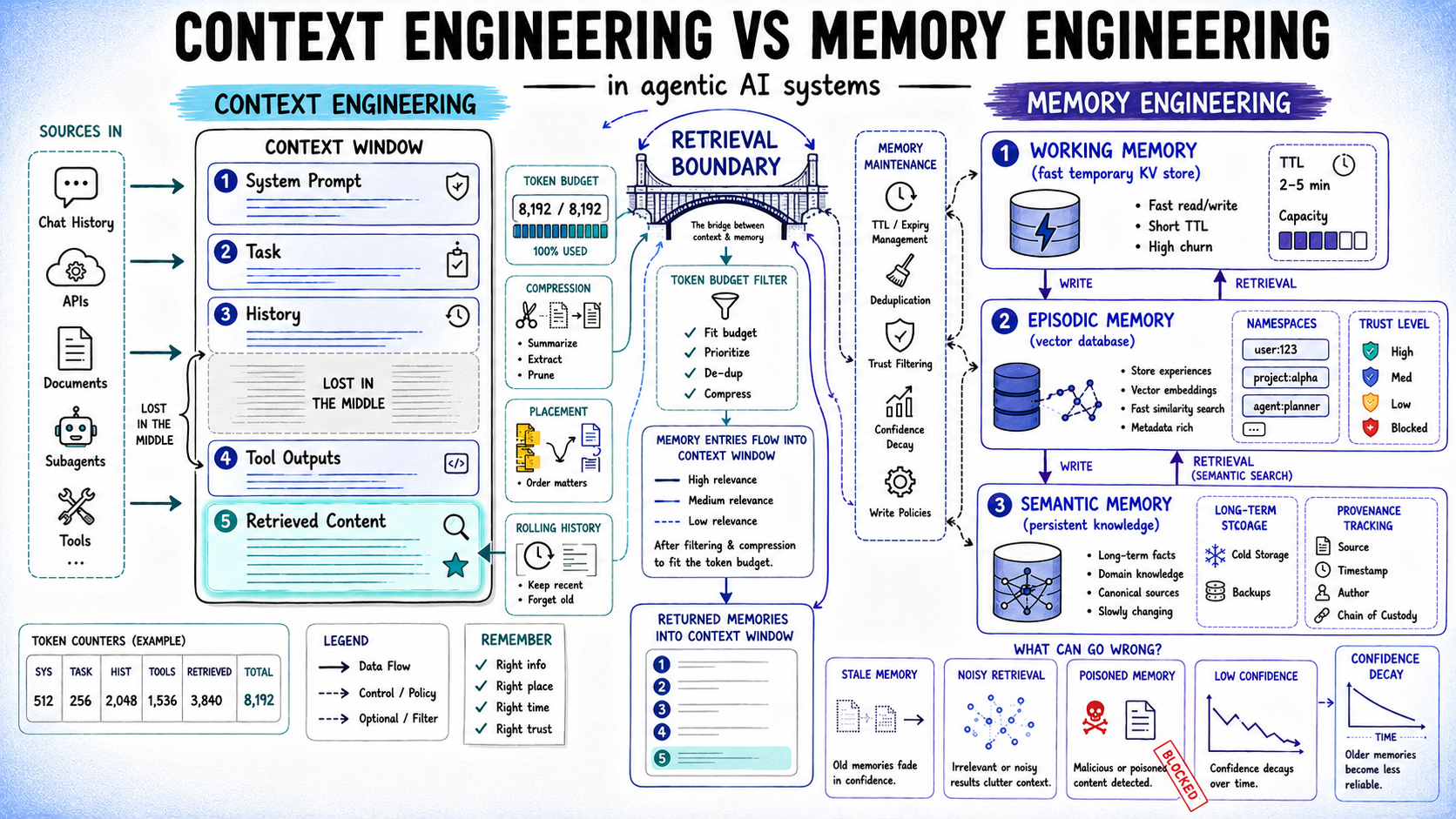
Finally, conversation history management is crucial for long-running agents. Conversation history grows faster than almost any other context component. Carrying the full historical dialogue into every inference call rapidly increases costs and degrades reliability. Effective strategies include a rolling window (keeping only the most recent interactions), hierarchical summarization (condensing older turns into concise summaries), or structured state extraction (identifying and extracting key facts and preferences from dialogue). These methods ensure that relevant history is preserved without overwhelming the context window.
Memory Engineering: Forging an Enduring Mind
In contrast to context engineering’s focus on the ephemeral present, memory engineering deals with information that persists beyond a single interaction. It encompasses the comprehensive systems and policies responsible for writing, storing, retrieving, updating, and governing information so that future interactions, even across sessions or with other agents, can leverage it. When an AI agent recalls a user preference learned weeks ago, coordinates complex tasks with another agent based on shared knowledge, or applies a successful action pattern from a previous run, it is relying on a well-designed memory engineering system.
One of the most overlooked yet impactful aspects is write policy design. The quality of information retrieved is ultimately constrained by what enters the memory store. A robust write policy specifies: what information is worth storing (e.g., only validated facts, high-importance decisions), how much detail to retain, the assigned trust level (e.g., internal system facts vs. user input), and explicit conditions for updating, compressing, or forgetting. Without such policies, memory stores tend to accumulate excessive, low-value, or outdated data, leading to degraded retrieval quality and an ever-growing, less useful memory system.
The storage layer selection is dictated by the type of memory required. Different memory types serve distinct purposes and necessitate appropriate backends:
- Working Memory: Active task state, intermediate results. Often stored in-memory or short-lived key-value (K/V) stores like Redis for fast, direct lookups.
- Episodic Memory: Past interactions, task runs, decisions. Typically uses vector stores (e.g., Pinecone, Weaviate, Chroma) for semantic similarity searches.
- Semantic Memory: Persistent facts, user preferences, domain knowledge. A hybrid approach often combines vector stores for conceptual search with K/V or relational databases for exact fact retrieval.
- Procedural Memory: Learned workflows, successful action patterns. Might be stored in structured databases or even directly injected into prompts as learned rules.
The distinction between retrieval-based memory (treating past interactions as loosely related documents) and state-based memory (structured, validated facts) is crucial. While retrieval-based memory can be brittle to phrasing variations, structured state extraction offers more consistent results for facts that need reliable application across sessions.
A sophisticated retrieval strategy is essential. Reading from memory is rarely a single operation. An effective retrieval layer often employs a multi-stage approach: checking working memory first for speed and exact matches, then falling back to semantic search in episodic or semantic memory if needed. Importantly, metadata filters (e.g., for recency, trust level) are applied before returning results, and only the information strictly necessary for the current step is injected.
Finally, memory maintenance is non-negotiable for long-term system health. A memory store without a maintenance policy inevitably degrades. Stale facts compete with current ones, and the signal-to-noise ratio declines. Maintenance routines include confidence decay on volatile facts, deduplication of semantically similar entries, TTL (Time-To-Live) based expiry for working memory and time-sensitive data, and periodic compression of old episodic records into session-level summaries. A well-designed MemoryEntry schema, encoding attributes like importance, confidence, trust_level, and expires_at, makes these maintenance policies explicit and easier to manage.
The Critical Intersection: Bridging Memory and Context
While context and memory engineering address distinct problems, their success hinges on their seamless integration at the "retrieval boundary." This is the point where information retrieved from persistent memory is prepared for entry into the model’s active context window. Memory systems generate candidate information, but it is context assembly that makes the final decisions: what retrieved information to include, how to compress it, and where to place it within the prompt. This dynamic interplay is what differentiates a collection of components from a truly coherent agent system.
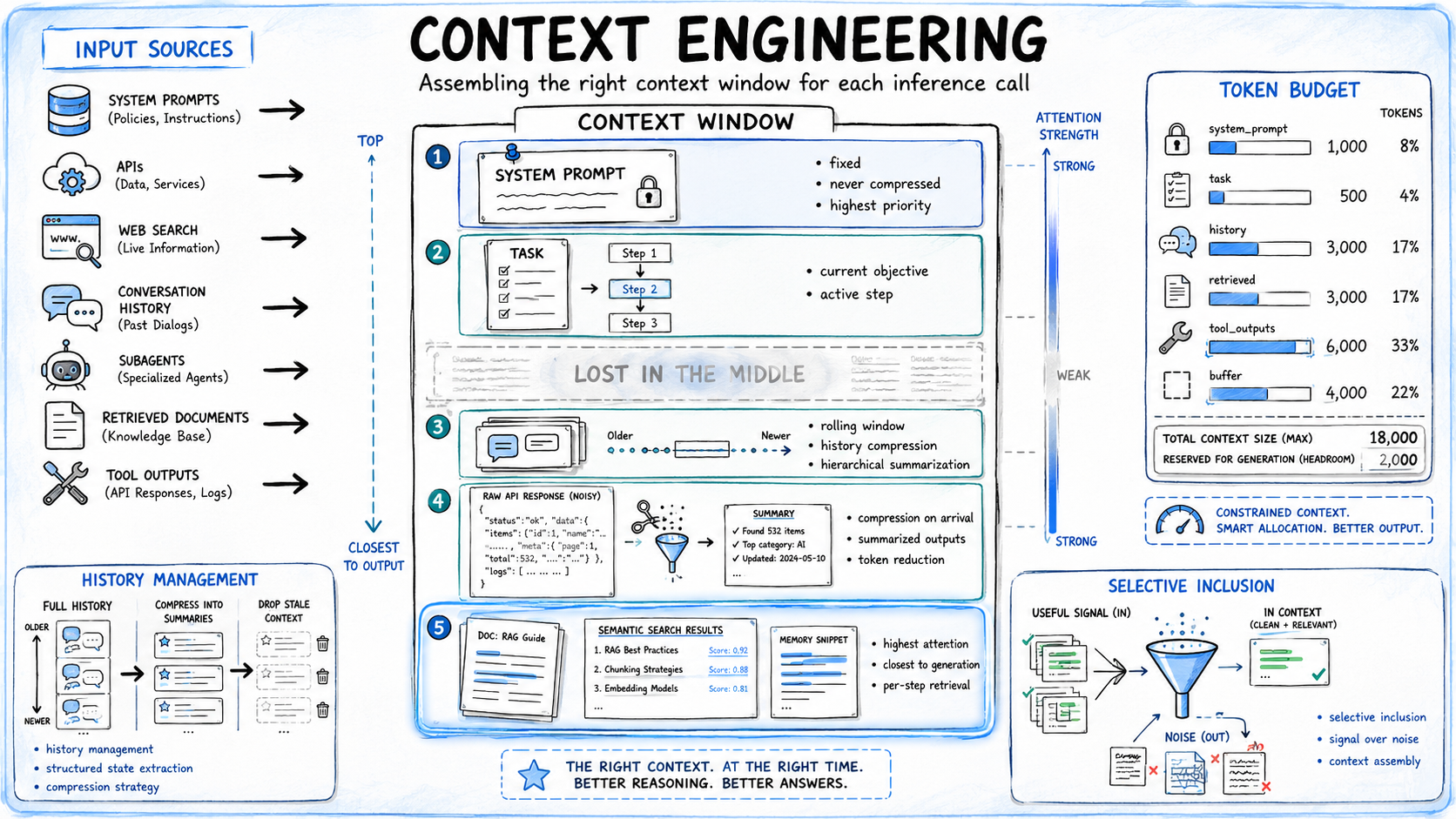
A common failure mode is retrieval without a context budget. Developers often treat retrieval as a standalone search problem, where the memory system returns a set of relevant entries, and the context assembler injects all of them. This can lead to the context window being gradually filled by retrieved content, leaving insufficient room for critical instructions, tool outputs, or the agent’s internal reasoning traces. Symptoms include the agent ignoring instructions, generating overly verbose or irrelevant responses, or appearing to "forget" its primary objective. The problem is not necessarily a flawed memory system, but rather a context assembler lacking a token budgeting mechanism. The solution lies in retrieval-aware context assembly, where the context layer first allocates a specific token budget for retrieved content, and the retrieval layer then returns only the highest-value memories that fit within that constraint. This ensures that retrieval operates within the overall context limitations, preventing overflow and maintaining the integrity of the prompt.
Another significant issue is the poor placement of retrieved information. Even highly relevant memories can fail to influence the model if they are incorrectly positioned within the context window. Treating retrieval purely as a search problem, where memories are simply appended wherever they arrive, ignores the nuanced way LLMs process information. The "lost in the middle" effect means that a critical retrieved fact buried deep within a long context might be overlooked, leading to subtle reasoning errors or incomplete responses, even though the information was technically present. The retrieval succeeded, but the placement failed. Therefore, context assembly must optimize for both: selecting the right information and positioning it strategically near the active reasoning region to maximize its influence.
Effectively, retrieval is not just an independent search operation; it is the crucial first step in turning stored memory into usable context. The objective is not merely to find relevant information, but to ensure it is the right information for the current step, in the right amount to fit the context budget, and placed in the right location where the model can effectively utilize it. When memory engineering and context engineering are designed as a unified retrieval-to-context pipeline, AI agent systems become significantly more reliable, efficient, and scalable.
Implications and Future Outlook
The maturation of context and memory engineering has profound implications for the future of AI. For developers, it signifies a shift from purely reactive prompt engineering to proactive system design, requiring a deeper understanding of information flow and LLM cognitive biases. This paradigm shift will lead to more robust AI products, capable of handling complex, real-world scenarios with greater autonomy and fewer errors.
For users, these advancements translate directly into more intelligent, personalized, and consistent AI experiences. Agents will remember past interactions, adapt to user preferences over time, and maintain a coherent understanding of long-running tasks, making interactions feel more natural and intuitive. Imagine a personal AI assistant that truly learns your habits and preferences, or a customer service agent that remembers the full history of your complex issue across multiple calls, rather than starting from scratch each time.
Ethical considerations also come to the forefront. Robust memory engineering requires careful management of data freshness, trust levels, and provenance to prevent the propagation of outdated or biased information ("memory poisoning"). Policies must be in place to ensure privacy, data retention, and the ability to update or forget information responsibly. Future research will likely focus on self-correcting memory systems, active learning for dynamic write policies, and more sophisticated methods for cross-agent knowledge sharing, pushing the boundaries of what autonomous AI systems can achieve.
In conclusion, context and memory engineering are not peripheral concerns but fundamental layers of a single, integrated system that dictates what an AI model knows, when it knows it, and how that knowledge is effectively applied. Context engineering sculpts the immediate information landscape for each inference, while memory engineering builds the enduring cognitive foundation across time. Only when these two disciplines are harmonized and aligned can an agentic system truly transition from a collection of isolated functions to a coherent, intelligent, and dependable partner in complex human-AI interactions.
