

The modern software engineering landscape has experienced a profound shift away from monolithic architectures and hardware-heavy virtualization toward agile, portable, and resource-efficient deployment models. At the heart of this transformation is containerization, a methodology that packages applications and their underlying dependencies into standardized, isolated units known as containers. As organizations worldwide accelerate their cloud-native transformations, understanding the technical mechanics, strategic advantages, and ongoing operational challenges of containers has become critical for IT leaders, software developers, and enterprise architects alike.
To fully appreciate the prominence of containerization today, it is necessary to examine its historical roots and technical evolution. While the fundamental concepts of process isolation—such as the chroot system call introduced in Unix in 1979—have existed for decades, modern containerization emerged through incremental innovations in Linux kernel capabilities. In 2000, FreeBSD introduced Jails, followed by Linux VServer in 2001, and Solaris Zones in 2004, each providing methods for partitioning computer resources. A major milestone occurred in 2008 with the introduction of Linux Containers (LXC), which combined kernel control groups (cgroups) and namespaces. However, the paradigm shifted definitively in 2013 when Docker debuted, introducing an accessible engine, a standardized image format, and a developer-friendly ecosystem that propelled containerization from a niche systems-administration tool into an enterprise standard.
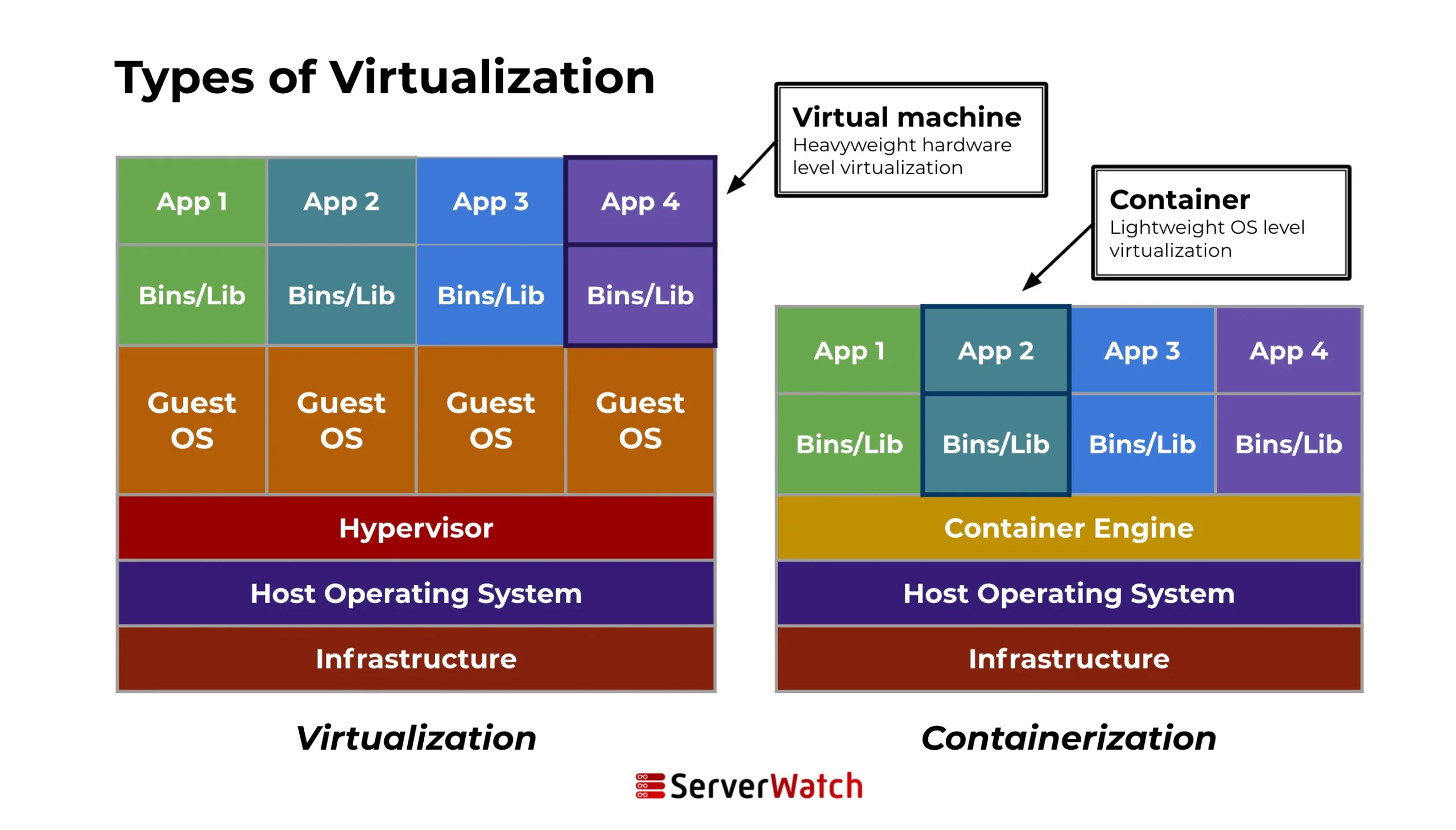
At its core, a container is a lightweight, standalone, and executable software package that contains everything required to run an application: code, runtime environments, system libraries, configuration settings, and system tools. Unlike traditional deployment models or virtual machines, containers execute directly on the host operating system’s kernel while maintaining isolated filesystems, central processing unit allocations, memory spaces, and process trees. Because multiple containers share the host kernel without requiring a dedicated guest operating system for each instance, they eliminate the substantial overhead associated with hypervisor-based virtualization. This architectural distinction translates directly into rapid startup times, measured in milliseconds rather than minutes, and dramatically higher density, allowing organizations to run significantly more workloads on the same physical or cloud-based hardware footprint.
The divergence between containers and virtual machines (VMs) dictates their respective use cases within enterprise infrastructure. Virtual machines rely on a hypervisor—either Type 1 (bare-metal) or Type 2 (hosted)—to virtualize physical hardware, on top of which an entire guest operating system is installed. This grants VMs a high degree of security and isolation, making them ideal for running multi-tenant environments with disparate operating systems on a single physical server. Conversely, containerization abstracts the operating system rather than the hardware. By sharing the host kernel, containers optimize resource utilization and streamline scaling, rendering them exceptionally well-suited for modern, distributed design patterns.
Industry adoption metrics underscore this architectural preference. According to recent enterprise cloud surveys conducted by organizations like the Cloud Native Computing Foundation (CNCF), over 90% of global enterprises utilize container technologies in production environments. This widespread deployment is largely driven by the explosive growth of microservices architectures, where large, monolithic applications are decomposed into dozens or hundreds of small, loosely coupled, and independently deployable services. Each microservice can be packaged into its own distinct container, eliminating dependency conflicts, simplifying maintenance, and enabling teams to scale specific components dynamically in response to real-time traffic fluctuations.
Beyond microservices, containerization has fundamentally altered continuous integration and continuous deployment (CI/CD) pipelines. By encapsulating an application and its entire operational environment into a single artifact, containers eliminate the classic "it works on my machine" dilemma. Software engineered within a developer’s local workstation runs with identical behavior across testing, staging, and production clusters. This consistency accelerates release cycles, reduces deployment failures caused by environmental discrepancies, and streamlines automated testing frameworks where ephemeral container instances can be spun up and torn down instantaneously for every code commit.
Despite these clear operational advantages, the rapid maturation of container ecosystems has introduced distinct management and security challenges for enterprise IT teams. Chief among these concerns is container security. Because all containers on a given host share the underlying kernel, a security vulnerability or exploit that compromises the kernel can potentially jeopardize every container running on that host. Furthermore, the sprawling nature of containerized environments—often referred to as container sprawl—complicates visibility, network monitoring, and vulnerability management. Securing a containerized architecture requires a comprehensive, multi-layered approach that includes vulnerability scanning of container images prior to deployment, runtime security monitoring, strict implementation of the principle of least privilege, and network segmentation policies.
Management complexity represents another significant hurdle for organizations transitioning to container-native operations. Managing a handful of containers manually is straightforward, but orchestrating hundreds or thousands of containers across multi-cloud and hybrid environments requires sophisticated orchestration platforms. Kubernetes, originally developed by Google and now maintained by the CNCF, has emerged as the de facto industry standard for container orchestration. Kubernetes automates the deployment, scaling, networking, and load balancing of containerized workloads. However, mastering Kubernetes introduces a steep learning curve, requiring specialized operational expertise, rigorous cluster configuration, and robust observability tooling to prevent misconfigurations that could lead to service outages.
Integration with legacy enterprise systems also demands careful strategic planning. Many older applications were architected with monolithic assumptions, tightly coupled databases, and hardcoded environment variables that resist easy containerization. Modernizing these legacy workloads often requires rearchitecting the application code or implementing enterprise service meshes and API gateways to bridge the communication gap between legacy backends and modern containerized frontends.
Looking toward the future, containerization is continuing to evolve at a rapid pace, intersecting directly with emerging technological domains such as artificial intelligence, machine learning, the Internet of Things (IoT), and edge computing. In the realm of AI and generative models, containers provide a standardized method for packaging heavy machine learning libraries, specialized GPU runtimes, and complex model weights, ensuring that AI workflows can be seamlessly migrated from local development environments to hyperscale cloud clusters or resource-constrained edge devices. Simultaneously, the evolution of container standards is being shaped by stricter regulatory compliance frameworks, data residency laws, and the push toward zero-trust security architectures, driving vendors to develop immutable infrastructure models and confidential computing containers that encrypt data both in transit and in memory.
Ultimately, containers have permanently altered the trajectory of software development, deployment, and infrastructure management. By offering unprecedented levels of portability, resource efficiency, and environmental consistency, containerization empowers businesses to accelerate innovation and respond dynamically to market demands. As digital transformation initiatives continue to mature, organizations that successfully navigate the operational and security complexities of containerization will cement a competitive advantage, securing a resilient and scalable foundation for the next generation of enterprise software architecture.
