

Containerization has fundamentally reshaped the architecture of enterprise software, transitioning from an experimental fringe technology into the cornerstone of modern cloud-native computing. By encapsulating applications alongside their runtime environments, system tools, libraries, and settings into lightweight, standalone packages, containers resolve the historic friction between development and operations. As organizations increasingly migrate legacy systems to scalable, distributed infrastructures, understanding the mechanics, architectural differences, and strategic implications of container technologies has become vital for IT leaders.
Background Context and Historical Evolution
The roots of containerization stretch back to early Unix operating system features like chroot introduced in 1979, which allowed developers to isolate disk directories. Over subsequent decades, technologies such as FreeBSD jails and Solaris Zones refined process isolation. However, the modern era of containerization truly began in 2008 with the launch of LXC (Linux Containers), which combined Linux kernel namespaces and control groups (cgroups) into a cohesive management interface.
The inflection point for widespread enterprise adoption arrived in 2013 with the introduction of Docker. By standardizing the container image format and offering an intuitive command-line interface, Docker democratized a process previously restricted to elite systems administrators. Following Docker’s market entry, the rapid proliferation of containerized workloads necessitated robust orchestration mechanisms. This led Google to open-source Kubernetes in 2014, based on its internal Borg system. Kubernetes quickly established itself as the de facto standard for automating the deployment, scaling, and operation of application containers across clusters of hosts.
Core Architecture: Containers Versus Virtual Machines
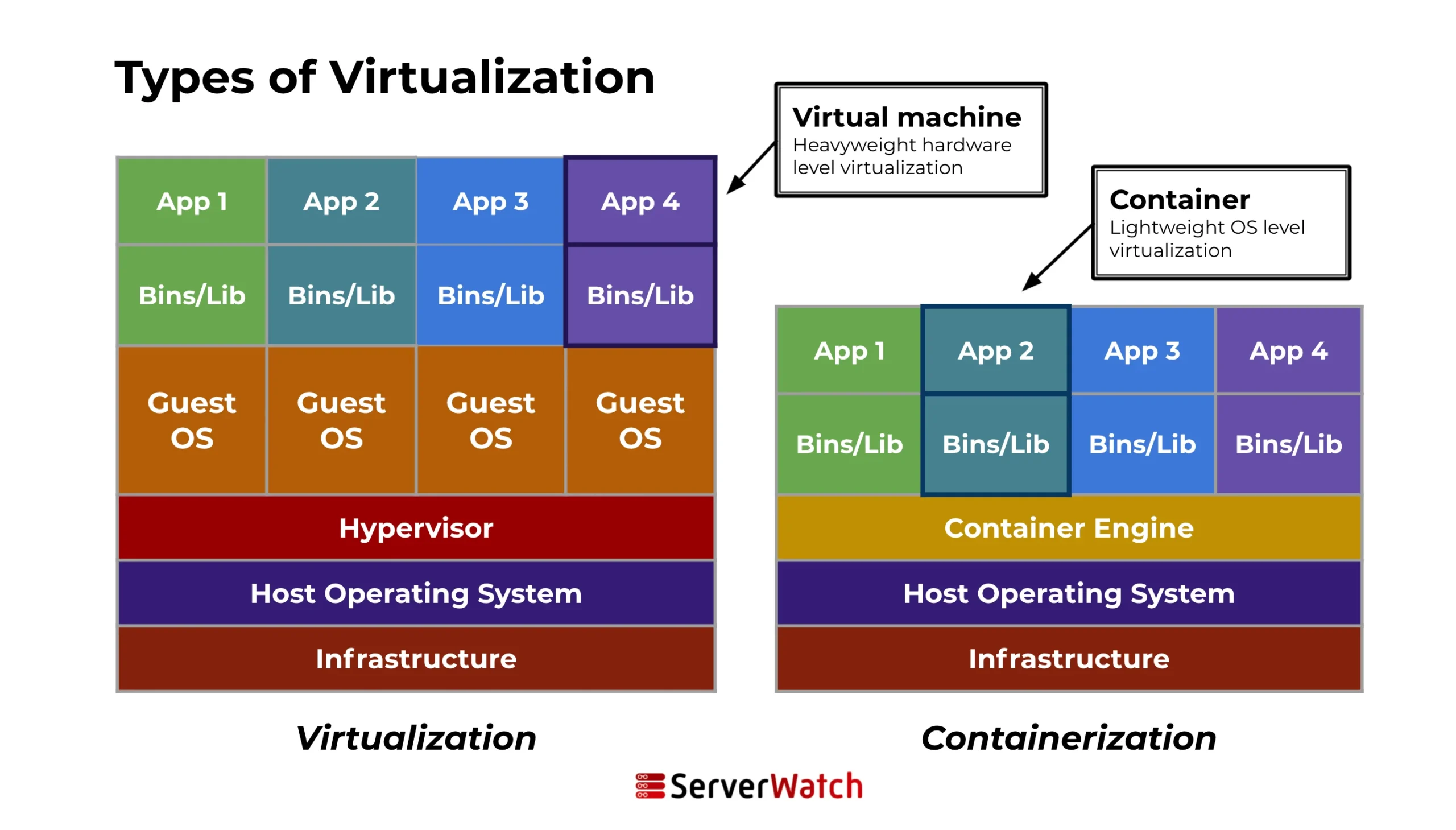
To comprehend the operational efficiency of containerization, industry analysts frequently contrast containers with traditional virtual machines (VMs). While both technologies provide isolated execution environments for applications, their underlying architectures diverge significantly.
Virtual machines operate via a hypervisor—either type 1 running directly on bare-metal hardware or type 2 running on top of a host operating system. Each VM necessitates a full guest operating system, virtualized hardware resources, and dedicated binaries and libraries. Consequently, VMs typically consume gigabytes of storage, require substantial memory overhead, and take minutes to boot.
In contrast, containers abstract at the operating system level rather than the hardware level. Multiple containers run directly on a single host operating system, sharing the host kernel while maintaining isolated user spaces, filesystems, and process trees. Because they eliminate the need to duplicate an entire guest OS for every application instance, containers occupy only megabytes of storage, launch in fractions of a second, and yield significantly higher density on identical physical hardware.
| Metric / Feature | Containerization | Virtualization (VMs) |
|---|---|---|
| Operating System | Shares the host OS kernel; isolates process spaces. | Requires a dedicated guest OS for each instance. |
| Resource Overhead | Minimal; shares underlying system resources efficiently. | High; provisions dedicated virtualized hardware and memory. |
| Startup Speed | Milliseconds to seconds. | Minutes due to full OS boot cycle. |
| Portability | High; packages app and dependencies uniformly across environments. | Moderate; bound by image formats and hypervisor dependencies. |
| Security Boundary | Process-level isolation; kernel vulnerabilities can impact hosts. | Hardware-level isolation via hypervisor; robust security perimeter. |
Key Components and Operational Workflow
The containerization lifecycle relies on a distinct set of components that streamline software distribution:
- Container Image: A read-only, immutable template containing application code, dependencies, libraries, and environment variables. Images are structured in layers, promoting efficient caching and incremental downloads.
- Container Registry: A centralized repository (such as Docker Hub, Amazon Elastic Container Registry, or GitHub Packages) used to store, secure, and distribute container images.
- Container Engine: The runtime software (e.g., Docker Engine, containerd, CRI-O) responsible for building, managing, and executing containers on the host operating system.
- Orchestration Layer: Platforms like Kubernetes that manage scaling, networking, load balancing, and health monitoring across distributed container fleets.
The workflow typically begins with a developer writing code and defining configuration files, such as a Dockerfile. The container engine builds an image from these instructions, which is then pushed to a registry. Testing and production environments pull this immutable image from the registry, guaranteeing that the application executes identically regardless of underlying infrastructure discrepancies.
Enterprise Use Cases in the Modern Software Landscape
Organizations across financial services, retail, telecommunications, and healthcare have integrated containerization into core operational workflows due to its versatility across several critical domains:
Microservices Architecture
Modern applications increasingly abandon monolithic codebases in favor of microservices, where complex applications are decomposed into small, independently deployable services. Containers provide the ideal runtime boundary for microservices. Each service operates in its own container, allowing development teams to write components in different programming languages, update services without risking system-wide downtime, and scale individual components dynamically based on real-time traffic demands.
Continuous Integration and Continuous Deployment (CI/CD)
Containers eradicate the perennial engineering complaint that "it worked on my development machine." By standardizing the runtime environment from local workstations through automated testing pipelines to staging and production servers, containers accelerate release cycles. Automated CI/CD tools can spin up ephemeral container instances to run test suites in production-equivalent environments, reducing regression bugs and deployment failures.
Cloud-Native Migration and Multi-Cloud Strategy
As enterprises migrate legacy workloads to public cloud providers like Amazon Web Services, Microsoft Azure, and Google Cloud Platform, containerization offers unprecedented portability. Applications packaged in containers can move seamlessly between on-premises data centers and diverse cloud providers without costly architectural rewrites, preventing vendor lock-in and optimizing infrastructure costs.
Comprehensive Benefits of Containerization
Industry data consistently highlights the operational advantages realized by organizations implementing container strategies:
- Resource Optimization: High container density reduces server footprint and hardware procurement expenditures.
- Rapid Scalability: Instantaneous container startup times enable elastic scaling architectures that automatically adapt to traffic spikes.
- Environmental Consistency: Eliminating configuration drift between development, testing, and production environments minimizes downtime.
- Developer Productivity: Standardized packaging allows engineering teams to focus on writing application logic rather than troubleshooting infrastructure discrepancies.
- Fault Isolation: If a single container crashes due to application errors, adjacent containers remain unaffected, bolstering overall system resilience.
- Simplified Dependency Management: Bundling libraries directly into container images prevents version conflicts across shared hosting environments.
- Enhanced Portability: Workloads run uniformly across physical servers, virtual machines, local developer laptops, and public clouds.
- Modular Updates: Individual microservices can be patched or upgraded independently without requiring full application redeployments.
- Automated Management: Orchestration tools automate operational tasks, including self-healing, rolling updates, and resource allocation.
- Accelerated Time-to-Market: Streamlined CI/CD pipelines empower businesses to release new software features rapidly.
- Improved Collaboration: Clear divisions between infrastructure configuration and application code enhance coordination between development and operations teams.
- Efficient Storage Utilization: Layered image architectures ensure that shared base layers are stored only once on the host system.
- Cost-Efficient Licensing: Reduced hardware requirements frequently translate to lower software licensing costs associated with operating systems and hypervisors.
Emerging Challenges and Security Considerations
Despite widespread enterprise adoption, containerization introduces distinct technical complexities and security hurdles that engineering leadership must proactively manage.
Security Vulnerabilities
Because containers share the host operating system kernel, a vulnerability that allows an attacker to break out of a container namespace can compromise the entire host system and adjacent workloads. Common security risks include running containers with root privileges, utilizing outdated base images containing unpatched software vulnerabilities, and failing to scan container registries for malicious code. Organizations mitigate these risks through automated image vulnerability scanning, enforcing principle-of-least-privilege permissions, and adopting kernel-level isolation technologies like gVisor or Kata Containers.
Management Complexity
While individual containers are lightweight, enterprise environments frequently manage tens of thousands of instances simultaneously. This scale introduces significant observability challenges regarding log aggregation, network monitoring, and storage persistence. Deploying advanced orchestration platforms like Kubernetes requires specialized technical expertise, creating potential skills gaps within traditional IT departments.
Legacy System Integration
Refactoring legacy monolithic applications to run within containerized environments often requires substantial engineering effort. Systems reliant on tightly coupled hardware dependencies or archaic operating system configurations resist straightforward containerization, necessitating phased migration strategies or strategic application retirement.
Market Landscape: Key Technologies and Platforms
The ecosystem surrounding containerization features a robust suite of tools that dominate enterprise infrastructure:
- Docker: The foundational platform that popularized containerization, offering comprehensive utilities for building and sharing container images.
- Kubernetes (K8s): The open-source market leader for orchestrating containerized workloads, providing automated deployment, scaling, load balancing, and self-healing across complex clusters.
- OpenShift: Red Hat’s enterprise-grade container platform built on top of Kubernetes, providing added security, developer tooling, and integrated CI/CD pipelines.
- Amazon ECS and EKS: Managed container services provided by AWS, allowing organizations to run containers without managing underlying server clusters directly.
- LXD and Podman: Alternative container engines emphasizing rootless operation and enhanced security isolation relative to traditional daemon-based architectures.
Future Trends and Industry Outlook
The trajectory of containerization indicates deeper convergence with emerging technological paradigms. Industry observers note several pivotal trends shaping the future of software infrastructure:
- Serverless Containers: Platforms such as AWS Fargate and Google Cloud Run abstract infrastructure management entirely, allowing developers to execute containers on-demand without provisioning or managing underlying server nodes.
- Artificial Intelligence and Machine Learning Integration: Containers are increasingly utilized to package complex AI/ML pipelines, ensuring that data science models train and execute consistently across disparate cloud and edge environments.
- Edge Computing Expansion: As Internet of Things (IoT) devices proliferate, lightweight container runtimes enable localized data processing and application deployment at network edges where bandwidth and power are constrained.
- Stricter Security and Compliance Standards: Regulatory frameworks increasingly mandate rigorous governance over software supply chains, accelerating the adoption of cryptographically signed container images and automated compliance auditing.
Bottom Line: The Indispensable Role of Containers
Containerization has fundamentally altered the economics and mechanics of software engineering, delivering unmatched operational efficiency, scalability, and environmental consistency. As enterprises continue their digital transformation journeys, containers will remain the foundational engine powering cloud-native innovation. Organizations that master container orchestration, robust security protocols, and modern CI/CD integration will secure a definitive competitive advantage in an increasingly digitized global economy.
