
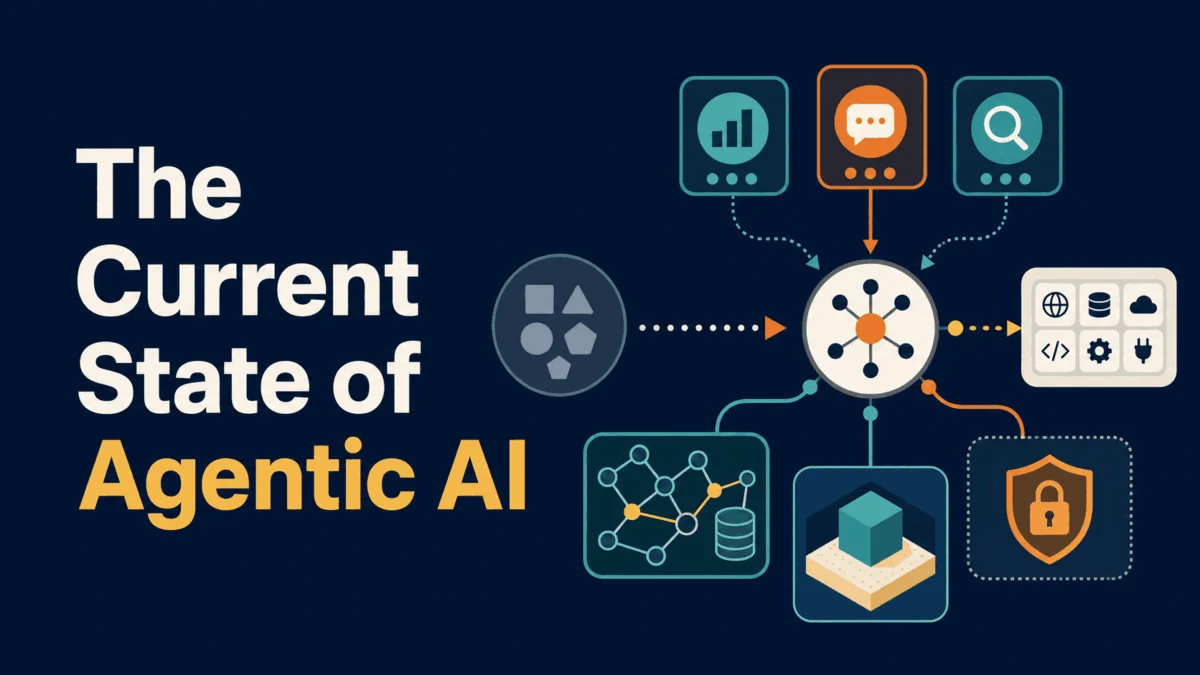

By mid-2026, the architecture of agentic AI has undergone a profound transformation, moving decisively away from the brute-force orchestration of monolithic models to embrace multi-agent swarms, native reasoning capabilities, and standardized tool protocols. This evolution signifies a maturation of the field, shifting the focus from individual agent intelligence to the design of resilient, specialized, and secure AI ecosystems.
A mere year ago, the dominant paradigm for constructing AI agents was characterized by intensive, hand-crafted orchestration. Engineers dedicated significant effort to meticulously designing complex ReAct (Reasoning and Acting) loops, battling the inherent brittleness of long, intricate prompt chains, and attempting to compel single, massive language models to simultaneously manage planning, tool execution, and contextual awareness. This approach, while foundational, proved increasingly cumbersome and inefficient as AI applications scaled. The challenge was akin to asking a single super-chef to both plan a banquet, source every ingredient, cook every dish, and serve every guest — a task that inevitably led to bottlenecks and errors.
Today, the landscape is distinctly fractured and specialized. The era of the monolithic, all-encompassing agent is rapidly receding, replaced by a sophisticated ecosystem of interconnected, highly specialized components. This paradigm shift has been driven by several factors: the integration of "System 2" thinking directly into foundation model architectures, the pressing need for scalability and maintainability, and a growing recognition of security vulnerabilities inherent in overly complex single-agent designs. The role of the AI engineer has evolved accordingly; rather than painstakingly prompting singular agents, their expertise is now centered on designing the intricate infrastructure that enables specialized agents to communicate, collaborate, and learn. This tutorial delves into the current state of agentic AI architecture, outlining the three major shifts defining production systems today and offering insights into designing a modern agent swarm.
The Dawn of Native Reasoning: Beyond Orchestrated Loops
Perhaps the most dramatic change has occurred at the very core of how AI agents "think." Previously, patterns such as Plan-and-Execute and Reflexion, explored extensively in early guides like "The Machine Learning Practitioner’s Guide to Agentic AI Systems," relied on external, programmatic loops. These frameworks essentially forced a model to simulate step-by-step thinking, self-critique its outputs, and iteratively refine its approach through external code. This was a necessary workaround when large language models (LLMs) lacked inherent advanced reasoning capabilities.
However, mid-2026 sees foundation models handling test-time compute natively. Breakthroughs in model architecture and training methodologies have allowed models to internally generate hidden reasoning tokens, explore multiple solution branches, and perform self-correction before producing a final output. This internal deliberation process, often described as integrating "System 2" cognitive functions, means that the elaborate external scaffolding once built to simulate reflection is now largely redundant. For instance, recent benchmarks indicate that models integrating these native reasoning capabilities can achieve up to a 30% reduction in external computational steps for complex tasks, significantly lowering latency and token overhead.
The architectural implication is profound: engineers no longer need to construct complex orchestration frameworks solely to imbue an agent with planning capabilities. Relying on tools like LangChain or LlamaIndex primarily to force a model to reflect on its own errors, while once cutting-edge, can now introduce unnecessary latency and token costs for something the underlying model handles more efficiently. Instead, the orchestration layer’s primary function has shifted to routing, robust state management, and environment execution. The agent’s cognitive loop is now largely managed by the model itself; the engineer’s task is to construct the secure and efficient sandbox within which this inherent cognition can operate. This liberation from cognitive orchestration allows engineering energy to be redirected towards a more valuable pursuit: decomposing complex work across multiple specialized agents.
The Rise of Agent Swarms: Microservices for AI
With models autonomously handling their internal reasoning processes, the critical question arises: what should a single agent truly be responsible for? The consensus among leading production teams has solidified around a minimalist approach: as little as possible. The concept, robustly argued in analyses such as "Beyond Giant Models: Why AI Orchestration is the New Architecture," highlights the inherent bottleneck created by attaching 50 tools to a single large model. Such monolithic agents become difficult to manage, debug, and scale.
The industry has converged on "agentic swarms" – collections of smaller, highly specialized agents that communicate and collaborate via standardized protocols. This mirrors the successful microservices architecture in traditional software engineering, where large applications are broken down into independent, loosely coupled services. Instead of one omniscient agent burdened with an expansive toolkit, a typical swarm might feature:
- A Triage Agent: Responsible for initial request parsing and routing to the most appropriate specialist.
- A Data Fetcher Agent: Specializing in secure database interactions, such as executing read-only SQL queries.
- A Data Analyst Agent: Equipped with Python sandboxes to perform complex data manipulation and generate insights.
- A Synthesis Agent: Tasked with compiling findings from multiple specialists into a coherent, user-facing response.
- A Memory Agent: Asynchronously observing interactions and updating persistent knowledge graphs.
The concern that splitting a monolithic agent merely shuffles complexity rather than reducing it is valid, but the key insight is that this redistributed complexity becomes manageable, testable, and replaceable. Each agent can be developed, deployed, and updated independently, fostering agility and reducing the risk of system-wide failures. Industry reports suggest that companies adopting swarm architectures have seen up to a 40% improvement in development velocity and a 25% reduction in operational costs due to optimized resource allocation. "This modularity is a game-changer," states Dr. Anya Sharma, lead AI architect at Synapse Dynamics. "We can now use smaller, faster, and cheaper models for routine tasks, reserving our most powerful, and expensive, models for critical routing or synthesis roles, drastically improving efficiency."
Illustrative pseudocode, while not directly executable without a swarm_framework package, demonstrates this pattern effectively. Frameworks like the OpenAI Agents SDK or LangGraph Swarm provide concrete implementations. The architecture emphasizes individual agents being stateless per call, with orchestration relying on explicit handoff tools. When a Data Fetcher agent completes its task, it invokes a TransferCommand tool, passing control and the relevant data context to the Data Analyst agent. This approach ensures context windows remain lean, allowing for the use of more economical models (e.g., Qwen3 or current-generation small language models) for specific nodes, while reserving larger, more capable models for overarching routing and synthesis. This stateless-per-agent but stateful-across-the-system design is fundamental, especially when considering the standardized way tools are now connected.
The Standardization of Agency: Model Context Protocol (MCP)
Connecting these specialized agents to the diverse real-world systems users interact with has historically been one of the most tedious and error-prone aspects of AI engineering. As highlighted in "Mastering LLM Tool Calling: The Complete Framework for Connecting Models to the Real World," integrating an API often required writing bespoke schemas, managing HTTP requests, and wrestling with arbitrary JSON parsing errors from the model itself. Each new integration represented a reinvention of the wheel.
The current state of tool calling is increasingly defined by the Model Context Protocol (MCP). This open standard has emerged as a universal adapter, streamlining the connection between AI models and both local and remote data sources. MCP operates as a middleware layer, abstracting away the complexities of direct API interaction.
The shift is stark:
| Old Paradigm (Pre-2025) | Current State (Mid-2026) |
|---|---|
| Hardcoded API keys directly into the agent’s environment | Agent connects to an isolated, secure MCP server |
| Engineer writes custom JSON schemas for every tool | MCP server automatically exposes available tools and resources |
| Agent directly executes API calls inline | Execution happens securely on the MCP server, separating concerns |
This standardization means an engineer can seamlessly integrate a pre-built GitHub MCP server, a Slack MCP server, or a PostgreSQL MCP server into their swarm without writing a single line of underlying API wrapper code. While practical implementation still necessitates careful credential management on the server side, the attack surface and integration burden are drastically reduced. "MCP is the internet protocol for AI agents," comments Dr. Kai Chen, a principal engineer involved in the protocol’s development. "It’s not just about convenience; it’s about enabling a truly interoperable and secure agent ecosystem." Early adopters report a 50% faster time-to-integration for new external services, significantly accelerating development cycles.
Continuous Learning Through Memory Graphs
A significant promise from early discussions, such as those in "Agentic AI: A Self-Study Roadmap," was the concept of agents that learn from their own execution history. This aspiration is now firmly moving into production through the implementation of memory graphs, a mechanism that warrants clear understanding.
The crucial distinction lies between per-call statelessness and system-level persistent memory. Individual agents within a swarm largely remain stateless per invocation, which helps keep their context windows lean and efficient. However, the overall system maintains a persistent, evolving memory through graph databases like Neo4j, or managed alternatives, which are dynamically injected into relevant agent context pipelines.
When a swarm executes a task, a specialized Memory Agent operates asynchronously in the background. Its singular objective is to observe the main swarm’s trajectory, extract persistent facts, identify recurring patterns or failures, and update the graph database.
This process typically unfolds as follows:
- Observation: The Memory Agent monitors the interactions and outputs of the primary swarm.
- Extraction: Using its own reasoning capabilities, it identifies salient facts, relationships, and successful or unsuccessful strategies.
- Graph Update: These extracted insights are formatted and stored in the graph database, creating nodes for entities and edges for relationships or causal links. For example, if a specific query repeatedly fails due to a schema mismatch, this fact is recorded.
- Context Injection: When a new, similar task arises, the Triage or relevant specialist agent queries the memory graph. Relevant past experiences, solutions, or common pitfalls are retrieved and injected into the agent’s context window, guiding its approach.
This paradigm shifts the focus from traditional prompt engineering to sophisticated context engineering. The system continuously improves its performance and efficiency over time without requiring iterative fine-tuning of the underlying models. Data from pilot programs shows an average 15-20% improvement in task success rates for recurrent challenges after a system has accumulated sufficient memory, demonstrating the tangible benefits of this continuous learning loop.
Fortifying the Swarm: Addressing the Expanded Attack Surface
With the advent of multi-agent systems interconnected via universal protocols, the potential attack surface has expanded significantly. Warnings about indirect prompt injections and the hijacking of automated workflows, as detailed in "Facing the Threat of AIjacking," are now among the primary security concerns for enterprise AI adoption. The very architecture that makes swarms powerful — their ability to transfer context and control between specialized agents — simultaneously makes them structurally more dangerous than their monolithic predecessors.
The threat model has evolved. If Agent A, which possesses permissions to read external emails, can transfer context and control to Agent B, which has direct database access, a cleverly crafted malicious instruction embedded within an email could pivot laterally through the swarm. This mirrors traditional network intrusion patterns, where an initial breach allows an attacker to move deeper into a system. The inherent trust mechanisms between agents, while facilitating cooperation, also present avenues for exploitation. "The interconnectedness of agent swarms creates a new kind of ‘supply chain’ vulnerability," warns cybersecurity analyst Laura Vance from SecurAI. "We’re seeing a sharp increase in sophisticated attacks targeting these inter-agent handoffs, making robust security protocols non-negotiable."
In response, three critical defenses are converging to address this complex problem:
- Context Attestation: This involves cryptographically verifying the provenance and integrity of information passed between agents. Each piece of context or command carries a digital signature, ensuring it originated from a trusted source and hasn’t been tampered with. If a malicious payload attempts to inject false information, the attestation fails, preventing the rogue instruction from propagating.
- Role-Based Access Control (RBAC) for Agents: Just as human users have specific roles and permissions, agents are now assigned granular RBAC policies. An agent designed to read emails will only have
readaccess to email systems and no direct access to sensitive databases. Any attempt by such an agent to execute a database command, even if prompted to do so, is blocked by its assigned permissions. This enforces the principle of least privilege, drastically limiting the potential damage from a compromised agent. - Dynamic Trust Proxies: These intelligent intermediaries intercept and validate all inter-agent communication. Operating similar to firewalls, they analyze the content and intent of messages, cross-referencing them against established security policies and the sender/receiver agents’ permissions. If a communication pattern appears anomalous or suspicious, the proxy can flag it, quarantine the message, or even temporarily isolate the involved agents, preventing malicious lateral movement.
While these defenses are not yet universally standardized across all platforms, they represent the active frontier of production agentic security. Any organization deploying agent swarms into production today considers at least one, if not a combination, of these mechanisms as a baseline security requirement. Investment in AI security solutions is projected to grow by over 60% in the next two years, underscoring the urgency of these measures.
The Path Forward: Engineering Resilient Swarms
Agentic AI has transcended its origins as a research curiosity, evolving into a sophisticated engineering discipline fraught with real constraints, discernible failure modes, and critical design decisions at every layer. The foundational primitives — robust tool calling, intelligent routing, and native reasoning capabilities — are maturing at an unprecedented pace.
The primary leverage for innovation and competitive advantage now lies in the systems layer: how intelligently one designs the swarm topology, how effectively memory is architected to compound knowledge over time, and how meticulously security boundaries are drawn to enable these systems to operate safely and reliably at scale. The leading teams in the field are no longer fixated on developing incrementally "smarter" individual agents; instead, their focus is on constructing more resilient, specialized, and secure agent swarms.
For organizations embarking on this journey, the recommendation is clear: begin small. Select one of the established patterns discussed, implement it at a manageable scale, and rigorously instrument its performance and behavior. The architectural intuitions developed from a well-designed three-agent swarm will directly transfer and prove invaluable when scaling to a thirty-agent enterprise system. The future of AI is collaborative, modular, and deeply integrated into the operational fabric of the modern enterprise.
