

The software engineering industry is undergoing a structural transformation that is fundamentally redefining the velocity and architecture of digital product delivery. For decades, the measure of a high-performing engineering organization was expressed in modest multiples—how many code deployments could be safely executed per week. Today, the integration of autonomous coding agents is converting that linear multiple into an exponential curve. This shift has exposed a profound operational divide across the tech sector. The distinguishing factor between elite engineering organizations and the rest of the industry is no longer access to superior tooling or premier talent. Instead, it is whether a team has successfully reengineered its delivery infrastructure into what industry practitioners now designate as a "software factory."
In this emerging paradigm, a software factory functions as a largely autonomous system where human intent enters as specifications, tickets, and scenarios, while autonomous agents handle the heavy lifting of planning, writing, testing, and shipping code changes. Within these frameworks, human engineers retain ownership over high-level intent, architectural guardrails, and final review gates. However, the sheer volume of code generated by these systems has outpaced legacy human-centric workflows, forcing organizations to rethink the foundational components of continuous integration and deployment.
Quantifying the Acceleration: The Anthropic Benchmark
To understand the scale of this operational shift, one need only look at empirical data released by leading AI laboratories. In May, artificial intelligence research company Anthropic reported merging approximately 2,500 code changes per day into its repositories. By September of the same year, that figure had skyrocketed to more than 30,000 merged code changes daily.
This dramatic acceleration demonstrated unequivocally that manual coding had ceased to be the primary bottleneck in software development. Instead, the bottleneck shifted squarely onto developer infrastructure that had been historically optimized for human scales of productivity. Industry leaders were left confronting a fundamental architectural question: What does continuous integration even mean when tens of thousands of code changes are merged into production systems while automated test suites are still executing?
The core challenge of the software factory can be understood through the lens of traditional control theory. In this model, human intent acts as the desired setpoint, autonomous agents serve as the system controller, and the verification pipeline acts as the sensor. A foundational principle of engineering control loops dictates that a controller that outruns its sensor does not achieve greater efficiency; rather, it destabilizes the system. It continuously retries operations based on stale information and ultimately ships system failures that a properly synchronized sensor would have otherwise intercepted. Consequently, the speed, accuracy, and capacity of the verification sensor dictate the extent to which a software factory can safely operate with full autonomy.
Deconstructing the Agentic Software Factory
Industry experts, including developer advocate Addy Osmani, define a modern software factory as a collection of concurrent control loops operating simultaneously, fed by a continuous work queue and funneled through strict review gates into production environments.
The anatomy of this architecture comprises several distinct phases:
- Intent: The formal specifications, user stories, and acceptance scenarios that define the parameters of a successful task.
- Work Queues: The backlogs that hold pending tasks for autonomous processing.
- Execution Harnesses: The constrained environments that equip individual coding agents with specific tools, contextual boundaries, and organizational rules.
- Generation: The phase where coding agents actively write and refactor source code.
- Verification: The suite of automated tests, behavioral scenario runs, and runtime checks designed to validate code safety prior to merging.
- Review Gates: The checkpoints where human oversight or automated policy enforcement permits code to merge.
- Integration and Deployment: The automated pipelines that push verified changes into production, feeding real-time telemetry and incident reports back into the work queue.
Evolution of the Sensor: Shifting from Static Stages to Real-Time Services

Autonomous agents fundamentally disrupt the software delivery lifecycle in two critical ways. First, they introduce a high-velocity generation phase, overwhelming downstream stages with a continuous influx of code changes. Second, they transform verification from a static milestone that human developers wait for into an active, on-demand service that agents query dynamically from within their internal execution loops.
Historically, the software development lifecycle (SDLC) relied on cheaper, asynchronous stand-ins for live system verification. Organizations utilized fast unit tests at the commit stage, broader integration tests within continuous integration servers, shared staging environments immediately prior to release, and production telemetry after deployment. This staged approach was necessary because querying the real, live system for every minor code modification was historically too slow and computationally expensive. Each stage traded absolute fidelity for execution speed—a compromise that remained viable as long as human developers set the operational pace.
However, this traditional compromise collapses in an agentic workflow. A human developer who spent two days crafting a feature barely noticed if a staging environment took four hours to generate a test report. In contrast, an agent capable of writing a feature in four minutes must either idle—thereby wasting its operational velocity—or proceed using whatever limited visibility it possesses. For many development teams, that limited visibility remains restricted to isolated unit tests and basic mocks.
The Ladder of Sensors and the StrongDM Case Study
Software entrepreneur Dan Shapiro categorizes AI-assisted coding into distinct evolutionary levels based on the verification mechanisms employed at each stage. At Level 3, agents write code while human developers manually review diffs throughout the day—a bottleneck where the vast majority of engineering organizations currently plateau. At Level 4, automated tests serve as the primary sensor, though the safety of this approach depends entirely on the fidelity of the environment against which those tests are executed.
A notable benchmark in this space was established by infrastructure firm StrongDM, which implemented two radical operational rules: source code must neither be written by humans nor reviewed by humans. While these provocative rules garnered widespread industry attention, their operational success relied entirely on the company’s proprietary "Digital Twin Universe." This infrastructure features behavioral clones of third-party software dependencies against which agents execute thousands of distinct verification scenarios concurrently.
This distinction highlights the boundary between merely injecting AI agents into an existing legacy pipeline and operating a true software factory. While governance rules and agent prompts can be easily replicated, the underlying verification sensor remains complex and resource-intensive. It is the sensor—not the model—that dictates the appropriate level of human involvement, restricting human oversight to high-level architectural intent rather than per-change line reviews.
Evaluating Sensor Properties: Latency, Fidelity, and Bandwidth
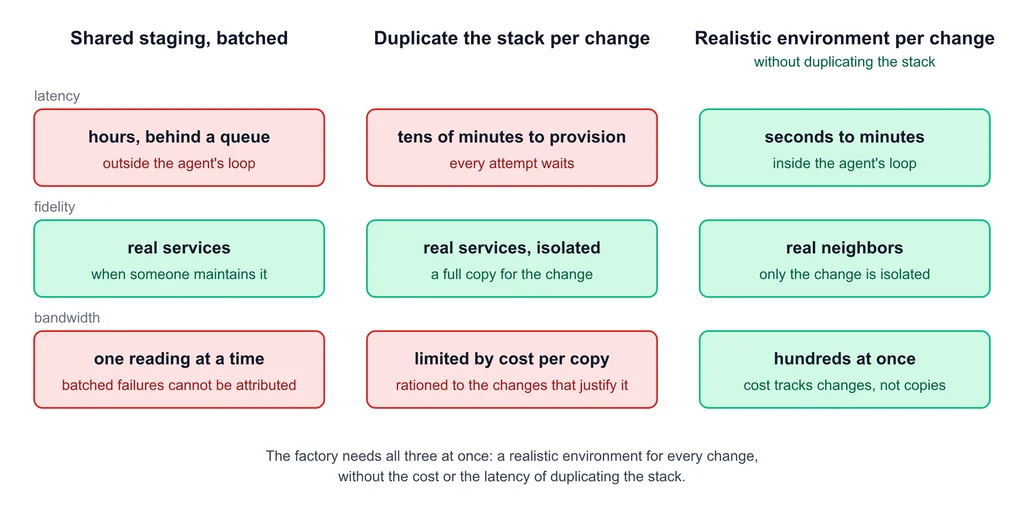
For a software factory to function reliably at scale, its verification sensor must satisfy three rigorous properties: latency, fidelity, and bandwidth.
Latency refers to the duration required for the sensor to report verification results. High latency introduces severe instability into the control loop. If a sensor takes too long to respond, every subsequent action taken by an agent rests upon a system state that no longer exists. Consequently, the agent executes retries based on unverified assumptions, while other agents construct further modifications on top of unstable foundations. Modern engineering teams must track time-to-signal metrics, measuring the precise minutes elapsed from a change being ready to receiving verified results in a production-like environment.
Fidelity measures how closely the sensor’s readings reflect the behavior of the actual production system. Fidelity is often more critical than latency because an autonomous control loop will inherently trust a biased sensor. Traditional unit tests and mocks evaluate code against simplified models of dependencies, causing agents to optimize for whichever metrics the sensor rewards. To combat this, advanced software factories utilize isolated holdout test sets located outside the primary codebase. The key performance indicator for fidelity is the escape rate—the percentage of software defects that successfully bypass verification and are discovered only after merging.

Bandwidth defines the volume of concurrent readings the sensor can process simultaneously. This property is frequently strained first by autonomous agents. Traditional shared staging environments are typically capable of processing only one verification run at a time. When dozens of autonomous agents flood a shared environment with concurrent tests, results become hopelessly entangled, making it impossible to attribute system failures to specific code changes. Concurrency capacity is therefore a vital metric for modern engineering infrastructure.
Autonomy, Back Pressure, and Cloud-Native Complexities
An organization’s operational autonomy is strictly bounded by the capabilities of its verification sensor—a dynamic known in the industry as back pressure. When an infrastructure relies exclusively on basic compilers and unit tests, human oversight must remain absolute. Conversely, when an organization deploys per-change verification within a production-like environment, an agent can iterate autonomously until verification succeeds, allowing human engineers to review intent and empirical evidence rather than raw source code.
This architectural reality is acutely complicated in modern cloud-native, distributed systems. In a microservices architecture, software behavior is distributed across complex service boundaries. A minor field renaming in one service may break an API contract relied upon by an entirely different team’s service. Each individual change may appear locally correct within its own repository yet fail catastrophically when integrated into the broader system.
Consequently, building a faithful verification sensor for cloud-native architectures requires including real, adjacent services in the test loop. Achieving this demands satisfying all three sensor properties simultaneously: high fidelity via real service dependencies, combined with low latency and high bandwidth to support continuous, concurrent agent activity.
Historically, engineering teams have been forced to compromise, successfully achieving only two of the three properties. Utilizing shared staging environments provides high fidelity but suffers from catastrophic bottlenecks and high latency. Conversely, duplicating the entire application stack for every individual code change ensures isolation and fidelity but introduces prohibitive provisioning delays and infrastructure costs.
To resolve these challenges, specialized infrastructure platforms—such as Signadot and emerging control-plane technologies—have been developed to provide agentic systems with realistic, lightweight execution environments where real services can handle requests concurrently without the massive overhead of duplicating entire cloud clusters.
Conclusion
The widening performance gap between elite engineering organizations merging tens of thousands of changes daily and the rest of the software industry is not a reflection of AI model capabilities. Rather, it is a consequence of developer infrastructure readiness. As autonomous agents become ubiquitous, the ultimate competitive differentiator will remain the speed, fidelity, and concurrency of the verification sensor. Organizations that successfully reengineer their software delivery lifecycles around robust, real-time verification loops will unlock unprecedented engineering velocity, while those relying on legacy human-scale infrastructure risk accelerating system instability.
