

In an era witnessing the rapid proliferation of sophisticated AI agents, the methods by which these autonomous systems are assessed have become critically important. This article delves into a systematic framework for rigorously evaluating AI agents, moving beyond superficial final output checks to scrutinize their entire execution process. This comprehensive approach is vital for ensuring reliability, efficiency, and overall performance before agents are deployed in real-world scenarios.
The Evolution of AI Evaluation: From LLMs to Autonomous Agents
The landscape of artificial intelligence has evolved significantly beyond static large language models (LLMs) that primarily generate text based on prompts. Today’s AI agents are dynamic entities capable of reasoning, planning, executing multi-step tasks, and interacting with external tools and environments. This paradigm shift, however, has exposed a critical gap in traditional evaluation methodologies. Many development teams, accustomed to assessing LLMs by inspecting final outputs, are finding this approach woefully inadequate for the complexities of AI agents. Such an oversight frequently masks critical failures, including inappropriate tool selection, erroneous tool arguments, poor handling of tool failures, or inefficient action sequences. The inability to pinpoint the precise locus of failure makes debugging and improvement an arduous, often speculative, process.
Agent evaluation specifically addresses this deficiency. Instead of a narrow focus on end results, it embraces a holistic examination of the agent’s full operational journey. This includes understanding its reasoning capabilities, decision-making processes, tool utilization, and adaptive behavior throughout a task’s unfolding. Such granular insight is indispensable for establishing an accurate baseline of an agent’s reliability, operational efficiency, and overall performance, enabling developers to preemptively identify and rectify issues well before production deployment. The principles outlined below establish a foundational, systematic methodology for accurately measuring and continuously enhancing agent performance.
The Imperative for Distinct Agent Evaluation Methodologies
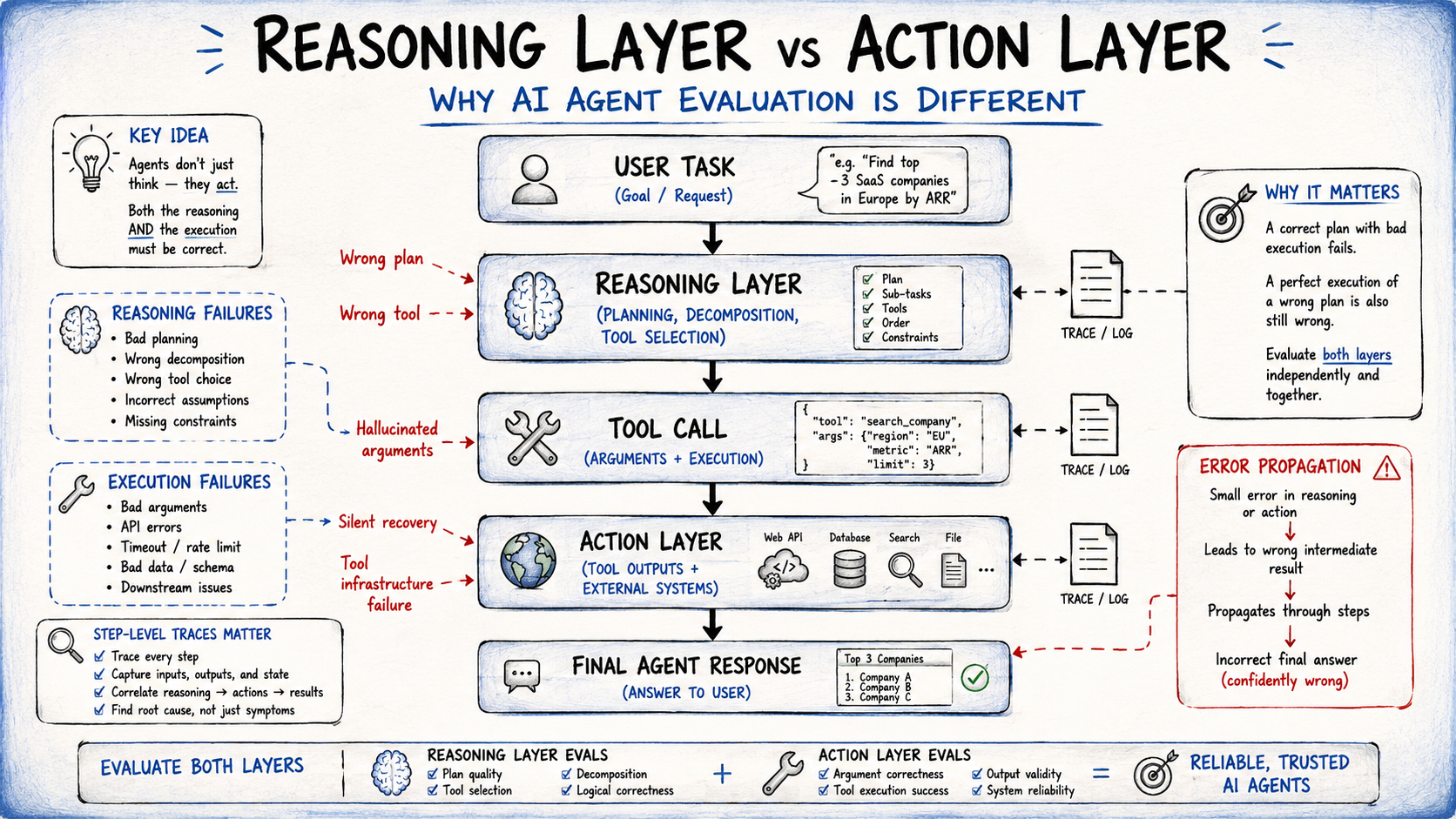
A common initial reaction to an agent’s failure is to attribute it to a flawed prompt, suggesting a need for clearer system instructions. While this can occasionally be true, a more frequent underlying issue is a measurement problem: the evaluation framework itself was not designed to detect the specific failure mechanism. AI agents operate across multiple layers—a reasoning layer and an action layer—and failures can occur independently within each. For instance, an agent might correctly reason about the necessary steps but then invoke the right tool with malformed arguments. A singular, end-to-end accuracy check inherently overlooks these distinct failure surfaces.
Industry experts emphasize that useful agent evaluation must operate at two distinct scopes: task-level evaluation (assessing overall task completion) and step-level evaluation (analyzing each individual action). A task completion rate of 80% offers no diagnostic value regarding the 20% failure rate. It doesn’t clarify whether failures stem from poor planning, incorrect tool selection, faulty arguments, or infrastructure issues. This is where step-level traces become indispensable. These detailed logs capture every tool call, its arguments, its result, and the agent’s subsequent decision, making precise diagnosis possible. Without such tracing capabilities, debugging production failures descends into guesswork, significantly hindering rapid iteration and improvement. Leading AI research institutions and tech companies are increasingly advocating for robust tracing as a core component of any agent development pipeline, recognizing its role in accelerating debugging and ensuring agent reliability.
Establishing Clear Success Metrics: Defining "Good" Performance
The efficacy of any evaluation system is directly proportional to the clarity and precision of its success criteria. A well-constructed evaluation task is one where multiple domain experts, working independently, would consistently arrive at the same pass/fail verdict. The starting point for such clarity involves unambiguous task specifications coupled with reference solutions. These "known-correct" outputs not only prove the solvability of the task but also serve to verify the correct configuration of the grading logic.
Before any evaluation runs commence, several critical elements must be explicitly defined:
- Detailed Task Specifications: Clearly outlining what the agent is expected to achieve.
- Reference Solutions: Exemplar outputs or execution paths that represent perfect performance.
- Grading Rubrics: Specific criteria against which agent performance will be measured, often broken down into various dimensions (e.g., accuracy, efficiency, safety).
- Failure Modes: Anticipated ways an agent might fail, helping to design evaluations that specifically target these weaknesses.
Building a set of well-specified tasks derived from real-world usage failures is a far more effective starting point than waiting for a hypothetically perfect, exhaustive dataset. Experience has shown that the longer teams delay in constructing these initial evaluations, the more complex and challenging the process becomes, ultimately slowing down development cycles.
Automated Assessment: Code-Based Graders for the Action Layer
For evaluating the action layer of an AI agent, deterministic graders—automated code that checks specific conditions without human or model-in-the-loop judgment—represent the most efficient, cost-effective, and reproducible option. These should always be the initial point of evaluation for the action layer. Examples include:
- Output Format Validation: Ensuring the agent’s output adheres to predefined JSON schemas or specific data structures.
- Argument Correctness Checks: Verifying that tool calls use the correct parameters and values.
- API Response Verification: Confirming that the agent correctly interprets and acts upon responses from external APIs.
- Functional Outcome Tests: Checking if a specific state change occurred (e.g., a database entry was created, a file was processed).
These code-based graders are typically fast, objective, and straightforward to debug. However, their deterministic nature makes them inherently brittle. For example, a grader meticulously checking for "confirmation_code": "CONF-789" would incorrectly flag a functionally identical response that formats the same data differently (e.g., "confirmationCode": "CONF-789" or simply "CONF-789" within a sentence). This limitation highlights the need for complementary evaluation methods.
Nuanced Assessment: Model-Based Judges for Reasoning and Output Quality
Certain dimensions of AI agent evaluation resist simple deterministic checks. These include the subjective quality of an output, its tone, faithfulness to retrieved context, or the appropriateness of its empathy in a conversational setting. For such nuanced assessments, leveraging a language model as a judge—often referred to as "LLM-as-a-Judge"—is an increasingly prevalent and powerful technique. This approach offers flexibility and the capacity to handle open-ended outputs, but it introduces challenges related to non-determinism and calibration drift that are absent in code-based graders.
To maintain the reliability of model-based graders, several best practices are essential:
- Structured Rubrics are Paramount: Vague instructions like "Evaluate whether the response is helpful" generate noisy, inconsistent results. A robust rubric explicitly specifies that a response must, for example, directly address the user’s question, ground all claims in retrieved context, and avoid suggesting out-of-scope actions. Each dimension should ideally be graded with a separate, isolated judgment to improve clarity and diagnostic value.
- Regular Calibration Against Human Judgment: The accuracy of LLM-as-a-Judge systems must be routinely validated against a sample of evaluations performed by human domain experts. Divergences between LLM and human judgments almost invariably point to issues within the rubric itself, signaling a need for refinement. Incorporating an explicit "Cannot determine" option for the grader helps prevent forced judgments on ambiguous cases, further enhancing reliability.
- Partial Credit for Multi-Component Tasks: In complex workflows, a binary pass/fail metric can obscure significant progress. A support agent that accurately identifies a customer’s problem and verifies their identity, but then fails to process a refund, is demonstrably more effective than one that fails at the very first step. Implementing partial credit for multi-component tasks provides a more granular and informative breakdown of where an agent is succeeding or failing, facilitating targeted improvements.
Tailoring Evaluation Strategies to Agent Types
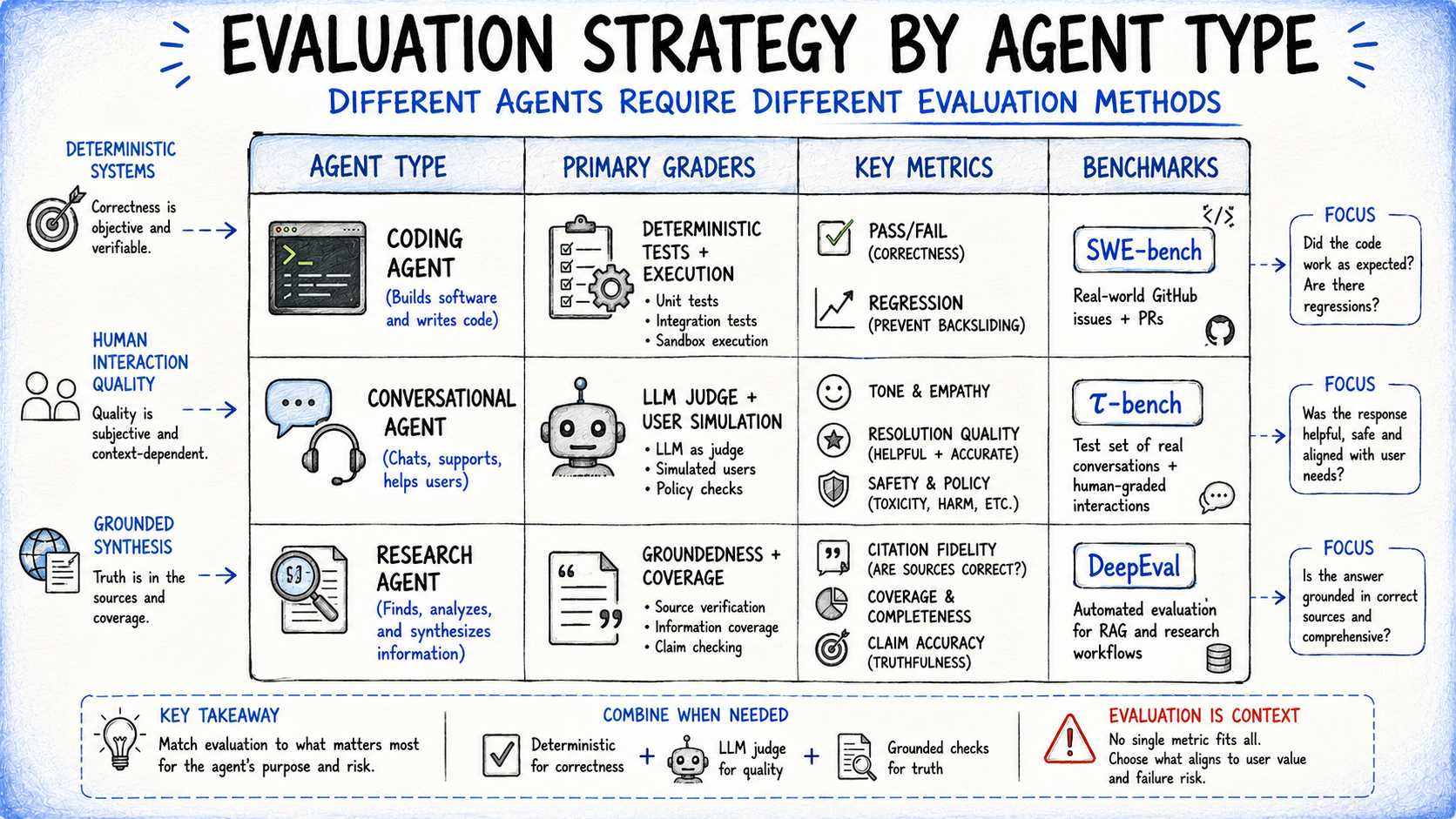
While grading strategies offer broad applicability, the specific type of AI agent profoundly influences which graders carry the most weight and which failure modes warrant the highest prioritization.
- Coding Agents: These agents specialize in writing, testing, and debugging code. Software is largely deterministic; the primary evaluation questions revolve around whether the code executes successfully, whether tests pass, and whether fixes resolve issues without introducing regressions. Established benchmarks like SWE-bench Verified and Terminal-Bench exemplify this pass/fail approach, often augmented by rubric-based quality checks for security vulnerabilities, readability, and robust edge case handling.
- Conversational Agents: Engaged in user interactions across domains like customer support, sales, and coaching, these agents require evaluation not only on task resolution but also on the quality of the interaction itself. This includes assessing appropriate tone, clear explanations, and overall user experience. This often necessitates a second language model simulating the user, as seen in benchmarks like 𝜋-bench, which grades both task completion and interaction quality across multiple conversational turns.
- Research Agents: Tasked with gathering and synthesizing information from diverse sources, research agents demand rigorous checks for groundedness (verifying claims against retrieved sources), coverage (ensuring all essential information is included in the answer), and source quality (confirming the consultation of authoritative and reliable materials).
Addressing Non-Determinism in Agent Performance
A fundamental characteristic of AI agents, particularly those leveraging advanced LLMs, is their inherent non-determinism. The same task, with identical inputs, processed by the same agent, can yield varying tool selections, reasoning paths, and ultimate outcomes. Consequently, single-trial evaluations can be profoundly misleading, failing to capture the underlying variability that simple accuracy metrics obscure.
This non-determinism stems from multiple sources: the stochastic nature of model outputs, variable tool latency, partial system failures, and the agent’s adaptive decision-making processes. Evaluating an agent, therefore, requires analyzing distributions of outcomes rather than relying on a single execution trace. To account for this variability, metrics such as pass@k and pass^k are commonly employed:
- pass@k: Measures the probability that at least one out of k independent attempts by the agent will succeed. For example, if an agent is run three times on a task, and at least one run is successful, it counts as a pass for pass@3.
- pass^k: Measures the probability that all k independent attempts by the agent will succeed. If an agent has a 75% single-trial success rate, its pass^3 rate would be approximately 42% (0.75 0.75 0.75), vividly illustrating how quickly reliability can degrade across repeated runs.
The selection between these metrics is ultimately a product-level decision, not purely technical. If the system only requires one successful outcome (e.g., generating a correct code snippet that can then be manually selected), then pass@1 or pass@k is appropriate. However, if every interaction with the agent must consistently succeed without human intervention, pass^k provides a more meaningful and stringent measure of reliability.
Strategic Evaluation: Capability vs. Regression Suites
Effective AI agent evaluation necessitates a clear distinction between two primary types of evaluation suites: capability and regression.
- Capability Evals: These are forward-looking, designed to answer: "What new abilities has this agent acquired?" Consequently, they should initially exhibit relatively low pass rates, focusing on tasks that currently challenge the system. Once a capability evaluation suite consistently achieves very high scores (e.g., above 90%), it often ceases to measure new capabilities and instead merely confirms reliability on already-solved problems. At this point, new, more challenging tasks should be introduced.
- Regression Evals: Serving a different, critical purpose, regression evaluations ask: "Can the agent still perform everything it previously could?" These tests are expected to run close to 100% success and act as a vital safeguard against performance degradations. Any significant drop in score within a regression suite signals a critical issue that must be investigated and resolved before release, preventing the reintroduction of old bugs or the degradation of existing functionality.
Over time, tasks from capability evaluations will naturally become easier for the agent. As their pass rates increase and performance stabilizes, these tasks can be promoted into the regression suite. However, it is crucial to continually introduce new and more challenging capability evaluations before the existing suite becomes saturated. A fully saturated suite becomes less sensitive to genuine improvements, meaning significant progress might be masked as mere noise rather than a clear signal of advancement.
Extending Evaluation into Production Monitoring: Real-World Validation
While development evaluations are designed to anticipate and capture expected failures, true production environments inevitably reveal unforeseen issues. Real users introduce a spectrum of inputs, edge cases, and contextual nuances that are rarely fully replicated in synthetic test suites. Therefore, robust production monitoring is not merely an addition but a necessary extension of the entire evaluation process.
A truly comprehensive evaluation system integrates several complementary signals:
- Automated Evaluations: Continuously run on every code commit, these cover known failure modes at scale, preventing issues from reaching users. However, they can foster false confidence if real-world usage diverges significantly from the test distribution.
- Production Monitoring: This tracks operational metrics such as latency, error rates, tool failures, and token usage. It effectively surfaces issues that synthetic tests might miss, though typically only after they have occurred in live environments.
- User Feedback: Although often sparse and self-selected, direct user feedback is invaluable. It highlights instances where an agent might appear "correct" by internal metrics but fundamentally fails to address the user’s actual intent or expectation. This qualitative data is often highly informative.
- Manual Transcript Review: Providing deep qualitative insight into an agent’s reasoning, tool usage, and decision paths, manual review is crucial for validating whether automated graders are accurately measuring the desired behaviors. It helps uncover nuanced failures that quantitative metrics alone might miss.
Collectively, these layers forge a more complete and accurate understanding of an agent’s performance in practice. The underlying infrastructure enabling this comprehensive view is step-level tracing—capturing every detail of reasoning, tool calls, arguments, results, and decisions throughout the agent’s operational loop. Industry-leading tools like LangSmith, Arize Phoenix, Braintrust, and Langfuse provide robust tracing and evaluation frameworks, while platforms such as Harbor and DeepEval handle the overarching evaluation harness layer, integrating these diverse signals into a cohesive monitoring and improvement pipeline.
Conclusion and Future Outlook
The rigorous evaluation of AI agents is no longer an optional luxury but an operational imperative for any organization developing and deploying these advanced systems. By moving beyond simplistic output checks to a deep analysis of the entire execution process, developers can build more reliable, efficient, and trustworthy AI. The eight-step framework—from understanding the distinct challenges of agent evaluation to extending monitoring into production—provides a clear roadmap for achieving this. As AI agents become increasingly integrated into critical infrastructure and daily life, the commitment to sophisticated evaluation methodologies will be paramount to unlocking their full potential while mitigating inherent risks, paving the way for a future where AI systems are not only intelligent but also consistently dependable. Further exploration of resources like Anthropic’s "Demystifying evals for AI agents" guide, particularly its section on "Going from zero to one: a roadmap to great evals for agents," offers valuable next steps for practitioners seeking to implement these strategies.
