
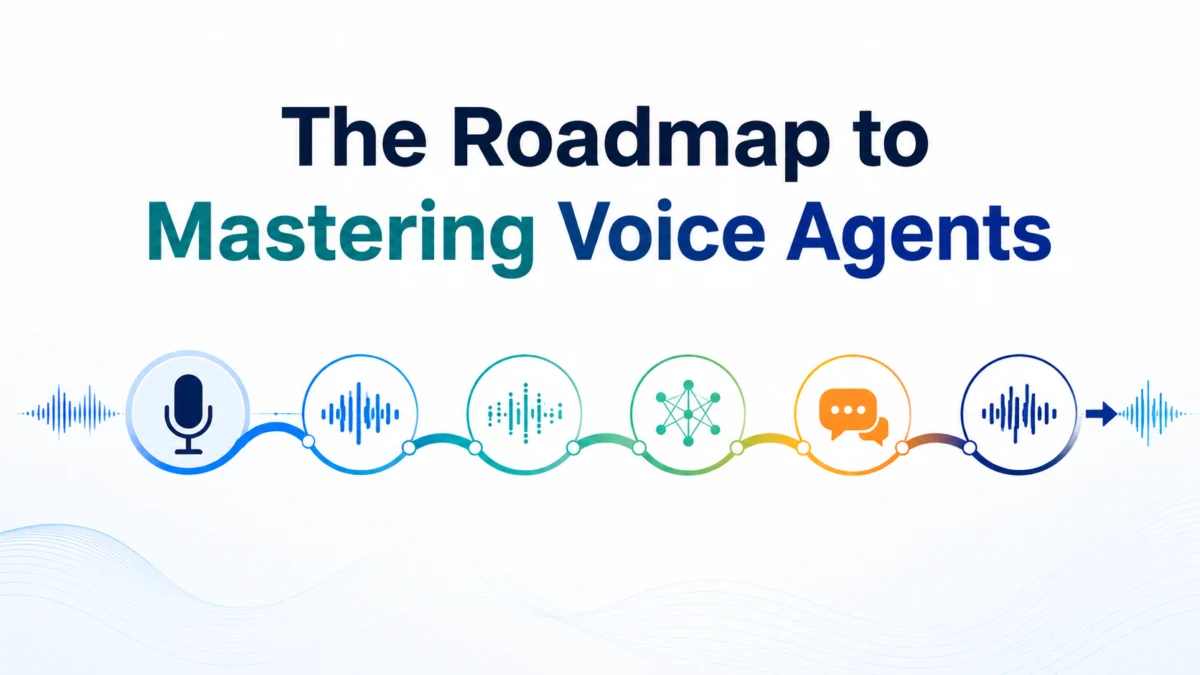

The rapid evolution of generative artificial intelligence has moved beyond the constraints of text-based interfaces, ushering in an era where voice-enabled interaction is becoming the primary modality for human-machine communication. As Large Language Models (LLMs) achieve unprecedented levels of reasoning capability, developers are increasingly tasked with bridging the gap between digital cognition and human speech. This transition necessitates a departure from standard text-based workflows, requiring engineers to master a complex, multi-stage pipeline that prioritizes low-latency performance and nuanced conversation design.
The Anatomy of the Voice AI Pipeline
At its core, a voice agent is a sophisticated orchestration of three distinct technological pillars. Unlike text-based agents, which operate in a stateless or session-based query-response loop, voice agents must manage a continuous, asynchronous flow of audio data.
- Automatic Speech Recognition (ASR): This initial stage functions as the gateway, converting acoustic waveforms into a text transcript. The industry standard has shifted toward end-to-end models like OpenAI’s Whisper, which utilize transformer-based architectures to process audio frames in parallel.
- Language Processing and Reasoning: Once transcribed, the text is fed into an LLM. In a voice context, this layer is modified to prioritize brevity and "speech-friendly" formatting. Because the agent must provide an immediate auditory response, prompt engineering here focuses on preventing the model from outputting complex markdown or dense data tables that translate poorly into spoken word.
- Text-to-Speech (TTS): The final stage involves high-fidelity synthesis. Modern neural TTS systems, such as ElevenLabs or Deepgram, now offer emotional inflection and varying speaking rates, which are critical for maintaining user engagement.
The Latency Imperative and Market Context
The commercial viability of voice agents is inextricably linked to the "latency budget." In human conversation, a response delay exceeding 600 milliseconds is typically perceived as a noticeable lag; anything beyond 1,000 milliseconds often causes the user to repeat themselves, triggering a breakdown in the flow of interaction.
Market data underscores the urgency of this challenge. According to industry reports from 2025, consumer retention for voice-first applications drops by nearly 40% when the "time to first byte" of audio exceeds two seconds. Consequently, the industry has shifted toward "streaming architectures." In this model, the LLM begins generating text tokens and streaming them to the TTS engine before the full response has been finalized. This creates a "pipelined" effect where the agent begins speaking while the latter half of its response is still being computed.
Chronology of Development: A Strategic Roadmap
Building a production-ready voice agent requires a structured approach to prevent architectural bottlenecks.
Stage 1: Foundational Audio Engineering
Before writing code, developers must understand audio sampling rates, bit depths, and encoding formats like Opus or PCM. Understanding the physical constraints of audio—such as the impact of background noise on Word Error Rates (WER)—is vital for initial model selection.
Stage 2: Orchestrating the Core Logic
The focus here is on the "Reasoning Layer." Developers must optimize LLM prompts to ensure the model understands the conversational context. This includes techniques like "System Instructions" that force the model to adopt a persona or adhere to strict length constraints.
Stage 3: Implementing Streaming and Concurrency
This is the technical watershed moment. Engineers must move away from REST APIs and toward WebSockets or gRPC to enable full-duplex communication. The ability to handle "interrupts"—where the user speaks while the agent is still generating audio—is the hallmark of a sophisticated system.
Stage 4: Conversation Design and Linguistics
While technical, this stage is inherently human-centric. It involves crafting "repair strategies" for when the agent misunderstands a user. Effective systems use subtle cues, such as "Could you repeat that?" or "I think you meant X," to keep the dialogue coherent.
Stage 5: Integration with External Tools
A voice agent is effectively a "dumb" system unless it can interface with live databases or APIs. This stage involves Function Calling, where the LLM is trained to identify when it needs to look up a stock price, schedule an appointment, or retrieve customer account details via a backend service.
Stage 6: Deployment and Telephony Infrastructure
Deploying to a web browser is vastly different from deploying to a telephone network. Integrating with platforms like Twilio or Vonage requires knowledge of SIP (Session Initiation Protocol) and the nuances of PSTN (Public Switched Telephone Network) latency.
Stage 7: Evaluation and Iterative Refinement
Production monitoring requires more than just code logs. It requires "Audio Analytics," where teams review conversation transcripts alongside audio recordings to identify points of frustration. Metrics like "Task Completion Rate" and "Average Handle Time" (AHT) become the primary KPIs for success.
Industry Implications and Future Outlook
The shift toward voice-first AI is having a profound impact on the customer service and healthcare sectors. For instance, in clinical settings, voice agents are currently being deployed to automate patient intake, allowing practitioners to focus on care rather than documentation. In the retail sector, voice agents are evolving from basic menu-navigation systems into proactive sales assistants capable of nuanced product recommendations.
However, the widespread adoption of these systems brings critical challenges. Security and privacy concerns regarding biometric voice data are leading to new regulatory frameworks. Furthermore, the "uncanny valley"—the phenomenon where an AI sounds almost, but not quite, human—remains a significant hurdle for brand identity. Organizations are increasingly investing in custom voice models to ensure their agents sound consistent and trustworthy, rather than relying on generic, off-the-shelf voices.
Expert Perspective: The Discipline of "End-to-End" Thinking
Industry analysts emphasize that the most successful implementations are those that view the voice agent not as a collection of disjointed APIs, but as a singular, unified system. "The most common failure point for new developers is treating STT, LLM, and TTS as silos," notes a lead engineer at a major AI infrastructure firm. "The magic happens in the hand-offs. If your TTS engine doesn’t understand the punctuation style of your LLM, the output will sound robotic. If your ASR doesn’t recognize the specific jargon of your industry, your reasoning layer will be useless. It is an exercise in total system synchronization."
Conclusion: Preparing for the Next Phase
As the roadmap for voice agents becomes clearer, the barrier to entry is lowering. With the proliferation of open-source models and managed API services, individual developers and large enterprises alike are gaining the ability to deploy sophisticated voice assistants with unprecedented speed. The future of AI interaction is spoken, not typed. For those currently building on the foundational layers of text-based AI, the transition to voice represents the next logical step in the maturity of the technology. By adhering to a rigorous, stage-gated development process, developers can ensure that their voice agents are not merely functional, but inherently human-centric and capable of handling the complexities of real-world dialogue.
