
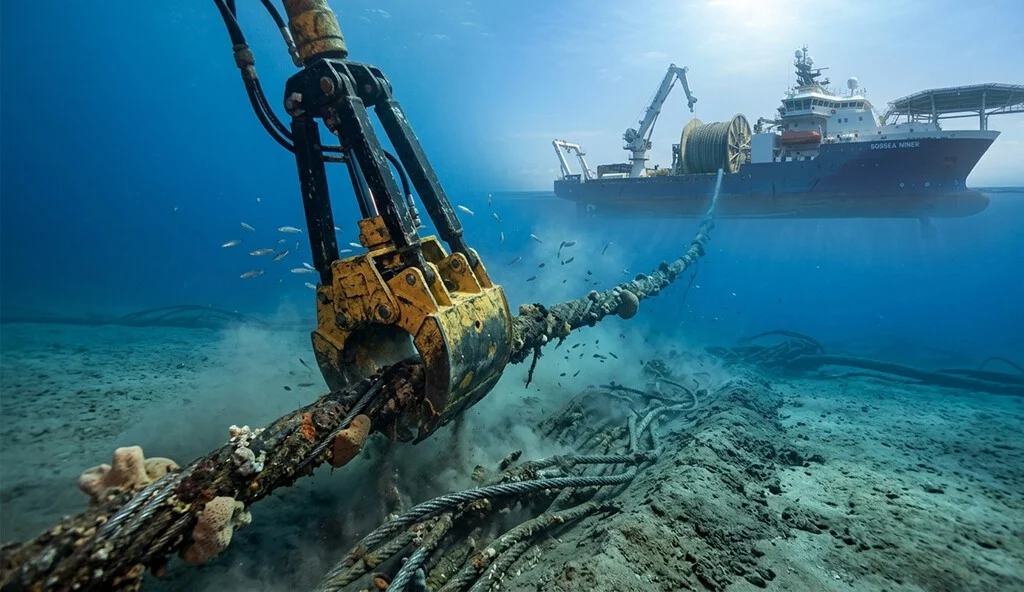

While much of modern discourse revolves around the omnipresent "cloud," the tangible backbone of our interconnected world lies far beneath the ocean’s surface: a vast, intricate network of submarine cables. This global infrastructure, currently spanning over 1.5 million kilometers across the planet’s oceans, is responsible for transmitting more than 99% of the world’s digital data traffic. It is a testament to human ingenuity, facilitating everything from international commerce and communication to social media interactions and scientific research. However, this indispensable network faces a silent, growing challenge: the finite lifespan of its components, leading to an accumulating "invisible landfill" on the seabed. Yet, within this environmental dilemma, a nascent industry is discovering a hidden economic opportunity.
The Indispensable Lifelines of the Digital Age
The concept of transoceanic communication is not new, tracing its origins back to the mid-19th century with the first transatlantic telegraph cables. These early ventures, fraught with technical challenges and immense costs, laid the groundwork for today’s high-capacity fiber optic networks. Modern submarine cables are marvels of engineering, designed to withstand the extreme pressures and corrosive environments of the deep sea. Typically, they are composed of multiple layers: an inner core of hair-thin optical fibers, protected by copper conductors (for power transmission to repeaters), petroleum jelly, steel strength members, and an outer sheath of polyethylene. This complex construction ensures both the integrity of the data transmission and the physical resilience against marine hazards.
The scale of this infrastructure is truly staggering. Major routes crisscross the Atlantic and Pacific, connecting continents and driving global economies. For instance, the Marea cable, a joint venture between Microsoft and Facebook (now Meta), stretches 6,600 kilometers across the Atlantic, capable of transmitting 160 terabits per second. Similar colossal projects continuously expand and upgrade the network, reflecting the ever-increasing demand for bandwidth. The International Cable Protection Committee (ICPC), an organization dedicated to promoting cable protection and safeguarding the submarine cable network, estimates that the total length of in-service submarine cables could circle the Earth almost 40 times.
The Finite Lifespan and Causes of Demise
Despite their robust construction, submarine cables are not immortal. Their average operational lifespan is estimated to be around 25 years. This obsolescence is driven by a combination of factors, including technological advancements that render older cables less efficient, material degradation over time, and the sheer demand for greater capacity. As newer, higher-bandwidth cables are laid, older ones become economically unviable to maintain or upgrade, even if physically intact.
However, many cables meet their end prematurely due to a variety of external factors. The ICPC reports that between 100 and 200 cable faults occur globally each year. The vast majority of these incidents are accidental, with human activities being the primary culprit. Fishing trawlers, with their heavy nets and anchors, are frequently cited as the leading cause of damage, especially in shallower coastal waters. Ship anchors, particularly those dragged during storms or in congested shipping lanes, also pose a significant threat. Natural phenomena contribute to a smaller but still impactful percentage of failures, including seismic activity, underwater landslides (turbidity currents), and even marine animals. While tales of sharks biting cables are largely anecdotal in the fiber optic era (as opposed to earlier copper cables), specific instances of marine life interacting with and potentially damaging cables have been documented, such as burrowing crustaceans.
Beyond accidental damage, the geopolitical landscape introduces a more sinister threat: intentional sabotage. In an era of heightened international tensions, the vulnerability of this critical infrastructure has become a significant concern for national security agencies worldwide. The deliberate cutting or disruption of submarine cables could have catastrophic consequences, crippling economies, disrupting military communications, and instigating international crises. While official reports of state-sponsored sabotage are rare, the potential for such acts is a constant undercurrent in strategic planning, as evidenced by increased surveillance and protective measures in contested maritime zones.
The Silent Graveyard Beneath the Waves
When a submarine cable reaches the end of its operational life or becomes irreparably damaged, it is typically abandoned on the seabed. This practice, driven by prohibitive costs and logistical complexities of retrieval, has led to the accumulation of an enormous "invisible landfill" across the world’s oceans. Reports estimate that approximately two-thirds of all submarine cables ever installed in the history of telecommunications are now out of service, lying dormant and slowly degrading on the ocean floor. This represents millions of kilometers of discarded infrastructure, forming a vast, unmanaged waste stream.
The presence of these "zombie cables" is not without consequence. Environmentally, they contribute to marine pollution. Although the core optical fibers are inert, the protective layers, composed of polyethylene plastics and various metals like copper and steel, can degrade over time, leaching materials into the marine environment. While the long-term ecological impact of these specific materials in deep-sea environments is still being studied, concerns exist regarding potential interference with sensitive ecosystems, disruption of benthic habitats, and the introduction of microplastics. Furthermore, abandoned cables can physically interfere with the laying of new cables, creating logistical challenges and increasing costs for future infrastructure projects.
The decision to leave defunct cables in place is primarily economic. The cost of recovering a submarine cable, particularly one lying in deep waters, can be astronomical. It requires specialized vessels, sophisticated underwater robotics, and highly trained personnel, resources that are scarce and expensive. The process is also time-consuming and energy-intensive. As an illustration of this dilemma, a pioneering fiber optic submarine cable, installed 40 years ago and decommissioned in 2002, was recently extracted. Despite serving only 14 years, it lay unused for 24 years before the costly decision was made to remove it—a decision often made only when a new cable route absolutely requires clearing the old one, or when the salvage value becomes exceptionally high. For most defunct cables, the financial equation simply does not favor retrieval, condemning them to an indefinite resting place.
The Rise of Submarine Cable Recycling: A Hidden Business Opportunity
Despite the challenges, a niche but growing industry is emerging to address the problem of discarded submarine cables: deep-sea recycling. Companies are increasingly recognizing the inherent value in these underwater relics, transforming what was once considered waste into a valuable resource. The primary driver behind this shift is the escalating global demand for raw materials, particularly copper. With copper prices soaring due to its critical role in electrification, renewable energy, and digital technologies, the metallic core of these cables represents a significant economic incentive for recovery.
Companies like Subsea Environmental Services and Mertech Marine have positioned themselves as pioneers in this specialized field, effectively becoming the "scrappers of the sea." Their operations involve deploying specialized vessels equipped with advanced retrieval systems to locate, cut, and hoist defunct cables from the ocean floor. Once onboard, the cables are brought to onshore processing facilities where the various materials are meticulously separated. The copper, steel, and polyethylene are then prepared for recycling, re-entering the supply chain as valuable raw materials.
This "circular economy" approach offers a dual benefit. Economically, it taps into a previously unexploited source of valuable metals, mitigating some of the pressures on traditional mining operations. Environmentally, it provides a solution to marine pollution, reducing the accumulation of man-made debris on the seabed and lessening the potential ecological impact. By transforming what would otherwise be a long-term environmental liability into a sustainable resource, these companies are demonstrating an intelligent strategy for resource management and waste reduction.
Economic and Environmental Imperatives
The economic rationale for submarine cable recycling is becoming increasingly compelling. A typical deep-sea fiber optic cable contains significant quantities of copper, steel, and high-grade polyethylene. Given the current global commodity markets, the aggregated value of these materials across millions of kilometers of defunct cables represents a substantial, untapped resource. For example, a single kilometer of submarine cable can contain hundreds of kilograms of copper, which, at current market prices, translates into considerable value. The steel can be recycled for various industrial applications, and the polyethylene, a widely used plastic, can be processed for reuse in manufacturing.
Beyond the immediate financial gains from material recovery, there are broader environmental imperatives. The removal of plastic and metallic waste from marine ecosystems contributes directly to ocean health initiatives. As global awareness of plastic pollution and its detrimental effects on marine life grows, the systematic removal of large-scale industrial waste, such as defunct cables, aligns with broader sustainability goals. This practice not only cleans the seabed but also prevents potential future environmental degradation as materials slowly break down over centuries.
Furthermore, the recycling of these materials reduces the demand for virgin resources, thereby decreasing the environmental footprint associated with mining and manufacturing new materials. This contributes to a more sustainable industrial cycle, aligning with principles of resource efficiency and waste minimization.
Geopolitical Dimensions and Future Outlook
The continued reliance on submarine cables underscores their critical geopolitical importance. As the primary arteries of global communication, their security is paramount. The vulnerability to accidental damage and, more critically, intentional sabotage, necessitates ongoing investment in protection, monitoring, and rapid repair capabilities. The "one ship in Africa" scenario, where a single vessel is responsible for repairing cables that connect an entire continent, highlights the fragility of this infrastructure in certain regions and the need for greater redundancy and resources.
Looking ahead, the future of submarine cables will likely involve a multi-faceted approach. Technologically, advancements in materials science may lead to even more durable and environmentally benign cable designs, while sophisticated monitoring systems could provide early warnings of potential damage. Operationally, there will be an increasing emphasis on proactive maintenance, rapid repair capabilities, and strategic redundancy in cable routes to mitigate the impact of outages.
From a policy perspective, international cooperation will be crucial. Developing standardized regulations for cable disposal, promoting sustainable end-of-life management, and fostering a global framework for recycling will be essential. Governments and international bodies like the United Nations and the ICPC are increasingly recognizing the need for concerted action to manage this vital, yet vulnerable, infrastructure throughout its entire lifecycle—from deployment to responsible decommissioning and recycling.
In conclusion, the vast network of submarine cables, while a triumph of modern engineering, presents a complex challenge at the end of its operational life. The accumulation of defunct cables on the ocean floor represents both an environmental concern and a logistical puzzle. However, the emergence of a specialized recycling industry offers a promising solution, transforming submerged waste into valuable resources. This innovative approach not only addresses the environmental legacy of our digital age but also provides a sustainable pathway for resource recovery, highlighting the intricate balance between technological progress, environmental stewardship, and economic ingenuity in our increasingly interconnected world.
