
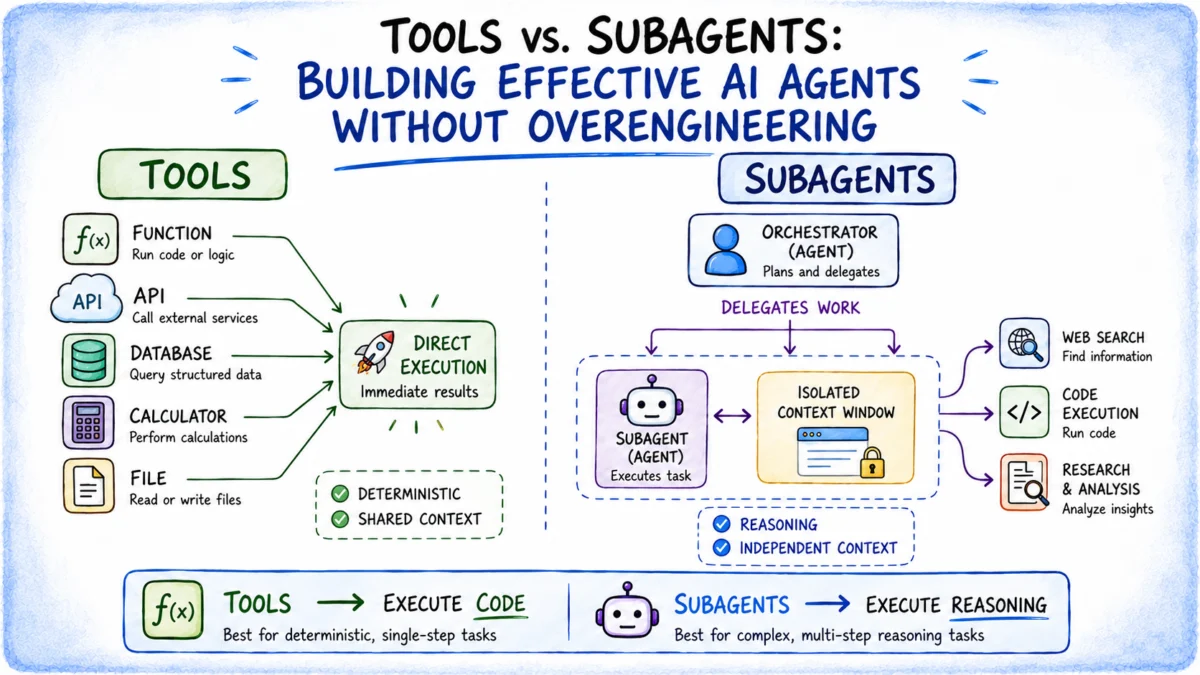

The proliferation of advanced AI models has ushered in an era where AI agents are no longer confined to academic research but are becoming integral components of real-world applications. As developers harness the power of Large Language Models (LLMs) to create sophisticated agents capable of autonomous decision-making and action, a critical architectural challenge emerges: discerning whether a specific piece of agent functionality should be implemented as a direct tool call or delegated to an independent subagent. This decision, often overlooked in initial prototyping, carries significant implications for an agent’s efficiency, cost, scalability, and maintainability, potentially leading to either a streamlined, powerful system or an overengineered, cumbersome one.
The Evolving Landscape of AI Agent Architectures
The journey of AI agent development has seen rapid evolution. Initially, LLMs were primarily used for text generation and understanding. The concept of an "agent" emerged as developers sought to imbue these models with the ability to perform multi-step tasks, interact with external systems, and adapt to dynamic environments. This necessitated the integration of tools, allowing LLMs to transcend their textual confines and execute concrete actions in the digital world. Tools, in this context, are essentially wrappers around external functions—API calls, database queries, file operations, or calculations—that the LLM can invoke based on its reasoning.
However, as tasks grew more complex, and the limitations of a single, monolithic agent managing a vast array of tools within a single context window became apparent, the idea of hierarchical or multi-agent systems gained traction. This led to the introduction of "subagents"—smaller, specialized agents, often LLM-powered themselves, designed to handle specific subtasks independently. This architectural shift addresses the challenges of context window bloat, cognitive overload for the main agent, and the need for parallel processing. The choice between a simple tool and a more complex subagent is now a cornerstone decision for any serious AI agent developer.
Understanding AI Agent Tools: The Foundation of Interaction
At its core, an AI agent tool represents a capability that allows the agent to interact with external systems and perform actions beyond its inherent knowledge base. These are typically programmatic interfaces: functions, API endpoints, database access points, web search utilities, or file system operations. When an agent decides to use a tool, it’s essentially calling a predefined piece of code.
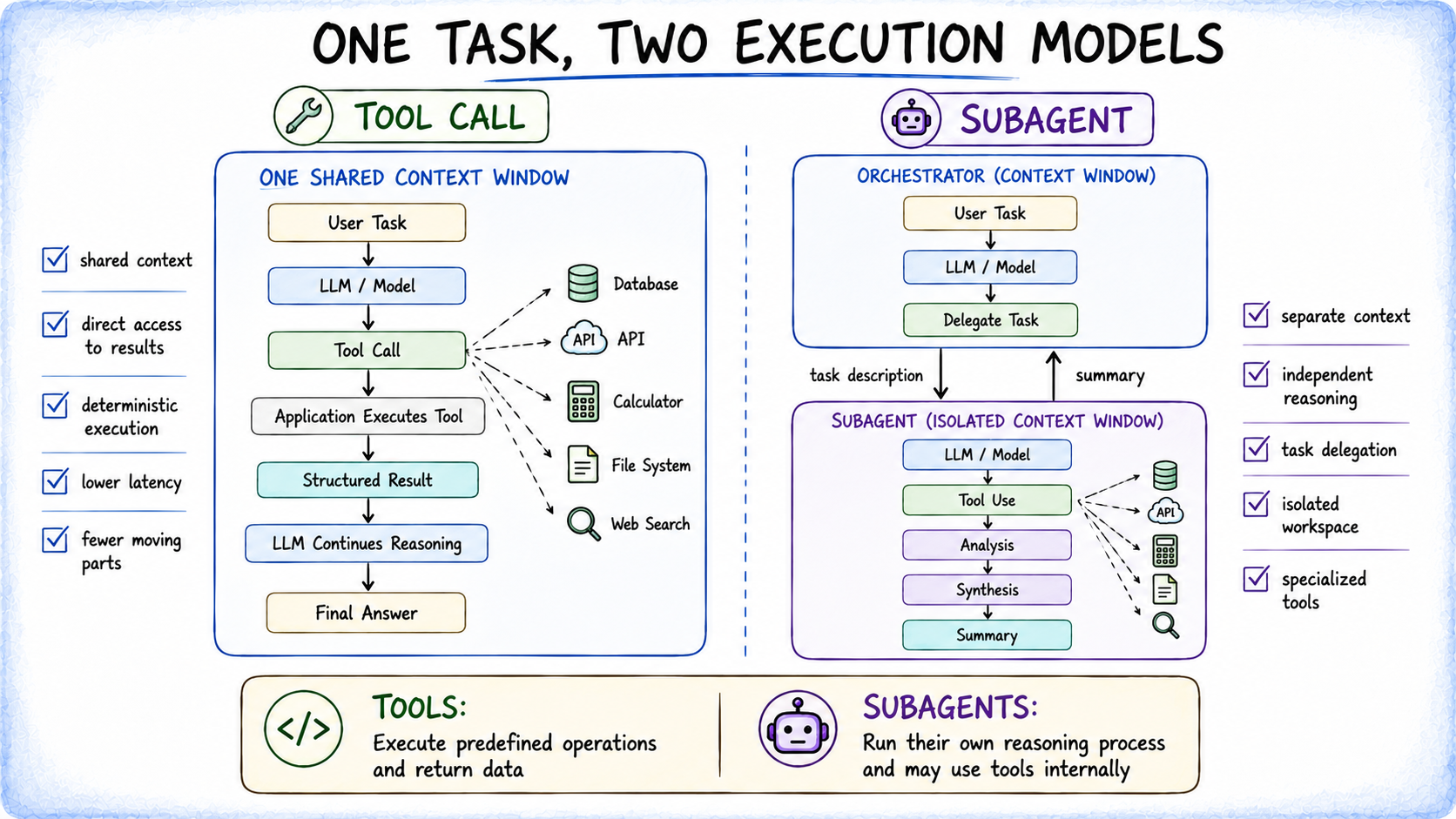
A typical tool interaction unfolds predictably: the agent, after analyzing its current task and context, determines that an external action is required. It then selects the appropriate tool, formats the necessary inputs (often guided by a schema provided to the LLM), and executes the tool. The tool performs its specific operation—say, fetching a user record from a CRM, posting a message to a communication platform, or executing a complex financial calculation—and returns a deterministic output. This output is then fed back into the orchestrating agent’s context window, allowing the LLM to interpret the result and continue its reasoning process.
The critical distinction here is that tools do not perform reasoning themselves. They are executors. They run predefined operations and return data. The intelligence, planning, interpretation, and subsequent decision-making around these operations remain entirely within the domain of the orchestrating LLM. This makes tools incredibly efficient, deterministic, and generally inexpensive. Because they are direct function calls, their latency is typically low, and their behavior is predictable, simplifying debugging and error handling within the orchestrator’s loop. Examples abound: querying a vector database for relevant documents, performing a sentiment analysis on a piece of text using a dedicated NLP library, or even generating an image via a stable diffusion API. If a task can be encapsulated into a well-defined function with clear inputs and outputs, and does not require iterative decision-making, it is a strong candidate for a tool.
Deconstructing Subagents: Orchestrating Complex AI Workflows
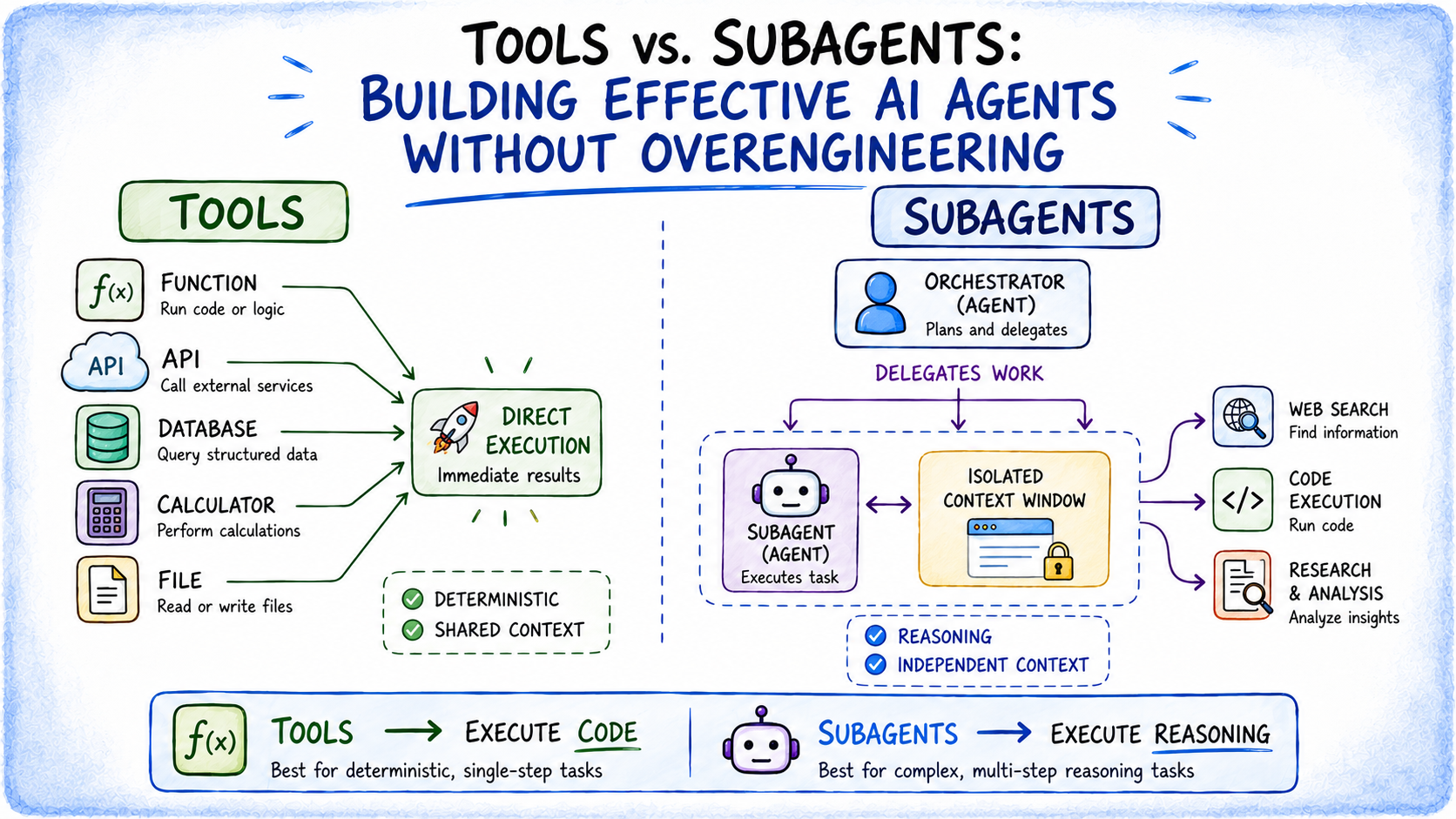
In contrast to tools, a subagent is a separate, often independent, AI agent instance. It typically possesses its own dedicated LLM call, its own system prompt, an isolated context window, and frequently, its own specialized set of tools. When an orchestrating agent delegates a task to a subagent, it’s not just calling a function; it’s entrusting a portion of the reasoning process to another autonomous entity.
From the orchestrator’s perspective, the interaction might superficially resemble a tool call: a task is sent, and a result is received. However, the internal mechanics are vastly different. The subagent, upon receiving its assignment, initiates its own multi-step reasoning loop. It might consult its own internal knowledge, make its own tool calls (using its specialized toolset), manage its own state, and iteratively refine its understanding and actions to fulfill the delegated task. The orchestrator has no direct visibility into these intermediate steps; it only receives a summarized conclusion or a final output once the subagent deems its task complete.
This architectural pattern is particularly powerful for complex, multi-faceted problems. Consider a "research subagent" tasked with "analyzing the competitive landscape for a new product." This task isn’t a single API call. It involves multiple web searches, reading and synthesizing information from various sources, identifying key trends, and structuring a comprehensive report. Each of these steps requires independent reasoning and decision-making that would quickly overwhelm the context window of a single orchestrating agent. By delegating this to a subagent, the orchestrator’s context remains clean and focused on the higher-level goal, while the subagent handles the granular, iterative work. Furthermore, subagents enable parallel execution, allowing multiple complex tasks to be processed concurrently, significantly speeding up overall system performance. This is a foundational principle behind frameworks like Microsoft’s AutoGen, which excels at coordinating specialized agents working in parallel.
The Critical Distinction: Tools vs. Subagents – A Comparative Analysis
The fundamental difference lies in what executes: tools execute code, while subagents execute reasoning. This distinction ripples through various operational and architectural aspects, as summarized below:
- Execution Mechanism: Tools are direct calls to your code (e.g., Python functions, API endpoints). Subagents involve an additional LLM inference cycle, meaning another instance of an LLM is processing prompts and generating responses.
- Context Management: Tool results are directly integrated into the orchestrator’s context window, allowing for immediate, seamless follow-up reasoning. Subagents operate with an isolated, fresh context, preventing their intermediate steps from polluting the orchestrator’s working memory. This isolation is crucial for maintaining focus and preventing "context drift" in complex tasks.
- Reasoning Capability: Tools are devoid of reasoning; they are purely deterministic executors. Subagents possess full, multi-step reasoning capabilities, allowing them to adapt, explore, and iteratively solve problems.
- Error Handling: Errors in tool execution (e.g., bad API schema, network failure) are typically structured and returned to the orchestrator, which can then decide on a retry or alternative strategy within its existing reasoning loop. Subagents, being autonomous, are expected to handle many errors internally or surface only high-level failures to the orchestrator, potentially adding a layer of abstraction to debugging.
- Cost Implications: Tools incur only the execution cost of the underlying code (e.g., database query cost, API call fee). Subagents, however, introduce the significant cost of additional LLM calls, which can quickly escalate given the per-token pricing models of most advanced LLMs.
- Latency Profile: Tool calls are generally low-latency, often completing in milliseconds, as they are direct function executions. Subagents, requiring a full LLM inference cycle, introduce higher latency, typically in the range of seconds, depending on the model and task complexity.
- Visibility and Debuggability: The orchestrator has full visibility into tool results, which are directly present in its context, making debugging straightforward. Subagent’s internal reasoning steps are opaque to the orchestrator, making debugging delegated tasks more challenging, as only the final summary is observed.
- Failure Modes: Tools might fail due to incorrect arguments, API errors, or schema mismatches. Subagents can fail due to LLM hallucinations, loss of context within their own reasoning loop, or coordination failures with the orchestrator.
The choice, therefore, is not merely semantic but deeply practical, influencing the performance, cost-effectiveness, and reliability of the entire AI system.
Strategic Deployment: When to Leverage Each Approach
The decision framework for tools versus subagents can be distilled into three primary questions:
-
Is the task primarily execution or reasoning?
If a task is well-defined, has predictable inputs and outputs, and can be achieved through a single, deterministic operation, a tool is almost always the superior choice. This encompasses actions like calling an external API (e.g., fetching weather data, sending an email), transforming or validating data (e.g., regex matching, unit conversion), reading/writing files, or performing a specific search (e.g., a SQL query or a vector database lookup). Leading AI development frameworks often provide robust tooling for these scenarios, reflecting industry consensus on their efficiency.
Conversely, if the task requires exploration, analysis, synthesis, or a sequence of decisions where each step influences the next, it is a prime candidate for a subagent. Examples include generating complex code, conducting multi-source research, performing iterative data analysis, or strategic planning. -
Does the intermediate work matter to the orchestrator?
Tool results are typically concise and immediately useful within the orchestrator’s context—a single JSON response, a boolean flag, or a numerical value. They augment the orchestrator’s understanding without cluttering its thought process.
However, if a task generates substantial intermediate data—multiple search results, extensive document excerpts, iterative code compilation logs, or detailed analysis steps—this information would introduce significant "noise" into the orchestrator’s context window. This noise can degrade the orchestrator’s performance, leading to distractions or reduced focus. A subagent, by isolating this verbose process and returning only a distilled conclusion, keeps the orchestrator’s reasoning clean and efficient. -
Can the task run independently or in parallel?
A tool executes synchronously as part of the orchestrator’s current workflow, returning a result before the orchestrator proceeds. This sequential nature is fine for simple, quick operations.
When a task can be delegated, executed autonomously, or run concurrently with other tasks, a subagent becomes highly advantageous. This is particularly relevant for scenarios involving processing multiple documents simultaneously, researching several distinct topics, or coordinating specialized workflows where different types of expertise are needed. The ability to parallelize complex tasks across multiple subagents can dramatically reduce overall execution time and enhance system throughput.
Navigating the Overengineering Trap: Simplicity as a Virtue
One of the most common pitfalls in designing AI agent systems is the premature introduction of subagents. While the allure of modularity and specialized agents is strong, every subagent adds inherent complexity. Each subagent introduces:
- Another LLM call: Increasing both monetary cost and latency.
- Another context window: Requiring careful management of input and output.
- Another reasoning loop: Adding more potential points of failure and unpredictable behavior.
- Additional coordination overhead: Demanding clear communication protocols and error handling between agents.
In many scenarios, a thoughtfully designed tool can accomplish the task with far less overhead. If a task can be distilled into a deterministic function—an API call, a database query, or a simple calculation—shoehorning it into a subagent creates unnecessary complexity without providing commensurate value. Industry leaders and framework developers consistently advocate for starting simple. The "default to tools" philosophy suggests that subagents should only be introduced when tools demonstrably fail to meet a specific architectural requirement, such as managing context window limitations, enabling parallel processing, or isolating truly complex, multi-step reasoning.
The crucial question developers must continually ask themselves is: "What concrete architectural advantage does this subagent actually provide?" If the answer isn’t a clear justification related to complex reasoning, parallelization, or context isolation, then a tool is likely the more robust and cost-effective solution.
The Art of Handoffs: Ensuring Effective Multi-Agent Communication
When subagents are deemed necessary, the quality of communication between the orchestrator and its subagents becomes paramount. Unlike tool calls, which rely on typed inputs and structured outputs, subagent interactions often involve natural language tasks and summarized conclusions. This necessitates clear, unambiguous handoffs.
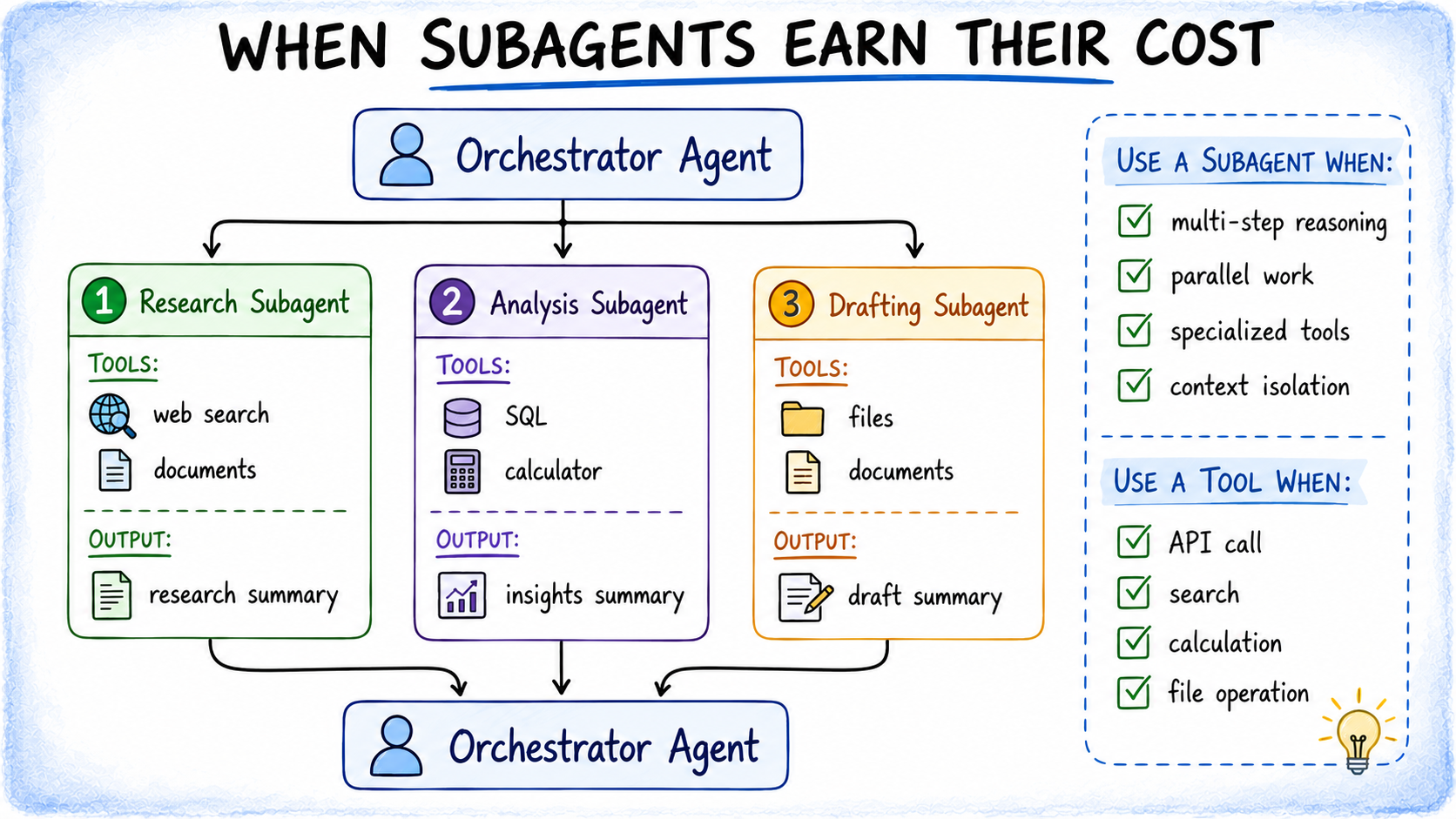
The orchestrator must define the task for the subagent with sufficient clarity and context for the subagent to operate independently, without inheriting the orchestrator’s entire historical conversation or implicit assumptions. Similarly, the subagent must return a concise, actionable summary of its findings, rather than a verbose log of its internal steps. For instance, a research subagent might return: "Identified three key competitors, summarizing their market share, core offerings, and strategic advantages." It should not return every search query, every document excerpt, or every intermediate thought process.
This "pass tasks down; pass conclusions back up" contract offers dual benefits: it prevents the orchestrator’s context from being polluted with extraneous information, and it significantly improves the debuggability and maintainability of the multi-agent system. Clear responsibilities and well-defined output formats for each subagent ensure that the system remains coherent and comprehensible, mitigating the complexities inherent in distributed AI architectures. Systems that allow subagents to share mutable state or return partial results mid-task often introduce intractable coordination challenges that quickly outweigh any perceived benefits.
Future Implications and Evolving Architectures
The strategic choice between tools and subagents is not static; it will continue to evolve as AI capabilities advance. We are already seeing trends towards more sophisticated agentic frameworks that offer adaptive tool use, where agents can dynamically discover and integrate new tools. Hierarchical agent systems, with multiple layers of orchestration and sub-orchestration, are also becoming more prevalent for tackling grander challenges. The ability to make informed architectural decisions today will directly influence the scalability, cost-efficiency, and overall success of AI applications tomorrow.
Developers and architects must cultivate a nuanced understanding of these paradigms, prioritizing simplicity and efficiency wherever possible, and embracing the power of modularity only when truly necessitated by task complexity. This disciplined approach will be key to unlocking the full potential of AI agents, transforming them from novel curiosities into indispensable components of our digital infrastructure.
Conclusion
The architectural decision of whether to employ a tool or a subagent is a pivotal one in the design of effective AI agent systems. While tools offer deterministic execution, speed, and cost-efficiency for well-defined operations, subagents provide critical multi-step reasoning, context isolation, and parallel processing capabilities for complex, ambiguous tasks. Defaulting to tools for straightforward actions and introducing subagents only when a clear architectural advantage is presented guards against the common trap of overengineering. By understanding their distinct roles, costs, and benefits, developers can build robust, scalable, and intelligent AI agents that perform optimally without incurring unnecessary complexity or expense, ensuring the continued advancement and practical deployment of AI technologies.
