

The "What’s Next with AWS" event today served as a pivotal platform for Amazon Web Services to unveil a suite of advanced agentic AI solutions and announce a significant expansion of its strategic partnership with OpenAI, fundamentally reshaping how businesses leverage artificial intelligence. Key executives, including AWS CEO Matt Garman, SVP Amazon Applied AI Solutions Colleen Aubrey, CMO of AWS Julia White, and leaders from OpenAI, converged to discuss the transformative impact of agentic AI on enterprise operations, marking a definitive shift towards autonomous and intelligent systems across various business functions. The event underscored AWS’s commitment to delivering cutting-edge AI capabilities, integrating them deeply into enterprise workflows, and fostering an ecosystem of innovation through strategic collaborations.
The Strategic Imperative: Agentic AI at the Forefront
The "What’s Next with AWS" event, typically a forum for major product announcements and strategic updates, highlighted the burgeoning importance of agentic AI as the next frontier in enterprise technology. Agentic AI refers to intelligent systems capable of perceiving their environment, making decisions, and taking actions autonomously to achieve specific goals, often interacting with other systems and humans. This represents an evolution from traditional AI, which primarily focuses on predictive analytics or automation of discrete tasks, towards more holistic and proactive intelligence.
Matt Garman, CEO of AWS, in his opening remarks, likely emphasized the strategic vision behind AWS’s aggressive push into agentic AI. "Our customers are consistently seeking ways to unlock greater efficiency, foster innovation, and deliver unparalleled experiences," Garman might have stated. "Agentic AI is not just about automating tasks; it’s about empowering businesses with intelligent partners that learn, adapt, and act on their behalf, allowing human talent to focus on strategic initiatives and creativity. This is the future of work, and AWS is building the foundational technologies and applications to make it a reality for every enterprise." This sentiment reflects a broader industry trend where businesses are moving beyond simple automation to deploy intelligent systems that can orchestrate complex workflows and respond dynamically to changing conditions. The market for AI in enterprises is projected to grow significantly, with agentic AI expected to play a crucial role in driving this expansion, particularly in areas requiring autonomous decision-making and dynamic resource allocation.
Amazon Quick: The Personalized AI Assistant for Work
At the heart of the announcements was Amazon Quick, a new AI assistant designed to connect seamlessly across an enterprise’s disparate applications, learn individual user preferences and priorities, and proactively take action on their behalf. Positioned as a comprehensive digital aide, Amazon Quick aims to streamline daily operations and enhance productivity for knowledge workers.
Starting today, Amazon Quick is available with a new dedicated desktop application, signaling AWS’s intent to embed this assistant directly into the daily workflow of professionals. The introduction of Free and Plus pricing plans makes the technology accessible to a broader range of users, from individual professionals to large enterprises, fostering widespread adoption. A standout feature announced is the ability to generate visual assets directly within the chat interface, transforming how users interact with and create content. This capability, powered by advanced generative AI models, allows for rapid prototyping of images, presentations, or marketing materials, significantly reducing the time and effort traditionally required for such tasks. Furthermore, AWS announced enhanced connectivity options, enabling Quick to integrate with an even wider array of third-party applications and services, making it a true central nervous system for digital work.
Colleen Aubrey, SVP Amazon Applied AI Solutions, likely highlighted Quick’s transformative potential. "In today’s fast-paced business environment, employees are often overwhelmed by the sheer volume of information and the need to juggle multiple applications," Aubrey might have observed. "Amazon Quick is designed to cut through that complexity. By intelligently connecting to all your tools, understanding your context, and anticipating your needs, Quick acts as a force multiplier, freeing up valuable time and cognitive load. Imagine an assistant that not only retrieves information but also drafts responses, schedules meetings, analyzes data, and even creates visuals—all based on a simple natural language prompt."
The initial launch is further bolstered by an update on April 29th, which introduced a new Quick feature enabling users to build custom applications using natural language. This significant enhancement allows non-technical users to tailor Quick’s capabilities to specific business processes or departmental needs without writing a single line of code, democratizing application development and accelerating digital transformation within organizations. This low-code/no-code approach, powered by natural language, aligns with a broader industry trend of making complex AI tools accessible to a wider audience, thereby fostering greater innovation at the operational level.
Amazon Quick enters a competitive landscape populated by other enterprise AI assistants such as Microsoft Copilot and Google Gemini for Workspace. However, AWS aims to differentiate Quick through its deep integration with the AWS ecosystem, its focus on cross-application connectivity, and its unique ability to learn and adapt to individual user behavior, offering a highly personalized and proactive assistant experience. The success of Quick will depend on its ability to demonstrate tangible productivity gains and seamless integration across diverse enterprise software stacks.
Amazon Connect Expands into Specialized Agentic AI Solutions
Building on the success of its cloud contact center service, Amazon Connect is undergoing a significant strategic evolution, expanding from a single product into a comprehensive suite of four specialized agentic AI solutions. These solutions are meticulously designed to integrate within existing workflows across critical business functions, bringing intelligent automation and decision support to new domains. This expansion underscores AWS’s strategy to move beyond general-purpose AI tools and offer industry-specific, highly tailored solutions that address unique challenges.
The four new agentic AI solutions under the Amazon Connect umbrella are:
- Amazon Connect Decisions (Supply Chains): This solution is engineered to optimize complex supply chain operations. In an era marked by increasing supply chain volatility and global disruptions, Connect Decisions can analyze vast datasets—including inventory levels, logistics, supplier performance, and demand forecasts—to make proactive, intelligent recommendations. It can automate order placement, optimize routing, predict potential disruptions, and suggest mitigation strategies, transforming reactive supply chain management into a predictive and adaptive system. The global supply chain management market, valued at hundreds of billions, presents a massive opportunity for AI-driven optimization, promising efficiency gains and resilience.
- Amazon Connect Talent (Hiring): Addressing the persistent challenges in talent acquisition and management, Connect Talent leverages AI to streamline the hiring process. From intelligent candidate sourcing and screening to interview scheduling and personalized candidate communication, this solution aims to improve the efficiency and fairness of recruitment. It can analyze resumes, assess cultural fit based on various data points, and even help craft job descriptions, enabling HR teams to identify the best candidates more quickly and reduce time-to-hire. With the global talent acquisition technology market experiencing significant growth, AI’s role in refining recruitment processes is becoming indispensable.
- Amazon Connect Customer (Customer Experience): This solution enhances the core strengths of Amazon Connect, focusing on elevating customer interactions. Beyond traditional contact center functionalities, Connect Customer integrates agentic AI to provide proactive support, personalize customer journeys, and resolve issues more efficiently. It can anticipate customer needs, suggest relevant products or services, and automate routine inquiries, allowing human agents to focus on complex, high-value interactions. This directly addresses the growing demand for seamless, personalized customer experiences, which is a key differentiator for businesses in competitive markets.
- Amazon Connect Health (Health Care): Tailored specifically for the highly regulated and complex healthcare industry, Connect Health aims to improve patient care coordination, administrative efficiency, and overall healthcare delivery. This solution can assist with appointment scheduling, patient intake, managing electronic health records (EHRs), and providing intelligent support for healthcare professionals. It can also help process insurance claims and ensure compliance with healthcare regulations, alleviating administrative burdens and allowing medical staff to dedicate more time to patient care. The application of AI in healthcare is a rapidly expanding field, projected to reach hundreds of billions in value, driven by the need for efficiency, accuracy, and improved patient outcomes.
Julia White, CMO of AWS, likely emphasized the strategic value of these verticalized solutions. "Businesses today are not just looking for generic AI; they need intelligent solutions that understand the nuances of their specific industry and workflows," White might have commented. "With the expansion of Amazon Connect into these four distinct agentic AI solutions—Decisions, Talent, Customer, and Health—we are delivering highly specialized, powerful tools that integrate directly into existing processes. This isn’t just about automation; it’s about intelligent orchestration, enabling businesses to unlock unprecedented levels of efficiency, innovation, and strategic advantage across their most critical functions." The expansion represents a clear move by AWS to capture market share in specific enterprise verticals by offering purpose-built AI agents.
AWS and OpenAI Expand Partnership: Unlocking Frontier Intelligence on Trusted Infrastructure
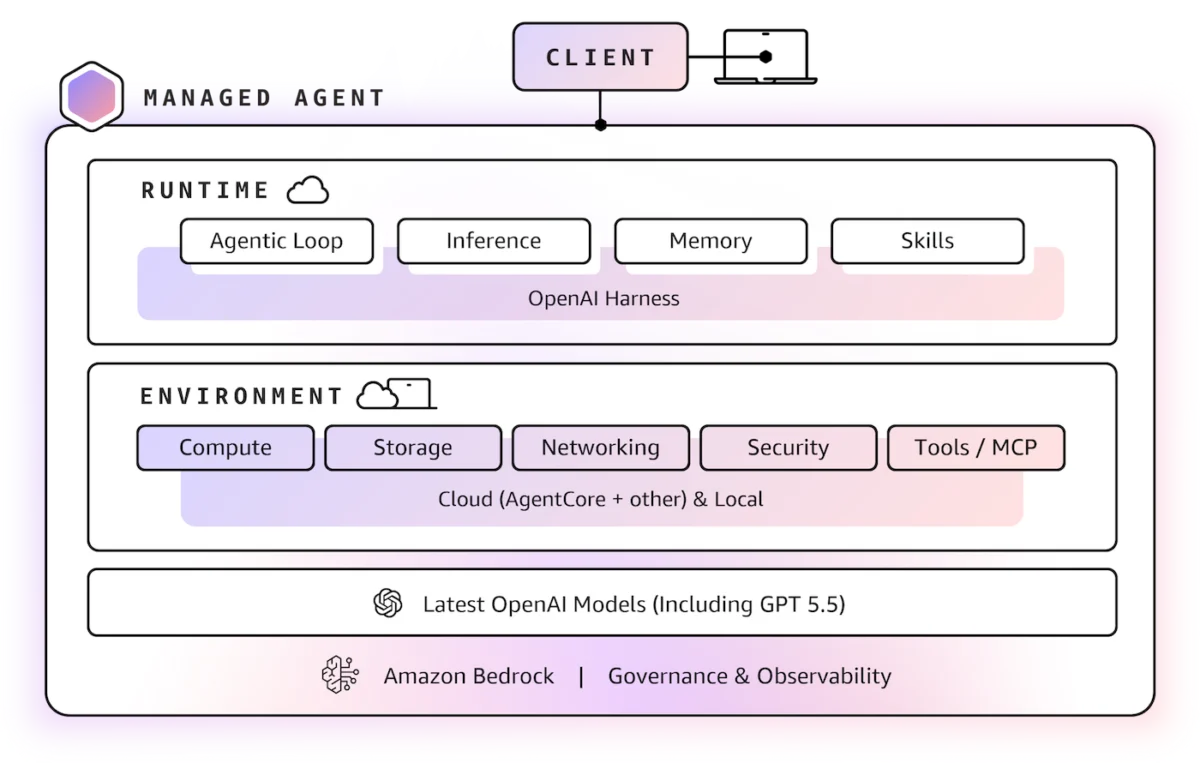
Perhaps one of the most significant announcements of the event was the expanded partnership between AWS and OpenAI. This collaboration aims to bring the latest frontier intelligence from OpenAI directly to enterprises leveraging AWS’s robust and secure infrastructure through Amazon Bedrock. This partnership addresses a critical need for businesses seeking access to cutting-edge AI models while maintaining enterprise-grade security, scalability, and control.
The expanded partnership includes several key components, all initially available in limited preview:

- Bringing Latest OpenAI Models to Amazon Bedrock: AWS will integrate OpenAI’s most advanced and powerful models into Amazon Bedrock, its fully managed service that provides access to foundation models (FMs) from leading AI companies. This means enterprises can now access OpenAI’s state-of-the-art generative AI models alongside offerings from Amazon, Anthropic, Stability AI, and others, all through a unified API and a secure AWS environment. This significantly simplifies the process for developers to experiment with and deploy various FMs, accelerating innovation without the overhead of managing complex infrastructure.
- Launching Codex on Amazon Bedrock: Codex, OpenAI’s powerful AI system that translates natural language into code, will also be made available on Amazon Bedrock. This is a game-changer for software development, enabling developers to write code more efficiently, automate routine coding tasks, and even generate entire applications from simple natural language descriptions. The availability of Codex on Bedrock provides a secure and scalable platform for enterprises to leverage this advanced coding assistant, fostering faster development cycles and innovation.
- Launching Amazon Bedrock Managed Agents, Powered by OpenAI: This offering is perhaps the most direct embodiment of agentic AI within the partnership. Amazon Bedrock Managed Agents, powered by OpenAI, will allow enterprises to build and deploy sophisticated AI agents that can perform multi-step tasks, interact with enterprise systems, and automate complex workflows. These agents, built on OpenAI’s advanced models, will operate within the secure and governed environment of Amazon Bedrock, giving businesses the "frontier intelligence they want on the infrastructure they trust." This feature significantly lowers the barrier to entry for developing and deploying sophisticated AI agents that can tackle real-world business challenges, from customer service automation to data analysis and operational optimization.
An AWS spokesperson, commenting on the collaboration, stated, "Our expanded partnership with OpenAI is a testament to our commitment to providing customers with the broadest and deepest set of AI capabilities. By bringing OpenAI’s cutting-edge models and agentic capabilities to Amazon Bedrock, we are empowering enterprises to leverage the very best of generative AI and agentic systems, all within the secure, scalable, and reliable infrastructure they have come to expect from AWS."
Leaders from OpenAI likely echoed this sentiment, emphasizing the benefits of reaching a broader enterprise audience through AWS. "Partnering with AWS allows us to extend the reach of our advanced AI models to a vast ecosystem of enterprise customers who prioritize robust infrastructure and comprehensive management tools," an OpenAI representative might have commented. "The integration of our models, including Codex and the power behind Bedrock Managed Agents, on AWS’s trusted platform will accelerate the adoption of transformative AI capabilities across industries, enabling businesses to innovate faster and more securely."
This expanded partnership holds significant implications for the AI market. For AWS, it strengthens Bedrock’s position as a leading platform for accessing a diverse range of FMs, making it even more attractive to enterprises. For OpenAI, it provides a crucial avenue for enterprise adoption and deployment of its models, particularly for businesses that prefer cloud-agnostic solutions or have existing investments in AWS. The availability of Managed Agents powered by OpenAI on Bedrock also signals a fierce competition in the agentic AI space, with major cloud providers vying to offer the most capable and integrated solutions. The "limited preview" status indicates a phased rollout, allowing AWS and OpenAI to gather feedback and refine the offerings before general availability, ensuring robustness and meeting enterprise demands.
Broader Impact and Future Outlook
The announcements from the "What’s Next with AWS" event collectively paint a clear picture of AWS’s strategic direction: a comprehensive push into agentic AI across all layers of its cloud offerings, from foundational models to specialized applications. The introduction of Amazon Quick, the expansion of Amazon Connect into verticalized agentic solutions, and the deepened partnership with OpenAI underscore a concerted effort to make intelligent, autonomous systems an integral part of enterprise operations.
The implications for businesses are profound. The advent of agentic AI promises not only increased efficiency and automation but also a fundamental shift in how work is performed. Employees will increasingly collaborate with AI agents, delegating routine tasks and leveraging AI’s analytical power to make more informed decisions. This transition will necessitate new skills, revised workflows, and a strategic embrace of AI at every level of an organization.
From a competitive standpoint, AWS is positioning itself as a central player in the rapidly evolving agentic AI landscape. By offering both its own proprietary solutions and integrating leading third-party models like OpenAI’s, AWS aims to provide unparalleled choice and flexibility for enterprises. This strategy is likely to intensify competition among cloud providers and AI developers, driving further innovation and accelerating the pace of AI adoption globally. The market for agentic AI is still in its nascent stages but is projected to grow exponentially as enterprises recognize the transformative potential of systems that can not only process information but also act intelligently upon it.
Looking ahead, the announcements from "What’s Next with AWS" signify a critical inflection point in the journey of enterprise AI. As these agentic solutions move beyond limited preview and become more widely available, they are poised to revolutionize industries ranging from manufacturing and logistics to healthcare and customer service. The future of business will increasingly be defined by intelligent automation and the seamless collaboration between human and artificial intelligence, with AWS playing a pivotal role in shaping this new era. The focus on integrating these capabilities into existing workflows and providing flexible access to frontier models reflects a mature understanding of enterprise needs, paving the way for a more intelligent, efficient, and innovative global economy.
