

True Anomaly, the Colorado-based aerospace and defense technology firm, announced on Tuesday that it has successfully closed a $650 million Series D funding round, marking a significant milestone in the company’s rapid ascent within the national security space sector. This latest infusion of capital, co-led by Eclipse and Riot Ventures, is earmarked for an aggressive expansion of the company’s workforce and the industrial scaling of its "space superiority" product lines. The round, which includes $50 million in debt financing provided by Stifel Bank, brings True Anomaly’s total capital raised to more than $1 billion since its founding.
The participation in this round reflects a broad base of institutional interest in the intersection of venture capital and defense technology. Joining the lead investors were new participants Paradigm, Atreides, G Squared, The Private Shares Fund, and VanEck. They were joined by a robust cohort of existing backers, including Accel, Menlo Ventures, ACME Capital, Space VC, Meritech Capital, Narya, and 645 Ventures. This level of investment underscores a growing confidence among private investors in the "New Space" defense sector, which seeks to provide the U.S. Department of Defense (DoD) with agile, commercially derived solutions to counter emerging threats in orbit.
Scaling Operations and Workforce Expansion
The primary objective of this Series D round is to provide True Anomaly with the "dry powder" necessary to meet an accelerating demand from the U.S. Space Force and other allied nations. Central to this growth is a massive recruitment drive. As of early 2026, the company employs approximately 300 personnel, a significant increase from the 250 employees reported at the end of 2025. However, the company’s roadmap suggests this is merely the beginning. True Anomaly has stated its intention to increase its headcount to 500 by the end of 2026, with a long-term goal of reaching 1,000 employees by the conclusion of 2028.
To accommodate this workforce and the manufacturing requirements of its hardware, True Anomaly currently operates out of a 140,000-square-foot facility. Company leadership has indicated that they plan to grow this footprint "exponentially" over the next few years. This expansion is necessary to transition from prototype development to the mass production of autonomous orbital vehicles. The ability to produce satellites at scale is a core component of the U.S. Space Force’s shift toward "proliferated" architectures—using many small, inexpensive satellites rather than a few large, expensive ones to ensure resilience against attack.
Even Rogers, co-founder and CEO of True Anomaly, emphasized that the funding is a direct investment in national security. “This capital, as with all of our funding rounds, will be invested entirely in space dominance at scale,” Rogers said in a formal statement. “We will continue to design and deliver the next generation of products the U.S. and its Allies need for space superiority.”
Technical Innovation: The Jackal and Mosaic Platforms
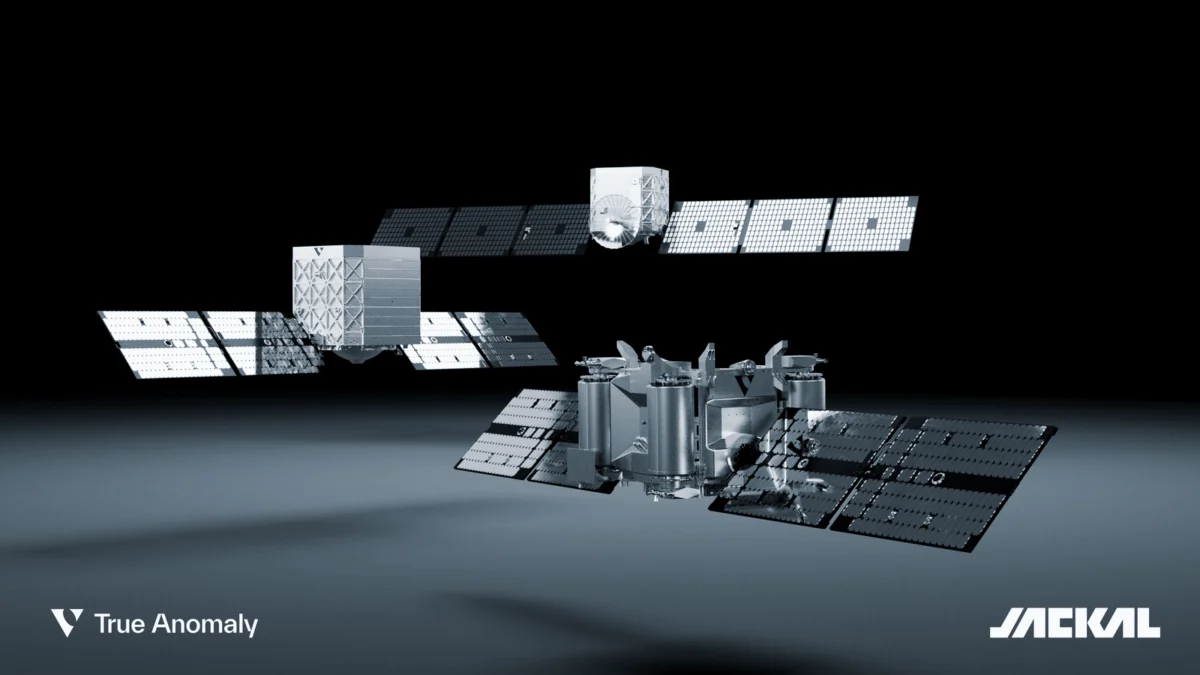
At the heart of True Anomaly’s value proposition is the Jackal autonomous orbiting vehicle (AOV). The Jackal is designed to address a critical gap in current U.S. space capabilities: the ability to perform Rendezvous and Proximity Operations (RPO) with high precision and autonomy. RPO involves one spacecraft approaching another closely to inspect it, interact with it, or monitor its movements.
The Jackal is capable of maneuvering in Low-Earth Orbit (LEO) to conduct persistent surveillance of adversary spacecraft. This "space domain awareness" is vital for identifying whether a foreign satellite is a benign communication tool or a potential weapon. Furthermore, the Jackal serves a unique training role. It can be programmed to replicate the flight patterns and behaviors of adversary spacecraft, allowing U.S. Space Force operators to engage in "live-fire" style training exercises in orbit—a concept known as "aggressor training" that has long been a staple of aerial combat training but is relatively new to the space domain.
Supporting the hardware is True Anomaly’s proprietary software platform, Mosaic. Mosaic acts as the operating system for space superiority, enabling the Jackal to perform complex missions either through direct human command or via high-level autonomous protocols. The integration of Mosaic allows for "tactically responsive space" operations, where a vehicle can be launched and deployed to intercept or observe a target on short notice, reacting to real-time changes in the orbital environment.
Recent Contractual Successes and Government Relations
The timing of the Series D funding coincides with a string of high-profile contract wins from the U.S. government. Just last week, the U.S. Space Force identified True Anomaly as one of 12 companies selected to develop prototype technologies for space-based interceptors. This program represents a major shift in U.S. defense policy, as the military explores active defense mechanisms to protect high-value assets in orbit from physical or electronic interference.
Additionally, earlier this month, True Anomaly was named as one of 14 companies participating in the Andromeda program. Andromeda is a Space Force initiative focused on enhancing space domain awareness (SDA) through the integration of commercial data and advanced sensor platforms. These contracts, alongside other classified and unclassified work, demonstrate that True Anomaly has successfully transitioned from a venture-backed startup to a trusted partner within the defense industrial base.
The company’s ability to secure these contracts is largely attributed to its "Silicon Valley" approach to hardware—iterating quickly, utilizing commercial off-the-shelf components where possible, and prioritizing software-defined capabilities. This contrasts with the traditional "Prime" defense contractors, whose development cycles often span decades and involve significantly higher costs.
Background Context: The Rise of the Contested Domain
The rapid growth of True Anomaly must be viewed through the lens of a changing geopolitical landscape. For decades, space was considered a sanctuary, a domain where satellites operated without fear of interference. However, the emergence of anti-satellite (ASAT) missiles, co-orbital "stalker" satellites, and sophisticated electronic jamming from nations like China and Russia has forced a reevaluation of space security.
The U.S. Department of Defense has officially designated space as a "warfighting domain," similar to land, sea, and air. This designation has led to the creation of the U.S. Space Force and a corresponding increase in funding for technologies that can defend orbital assets. True Anomaly’s focus on "space superiority"—the ability to ensure one’s own freedom of action in space while denying it to an adversary—aligns perfectly with this strategic pivot.
The Jackal vehicle, for instance, addresses the need for "active" space domain awareness. While ground-based radars and telescopes can track objects in orbit, they often lack the resolution to determine a satellite’s intent. By sending a Jackal to perform a close-up inspection, the military can gather high-fidelity intelligence that ground-based systems simply cannot provide.
Industry Analysis and Implications
The $650 million funding round is a watershed moment for the defense tech industry. It signals that the "defense-tech" category—once avoided by mainstream venture capitalists due to long sales cycles and regulatory hurdles—is now one of the most attractive sectors in the market. True Anomaly joins a small but elite group of "defense unicorns," such as Anduril Industries and Palantir, that are successfully challenging the dominance of traditional aerospace giants.
Market analysts suggest that this influx of capital will likely lead to a period of consolidation or intense competition within the SDA and RPO markets. With over $1 billion in total funding, True Anomaly has the financial runway to outpace smaller competitors and potentially acquire niche technology firms to bolster its Mosaic software or sensor capabilities.
Furthermore, the inclusion of debt financing from Stifel Bank indicates that True Anomaly is moving toward a more mature capital structure. While venture equity is used for high-risk research and development, debt is often used to fund predictable growth, such as building out manufacturing facilities or fulfilling existing government contracts. This blend of capital suggests a company that is stabilizing its business model while maintaining its innovative edge.
Chronology of True Anomaly’s Growth
- 2022-2023: True Anomaly is founded by Even Rogers and a team of former military officers and aerospace engineers. The company quickly secures initial seed and Series A funding to develop the Jackal prototype.
- Late 2023: The company unveils the Mosaic software platform and begins testing autonomous maneuvers in simulated environments.
- 2024: True Anomaly expands its footprint in Colorado and secures its first major Space Force contracts for space domain awareness.
- 2025: The company reaches 250 employees and begins preparing for the launch of its first Jackal vehicles into orbit for testing.
- April 2026: True Anomaly is awarded contracts for the Andromeda program and space-based interceptor work.
- Late April 2026: The company announces the $650 million Series D round, bringing total capital to over $1 billion.
Future Outlook
Looking ahead, True Anomaly’s success will depend on its ability to execute its ambitious hiring and manufacturing plans. The aerospace industry is currently facing a talent shortage, particularly for engineers with the high-level security clearances required for defense work. True Anomaly’s plan to add 700 employees over the next three years will be a significant operational challenge.
However, the demand for its products shows no signs of waning. As the U.S. Space Force continues to prioritize "Tactically Responsive Space," the need for readily available, maneuverable vehicles like the Jackal will only increase. If True Anomaly can demonstrate the effectiveness of its Jackal-Mosaic ecosystem in upcoming orbital demonstrations, it may well become the primary provider of space superiority hardware for the Western world.
The broader implication of this funding is a shift in how national security is built. By leveraging private capital to develop cutting-edge defense technology, the U.S. is creating a more resilient and innovative industrial base. True Anomaly stands at the forefront of this movement, representing a new era where the speed of Silicon Valley meets the mission-critical requirements of the Pentagon. As the company scales toward 1,000 employees and expands its fleet of orbiting vehicles, it will remain a central player in the ongoing effort to secure the "high ground" of space.
