
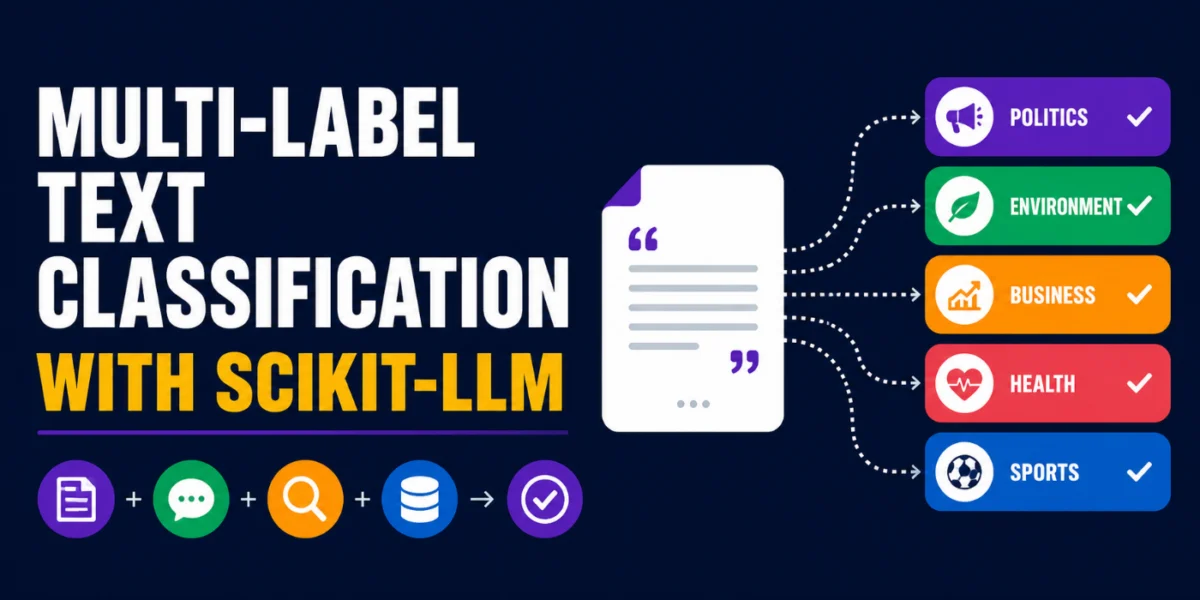

The landscape of natural language processing (NLP) is undergoing a profound transformation, driven by the exponential advancements in large language models (LLMs). This revolution is particularly impactful in complex tasks such as text classification, where the ability to categorize information accurately and efficiently is paramount. Traditionally, developing robust text classifiers, especially for multi-label scenarios, has demanded extensive computational resources, vast quantities of painstakingly labeled training data, and a deep understanding of intricate neural network architectures. However, a new paradigm is emerging, leveraging the inherent reasoning capabilities of LLMs to perform sophisticated classification tasks with unprecedented ease, often requiring no labeled training data at all. This article delves into the innovative methodology of multi-label text classification using LLMs in conjunction with the scikit-LLM library, presenting a practical, zero-shot approach that bypasses the conventional hurdles of model training and data annotation.
The Evolution of Text Classification: From Binary to Nuanced Multi-Labeling
Text classification, at its core, involves assigning predefined categories or labels to textual content. For years, this often meant straightforward binary decisions—a product review is either "positive" or "negative," an email is "spam" or "not spam." As data complexity grew, multi-class classification emerged, allowing a text to belong to one of several distinct categories, such as categorizing news articles into "sports," "politics," or "finance." While these methods have served their purpose, they fall short in capturing the intricate, multifaceted nature of human expression and information.
Consider a customer feedback comment like, "I absolutely love the enhanced battery life, but the new design is incredibly awful." This single sentence simultaneously conveys both "joy" regarding battery life and "anger" or "disappointment" about the design. Traditional single-label or multi-class classifiers would struggle here, forced to pick a single dominant emotion or fail to capture the full spectrum of sentiment. This is precisely where multi-label classification becomes indispensable. It’s an "upgraded" classification task designed to assign multiple categories or labels to a single data object, such as a piece of text, concurrently. This capability is critical for applications ranging from comprehensive sentiment analysis and topic modeling to content tagging and medical diagnosis, where a single document might relate to several conditions or subjects.
The Zero-Shot Revolution: LLMs as Universal Classifiers
The conventional approach to multi-label classification typically involves training sophisticated deep learning models, often neural networks, on large datasets where each text sample is pre-annotated with all relevant labels. This process is resource-intensive, time-consuming, and prone to human error in labeling. The breakthrough lies in leveraging the advanced reasoning and generalization abilities of Large Language Models. Pre-trained on vast corpora of text data, LLMs have developed an impressive understanding of language, context, and semantic relationships. This enables them to perform tasks they haven’t been explicitly trained for, a phenomenon known as "zero-shot learning."
In a zero-shot context, an LLM can classify text into categories simply by being provided with a list of potential labels. It uses its pre-existing knowledge to infer which labels are most appropriate for a given input text, without needing to see any examples of previously labeled data for those specific categories. This paradigm shift dramatically reduces the time, cost, and specialized expertise required to build powerful classification systems, democratizing access to advanced NLP capabilities for a wider range of developers and organizations.
Scikit-LLM: Bridging the Gap Between LLMs and Traditional Machine Learning
While LLMs offer unprecedented power, integrating them into existing machine learning workflows can sometimes be cumbersome. This is where libraries like scikit-LLM play a crucial role. Scikit-LLM acts as an elegant wrapper, designed to make LLM inference feel as intuitive and familiar as using a traditional machine learning model within the widely adopted scikit-learn framework. For data scientists and developers already familiar with scikit-learn’s API (e.g., fit(), predict()), scikit-LLM provides a seamless transition, allowing them to harness the power of LLMs without needing to delve into the complexities of their underlying architectures or API calls.
One of scikit-LLM’s significant advantages is its flexibility. It supports various LLM providers, including commercial APIs like OpenAI and Anthropic, but also allows for the integration of free, open-source LLMs hosted on platforms that offer compatible API endpoints. This feature is particularly valuable for projects with budget constraints or those prioritizing data privacy and control. By abstracting away the intricacies of LLM interaction, scikit-LLM significantly lowers the barrier to entry for leveraging these powerful models in real-world applications.
A Practical Demonstration: Multi-Label Sentiment Analysis with Groq and Scikit-LLM
To illustrate this groundbreaking approach, let’s walk through a concrete example: performing multi-label sentiment classification on a real-world dataset.
1. Environment Setup and API Access:
The first step involves setting up the necessary Python environment. This includes installing scikit-llm and datasets, the latter being a library from Hugging Face for easy access to a vast repository of NLP datasets.
pip install scikit-llm datasetsFor this demonstration, we will leverage a free LLM offered by Groq, a company known for providing fast-inference LLMs via a dedicated LPU™ (Language Processing Unit) inference engine. To use Groq’s services, users need to register on their console and obtain a free API key. This key is crucial for authenticating requests to the LLM. Once obtained, it is configured within scikit-LLM:
from skllm.config import SKLLMConfig
from skllm.models.gpt.classification.zero_shot import MultiLabelZeroShotGPTClassifier

# 1. Setting your API key (replace "YOUR_FREE_API_KEY" with your actual Groq API key)
SKLLMConfig.set_openai_key("YOUR_FREE_API_KEY")

# 2. Setting the custom endpoint URL for Groq
SKLLMConfig.set_gpt_url("https://api.groq.com/openai/v1/")

# 3. Initializing the classifier.
# The "custom_url::" prefix routes to the specified URL.
clf = MultiLabelZeroShotGPTClassifier(model="custom_url::llama-3.3-70b-versatile", max_labels=3)
Here, we instantiate MultiLabelZeroShotGPTClassifier, a specialized class within scikit-LLM designed for multi-label zero-shot classification. The model parameter specifies the LLM to use (in this case, llama-3.3-70b-versatile hosted by Groq), and max_labels=3 limits the number of labels assigned to any single text, a useful constraint for managing output complexity.
2. Loading a Real-World Dataset: The go_emotions Challenge:
For our multi-label sentiment task, we utilize the go_emotions dataset, an excellent open-source resource from Google Research available on Hugging Face’s datasets hub. This dataset comprises Reddit comments annotated with 27 fine-grained emotion categories, making it ideal for demonstrating multi-label capabilities. We load a small subset for demonstration purposes:
from datasets import load_dataset
import pandas as pd

# 1. New explicit namespace/name to comply with new HF URI rules in the "datasets" library
dataset = load_dataset("google-research-datasets/go_emotions", split="train[:100]")
df = dataset.to_pandas()

# Extract the raw text comments
texts = df['text'].tolist()
print(f"Loaded len(texts) comments.")
print(f"Sample: 'texts[0]'")
This code snippet loads the first 100 training examples, converts them to a pandas DataFrame, and extracts the raw text comments, providing a quick sanity check of the loaded data.
3. Defining Candidate Labels for Zero-Shot "Training":
The core of the zero-shot approach lies in explicitly defining the set of labels the LLM should consider for classification. Unlike traditional methods, there’s no numerical encoding or embedding of these labels; the LLM understands them semantically. For our go_emotions subset, we select a representative list of emotions:
candidate_labels = [
    "admiration", "amusement", "anger", "annoyance",
    "approval", "curiosity", "disappointment", "joy",
    "sadness", "surprise"
]
These candidate_labels are then passed to the classifier’s fit() method. Crucially, X (the training data) is set to None, as no actual training on labeled examples is occurring. The fit() call here simply configures the LLM with the problem context—which labels to choose from.
# Fitting the model entirely zero-shot by passing X as None for no actual training,
# and providing our labels as a nested list
clf.fit(None, [candidate_labels])
4. Making and Interpreting Predictions:
With the LLM configured, we can now make predictions on our loaded text data. The predict() method functions identically to its scikit-learn counterpart:
# Run the predictions on our Reddit comments
predictions = clf.predict(texts)

# Display the results for the first few comments
for i in range(5):
    print(f"Comment: texts[i]")
    print(f"Predicted Sentiments: predictions[i]")
    print("-" * 50)
An excerpt from the output demonstrates the multi-label capability:
100%|████████████████████████████████████████| 100/100 [03:01<00:00,   1.82s/it]
Comment: My favourite food is anything I didn't have to cook myself.
Predicted Sentiments: ['amusement' 'joy' '']
--------------------------------------------------
Comment: Now if he does off himself, everyone will think he's having a laugh screwing with people instead of actually dead
Predicted Sentiments: ['anger' 'annoyance' 'surprise']
--------------------------------------------------
Notice how the first comment is correctly assigned "amusement" and "joy," reflecting the lighthearted tone, while the second comment, laden with dark humor, receives "anger," "annoyance," and "surprise." This exemplifies the LLM’s ability to discern multiple emotional nuances within a single piece of text.
Computational Considerations: It’s important to note that while the "fitting" process is near-instantaneous (as there’s no training), the prediction phase can take time, especially for a larger number of texts. This is because each prediction involves sending a request to the LLM (in this case, hosted by Groq) and waiting for its inference. The time taken will depend on the LLM’s complexity, the length of the input text, and the speed of the hosting service. Groq aims for high-speed inference, but external API calls inherently introduce latency.
Broader Implications and Use Cases
The ability to perform multi-label text classification without extensive labeled data has profound implications across numerous industries:
- Customer Service: Automatically categorize customer inquiries or feedback into multiple issue types (e.g., "billing," "technical support," "product complaint") and associated sentiments ("frustration," "satisfaction"). This enables faster routing and more targeted responses.
- Content Moderation: Identify posts violating multiple community guidelines (e.g., "hate speech," "harassment," "spam") for efficient review and action.
- Market Research: Analyze social media mentions, reviews, and surveys to identify multiple brand perceptions, product features discussed, and sentiment drivers simultaneously.
- Healthcare: Classify medical notes or research papers by multiple diseases, treatments, or patient symptoms, aiding in diagnosis, research, and information retrieval.
- Legal & Compliance: Categorize legal documents by relevant clauses, case types, or compliance issues, streamlining document review.
- Journalism & Media: Automatically tag news articles with multiple topics, entities, and emotional tones, improving content discoverability and recommendation systems.
Advantages of the Scikit-LLM Approach
The zero-shot multi-label classification facilitated by scikit-LLM offers several compelling advantages:
- Efficiency: Eliminates the time-consuming and expensive process of data labeling and model training. Rapid prototyping and deployment become feasible.
- Accessibility: Lowers the technical barrier for entry into advanced NLP, enabling developers with scikit-learn experience to leverage state-of-the-art LLMs.
- Flexibility: Easily adapt to new classification tasks by simply updating the
candidate_labelslist, without retraining. - Cost-Effectiveness: Supports free and open-source LLMs, reducing operational costs, especially for smaller projects or research.
- Scalability: While inference takes time, the development process scales much better, as new labels or domains don’t require new training cycles.
Challenges and Future Considerations
Despite its transformative potential, this approach is not without its considerations:
- Computational Cost: While labeled data is not needed for training, LLM inference, especially for large volumes of text, can still be computationally intensive and incur API costs if using commercial models.
- Model Bias and Ethics: LLMs inherit biases present in their training data. It’s crucial to be aware of and mitigate potential biases in classification outcomes, particularly in sensitive applications. Responsible AI practices are paramount.
- Evaluation: For production systems, a robust evaluation loop is essential. While zero-shot is powerful, measuring label-level precision, recall, and F1-score against a held-out, manually annotated sample provides concrete metrics of model performance and identifies areas for improvement.
- Prompt Engineering: The quality of the
candidate_labelsand any implicit instructions given to the LLM (through the library’s internal prompting) can significantly impact performance. Experimentation and refinement of these inputs are often necessary. - "Few-Shot" Refinement: While zero-shot is powerful, providing the classifier with a small number of labeled examples (few-shot learning, also supported by scikit-LLM) can sometimes noticeably sharpen its predictions, offering a balance between ease of use and performance.
The Future Landscape of NLP
The integration of LLMs with familiar libraries like scikit-learn, spearheaded by tools like scikit-LLM, marks a significant milestone in making advanced NLP more accessible and practical. As LLMs continue to evolve, offering even greater reasoning capabilities and efficiency, the possibilities for zero-shot and few-shot learning will expand further. The focus will increasingly shift from "how to train a model" to "how to best prompt and integrate a pre-trained powerhouse." This heralds an era where rapid prototyping, flexible adaptation, and sophisticated text understanding become standard, empowering developers to tackle complex linguistic challenges with unprecedented agility.
In conclusion, scikit-LLM, by harnessing the zero-shot reasoning of Large Language Models, offers a compelling and efficient pathway to multi-label text classification. It effectively eliminates the traditional barriers of data annotation and complex model training, ushering in a new era of accessible and powerful NLP solutions for diverse applications. The ability to quickly adapt to new classification scenarios by simply defining candidate labels represents a significant leap forward, making sophisticated text analysis more democratized and impactful than ever before.
