

The foundational architecture of the internet and modern corporate digital infrastructure relies entirely on hardware deployed somewhere in the physical world. While everyday language frequently blurs the distinction between intangible software and tangible infrastructure, the underlying structural divide between physical servers—often termed bare metal—and virtual servers remains one of the most consequential design choices for enterprise IT strategists today.
Understanding this technical divergence requires looking past abstract concepts like cloud computing, mobile applications, and online portals to examine the physical machinery powering the global digital economy. As data volumes expand exponentially and organizations seek to optimize operational spending alongside security, evaluating the operational dynamics of physical versus virtual servers is critical for CIOs, system administrators, and infrastructure engineers.
Historical Evolution and the Shift Toward Virtualization
The trajectory of enterprise computing has undergone a radical transformation over the past three decades. In the early 2000s, the global server market was dominated almost exclusively by physical, single-tenant hardware. Organizations routinely purchased, housed, and maintained individual rack-mounted or tower-based machines to run distinct IT workloads, such as local email hosting, internal file storage, and relational databases.
This traditional model, while offering direct hardware ownership and absolute resource exclusivity, suffered from severe inefficiencies. Industry analyses from the mid-2000s frequently highlighted that enterprise physical servers operated at average capacity utilization rates of barely 10% to 15%. Much of the expensive computing power, random-access memory (RAM), and storage capacity sat idle for extended periods, consuming electricity, generating heat, and requiring dedicated cooling infrastructure while failing to deliver a proportional return on capital expenditure.
The paradigm shifted with the mainstream commercialization of server virtualization technology, largely pioneered by companies like VMware in the late 1990s and early 2000s, followed by the rise of hyperscale cloud providers such as Amazon Web Services (AWS), Microsoft Azure, and Google Cloud Platform. By introducing a software abstraction layer known as a hypervisor, virtualization enabled engineers to slice a single, powerful physical machine into multiple isolated, independent virtual environments, or virtual machines (VMs).
This technological leap changed the economics of IT. Instead of provisioning a new physical server for every minor application, organizations could spin up virtual instances within minutes on shared hardware. Consequently, virtual servers now underpin the vast majority of global server workloads, driving the explosive growth of modern cloud computing and enabling tech giants to achieve unprecedented operational efficiencies at scale.
Anatomy and Capabilities of Physical Servers
A physical server—frequently referred to in contemporary data center architecture as a bare metal server—is a tangible, standalone computing machine equipped with physical components including a chassis, central processing units (CPUs), graphics processing units (GPU), RAM, persistent storage drives (HDD or SSD), power supply units, network interface cards, and an installed operating system. Designed explicitly for continuous, uninterrupted 24/7/365 operation, these machines are engineered not for general-purpose desktop computing, but to execute heavy server applications that service other computers across a network.
Physical servers range in form factor from compact, desktop-style units deployed in small office environments to massive, enterprise-grade blade servers and rack-mounted units housed within secure, climate-controlled hyperscale data centers.
Key Characteristics and Advantages
The defining architectural characteristic of a physical server is absolute resource exclusivity. Unlike virtualized environments where hardware assets are pooled and shared among multiple tenants or workloads, a bare metal server dedicates 100% of its computing, memory, storage, and networking throughput to a single operating system and its associated applications.
This exclusive resource allocation yields several distinct operational benefits:
- Uncompromised Performance: Applications running on physical servers never suffer from the "noisy neighbor" effect, a phenomenon in virtualized environments where a resource-intensive neighboring virtual machine spikes CPU utilization or saturates I/O channels, degrading performance across the shared host.
- Enhanced Security Isolation: Because there is no hypervisor layer mediating access between multi-tenant workloads, bare metal servers present a narrower attack surface, making them exceptionally difficult for external malicious actors to compromise via hypervisor escape vulnerabilities.
- Direct Hardware Control: Systems administrators retain granular control over the physical BIOS/UEFI, firmware updates, and hardware component selection, allowing for highly customized configurations tailored to specialized workloads.
Primary Industry Applications
Despite the ubiquity of cloud-based virtualization, physical servers maintain a vital, non-negotiable role in modern enterprise architecture, particularly for organizations bound by strict regulatory compliance, low-latency demands, or intensive computational requirements.
Key industrial sectors heavily reliant on physical servers include:
- Financial Services: High-frequency trading firms and banking institutions utilize bare metal servers to eliminate microsecond latencies and securely process sensitive transactional ledgers.
- Government and Defense: National security agencies and public sector organizations deploy physical servers on-premises or within air-gapped facilities to maintain absolute sovereignty and protection over classified data.
- Healthcare: Hospitals and pharmaceutical companies leverage physical infrastructure to manage massive electronic health record (EHR) databases while complying with stringent patient privacy mandates like HIPAA.
- Aerospace and Manufacturing: Computer-aided engineering, complex simulations, and industrial Internet of Things (IoT) data aggregation require the sustained high-performance computing (HPC) throughput characteristic of bare metal machines.
Architecture and Mechanisms of Virtual Servers
A virtual server is a software-defined digital replica of a physical server. Created through a process called server virtualization, a virtual machine utilizes only a fraction of a physical host’s total computing capacity, enabling numerous identical or distinct virtual servers to operate concurrently on the exact same underlying hardware.
The mechanics of this process rely on the hypervisor, a specialized layer of software or firmware. Type-1 hypervisors (also known as bare-metal hypervisors) run directly on the physical hardware, while Type-2 hypervisors run on top of a conventional host operating system. When an enterprise or cloud customer rents capacity, the hypervisor allocates specific, carved-out slices of CPU cores, virtual RAM, and virtualized storage disk space to form an independent VM.
Each VM operates as an isolated, self-contained system running its own guest operating system and applications. To the software running inside the virtual server, the environment is indistinguishable from a dedicated physical machine. Scaled across thousands of interconnected server racks in global data centers, this architectural model forms the backbone of modern cloud infrastructure.
Distinctive Features of Virtualized Environments
Virtual servers introduce a level of architectural flexibility and operational agility fundamentally unattainable with traditional physical hardware:
- Dynamic Scalability: Administrators can scale CPU, RAM, and storage allocations up or down dynamically without needing to physically swap out hardware components or rack new units.
- Rapid Provisioning: While ordering, shipping, racking, and configuring a physical server can take weeks or months, a new virtual server can be deployed via automated cloud orchestration tools in a matter of seconds.
- High Availability and Failover: Virtual servers can be automatically migrated or restarted on alternative physical hardware hosts if an underlying component fails, dramatically minimizing unplanned system downtime.
Common Virtual Server Use Cases
The versatility of virtual servers has made them ubiquitous across virtually every modern business sector. Common operational deployments include:
- Web Hosting and Application Servers: Hosting dynamic corporate websites, customer portals, and enterprise resource planning (ERP) applications.
- Software Development and Testing: Spun up and torn down rapidly to test code changes across multiple operating system environments without risking production infrastructure.
- Database Management: Hosting relational and non-relational database engines that require elastic scaling capabilities.
- Virtual Desktop Infrastructure (VDI): Delivering secure, centralized desktop environments to remote enterprise workforces.
Comprehensive Comparison: Physical vs. Virtual Servers
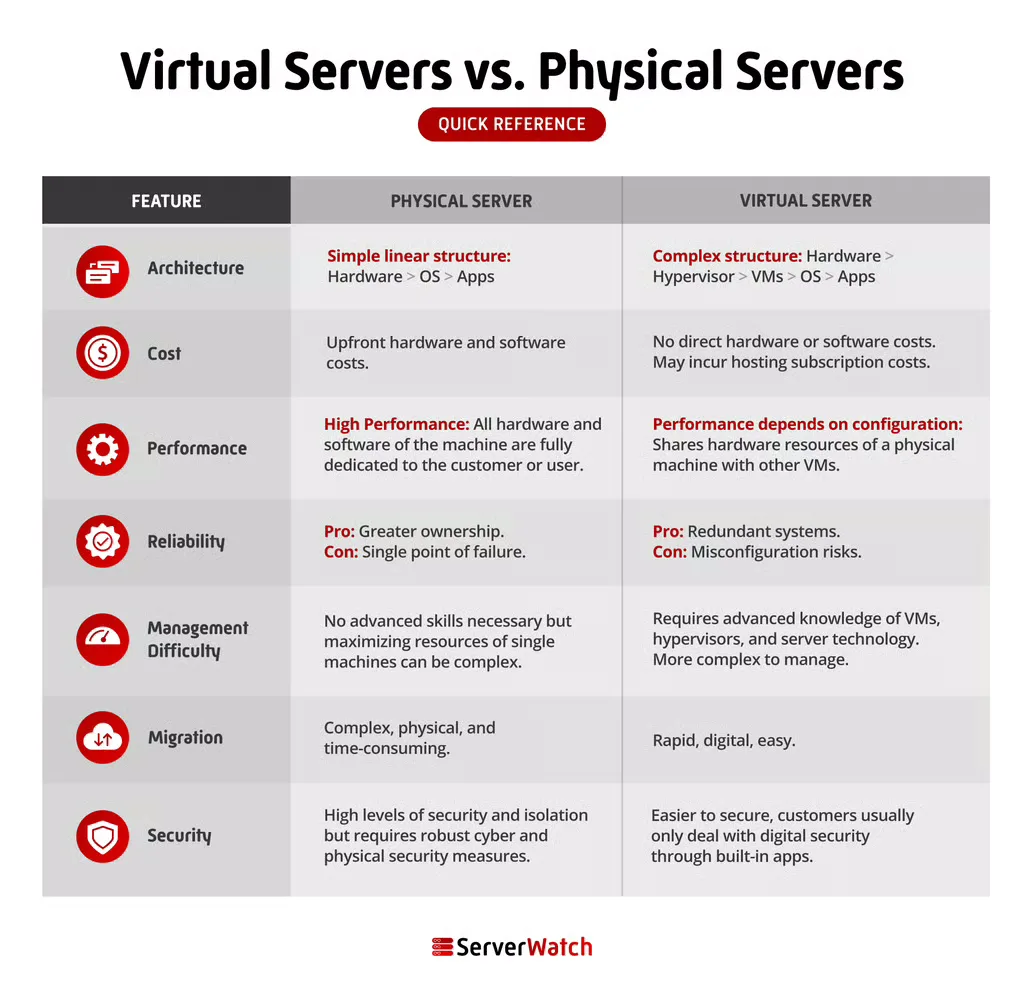
Evaluating whether to deploy physical or virtual infrastructure requires a detailed comparative analysis across core enterprise criteria: architecture, cost structures, performance metrics, reliability, management complexity, migration agility, and security postures.
Architectural Comparison
The foundational difference lies in structure. Physical servers feature a direct, unmediated relationship between the operating system and the hardware components (CPU, RAM, storage). Virtual servers introduce an intermediary abstraction layer—the hypervisor—which multiplexes physical hardware resources across multiple distinct virtual operating environments.
Cost Economics
At an initial glance, purchasing a single entry-level physical server may appear less expensive than subscribing to enterprise cloud virtualization services over many years. However, the total cost of ownership (TCO) tells a different story.

Virtual servers, particularly when consumed via public cloud providers, shift capital expenditures (CapEx)—such as hardware procurement, facility space, and redundant power supplies—into predictable operating expenditures (OpEx). Organizations utilizing cloud-based virtual servers are entirely insulated from hardware lifecycle management costs. If a physical motherboard or hard drive fails within a cloud data center, the vendor replaces the component transparently. Furthermore, businesses avoid the ongoing expenses associated with physical security, server room cooling, electricity bills, and emergency disaster recovery site maintenance.
Performance Benchmarks
Performance comparisons between physical and virtual servers no longer represent a sweeping victory for bare metal. Historically, the hypervisor layer introduced a minor computational overhead penalty. However, modern hardware-assisted virtualization extensions built directly into contemporary Intel, AMD, and ARM processors have reduced this performance tax to near-negligible levels.
Nevertheless, performance variance remains dependent on workload configuration:
- Compute-Intensive Workloads: Heavy computational tasks, complex data analytics, and massive database engines often achieve maximum throughput on physical servers due to the absence of hypervisor scheduling overhead.
- I/O-Intensive Workloads: While virtual servers can match physical performance in most categories, heavily loaded storage subsystems must be properly configured with high-speed SAN/NAS backends to avoid I/O bottlenecks in multi-tenant virtualized environments.
Reliability and System Resiliency
Both physical and virtual servers can achieve exceptional uptime (often exceeding 99.999%), but they accomplish this through contrasting methodologies.
A physical server relies on enterprise-grade hardware redundancy—such as dual hot-swappable power supplies, redundant RAID storage configurations, and Error-Correcting Code (ECC) memory. If the underlying machine experiences a catastrophic hardware failure, however, the server goes offline until manual repairs are completed.
Conversely, virtual servers achieve reliability through infrastructure-level redundancy. If a physical host machine running multiple virtual servers experiences a hardware failure, orchestration software instantly migrates or restarts those virtual instances on alternate, healthy physical nodes within the data center cluster, ensuring business continuity with minimal human intervention.
Management Difficulty and Operational Overhead
Managing physical servers demands specialized on-premises IT staff skilled in hardware maintenance, BIOS configurations, physical cabling, component replacements, and manual software patching.
Virtual servers hosted through managed cloud environments significantly reduce administrative overhead. Routine hardware maintenance, hypervisor updates, network switching, and physical security are fully outsourced to the cloud vendor. IT teams can instead focus on higher-level software configuration, application deployment, and security policy enforcement.
Migration Agility
One of the most profound operational advantages of virtual servers is migration flexibility. Because a virtual machine is essentially encapsulated within software files and virtual disk images, it can be exported, backed up, and migrated across different physical hosts with minimal effort—frequently executed live with zero application downtime using technologies like VMware vMotion or live migration tools in Hyper-V and KVM.
In stark contrast, migrating a physical server is a labor-intensive, physical endeavor. It requires manually powering down the machine, un-racking the chassis, transporting the hardware, re-cabling it in a new location, and reconfiguring network parameters. If hardware upgrades are required, technicians must physically swap out components inside the data center.
Security Postures
Both physical and virtual architectures can be engineered to meet rigorous enterprise security standards, but both demand meticulous configuration.
Physical servers offer inherent physical isolation; because no other tenant shares the hardware, risks associated with multi-tenant data leakage are eliminated. However, physical servers are vulnerable to physical theft, unauthorized local access, and hardware tampering if housed in inadequately secured on-premises server closets.
Virtual servers eliminate physical security risks by relying on enterprise-grade data center security protocols implemented by cloud vendors. However, virtual environments introduce unique software-level considerations, such as securing the hypervisor, managing virtual network segmentation, and preventing potential hypervisor escape vulnerabilities where a compromised guest OS attempts to breach neighboring virtual machines.
Strategic Industry Implications and Market Trends
The ongoing coexistence of physical and virtual servers reflects a mature enterprise IT market where architectural decisions are dictated strictly by workload requirements rather than dogmatic technology choices.
Market research indicates that while cloud-native applications and microservices architectures continue to drive unprecedented demand for virtual and containerized environments, the market for high-performance bare metal servers remains remarkably resilient. Industries dealing with massive datasets, proprietary financial algorithms, strict national data sovereignty laws, and high-frequency computational modeling continue to allocate significant budgets toward physical infrastructure.
At the same time, the boundaries between physical and virtual servers are increasingly blurring. Emerging technologies such as containerization (e.g., Docker, Kubernetes), edge computing, and hybrid cloud architectures allow enterprises to seamlessly integrate bare metal performance with virtualized scalability. Organizations frequently deploy hybrid models—running mission-critical core databases on secure physical bare metal servers while utilizing elastic virtual servers to handle fluctuating frontend web traffic and application delivery.
Summary: Selecting the Right Infrastructure for Your Enterprise
Ultimately, neither virtual nor physical servers represent a universal panacea for modern enterprise IT. Each paradigm offers a distinct set of operational trade-offs, advantages, and limitations.
Virtual servers stand out as the optimal choice for the vast majority of businesses. They deliver exceptional cost efficiency, rapid scalability, simplified management, effortless migration, and seamless access to cutting-edge cloud innovations. For standard business applications, web hosting, development environments, and general corporate IT workloads, virtualization remains the definitive industry standard.
Conversely, physical servers remain the superior solution for organizations that require absolute hardware ownership, uncompromised low-latency performance, specialized computational throughput, and airtight data isolation. Businesses operating in highly regulated sectors or managing resource-intensive, mission-critical workloads will continue to rely on bare metal infrastructure to secure their competitive edge.
Strategic IT decision-makers must carefully audit their specific performance requirements, regulatory obligations, budgetary constraints, and long-term growth trajectories. By adopting a tailored infrastructure strategy—whether purely virtual, strictly physical, or a hybrid combination of both—organizations can build a resilient, secure, and highly optimized digital foundation capable of supporting future enterprise demands.
