
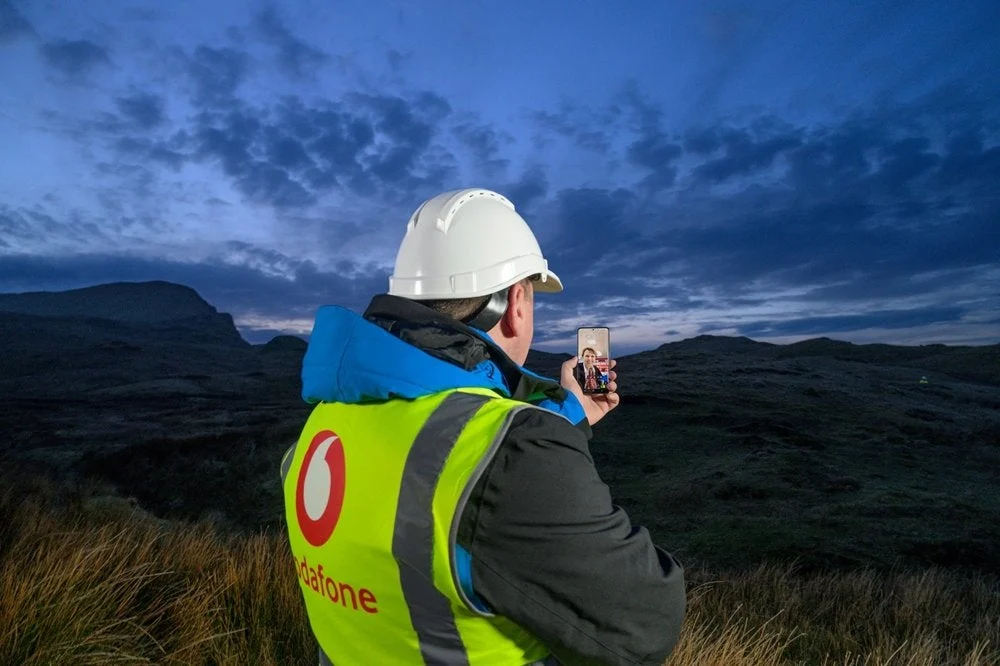

In a significant leap for telecommunications and public safety, Vodafone Ireland has successfully completed a series of groundbreaking tests utilizing AST SpaceMobile’s satellite constellation to facilitate mission-critical communications. This development marks the first time a video call has been successfully placed via satellite to a standard, unmodified mobile phone within Ireland, and represents a premier achievement for the European telecommunications sector. The trial, conducted in collaboration with Satellite Connect Europe—a joint venture between Vodafone and AST SpaceMobile—and Ireland’s Office of the Government Chief Information Officer (OGCIO), demonstrates the viability of space-based cellular broadband to bridge coverage gaps for first responders and emergency services operating in remote or underserved regions.
The successful test focused on Mission Critical Communications (MCx), a specialized suite of services designed to provide resilient voice, data, and video connectivity for frontline responders, public safety agencies, and the transportation sector. While MCx services are currently operational over terrestrial 4G and 5G mobile networks, their efficacy has historically been limited by the physical reach of ground-based cell towers. By integrating satellite technology directly with existing smartphone hardware, Vodafone and AST SpaceMobile have showcased a solution that could ensure continuous connectivity for emergency personnel, regardless of their proximity to traditional network infrastructure.
Technical Foundations and the Breakthrough Call
The core of this achievement lies in the Direct-to-Device (D2D) technology pioneered by AST SpaceMobile. Unlike traditional satellite telephony, which requires specialized, bulky handsets with large external antennas, AST SpaceMobile’s constellation is designed to communicate directly with standard LTE and 5G smartphones. This is achieved through the use of massive phased-array antennas deployed on Low Earth Orbit (LEO) satellites, which act as "cell towers in space."
During the trial, the partners successfully initiated a high-definition video call using a standard mobile phone. The call was routed through AST SpaceMobile’s BlueWalker 3 test satellite, the largest commercial communications array ever deployed in LEO. The technical success of this call proves that the latency and bandwidth requirements for real-time video—essential for modern emergency response, such as remote medical triage or real-time situational awareness—can be met through a satellite-terrestrial hybrid model.
This test is particularly relevant for Ireland’s OGCIO, which oversees the digital transformation of government services. The ability to maintain a high-bandwidth video link in areas where terrestrial signals are blocked by topography or distance is a priority for the Irish government’s long-term strategy for rural resilience and public safety.
A Chronology of the Vodafone and AST SpaceMobile Partnership
The successful Irish test is the culmination of years of strategic collaboration and technical iteration. The partnership between Vodafone Group and AST SpaceMobile dates back to the early stages of the satellite company’s development, with Vodafone serving as a lead investor and commercial partner.
- 2020-2022: Vodafone and AST SpaceMobile formalized their relationship, aiming to provide the first space-based cellular broadband network accessible by standard mobile phones. During this period, the companies worked on regulatory frameworks and technical specifications to ensure compatibility with existing 3GPP standards.
- September 2022: AST SpaceMobile launched BlueWalker 3 from Cape Canaveral. This satellite served as the primary testbed for the D2D technology, featuring a 693-square-foot antenna designed to capture signals from standard handsets from hundreds of miles above the Earth.
- April 2023: The partners achieved the first-ever space-based voice call between standard smartphones, connecting a call from Texas to Japan. This proved the basic concept of voice over satellite without hardware modifications.
- June 2023: AST SpaceMobile announced it had achieved initial 4G LTE download speeds of over 10 Mbps during tests with Vodafone, AT&T, and Nokia.
- September 2023: The first 5G satellite-to-smartphone connection was established, reaching download speeds of approximately 14 Mbps, further validating the potential for high-speed data applications like video streaming.
- July 2024: Vodafone Ireland announced the successful MCx video call and the acquisition of the country’s first test and trial license for D2D satellite technology, signaling a shift from experimental testing to localized implementation strategies.
Strengthening Network Resilience for First Responders
The integration of MCx with satellite technology addresses a critical vulnerability in emergency response. In many parts of rural Ireland and across the rugged terrains of the European continent, "dead zones" remain a persistent challenge. When a natural disaster, such as a flood or forest fire, occurs in these areas, or if terrestrial infrastructure is damaged during a crisis, first responders often lose the ability to communicate with command centers or coordinate with other units.
The MCx suite provides prioritized access to the network, ensuring that emergency data takes precedence over consumer traffic. By extending this priority access to a satellite layer, Vodafone is creating a "network of networks" that offers near-total geographic coverage. This resilience is vital for the Irish Coast Guard, Mountain Rescue teams, and rural ambulance services who frequently operate outside the footprint of traditional 4G and 5G towers.
Sheila Kavanagh, Network Director of Vodafone Ireland, emphasized the strategic importance of this integration. "By combining satellite technology with next-generation systems such as MCx, we are strengthening network resilience and helping frontline teams stay connected and respond effectively in remote areas," Kavanagh stated. She noted that the trial license recently secured by Vodafone Ireland would allow the company to further refine the user experience for emergency services before a wider commercial rollout.
Supporting Data and Market Context
The move toward satellite-to-cell connectivity is part of a broader global trend often referred to as the "convergence" of terrestrial and non-terrestrial networks (NTN). According to industry analysts, the D2D market is expected to be one of the fastest-growing segments of the space economy over the next decade.
Market research suggests that there are currently over 5 billion mobile subscribers globally, yet a significant portion of the Earth’s surface—estimated at over 90%—remains without terrestrial cellular coverage. For telecommunications giants like Vodafone, the ability to offer "gap-filler" coverage via satellite represents a massive opportunity to eliminate roaming blind spots and provide value-added services to government and enterprise clients.
AST SpaceMobile’s roadmap includes the launch of its first five commercial "BlueBird" satellites, which are significantly larger and more powerful than the BlueWalker 3 prototype. These satellites are scheduled for launch in the second half of 2024. Once operational, they will provide the capacity necessary to support continuous, non-intermittent data services in key markets, including Europe and the United States.
Official Responses and Strategic Implications
The involvement of the Office of the Government Chief Information Officer (OGCIO) highlights the public-sector interest in this technology. For the Irish government, the trial represents a step toward fulfilling the National Broadband Plan’s objectives and ensuring that the "Digital Ireland" framework includes robust provisions for emergency preparedness.
The OGCIO’s participation suggests that the government is looking beyond mere consumer connectivity, focusing instead on how satellite-augmented networks can improve the efficiency of public services. If successful, the deployment of D2D technology could reduce the need for expensive, specialized radio equipment for state agencies, allowing them to leverage standard commercial devices for secure, mission-critical tasks.
From a competitive standpoint, Vodafone’s successful test places it at the forefront of the D2D race in Europe. While other players like SpaceX (partnering with T-Mobile in the U.S.) and Lynk Global are also pursuing the satellite-to-cell market, Vodafone’s specific focus on MCx and high-bandwidth video for emergency services distinguishes its strategy. By targeting "mission-critical" use cases first, Vodafone is positioning the technology as an essential infrastructure tool rather than just a luxury feature for travelers or hikers.
Broader Impact on the Telecommunications Landscape
The implications of the Vodafone-AST SpaceMobile test extend far beyond the borders of Ireland. As the first successful satellite video call of its kind in Europe, it sets a technical and regulatory precedent for the European Union. The European Space Agency (ESA) and the European Commission have long advocated for "strategic autonomy" in space and telecommunications; projects like this align with those goals by utilizing European-led joint ventures to secure critical infrastructure.
Furthermore, the success of the MCx video call validates the 3GPP Release 17 and Release 18 standards, which include specifications for Non-Terrestrial Networks. This standardization is crucial for the industry, as it ensures that various satellite constellations and terrestrial networks can interoperate seamlessly.
As Vodafone Ireland continues to utilize its test and trial license, the focus will likely shift to optimizing handovers—the process by which a mobile phone switches from a terrestrial cell tower to a satellite without dropping the connection. Mastering this transition is the "holy grail" of hybrid connectivity, as it would allow users to move in and out of remote areas with no perceived interruption in service.
In conclusion, the successful trial by Vodafone Ireland, AST SpaceMobile, and the OGCIO represents a landmark moment in the evolution of mobile connectivity. By proving that standard smartphones can support high-definition video calls via satellite for mission-critical purposes, the partners have laid the groundwork for a future where "no signal" is a thing of the past. For first responders in Ireland and eventually across the globe, this technology promises a new era of safety, coordination, and resilience in the face of the most challenging environments. As the BlueBird constellation begins its deployment, the transition from experimental tests to life-saving reality appears closer than ever.
