
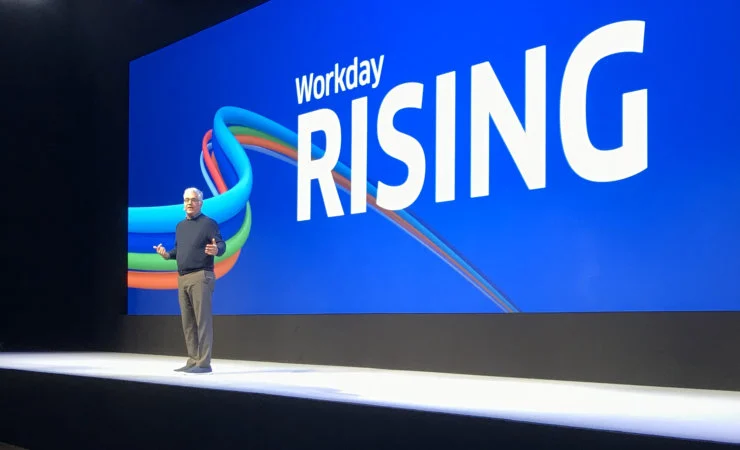

Enterprise cloud applications provider Workday has officially kicked off its annual Rising conference in Las Vegas with a sweeping series of artificial intelligence product announcements, signaling what leadership describes as the most significant opportunity in the company’s two-decade history. Returning co-founder and CEO Aneel Bhusri, alongside President of Product and Technology Gerrit Kazmaier, used the opening keynote to unveil a fundamental restructuring of enterprise workflows centered on human-agent collaboration. The announcements include the launch of Sana, a dynamic agentic home interface, an expanded suite of autonomous background agents, and a headless Trusted Agent Platform designed to allow secure, compliant customization across human resources, finance, and information technology.
The announcements arrive just months after Bhusri resumed the chief executive role, injecting a renewed sense of urgency into the company’s developmental roadmap. According to executive leadership, the rapid maturation of generative AI and large language models has accelerated development speeds to levels not witnessed since Workday’s founding in 2005. Rather than utilizing superficial bolt-on integrations, the company’s newly announced capabilities are natively embedded within its foundational data model, maintaining a single version of truth that guarantees strict adherence to enterprise security, data privacy, and regulatory compliance frameworks.
The Chronology of Workday’s AI Evolution
To fully contextualize the announcements made at the Las Vegas convention center, it is necessary to examine Workday’s technological trajectory over the past twenty years. Established in March 2005 by Dave Duffield and Aneel Bhusri following their tenure at PeopleSoft, Workday pioneered cloud-based enterprise resource planning (ERP) and human capital management (HCM) software. By centralizing disparate corporate databases into a unified, object-oriented data model, the company laid the groundwork for secure, cloud-native operational management.
In the ensuing decades, the enterprise software market underwent a gradual shift toward predictive analytics and machine learning. However, the commercial release of advanced generative models in late 2022 fundamentally altered software development paradigms. Competitors across the enterprise landscape rushed to introduce conversational overlays and chatbot assistants. Workday, conversely, spent the subsequent eighteen years consolidating its unified data architecture, preparing the groundwork for contextual reasoning engines that require access to deep, structured organizational metrics.
By mid-2023, the company began strategically integrating machine learning capabilities into performance management and skills forecasting. The announcements at the current Rising conference represent the culmination of this timeline: a transition from passive analytics and simple conversational helpers to proactive, autonomous agentic workflows capable of executing complex multi-step processes across finance, payroll, and human resources without direct human intervention at every microscopic stage.
Core Product Launches: Sana, Concierge, and Autopilot Agents
At the heart of Workday’s product rollout is Sana, designated as the new Workday Home interface. Described by executives as a dynamic agentic experience built to finish work rather than merely answer questions, Sana adapts dynamically to each employee’s specific role, schedule, security permissions, and current projects. Rather than serving as a static dashboard, Sana actively synthesizes daily tasks, alerting users to pending approvals, anomalies in financial reports, or mandatory compliance milestones.
Complementing Sana is Sana Concierge, an advanced HR and IT service agent engineered to intercept and resolve employee inquiries before they evolve into formal help desk tickets. The system handles complex administrative scenarios, including employee onboarding, offboarding protocols, complex leave-of-absence requests, and detailed payroll queries. Company leadership highlighted routine time-off requests as a primary efficiency metric, noting that Sana reduces processing time by more than 90 percent. Across the existing user ecosystem, Workday calculates this specific enhancement equates to the recovery of over 1.6 million hours of operational productivity.
Beyond user-facing interfaces, the company is deploying a suite of Autopilot agents designed to operate continuously in the background across core operational domains. These include specialized agents tailored for Talent Acquisition, global payroll execution, general ledger accounting, and workforce deployment. By automating repetitive administrative overhead, these agents aim to minimize the hours personnel spend chasing routine tasks, shifting human capital focus toward strategic decision-making, executive oversight, and creative problem-solving.
The Trusted Agent Platform and the Mandate for Enterprise Governance
As organizations increasingly adopt autonomous artificial intelligence tools, concerns regarding data leakage, algorithmic bias, and unauthorized autonomous actions remain paramount among enterprise chief information security officers. Addressing these apprehension head-on, Workday announced that its Trusted Agent Platform has transitioned to a headless architecture, empowering enterprise customers, third-party developers, and integration partners to build, run, and govern custom AI agents within established corporate boundaries.
Crucially, every agent operating within the ecosystem—whether developed internally by Workday, engineered by certified partners, or coded by enterprise clients—operates under identical governance rules. These include strict permission hierarchies, automated approval workflows, and immutable audit trails. Gerrit Kazmaier emphasized that the integration of powerful frontier AI models must be balanced with deterministic process execution and stringent security guardrails.
To enforce this, every agent deployed on the network utilizes the Agent Harness framework, which establishes operational boundaries defining what an agent can and cannot do relative to applicable corporate policies and regulatory standards. Furthermore, Workday announced that early next year, the platform will incorporate an Agent Context Service and Grounded Reasoning capabilities. These features will enable agents to dynamically identify necessary contextual data within the Workday database, cross-reference requests against internal corporate policies, and verify procedural compliance prior to executing any transaction.
Aneel Bhusri reinforced this commitment to institutional compliance by drawing a sharp distinction between lawful and lawless enterprise automation. In an environment dominated by headlines regarding data breaches and unregulated artificial intelligence deployments, Workday’s strategic differentiator is its insistence that autonomous agents respect existing enterprise data permissions and operational boundaries.
Strategic Workforce Transformation and Broader Industry Implications
The broader implications of Workday’s announcements extend far beyond incremental productivity gains, pointing toward a fundamental restructuring of the modern workplace. According to executive presentations at the conference, modern enterprises are currently navigating a complex strategic workforce transformation, transitioning into hybrid operational models where human workers and autonomous AI agents collaborate in real-time.
This shift alters the fundamental nature of corporate employment. Organizations are moving away from rigid, static job descriptions defined primarily by generalized skills toward fluid, agile task-oriented profiles. As autonomous agents assume responsibility for discrete, repetitive business processes, job roles are consolidating and evolving, necessitating sophisticated enterprise systems capable of modeling, capturing, and implementing these structural workforce changes in real-time.
Industry analysts observing the conference note that Workday’s strategy represents a calculated gamble on the maturity of enterprise software architecture. By refusing to rely on superficial bolt-on integrations or external conversational wrappers, the company is betting that enterprise buyers will increasingly favor deeply embedded, natively secure platforms over fragmented point solutions. The ability to guarantee a single version of truth while deploying autonomous agents across high-stakes domains such as corporate finance and global payroll provides a distinct competitive moat in an increasingly crowded software market.
As the Rising conference continues in Las Vegas throughout the week, attention will shift toward customer case studies, developer workshops, and live demonstrations of the newly announced agentic architecture. While the immediate focus remains on the technological capabilities showcased on stage, the long-term significance will be measured by how effectively global enterprises adopt these tools to redefine productivity, talent management, and operational governance in the emerging AI-driven economy.
