

Containers represent a paradigm shift in software deployment, offering a lightweight, standalone, and executable package that encapsulates everything needed to run an application. This includes code, runtime, system tools, libraries, and configurations. This technology is a cornerstone of the broader trend known as containerization, a method designed to package software with its dependencies in isolated environments, ensuring they run independently of other processes. This article delves into the intricacies of containerization, exploring its fundamental components, distinguishing it from virtual machines (VMs), and examining its significant benefits, diverse use cases, and leading technologies. We will also address the inherent challenges and forecast future trends within this dynamic field.
Understanding Containers: The Foundation of Modern Software Delivery
Containerization empowers developers to package and execute applications within isolated environments. This approach guarantees a consistent and efficient deployment experience across a spectrum of environments, from a developer’s local workstation to robust production servers, effectively mitigating concerns about operating system (OS) configurations and underlying infrastructure variations.
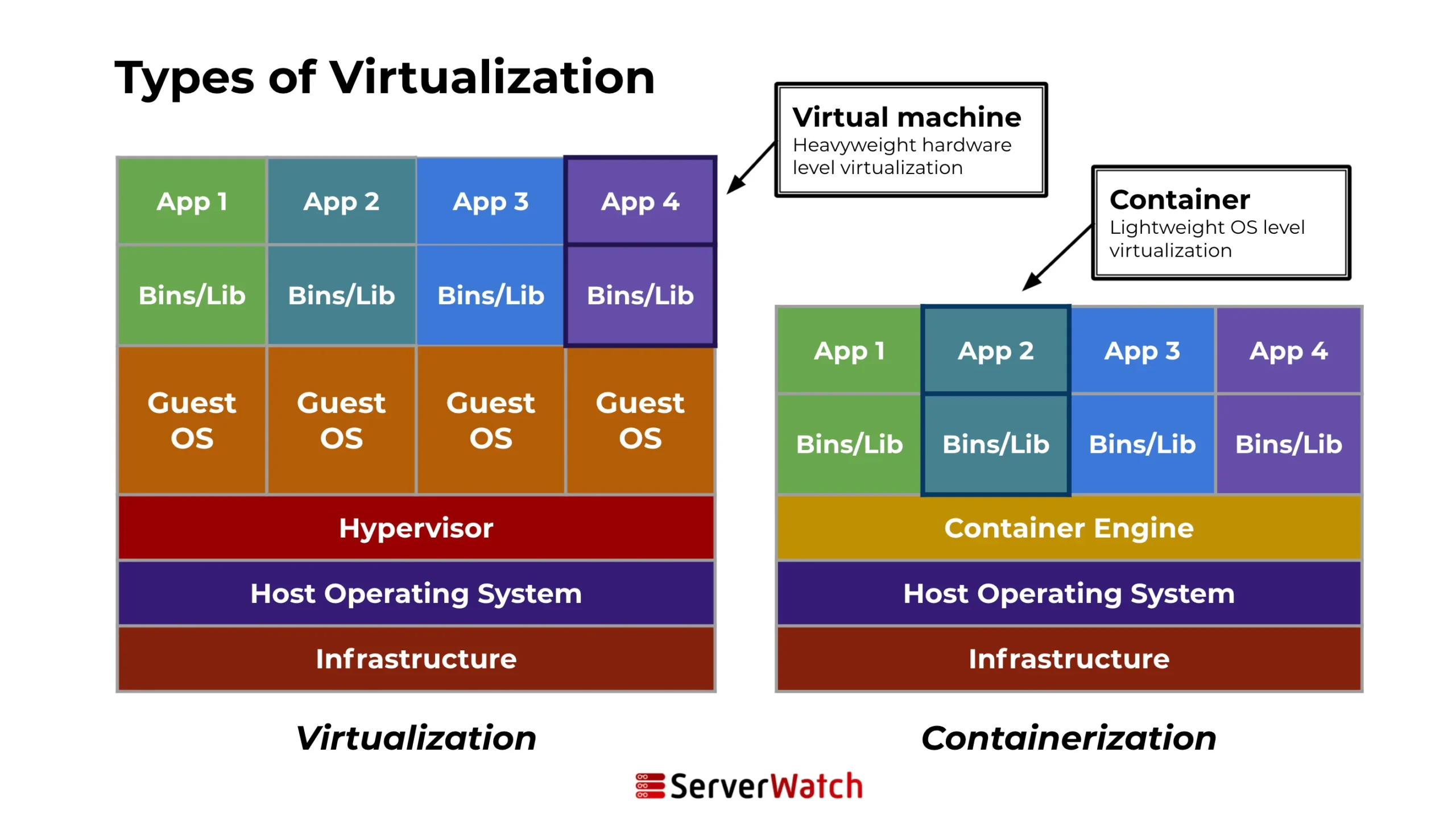
Unlike traditional deployment methods, containers package an application and its dependencies into a container image. This image serves as a self-contained unit, housing all the necessary components for the application’s execution: code, runtime, libraries, and system tools. A key architectural advantage of containers is their shared reliance on the host system’s kernel, while maintaining distinct filesystems, CPU, memory, and process spaces. This shared kernel architecture makes containers significantly more lightweight and resource-efficient compared to virtual machines.
[Image: A graphic visual showing the differences between Virtualization which uses a hypervisor and guest operating systems to create virtual machines, and containerization which uses a container engine to create lightweight virtual environments.]
Designed by Sam Ingalls. © ServerWatch 2021.
Containers vs. Virtual Machines: A Comparative Analysis
Both containers and VMs are instrumental in creating isolated environments for application execution, but their underlying mechanisms differ fundamentally.
| Feature | Containers | Virtual Machines |
|---|---|---|
| Architecture | Containers share the host system’s kernel, isolating application processes from the broader system. They do not require a full OS for each instance, rendering them more lightweight and faster to initiate than VMs. | A VM encompasses not only the application and its dependencies but also an entire guest OS. This OS operates on virtual hardware managed by a hypervisor, which resides above the host’s physical hardware. VMs offer strong isolation from each other and the host system, ensuring a high degree of security and control. |
| Resource Management | Containers are more efficient and consume fewer resources as they leverage the host system’s kernel and only necessitate the application and its runtime environment. | The requirement to run a full OS within each VM leads to higher system resource consumption, potentially resulting in less efficient utilization of underlying hardware. |
How Containerization Works: A Step-by-Step Overview
Containerization fundamentally involves encapsulating an application within a container that provides its own operating environment. This process typically unfolds through several key stages:
- Image Creation: Developers build a container image by defining its contents, including the application code, dependencies, libraries, and configuration files. This is often done using a Dockerfile or similar configuration language.
- Image Storage: The created container image is stored in a container registry, a centralized repository that allows for versioning and easy access.
- Container Runtime: A container runtime engine, such as Docker Engine or containerd, is responsible for managing the lifecycle of containers.
- Container Instantiation: When an application needs to be run, the container runtime pulls the specified image from the registry and creates a running instance, known as a container. This container operates in isolation, utilizing the host’s kernel but with its own dedicated resources.
- Orchestration (Optional but common): For managing multiple containers across a cluster of machines, container orchestration platforms like Kubernetes are employed. These platforms automate deployment, scaling, and management of containerized applications.
Key Components of a Container
Several critical components form the architecture of a container, enabling its isolated and portable functionality:
- Container Image: A read-only template containing the application, its dependencies, libraries, and configuration.
- Container Runtime: Software that runs and manages containers, such as Docker Engine, containerd, or CRI-O.
- Container Engine: The core component that provides the runtime environment and manages the container lifecycle.
- Namespace: A Linux kernel feature that isolates resources for a container, such as process IDs, network interfaces, and user IDs.
- Control Groups (cgroups): Another Linux kernel feature that limits, accounts for, and isolates the resource usage of a collection of processes. This allows for CPU, memory, I/O, and network bandwidth allocation.
- Union File Systems: Technologies like OverlayFS or AUFS that enable the creation of layered filesystems, allowing for efficient storage and sharing of image layers.
- Networking: Each container typically gets its own network namespace, allowing it to have its own IP address, routing table, and network interfaces, ensuring network isolation.
Container Use Cases: Driving Innovation Across Industries
The versatility and efficiency of containers have cemented their role in numerous applications across the modern software landscape, spanning development, deployment, and management.
Microservices and Cloud-Native Applications
Containers are intrinsically aligned with microservices, an architectural style that breaks down applications into small, independently deployable services. Each microservice can be encapsulated in its own container, ensuring isolation, minimizing conflicts, and facilitating independent updates and scaling. In the realm of cloud-native development, containers enable applications to achieve remarkable scalability and resilience. They can be readily replicated, managed, and monitored, facilitating efficient load balancing and high availability. Orchestration tools like Kubernetes further enhance this by dynamically managing containers for optimal resource utilization, automated healing, and streamlined scaling in response to fluctuating demand.
Continuous Integration/Continuous Deployment (CI/CD) Pipelines
Containers integrate seamlessly into CI/CD pipelines, fostering consistency from development to production environments. This uniformity is crucial for early issue detection and resolution. Furthermore, containers can automate testing environments, ensuring that every code commit is validated in a production-like setting, leading to more reliable deployments and accelerated release cycles. By encapsulating applications and their environments, containers guarantee consistent behavior across development, testing, staging, and production, significantly reducing deployment failures attributed to environmental discrepancies.
Application Packaging and Distribution
Containers simplify the packaging and distribution of software by bundling an application with all its dependencies. This portability allows applications to run across diverse platforms and cloud environments without modification. Container registries further enhance this by storing multiple versions of container images, enabling straightforward rollbacks to previous stable versions when necessary, thereby bolstering application deployment reliability and stability.
Benefits of Containerization: A Catalyst for Efficiency and Agility
Containerization has emerged as a foundational element of contemporary software development and deployment strategies due to its myriad advantages. These benefits collectively empower developers, operations teams, and businesses to achieve greater efficiency and agility.
- Portability: Containers run consistently across different environments, from local machines to cloud servers, eliminating the "it works on my machine" problem.
- Efficiency: Containers share the host OS kernel, requiring fewer resources than VMs, leading to higher density and lower infrastructure costs.
- Speed: Containers start up in seconds, significantly faster than VMs, accelerating development and deployment cycles.
- Isolation: Applications and their dependencies are isolated within containers, preventing conflicts and enhancing security.
- Scalability: Containers can be easily scaled up or down based on demand, managed by orchestration tools.
- Consistency: Ensures that applications behave the same way in development, testing, and production environments.
- Resource Optimization: Efficient resource utilization leads to cost savings and better performance.
- Developer Productivity: Simplifies the development workflow by providing consistent and reproducible environments.
- Faster Time to Market: Streamlined deployment processes accelerate the delivery of new features and applications.
- Simplified Management: Orchestration tools automate many complex management tasks.
- Enhanced Security: Isolation mechanisms can improve security posture, though proper configuration is critical.
- Cost Reduction: Lower infrastructure overhead and improved resource utilization translate to significant cost savings.
- Agility: Enables rapid iteration and adaptation to changing business requirements.
Challenges and Considerations in Containerization
Despite their considerable advantages, the widespread adoption of containerization also introduces a unique set of challenges and considerations that organizations must navigate.
Security Issues
While containers offer isolation, they are not inherently impervious to security threats. Potential vulnerabilities include:
- Container Image Vulnerabilities: Insecure or compromised base images can introduce malware or vulnerabilities into running containers. Rigorous image scanning and source verification are paramount.
- Runtime Security: Exploits targeting the container runtime or the host kernel could potentially lead to privilege escalation or compromise of other containers.
- Insecure Configurations: Misconfigurations in container networking, storage, or access controls can expose sensitive data or allow unauthorized access.
- Orchestration Platform Security: Vulnerabilities in orchestration platforms like Kubernetes can have far-reaching consequences, affecting all managed containers.
- Secrets Management: Improper handling of sensitive information like API keys and passwords within containers can lead to data breaches. Secure secrets management solutions are essential.
Complexity in Management
While containerization streamlines many deployment aspects, it introduces its own management complexities, particularly at scale:
- Orchestration Complexity: Managing large clusters of containers requires sophisticated orchestration tools like Kubernetes, which have a steep learning curve.
- Networking Complexity: Designing and managing container networks, especially in distributed environments, can be challenging.
- Monitoring and Logging: Aggregating logs and monitoring the performance of numerous distributed containers requires robust observability solutions.
- Stateful Applications: Managing stateful applications (e.g., databases) within containers requires careful consideration of data persistence and recovery.
- Skill Gap: A shortage of skilled professionals proficient in container technologies and orchestration can hinder adoption and effective management.
Integration with Existing Systems
Integrating containerized applications with existing legacy systems and infrastructure often presents unique challenges:
- Data Migration: Migrating data from traditional databases to containerized storage solutions can be complex and time-consuming.
- Interoperability: Ensuring seamless communication and data exchange between containerized applications and existing monolithic applications or services.
- Security Policy Alignment: Aligning container security policies with existing enterprise security frameworks and compliance requirements.
- Infrastructure Compatibility: Adapting existing on-premises infrastructure to support containerization, or managing hybrid cloud environments effectively.
- Cultural Shift: Embracing containerization often necessitates a cultural shift within IT teams, requiring new workflows and collaboration models.
Popular Container Technologies: The Ecosystem of Choice
The containerization landscape is dominated by a few key technologies that have become industry standards, alongside a growing ecosystem of supporting tools.
Docker
Docker is arguably the most influential container platform, having democratized containerization and made it accessible to a broader audience. It provides a comprehensive suite of tools for developing, shipping, and running containerized applications.
- Key Features: Docker Engine (runtime), Docker CLI (command-line interface), Docker Hub (registry), Docker Compose (orchestration for multi-container applications), Docker Swarm (native clustering).
- Benefits: Ease of use, extensive community support, large ecosystem of tools, rapid prototyping and development.
Kubernetes
Kubernetes (K8s) is the de facto standard for container orchestration, designed to automate the deployment, scaling, and management of containerized applications. It is highly extensible and designed to work with various container runtimes, including Docker.
- Key Features: Automated rollouts and rollbacks, service discovery and load balancing, storage orchestration, self-healing capabilities, secret and configuration management, batch execution.
- Benefits: Robust scalability and resilience, efficient resource utilization, declarative configuration, large and active community, vendor-neutral platform.
Other Notable Containers
Beyond Docker and Kubernetes, several other technologies contribute to the containerization ecosystem:
- Podman: A daemonless container engine for developing, managing, and running OCI (Open Container Initiative) containers on Linux systems. It offers a Docker-compatible CLI.
- containerd: An industry-standard container runtime that emphasizes simplicity, robustness, and portability. It is a core component of Docker and Kubernetes.
- LXC (Linux Containers): An older, lower-level containerization technology that provides OS-level virtualization. It is often used as a foundation for other container solutions.
- OpenShift: A Kubernetes distribution from Red Hat that adds developer and operations tools for enterprise-grade container application platforms.
Future Trends in Containerization: Shaping the Next Frontier
The evolution of containerization is continuous, with ongoing integration into emerging technologies and adaptation to new standards and regulations. Future trends are poised to redefine how applications are developed, deployed, and managed.
Integration with Emerging Technologies
Containerization is increasingly intersecting with cutting-edge fields, driving innovation:
- AI and Machine Learning: Containers are ideal for packaging and deploying complex AI/ML models, ensuring reproducibility and scalability of training and inference environments.
- Edge Computing: Lightweight containers are well-suited for deployment on edge devices, enabling distributed intelligence and localized processing.
- Serverless Computing: Containerization platforms are being integrated with serverless architectures, offering more flexibility and control for function execution.
- WebAssembly (Wasm): The rise of WebAssembly as a universal runtime is leading to explorations of running Wasm modules within containers, offering enhanced security and portability.
- Infrastructure as Code (IaC): Container orchestration manifests are becoming a key component of IaC strategies, enabling the automated provisioning and management of entire application stacks.
Evolution of Container Standards and Regulations
As containerization matures and becomes more integral to business and IT infrastructure, the development and enforcement of standards and regulations are gaining prominence:
- Supply Chain Security: Increased focus on securing the container supply chain, from image provenance to runtime integrity, driven by growing concerns about vulnerabilities.
- Standardization Efforts: Continued refinement of OCI standards for container images and runtimes to ensure interoperability and portability across different platforms.
- Regulatory Compliance: Growing demand for container solutions that meet specific industry regulations (e.g., HIPAA, GDPR) for data privacy and security.
- Policy Enforcement: Development of more sophisticated tools and frameworks for enforcing security policies and compliance requirements within containerized environments.
- Sustainability: Exploration of how containerization can contribute to more energy-efficient computing through better resource utilization.
Bottom Line: The Role of Containers Will Continue to Grow
Containers have fundamentally reshaped the landscape of software development and deployment, delivering unparalleled efficiency, scalability, and consistency. As these technologies continue their rapid evolution, containers are poised to become even more indispensable, fostering innovation and driving efficiencies across diverse sectors.
Looking ahead, the potential of containerization is immense. Its capacity to seamlessly integrate with future technological advancements and adapt to evolving regulatory landscapes positions it as a vital component of digital transformation strategies. Organizations that effectively leverage container technologies will be at the forefront of innovation, equipped to navigate the complexities of a rapidly evolving digital world.
Learn more about virtual machines, and explore the best virtualization companies to find the solution that best suits your needs.
