
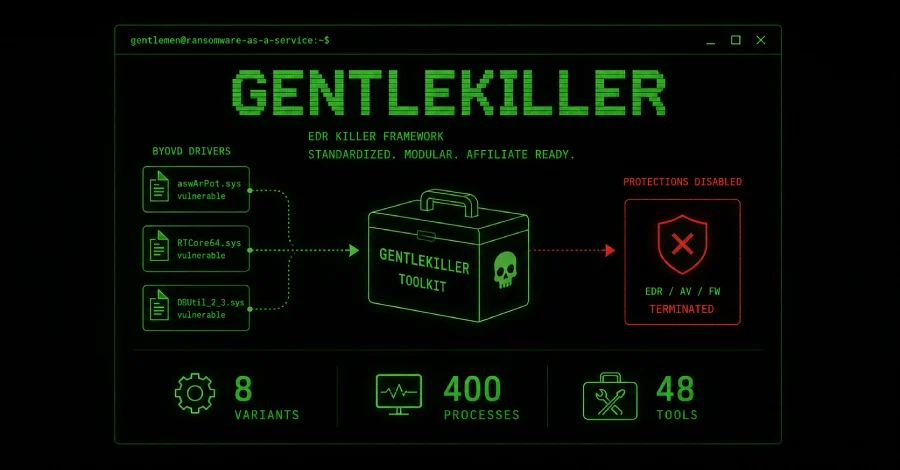

The Gentlemen ransomware-as-a-service (RaaS) operation has rapidly emerged as a formidable threat, distinguishing itself through an aggressively developed and meticulously maintained suite of endpoint detection and response (EDR) killer tools. These sophisticated utilities are systematically distributed to affiliates, serving to neutralize critical system defenses prior to the deployment of the group’s encryptor, thereby significantly increasing the success rate of their ransomware attacks. This arsenal of EDR-terminating capabilities is centrally managed under a bespoke framework known as GentleKiller, underscoring the group’s technical sophistication and strategic approach to overcoming modern cybersecurity measures.
Understanding the Threat: The Gentlemen’s Rise and Modus Operandi
Since its initial appearance in March 2025, The Gentlemen ransomware group has swiftly ascended the ranks of cybercriminal organizations, establishing itself as one of the most active and dangerous players in the RaaS ecosystem. The RaaS model, a pervasive business framework in the cybercrime world, allows developers to lease their ransomware infrastructure and tools to affiliates, who then carry out the actual attacks. In return, a percentage of the ransom payments is shared with the developers. This model significantly lowers the barrier to entry for aspiring cybercriminals, amplifying the scale and frequency of attacks globally.
Data compiled by Ransomware.live paints a stark picture of The Gentlemen’s impact, attributing over 504 successful victimizations to the group to date. Geographically, their targeting appears diverse yet concentrated, with a significant number of their victims located in Southeast Asia, South America, and Western Europe. This global footprint indicates a broad operational reach and a well-organized affiliate network capable of executing campaigns across different regions and economic sectors.
Recent investigations by prominent cybersecurity journalist Brian Krebs, corroborated by intelligence from PRODAFT, have shed light on the leadership behind this burgeoning operation. The reports identify Alexander Andreevich Yapaev, a 36-year-old Russian national known by the alias "hastalamuerte," as the orchestrator of The Gentlemen. Yapaev’s involvement in the cybercriminal underworld is not new; he previously operated as an affiliate for other notorious ransomware schemes, including Qilin. This background suggests a seasoned operator with a deep understanding of ransomware mechanics and the RaaS model, allowing him to build a highly effective and technically proficient organization.
Anatomy of an EDR Killer: The GentleKiller Framework
ESET, the Slovakian cybersecurity firm, has provided an in-depth analysis of The Gentlemen’s technical prowess, particularly highlighting their agile development and deployment of EDR killer samples designed to evade detection. The core of this capability lies in GentleKiller, which exhibits a remarkable degree of sophistication. The framework employs various binary protection techniques, such as Enigma or Themida, to obfuscate its malicious code and complicate analysis by security researchers. Furthermore, GentleKiller variants meticulously impersonate legitimate software from well-known cybersecurity vendors. This deception extends to using identical file names, version information, digital signatures, and even icons, making it exceedingly difficult for automated systems and even human analysts to distinguish them from benign applications.
GentleKiller is not a monolithic tool but rather a dynamic framework, evolving through at least eight distinct variants. Each variant is engineered to mimic a different legitimate product and, critically, to exploit a specific vulnerable or malicious driver as part of a bring your own vulnerable driver (BYOVD) attack. This targeted approach allows the ransomware to bypass EDR solutions by exploiting known weaknesses in system drivers, which operate at a highly privileged kernel level. GentleKiller’s extensive reconnaissance capabilities are evident in its design, as it actively scans for and targets approximately 400 processes associated with 48 distinct security programs from a multitude of vendors. This broad targeting ensures that a wide array of EDR solutions can be disabled, regardless of the specific vendor implemented by the victim organization.
The framework also integrates and standardizes third-party or leaked tools, such as HexKiller, ThrottleBlood, and HavocKiller. By funneling these diverse tools through a shared defense-evasion layer, The Gentlemen ensures a consistent and effective methodology for EDR termination, streamlining the process for their affiliates. This standardization minimizes the technical expertise required from affiliates, making the overall RaaS offering more appealing and scalable.

The BYOVD Vector: A Race Against Disclosure
One of the most concerning aspects of The Gentlemen’s operation is their unparalleled ability to "unusually quickly operationalize" newly disclosed proof-of-concept (PoC) exploits related to BYOVD attacks. In many documented cases, the group has integrated these exploits into their toolkit within days of their public release. This rapid integration highlights an advanced threat intelligence capability and an efficient development pipeline, allowing them to capitalize on zero-day or recently patched vulnerabilities before widespread defensive measures can be deployed.
BYOVD attacks exploit legitimate, signed, but vulnerable drivers to gain kernel-level privileges, effectively bypassing security software that operates at a lower privilege level. This technique is particularly potent because the drivers themselves are often digitally signed by legitimate vendors, making them appear trustworthy to the operating system. Once a malicious actor leverages such a driver, they can perform actions typically restricted to the operating system kernel, including disabling security products, modifying system configurations, and installing persistent malware.
Several specific drivers have been identified in connection with The Gentlemen’s BYOVD attacks. Notably, "PoisonX.sys" has been widely abused in recent months, facilitating various BYOVD attacks. One prominent instance involved its use to successfully disable CrowdStrike Falcon EDR, a leading endpoint protection solution. Another campaign, detailed by Huntress, uncovered an intrusion where threat actors leveraged BeyondTrust Remote Support to deploy ransomware on a network. Crucially, before the ransomware payload was executed, security tooling was systematically terminated using both "PoisonX.sys" and "hrwfpdrv.sys," demonstrating the critical role these driver exploits play in preparing the ground for a successful ransomware attack.
The underlying code of The Gentlemen’s EDR killers, even when abstracting away the impersonation layers and specific drivers, reveals numerous structural and behavioral commonalities. ESET researchers note that this strongly suggests the use of a shared development template. This design philosophy prioritizes ease of deployment and operational flexibility for affiliates, while simultaneously minimizing the development effort required from the core operators. Such an efficient model enables The Gentlemen to integrate newly abused drivers into their toolset almost immediately after an EDR killer PoC is publicly disclosed, maintaining a continuous edge over defenders.
The third-party, BYOVD-based EDR killers employed by the group further diversify their attack vectors and ensure redundancy in their ability to disable security solutions. This modular approach allows them to quickly swap out tools or drivers as new vulnerabilities are discovered or existing ones are patched, maintaining their offensive capabilities.
Beyond Encryption: Data Theft and Credential Harvesting
While ransomware is the primary objective, The Gentlemen’s operations are not limited to mere data encryption. ESET has also detected a Rust-based credential stealer, codenamed OxideHarvest (also known as buildx641), within their toolkit. This stealer is designed to harvest sensitive data from a wide array of popular web browsers, including Google Chrome, Microsoft Edge, Torch, Comodo, Epic Privacy Browser, Vivaldi, Brave, Opera, OperaGX, Mozilla Firefox, Waterfox, BlackHawk, and IceCat.
The inclusion of OxideHarvest signifies a growing trend among ransomware groups towards double extortion – not only encrypting data but also exfiltrating it for additional leverage. By stealing credentials, The Gentlemen can gain further access to corporate networks, cloud services, and personal accounts, escalating the potential damage and increasing the pressure on victims to pay the ransom. This multi-pronged approach maximizes the profitability and destructive potential of their attacks.
Strategic Advantages and Affiliate Model

The Gentlemen’s decision to centralize the EDR killing function and offer affiliates a ready-to-use, standardized EDR-killer suite represents a significant strategic advantage within the RaaS landscape. While many ransomware gangs delegate the responsibility of EDR evasion to their affiliates, The Gentlemen’s approach materially lowers the entry barrier for prospective partners. Affiliates, who may possess varying levels of technical expertise, benefit from a streamlined process that makes their job considerably easier and more efficient. This attractive proposition undoubtedly contributes to The Gentlemen’s ability to recruit and maintain a robust and active network of affiliates, fueling their rapid expansion and high victim count.
Broader Implications: The UEFI Secure Boot Vulnerability
The ongoing threat landscape related to BYOVD extends beyond conventional operating system drivers. In a related development, the CERT Coordination Center (CERT/CC) recently issued an advisory concerning multiple vendor-signed UEFI applications that are vulnerable to Secure Boot bypass via a BYOVD attack. This critical research was spearheaded by ESET researcher Martin Smolár, highlighting a fundamental flaw in the foundational software layer of many modern computer systems.
The affected applications, originating from prominent manufacturers such as Acer, AMD, ASUS, ECS, Getac, GIGABYTE, Toshiba, and Uniwill, pose a severe risk. As CERT/CC explained, if a target system trusts the certificate of an affected vendor, an attacker with administrative privileges or physical access can exploit these vulnerabilities to execute arbitrary code during the early pre-boot phase, even before the operating system initializes. This level of access grants an attacker unparalleled control over the system, allowing them to potentially install rootkits, disable security features, or manipulate the boot process itself, making detection and remediation exceedingly difficult.
To mitigate this profound risk, system administrators are strongly advised to apply updates to the UEFI Forbidden Signature Database (DBX). These updates revoke trust in the affected vendor-signed binaries, effectively preventing these vulnerable applications from executing during the critical boot process. This proactive measure is essential to prevent sophisticated threat actors, potentially including groups like The Gentlemen, from leveraging such deep-seated vulnerabilities for system compromise.
Defensive Strategies and Industry Response
The sophisticated and agile tactics employed by The Gentlemen underscore the persistent and evolving challenges faced by organizations in protecting their digital assets. Defending against such a technically advanced RaaS operation requires a multi-layered and proactive cybersecurity strategy.
Key recommendations for organizations include:
- Robust Patch Management: Maintaining up-to-date operating systems, applications, and drivers is paramount. Rapid patching, especially for newly disclosed BYOVD vulnerabilities, is critical to deny attackers exploitable pathways.
- Enhanced EDR Monitoring and Configuration: While EDR solutions are explicitly targeted, their advanced logging and behavioral analysis capabilities remain invaluable. Organizations must ensure EDRs are optimally configured, regularly updated, and monitored by skilled analysts who can detect anomalous behavior that might precede an EDR killer deployment.
- Principle of Least Privilege: Restricting user and application permissions to only what is absolutely necessary can limit the impact of a successful compromise, making it harder for attackers to gain the administrative privileges often required for BYOVD attacks.
- Network Segmentation: Segmenting networks can contain the lateral movement of attackers, preventing them from accessing critical systems even if an initial compromise occurs.
- Strong Authentication and Access Controls: Implementing multi-factor authentication (MFA) for all accounts, particularly those with administrative privileges, adds a crucial layer of security against credential theft.
- Regular Backups and Disaster Recovery Plans: Comprehensive, immutable backups stored offline are essential for recovery from ransomware attacks, regardless of how sophisticated the EDR evasion.
- Employee Training: Educating employees about phishing, social engineering, and other initial access vectors can significantly reduce the likelihood of an initial compromise.
- Threat Intelligence Integration: Staying abreast of the latest threat intelligence, particularly regarding groups like The Gentlemen and emerging BYOVD exploits, allows organizations to anticipate and prepare for potential attacks.
The cybersecurity industry continues to innovate in response to these evolving threats. ESET’s detailed research provides invaluable insights into the inner workings of The Gentlemen, enabling other security vendors and organizations to strengthen their defenses. However, the rapid operationalization of new exploits by groups like The Gentlemen highlights a continuous arms race, where defenders must constantly adapt and improve their security postures to stay ahead.
In conclusion, The Gentlemen ransomware group represents a significant and dynamic threat to global cybersecurity. Their sophisticated EDR killer framework, rapid exploitation of BYOVD vulnerabilities, and strategic RaaS model combine to create an exceptionally potent offensive capability. As cybercriminals continue to innovate, a proactive, multi-faceted, and intelligence-driven approach to cybersecurity defense is more critical than ever to protect against these increasingly professionalized and dangerous adversaries.
