
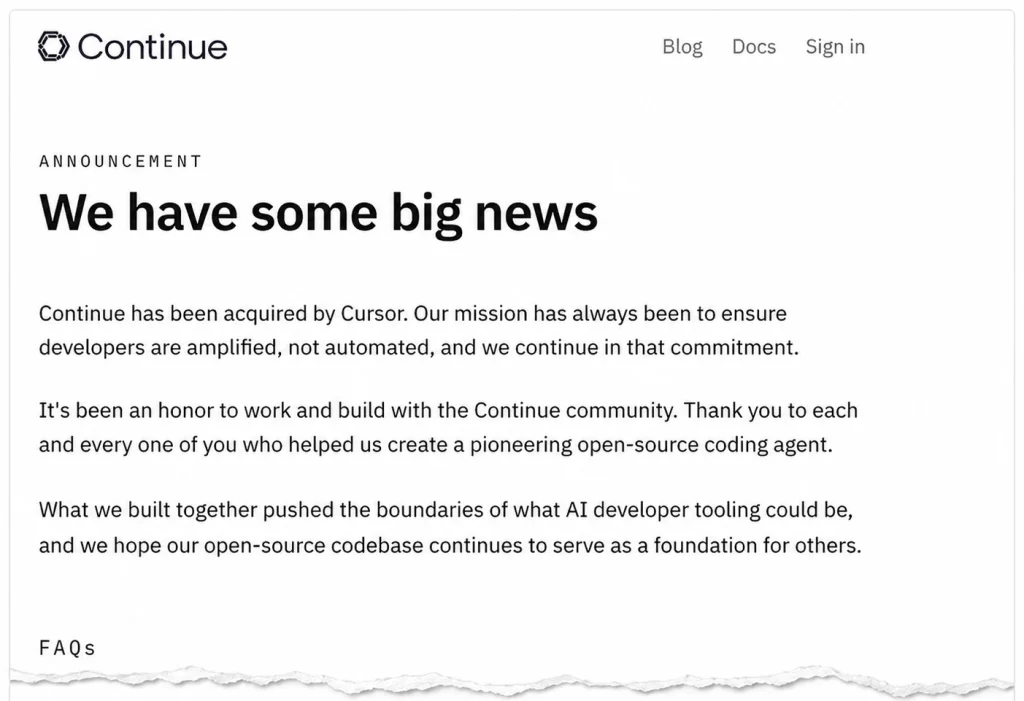

The landscape of AI developer tools is undergoing a significant period of consolidation, marked by the recent acquisition of the open-source coding assistant Continue by Cursor. This move by Cursor, an AI-native code editor, follows a period of intense activity for the company, which has engaged in several strategic acquisitions over the past 18 months. The deal reportedly occurred around the same time as SpaceX’s monumental $60 billion acquisition of Cursor, bringing Continue under the umbrella of Elon Musk’s aerospace and technology conglomerate.
While the financial terms of the Continue acquisition have not been publicly disclosed, the transition appears to have been understated. Continue updated its homepage around mid-June with a concise announcement confirming its acquisition by Cursor. An accompanying FAQ detailed the implications for existing users, including a deadline of July 15 to export their data before it would be permanently deleted, and the disabling of recurring billing. This indicates that Continue, as an independent entity, has ceased operations.
Confirmation of the acquisition emerged through various channels, including emails sent to Continue users and posts on professional networking platforms. Matthaus Krzykowski, an angel investor in Continue and a long-time collaborator through his data pipeline company dltHub, offered a personal tribute to the founding team. This team includes Ty Dunn and Nate Sesti, who co-founded Continue. Krzykowski’s perspective highlights the perceived gap in the market that Continue aimed to fill, even in the face of established players like GitHub Copilot.
"2023 was still very early days of coding agents – yet most investors thought GitHub Copilot had already won," Krzykowski stated in a public post. He elaborated on the developer experience at the time, noting that developers were often resorting to copy-pasting code snippets from general AI chatbots and lacked transparency into how tools like Copilot generated suggestions. This, he explained, fueled his conviction in supporting Dunn and Sesti, whom he had observed closely during their previous ventures.
Krzykowski’s tracking of Ty Dunn’s career began in 2019, when Dunn served as the first product manager at the Berlin-based conversational AI company Rasa. Dunn later became a founding engineer at dltHub in 2022 before co-founding Continue with Sesti in 2023. This background underscores the founders’ experience in the AI and developer tooling space, a factor likely considered in Cursor’s acquisition strategy.
The Open-Source Alternative: Continue’s Mission
Continue emerged from Y Combinator’s Summer 2023 cohort, positioning itself as a crucial open-source alternative in a market increasingly dominated by proprietary AI coding assistants. The platform offered a flexible solution for developers, available as extensions for popular Integrated Development Environments (IDEs) like VS Code and JetBrains, as well as a command-line interface (CLI). A key differentiator for Continue was its ability to allow developers to connect with any AI model of their choice and integrate context from their existing workflows and tools, such as Jira and Confluence. This enabled the creation of highly customized AI coding assistants tailored to specific organizational needs and environments.
Central to Continue’s value proposition was its emphasis on data control and transparency. In an industry where many closed-source tools offered limited insight into how user data was utilized, Continue aimed to provide a more transparent and user-centric approach. In an interview with TechCrunch in early 2025, following a $3 million seed funding round, Ty Dunn articulated this philosophy: "When you use Continue, you get to keep your data. As an organization, you can pool all of your data for all of your developers in one place. That is not possible in the one-size-fits-all, black box code assistant, where their SaaS offerings and strategy is to take your data and use it to improve it for everyone." This focus on data sovereignty resonated with developers concerned about privacy and intellectual property.
Despite this commitment to open-source principles and data control, the startup’s trajectory culminated in its acquisition by a prominent player in the proprietary AI coding tools market. By the time of the acquisition, Continue had garnered significant community support, evidenced by approximately 34,300 GitHub stars and 4,800 forks. The company had raised around $5 million in total funding. Prior to ceasing operations, the Continue team released a final 2.0.0 version, which included the removal of telemetry data and code cleanup, intended to facilitate a smoother transition for the open-source community. The codebase remains available under the Apache 2.0 license, allowing for continued development and modification by third parties.

Cursor’s Quiet Consolidation Strategy
The acquisition of Continue is not an isolated event for Cursor. It represents one of several strategic moves by the company over the past 18 months, a period marked by a consistent acquisition strategy aimed at consolidating its position in the AI developer tooling market. This strategy appears to have been somewhat overshadowed by the recent high-profile SpaceX acquisition news.
Coinciding with the Continue acquisition, Cursor also unveiled "Origin" at its Compile developer conference. Origin is presented as an agent-native alternative to GitHub for code hosting and collaboration, a development that also received relatively little public attention amidst the larger corporate news. This indicates Cursor’s ambition to not only enhance its AI coding assistance capabilities but also to build out a more comprehensive developer ecosystem.
Cursor’s recent acquisition history includes other notable entities. In the past 18 months, the company has acquired the AI coding assistant Supermaven and the code review startup Graphite. Unlike Graphite, which has continued to operate as a distinct product, the acquisition of Continue appears to be structured as an "acqui-hire," a common practice where the primary value lies in the talent and expertise of the acquired team rather than solely the product itself. The discontinuation of the Continue product and the limited public information regarding the transition of its team members to Cursor support this assessment.
According to Krzykowski, Nate Sesti, one of Continue’s co-founders, is indeed joining Cursor. The transition for other key personnel remains less clear. Ty Dunn’s LinkedIn profile indicates his departure from Continue in May, shortly before the acquisition was made public, and his future plans with Cursor are not yet confirmed. Chad Metcalf, who took over as CEO of Continue in April 2025, has also not made any public statements about his next professional steps.
Two of Continue’s founding engineers, Dallin Romney and Patrick Erichsen, have joined OpenClaw, an open-source AI agent that gained considerable traction earlier this year before its creator moved to OpenAI. Their move to OpenClaw signifies a continued engagement with the open-source AI agent space, albeit within a different organizational context.
The broader implications of these consolidations within the AI developer tool market are significant. As major players like Cursor expand their offerings through acquisitions and internal development, the competitive landscape is intensifying. Developers can expect to see more integrated AI-powered solutions that aim to streamline the entire software development lifecycle, from coding and collaboration to code hosting and review. The trend also raises questions about the future of open-source alternatives in this rapidly evolving sector and how they will coexist or be integrated into larger commercial platforms.
The integration of Continue’s technology and team into Cursor’s platform could lead to enhanced AI coding capabilities, offering developers more sophisticated tools for code generation, debugging, and optimization. The emphasis on context awareness and model flexibility, which were core tenets of Continue, may be leveraged to create more personalized and effective AI assistance. Furthermore, Cursor’s acquisition of Origin suggests a strategic vision to build a more cohesive development environment where AI is deeply embedded across all stages of the software development process.
This period of rapid consolidation underscores the immense investment and strategic importance placed on AI technologies for software development. As more companies vie for market share, acquisitions are likely to continue, shaping the tools and platforms that developers rely on daily. The success of these integrations will ultimately depend on their ability to deliver tangible improvements in developer productivity, code quality, and overall user experience.
The New Stack has reached out to both Cursor and Continue for official comment regarding the acquisition and the future plans of the respective teams. Updates will be provided should any further information become available.
