
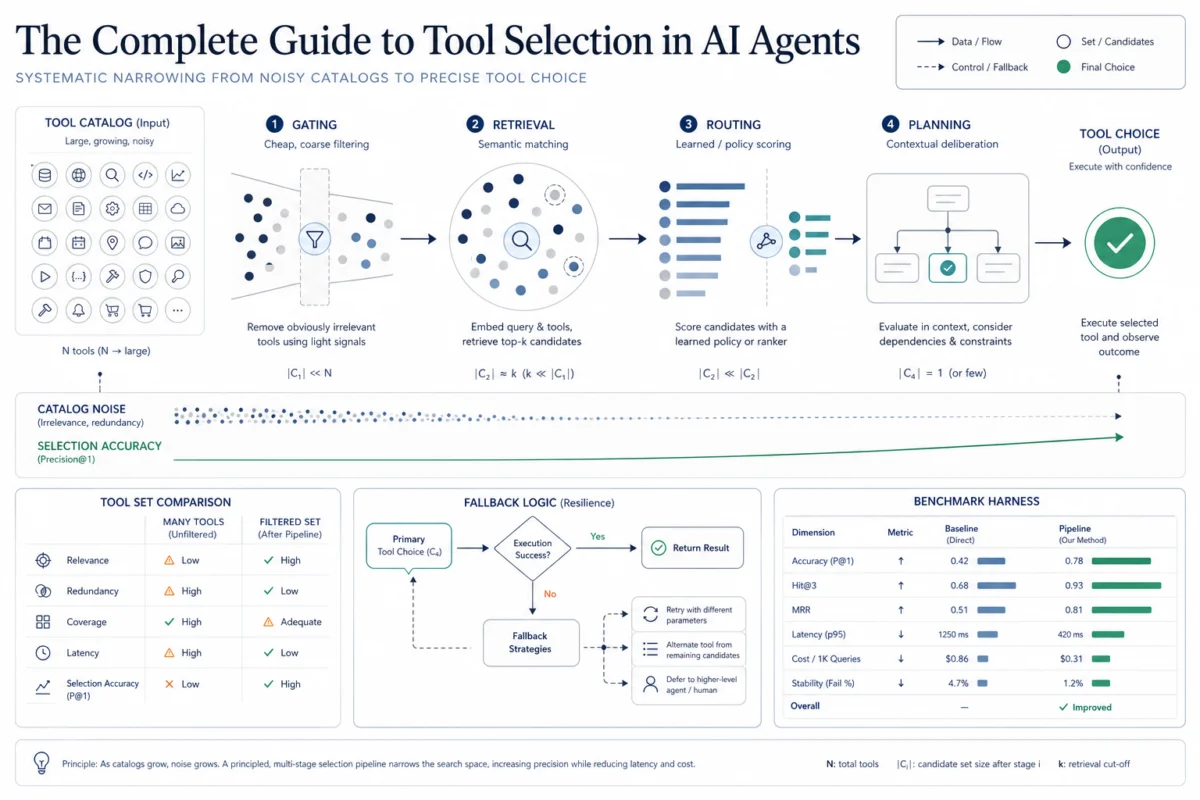

The rapid proliferation of artificial intelligence agents within enterprise environments has unveiled a critical challenge: the degradation of agent accuracy as their integrated tool catalogs expand. While initial deployments with a handful of tools often perform flawlessly, the integration of dozens of disparate functionalities—from intricate file operations and CRM access to communication platforms like Slack and various search APIs—routinely leads to a measurable decline in performance. This article delves into the underlying causes of this degradation and outlines six practical, architecturally sound techniques designed to maintain and enhance tool selection accuracy and efficiency for AI agents operating at scale. These methods, validated by recent research, demonstrate that superior agent performance does not necessitate larger language models but rather a more intelligent and dynamic approach to managing the information presented to them.
The Escalating Challenge of AI Agent Complexity
The journey of an AI agent often begins with impressive demonstrations featuring a lean, purpose-built set of tools. However, as these agents transition from proof-of-concept to production workhorses, their utility inevitably grows, demanding integration with an ever-expanding suite of enterprise applications. What starts as five simple tools can quickly balloon into forty or more, encompassing everything from financial ledger updates and customer service interactions to complex data analysis and internal communications. This exponential growth in tool availability, while increasing an agent’s versatility, paradoxically erodes its reliability. The very agent that once executed tasks with precision begins to falter, misidentifying tools, hallucinating parameters, or stalling due to incorrect function calls.
This decline is not an anomaly but, as observed across numerous deployments, the default trajectory for agents undergoing organic growth. Industry analysis of Multi-Capability Platform (MCP) tool descriptions consistently reveals quality issues, and production benchmarks indicate a noticeable drop in agent accuracy once the number of active tools surpasses a threshold of approximately 10 to 15. A seminal paper, RAG-MCP, published in May 2025, provided empirical evidence and a clear path forward, demonstrating that retrieval-based tool selection could more than triple tool selection accuracy from a mere 13.62% to an impressive 43.13% while simultaneously reducing prompt token consumption by over 50% on identical benchmark tasks. This research underscored a fundamental truth: tool selection is not a tertiary implementation detail but a core architectural decision that dictates an agent’s long-term viability and effectiveness in a real-world, dynamic tool ecosystem. The subsequent sections will detail six deployable techniques, presented in a logical order of implementation, designed to address this challenge: gating, retrieval, routing, planning, fallback logic, and rigorous benchmarking.
Deconstructing Degradation: Why Tool Selection Fails at Scale
The root cause of degrading agent performance with an expanding tool catalog lies in the fundamental operational mechanics of large language models (LLMs). Each tool’s definition—comprising its name, descriptive text, and parameter schema—must be transmitted to the LLM during every request, regardless of whether that specific tool is ultimately invoked. When an agent is equipped with 50 or more tools, this extensive metadata can consume a significant portion, typically 5% to 7%, of the model’s precious context window. This leaves less space for the actual user query, conversational history, and the intricate reasoning required to successfully complete a task, effectively "crowding out" essential information.
Compounding this issue is the well-documented "lost in the middle" effect, a cognitive bias observed in LLMs where information presented at the beginning and end of a context window is recalled far more reliably than data embedded in the middle. With dozens of similar-sounding tool definitions stacked sequentially, the single most appropriate tool for a given task often finds itself precisely in this "dead zone," overlooked not due to a failure in the model’s reasoning capabilities but because its attention is structurally diverted.
A second, more severe failure mode is tool hallucination. When an LLM’s attention is spread thin across a multitude of functionally similar tools, it can erroneously invent tool names that do not exist or correctly identify a tool but then attempt to populate its arguments with parameters borrowed from an entirely different tool’s schema. Such errors are hard failures, as there is no "slightly wrong" way to execute a nonexistent function or a function with malformed arguments. OpenAI, a leading developer in AI, acknowledges a practical upper limit of 128 tools per agent before significant degradation, though practical experience in production environments often shows a noticeable drop in accuracy once an agent actively manages more than 15 to 20 tools. The solution, therefore, is not merely to expand the context window of LLMs but to intelligently control the subset of information the model processes at any given time.
Strategic Interventions for Robust Agent Performance
Addressing the challenges of tool selection at scale requires a multi-layered approach, each technique building upon the last to create a resilient and efficient agent architecture.
Gating: The First Line of Defense
Before investing computational resources into sophisticated tool selection mechanisms, a more fundamental and cost-effective question should be addressed: Does the current conversational turn even require a tool? A substantial proportion of agent interactions are purely conversational, involving acknowledgments like "thanks," clarifications such as "what do you mean by that?", or simple follow-up questions. Running the full retrieval and tool-selection pipeline for every turn, including these purely communicative ones, incurs unnecessary latency and token costs.
A "gate" acts as a fast, inexpensive pre-filter. This can be as simple as a regular expression pattern match for common conversational phrases or a call to a smaller, more efficient classification model. Its purpose is to short-circuit the tool selection process for turns that do not demand external action. For instance, a basic gate can identify phrases like "thank you," "okay," or requests for clarification, immediately returning a conversational response without engaging the tool catalog. This initial filtering step costs almost nothing in terms of computational overhead and can capture a significant share of interactions—typically 20% to 30% in conversational agents. The economic benefit in terms of reduced latency and token expenditure makes gating an immediate return on investment for most agent deployments.
Retrieval-Based Selection: The RAG-MCP Revolution
Once it’s determined that a tool is needed, the next step is to efficiently identify the most relevant tools. Instead of presenting the LLM with the entire catalog, retrieval-based tool selection leverages the power of semantic search. Tool descriptions, along with their parameter schemas, are indexed and embedded into a vector store. When an incoming query arrives, it is similarly embedded, and a similarity search is performed against the indexed tool embeddings. Only the top-K most relevant tools (e.g., top 3-5) are then retrieved and presented to the LLM.
The RAG-MCP framework, detailed in its May 2025 publication, stands as a reference implementation for this paradigm. It demonstrated that by semantically identifying relevant MCP tools before the LLM sees the full catalog, tool selection accuracy dramatically improved from 13.62% to 43.13%. This more than threefold increase in accuracy was coupled with a reduction of over 50% in prompt tokens on benchmark tasks. The efficacy stems from the LLM now making a choice from a concise, highly relevant set of candidates, rather than sifting through a verbose list of near-misses or irrelevant options. This method not only improves accuracy but also significantly reduces the computational load and associated costs by presenting a much smaller, focused context to the LLM.
Semantic Routing: Navigating Complex Toolscapes
While retrieval excels at selecting specific tools from a flat list, semantic routing addresses a slightly different problem: identifying the appropriate category or "toolbox" when tools naturally cluster into distinct functional domains. Consider an enterprise agent that handles data operations, communication tasks, and scheduling. Routing allows the system to first determine if the user’s intent falls into "data," "communication," or "scheduling," and then load only the tools pertinent to that specific category.
This approach is particularly valuable in highly modular or departmentalized agent architectures. For example, a query related to "updating quarterly sales figures" would be routed to the "data management" module, which contains tools like query_database, read_file, and write_data. Conversely, "send a team-wide announcement" would trigger the "communication" module, exposing send_email and send_slack_message. Routing can be implemented using vector similarity against category centroid embeddings (e.g., averaged embeddings of example queries for each category) or even smaller, specialized LLMs trained for classification. A crucial aspect of robust routing is its ability to recognize when a query does not confidently fit into any predefined category, defaulting to a "general" category or escalating for clarification rather than making a low-confidence, potentially incorrect, guess.
Planner-Based Execution: Orchestrating Multi-Step Workflows
Many real-world agent tasks are not single-step actions but complex workflows requiring a sequence of tool calls. Directly exposing all tools to the LLM for multi-step reasoning can lead to the "God Agent anti-pattern," where a single, monolithic agent attempts to manage a vast array of tools without a clear internal plan, increasing the likelihood of errors at any stage.
Planner-based tool selection addresses this by first asking the LLM to output a structured, ordered plan. This plan decomposes a complex task into discrete subtasks, each explicitly tagged with the specific capabilities it requires. For example, a request to "summarize the latest sales report and email it to the team" might be broken down into:
- Search for the latest sales report file (required capability:
search). - Read the contents of the report file (required capability:
file_io). - Summarize the key findings (required capability:
synthesis). - Email the summary to the sales lead (required capability:
communication).
For each step, only the tools explicitly tagged for that step’s required capability are presented to the LLM. This dramatically narrows the tool list at each decision point, leveraging the same principle as retrieval but applied at a finer, sequential grain. This architectural pattern enhances reliability, makes debugging easier, and prevents errors in one part of a complex task from cascading unnecessarily across the entire workflow.
Robustness Through Fallback Logic: Ensuring Graceful Degradation
Even with advanced gating, retrieval, and routing mechanisms, real-world queries can be ambiguous, underspecified, or genuinely outside an agent’s current capabilities. How an agent responds to these edge cases determines whether it degrades gracefully or fails catastrophically. Implementing a multi-tier fallback logic chain is crucial for maintaining user trust and system stability.
A robust fallback chain typically operates in three tiers:
- High Confidence Resolution: If the primary tool selection (e.g., from retrieval or routing) yields a high confidence score, the tool call proceeds directly.
- Low Confidence Retry: If the initial confidence is low, the system attempts a retry. This often involves reformulating the user’s query—either through simple heuristics (e.g., stripping filler words) or by prompting a smaller LLM to restate the user’s intent more clearly and concisely. The reformulated query is then passed through the tool selection pipeline again.
- Escalation for Clarification: If even after a retry, the confidence remains below a predefined threshold, the agent should never attempt a low-confidence tool call. Instead, it should escalate the situation by explicitly requesting clarification from the user. A phrase like, "I’m not confident which tool fits your request. Could you clarify what you’d like me to do?" prevents potentially damaging incorrect actions and guides the user toward a successful interaction. This escalation path, often overlooked in initial designs, is paramount in production environments, as a confidently incorrect tool execution is far more detrimental than a system that transparently admits uncertainty and seeks user guidance.
Measuring Success: The Imperative of Benchmarking
The effectiveness of any optimization technique remains hypothetical until rigorously measured. Benchmarking is the critical final step, providing empirical validation of improvements in accuracy, cost, and latency. The methodology is straightforward: create a labeled dataset of (query, correct tool) pairs that accurately reflects real-world usage. This dataset should ideally be built from logged production queries to ensure relevance.
The system under test (your optimized agent pipeline) is then run against this benchmark set, and its performance is compared against a naive baseline where the full tool catalog is presented to the LLM for every decision. Key metrics to track include:
- Accuracy: The percentage of queries for which the correct tool was selected.
- Token Cost: The average number of prompt tokens consumed per query, directly impacting operational costs.
- Latency: The time taken to select a tool, measured at various percentiles (e.g., P50 for average experience, P95/P99 for worst-case performance).
The MCPToolBench++, a large-scale benchmark published in August 2025, provides a rigorous framework for such evaluations, encompassing over 4,000 real MCP servers across more than 40 categories. While its scale is formidable, the core principles apply to any agent system: consistent, repeatable measurement reveals whether architectural changes deliver tangible improvements. For instance, a benchmark comparison might show that a retrieval-filtered pipeline maintains 90% accuracy while reducing average tokens per query by 70% compared to a baseline, demonstrating a clear win in both efficiency and maintainability.
The Future of Agentic AI: Designed for Scale and Reliability
The six techniques outlined—gating, retrieval, routing, planning, fallback logic, and benchmarking—are not mutually exclusive alternatives but complementary layers within a robust agent architecture. Gating serves as a cost-effective initial filter, separating purely conversational turns from those requiring tool interaction. Retrieval or routing then intelligently narrows the tool catalog for relevant turns, ensuring the LLM operates with a focused context. Planning orchestrates multi-step tasks, further refining tool exposure to individual steps. Fallback logic provides essential resilience, preventing erroneous actions when initial selection is uncertain. Finally, continuous benchmarking is the indispensable feedback loop, quantifying the impact of these optimizations and guiding future development.
The dramatic improvements reported by research initiatives like RAG-MCP, showcasing accuracy increases of over 300% and token reductions by more than 50%, are not isolated incidents. They are predictable outcomes when developers move beyond the naive approach of presenting a vast, undifferentiated "phone book" of tools to an LLM before every decision. These advancements do not hinge on the advent of larger, more powerful models or ever-expanding context windows. Instead, they emphasize a paradigm shift: treating the AI agent’s tool list as a meticulously designed component rather than a simple append-only catalog. By embracing these architectural principles, enterprises can build AI agents that scale reliably, perform accurately, and deliver consistent value across increasingly complex operational landscapes.
