

Amazon Web Services (AWS) has announced the launch of CloudFormation Express mode, a transformative new deployment option designed to dramatically accelerate infrastructure provisioning for developers and AI tools. This innovation promises to slash deployment times by up to four times, fundamentally altering the pace of iterative development workflows and certain production scenarios within the AWS ecosystem. The core mechanism behind Express mode is its ability to complete deployments once resource configuration is applied, foregoing the traditional, often lengthy, stabilization checks that have historically added significant overhead to the process.
The Evolution of Infrastructure as Code and CloudFormation’s Role
To fully appreciate the significance of CloudFormation Express mode, it is essential to understand the landscape of Infrastructure as Code (IaC) and AWS CloudFormation’s pivotal role within it. Infrastructure as Code is the practice of managing and provisioning computing infrastructure through machine-readable definition files, rather than physical hardware configuration or interactive configuration tools. It emerged as a critical methodology to address the challenges of manual infrastructure management, offering benefits such as consistency, repeatability, version control, and auditability.
AWS CloudFormation, launched in 2011, quickly became a cornerstone of IaC within the AWS cloud. It provides developers and operations teams with a declarative language to model, provision, and manage AWS and third-party resources. Users define their desired infrastructure state in templates (YAML or JSON), and CloudFormation handles the orchestration, creating, updating, or deleting resources in the correct order and managing dependencies. This abstraction significantly simplified complex deployments, enabling organizations to scale their cloud operations with greater efficiency and fewer errors. Over the years, CloudFormation has evolved, introducing features like Change Sets for previewing modifications, Nested Stacks for modularity, and drift detection to identify configuration changes outside of CloudFormation management. Its widespread adoption underscores the industry’s reliance on robust IaC tools for managing increasingly intricate cloud architectures.
Understanding the Bottleneck: The Necessity and Cost of Stabilization Checks
Traditionally, every CloudFormation deployment operates in a "Standard mode," which includes comprehensive stabilization checks after resource configuration is applied. These checks are crucial for ensuring that provisioned resources are not just created but are fully operational, healthy, and ready to serve traffic before the deployment is officially marked as complete. For instance, when creating an Amazon EC2 instance, stabilization checks might wait for the instance to pass its status checks, for associated network interfaces to be fully attached and configured, and for any boot-up scripts to complete. Similarly, for a database service like Amazon RDS, it would confirm the database instance is fully online, accessible, and ready for connections.
While vital for ensuring the integrity and immediate usability of production environments, these extended stabilization checks can introduce significant delays, particularly in scenarios demanding rapid iteration. For developers iterating on infrastructure configurations, testing individual application components, or engaging in continuous integration/continuous deployment (CI/CD) pipelines, waiting minutes or even tens of minutes for each small change to stabilize becomes a substantial bottleneck. This latency translates into longer development cycles, reduced developer productivity due to increased context switching, and slower feedback loops, hindering agile methodologies. In a fast-paced cloud environment where agility is a competitive advantage, minimizing these wait times has become a critical objective.
CloudFormation Express Mode: A Strategic Shift for Accelerated Development
CloudFormation Express mode represents a strategic re-evaluation of the deployment completion criteria, offering a targeted solution for scenarios where immediate full stabilization is not the primary concern. In Express mode, CloudFormation signals deployment completion as soon as the resource configuration has been successfully applied, allowing resources to continue becoming operational in the background. This fundamental shift prioritizes speed for specific use cases without compromising the underlying resource provisioning logic.
The new mode is particularly beneficial for two primary scenarios:
- Iterative Development Workflows: Developers frequently make small, incremental changes to their infrastructure during the development and testing phases. For example, tweaking an AWS Lambda function’s memory allocation, adding a new S3 bucket policy, or modifying an Amazon SQS queue’s access policy. In these scenarios, waiting for every resource to pass full stabilization checks for each minor adjustment significantly impedes the development flow. Express mode allows developers to quickly deploy changes, test them, and iterate again, drastically shortening the feedback loop and fostering a more fluid development experience.
- AI-Assisted Infrastructure Development: The burgeoning field of AI-driven infrastructure management, where AI models generate, optimize, or modify cloud resources, stands to gain immensely from Express mode. AI tools, such as Kiro and those leveraging the AWS MCP Server and its plugins, thrive on rapid feedback loops to learn and refine their infrastructure-generating capabilities. Sub-minute deployment completion times enable these AI agents to experiment, validate configurations, and adapt much faster, accelerating the advancement of intelligent cloud automation.
- Production Scenarios Tolerant of Eventual Stabilization: While not suitable for all production deployments, Express mode can be leveraged in production environments where applications are designed to be resilient to eventual consistency or where immediate traffic shifting is not required. For instance, deploying a new logging pipeline or an auxiliary monitoring service might not require instant, full stabilization, making Express mode a viable option to expedite these deployments.
Crucially, Express mode introduces built-in resilience by automatically retrying dependent resources that encounter transient failures during provisioning within the same stack. This intelligent retry mechanism handles common timing issues that can arise as resources stabilize independently in the background, minimizing the need for manual intervention and enhancing the reliability of faster deployments. It is important to reiterate that Express mode changes when the deployment completes, not how resources are provisioned; the underlying process of creating and configuring resources remains robust and consistent with CloudFormation’s established standards.
Quantifiable Impact and Real-World Examples
The performance gains offered by CloudFormation Express mode are substantial. AWS benchmarks demonstrate a reduction in deployment time by up to four times, translating into significant time savings for development teams. The provided examples vividly illustrate this acceleration:
- Amazon Simple Queue Service (SQS) Queue with a Dead Letter Queue (DLQ): A common pattern for robust messaging systems. In Standard mode, creating such a configuration could take approximately 64 seconds. With Express mode, this process completes in a mere 10 seconds, a reduction of over 80%.
- Deleting an AWS Lambda Function with Network Interface Attachment: Lambda functions often require Elastic Network Interfaces (ENIs) when configured within a Virtual Private Cloud (VPC). Deleting such a function, which involves disassociating and cleaning up the ENI, can be a protracted process in Standard mode, taking anywhere from 20 to 30 minutes. Express mode slashes this down to an astonishing 10 seconds, a near-instantaneous deletion that dramatically improves cleanup and iteration cycles.
These examples highlight how Express mode can be particularly impactful for resource types with complex dependencies or lengthy stabilization routines, such as networking components (VPCs, subnets, security groups, NAT Gateways), database services (RDS instances, DynamoDB tables with global tables), and container services (ECS/EKS clusters). For organizations managing hundreds or thousands of such resources, these cumulative time savings can translate into hundreds of developer hours reclaimed annually, significantly boosting overall operational efficiency and innovation capacity. Industry data consistently shows that faster lead times for changes and lower change failure rates, both positively influenced by quicker deployments, are hallmarks of high-performing engineering organizations.
Seamless Integration and Flexible Configuration
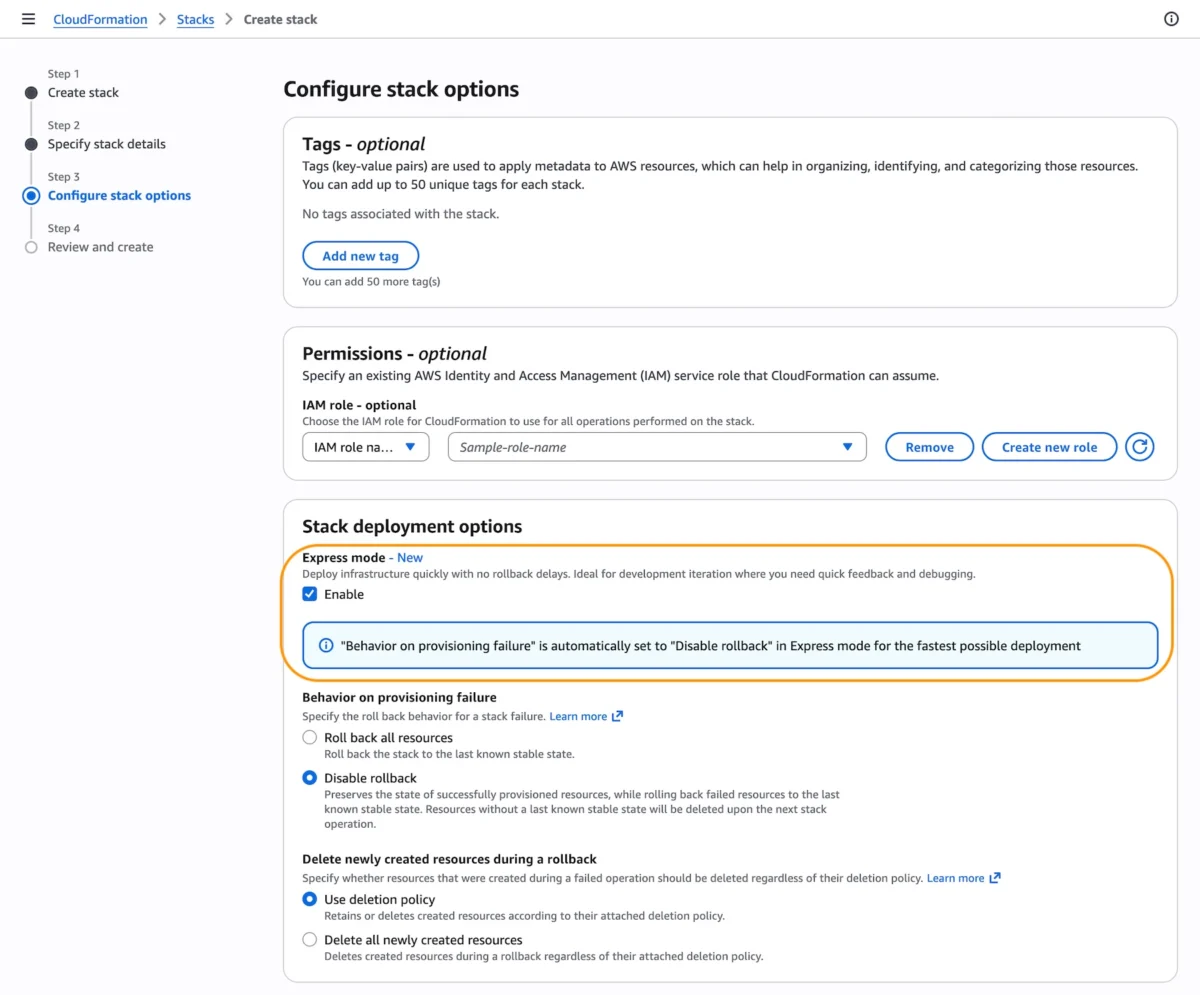
Adopting CloudFormation Express mode is designed to be straightforward, integrating seamlessly with existing workflows and tools. Users can enable Express mode directly through the AWS Management Console by selecting "Enable" under "Express mode" within the "Stack deployment options" when creating or updating a stack.
For programmatic control, Express mode is accessible via the AWS Command Line Interface (AWS CLI) and AWS SDKs. Developers can activate it by setting the --deployment-config parameter to '"mode": "EXPRESS"' when executing create-stack, update-stack, or delete-stack commands. Crucially, no changes to existing CloudFormation templates are required, ensuring backward compatibility and a smooth transition.

Infrastructure as Code tools built on CloudFormation, such as the AWS Cloud Development Kit (CDK), also support Express mode. CDK users can simply deploy their stacks using the cdk deploy --express command, which orchestrates the deployment through CloudFormation Express mode. Furthermore, AI tools like Kiro, which automate infrastructure provisioning, can leverage this new mode to achieve sub-minute feedback loops, accelerating their learning and operational efficiency.
By default, Express mode disables rollback for the fastest iteration experience. This means that if a deployment fails, CloudFormation will not automatically revert to the previous stable state. While this design choice maximizes speed, especially beneficial for development and testing, it necessitates that users either re-enable rollback by setting disableRollback to false in the deployment-config for production environments or implement their own monitoring and cleanup mechanisms for failed deployments. For iterative development, disabling rollback can be advantageous, allowing developers to inspect the partially deployed state and debug issues more directly. AWS advises adherence to the principle of least privilege for IAM roles used in deployments, regardless of the deployment mode.
Broader Implications and Industry Impact
The introduction of CloudFormation Express mode has far-reaching implications across the cloud computing landscape:
- Enhanced Developer Productivity and Experience: By dramatically reducing waiting times, Express mode empowers developers to maintain flow state, iterate more rapidly, and experiment more freely. This directly translates to higher job satisfaction, faster feature delivery, and ultimately, more innovative solutions. It alleviates a common pain point in the developer experience, particularly for those working on complex, multi-resource cloud applications.
- Accelerated DevOps and CI/CD Pipelines: Faster deployments mean faster CI/CD cycles. Automated pipelines can execute infrastructure changes and associated tests much quicker, enabling organizations to achieve higher deployment frequencies and shorter lead times for changes, key metrics for DevOps maturity. This can significantly improve an organization’s ability to respond to market demands and adapt to evolving business requirements.
- Catalyst for AI in Cloud Management: Express mode is a game-changer for AI-assisted infrastructure. AI models can now provision and manage infrastructure with unprecedented agility, enabling more dynamic resource allocation, predictive scaling, and self-healing systems. The ability to receive sub-minute feedback on generated infrastructure allows AI agents to learn and optimize their output much faster, pushing the boundaries of autonomous cloud operations. This could lead to a new generation of cloud management tools that are far more responsive and efficient.
- Competitive Edge for AWS: This innovation further solidifies AWS’s position as a leader in cloud infrastructure management. While other IaC tools exist, native integration with CloudFormation, combined with this significant speed improvement, provides a compelling advantage for AWS users, especially those deeply invested in the AWS ecosystem. It demonstrates AWS’s commitment to continuous improvement and responsiveness to developer needs.
- Shaping the Future of Cloud Provisioning: Express mode hints at a future where infrastructure changes are near-instantaneous, moving closer to the ideal of truly elastic and ephemeral cloud environments. This paves the way for more sophisticated architectural patterns, such as highly dynamic microservices that can be spun up and down on demand, and advanced disaster recovery strategies that rely on rapid re-provisioning.
- Considerations for Operational Maturity: While offering immense speed, Express mode requires a nuanced understanding of its implications. Organizations must carefully evaluate whether their production scenarios can tolerate eventual stabilization, particularly for mission-critical applications where immediate operational readiness is paramount. Robust monitoring and alerting systems become even more critical to track resource health and ensure proper stabilization in the background. The default disabling of rollbacks also necessitates mature operational practices for error handling and recovery.
Availability and Future Outlook
AWS CloudFormation Express mode is available immediately across all AWS commercial Regions at no additional cost. This broad availability ensures that a vast majority of AWS customers can begin leveraging its benefits without delay. For specific regional availability and a glimpse into the future roadmap, users are encouraged to visit the AWS Capabilities by Region page. Comprehensive documentation is also available through the CloudFormation documentation, providing detailed guidance on implementation and best practices. AWS also encourages users to provide feedback via AWS re:Post for AWS CloudFormation or through their usual AWS Support channels, emphasizing a commitment to continuous improvement based on user experience.
CloudFormation Express mode marks a significant milestone in cloud infrastructure management, reflecting AWS’s ongoing dedication to empowering developers and driving innovation. By addressing the critical need for speed in modern cloud workflows, it is set to transform how organizations build, deploy, and manage their cloud infrastructure, ushering in an era of unprecedented agility and efficiency.
