

NEW YORK, NY – Amazon Web Services (AWS) marked a significant moment in the evolution of artificial intelligence for the enterprise at its annual AWS Summit in New York City. On June 17, 2026, Swami Sivasubramanian, AWS Vice President of Agentic AI, delivered a pivotal keynote address, revealing a suite of advanced capabilities designed to empower organizations with more autonomous, intelligent, and governable AI agents. The announcements, centered around enhancements to Amazon Bedrock AgentCore and the introduction of autonomous agents within Amazon Quick, signal AWS’s accelerated push to integrate sophisticated AI into the core fabric of business operations, promising unprecedented levels of productivity and innovation.
The AWS Summit New York serves as a crucial platform for the cloud computing giant to connect with its vast customer base, ranging from startups to Fortune 500 companies, showcasing its latest advancements and strategic vision. This year’s event, held in the bustling metropolis, drew thousands of developers, IT professionals, and business leaders keen to explore the cutting edge of cloud technology, particularly in the burgeoning field of artificial intelligence. Sivasubramanian’s keynote, a highly anticipated segment of the summit, underscored AWS’s commitment to making advanced AI accessible and practical for real-world business challenges. His presentation illuminated a future where AI agents transcend mere task automation, evolving into proactive, intelligent assistants capable of complex reasoning, continuous learning, and secure interaction within enterprise ecosystems.
Revolutionizing Agent Creation with Amazon Bedrock AgentCore
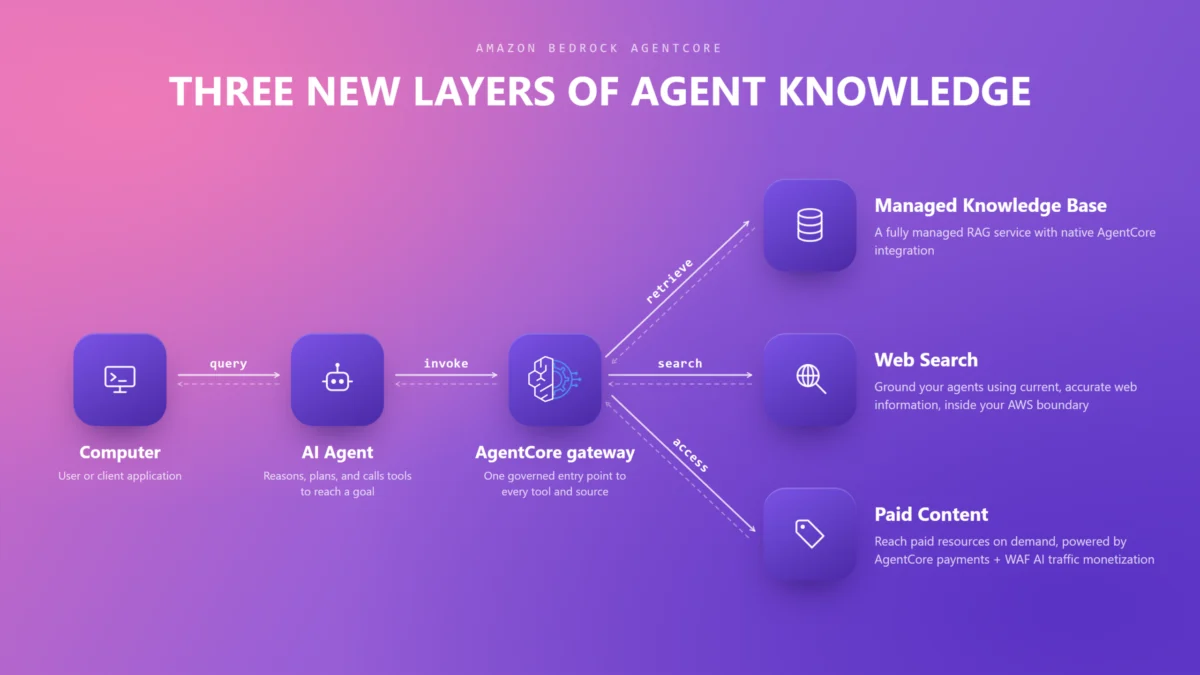
At the heart of AWS’s latest AI strategy lies Amazon Bedrock AgentCore, a foundational service designed to simplify the development and deployment of generative AI applications. The new capabilities introduced for AgentCore are poised to transform how businesses build, govern, and continuously improve their AI agents. A primary focus is on expanding the knowledge base available to these agents, allowing them to tap into diverse information sources.
Previously, AI agents often operated within predefined data sets or limited integrations. The new Bedrock AgentCore empowers agents to connect seamlessly with "organizational, web, and paid knowledge." This means an AI agent can now access a company’s internal documents, databases, and proprietary information, search the public web for real-time data, and even leverage subscriptions to specialized paid knowledge services. For instance, a research agent could synthesize internal sales reports with external market analysis from a paid subscription service and current news trends, providing a holistic view for strategic decision-making. This comprehensive knowledge integration significantly enhances the agents’ ability to provide accurate, contextually relevant, and up-to-date insights, moving them beyond simplistic query-response systems.
Furthermore, the updated AgentCore introduces sophisticated tools for helping teams "find and fix what’s going wrong in production." This capability is critical for the reliable operation of AI agents in complex enterprise environments. It includes enhanced monitoring, debugging, and diagnostic features that allow developers and IT teams to quickly identify performance bottlenecks, data inconsistencies, or logical errors within an agent’s workflow. By providing clearer visibility into agent behavior and execution paths, organizations can maintain high levels of operational efficiency and swiftly resolve issues, minimizing downtime and ensuring the integrity of AI-driven processes. This focus on observability and troubleshooting is a direct response to the increasing complexity of AI deployments and the need for robust operational governance.
Perhaps one of the most crucial advancements for enterprise adoption is the ability to "enforce controls that scale as agents grow more capable." As AI agents become more sophisticated and take on more critical roles, the need for stringent governance, security, and compliance mechanisms becomes paramount. These new controls within Bedrock AgentCore allow organizations to define granular access policies, data usage restrictions, and ethical guardrails that can automatically adapt as agents evolve in their capabilities and scope. This ensures that AI agents operate within defined boundaries, adhering to regulatory requirements and internal corporate policies, mitigating risks associated with data privacy, security breaches, or unintended AI behavior. The emphasis on scalable controls is a testament to AWS’s commitment to responsible AI development, providing businesses with the confidence to deploy advanced AI solutions without compromising security or compliance.
These collective enhancements to Amazon Bedrock AgentCore are designed to accelerate the development lifecycle of intelligent agents, enabling organizations to build more powerful and reliable AI solutions faster. The continuous learning aspect, hinted at in the original announcement, suggests mechanisms for agents to improve their performance over time through feedback loops and adaptive algorithms, further cementing their value within dynamic business environments.
Amazon Quick: Autonomous Agents for Unparalleled Productivity
Beyond the foundational agent-building capabilities, AWS also unveiled transformative advancements within Amazon Quick, its AI assistant platform. The launch of "new autonomous agents" within Amazon Quick represents a significant leap forward in personal and team productivity, allowing users to delegate specialized tasks to AI agents that operate proactively in the background.
These autonomous agents can be endowed with "specific expertise, tone, and access to tools." This customization allows businesses to create highly specialized AI assistants tailored to distinct departmental or functional needs. For example, a "finance agent" could be configured to autonomously process incoming orders, verify payment details, flag discrepancies, and initiate invoicing, all while adhering to established financial protocols and communicating in a formal tone. This not only automates routine tasks but also ensures consistency and reduces human error in critical financial operations.
Similarly, a "sales agent" could be deployed to monitor customer relationship management (CRM) systems, email communications, and internal messaging platforms like Slack. This agent could proactively draft follow-up emails after client meetings, identify potential sales risks based on communication patterns, or recommend next steps to sales representatives, such as suggesting a product demo or a pricing review. Such an agent acts as an always-on, intelligent co-pilot for sales teams, freeing up valuable human capital to focus on strategic client engagement rather than administrative overhead.
Complementing these specialized agents, AWS is also releasing a "new activity feed that is tailored to how you work." This intelligent feed consolidates disparate communication channels – including email, messaging applications, calendar events, and task lists – into a single, prioritized view. What makes this feature particularly innovative is its ability to "learn which messages you always answer fast, which threads you skip, and what topics drive your week." By understanding a user’s unique work patterns and preferences, the activity feed intelligently surfaces the most relevant and urgent information, cutting through digital clutter. This personalized prioritization helps users manage information overload, ensure critical items are addressed promptly, and maintain focus on high-priority tasks, ultimately reclaiming valuable hours in their day. The integration of such a smart activity feed with autonomous agents creates a synergistic ecosystem where proactive AI agents manage tasks and communications, and a personalized interface helps users stay on top of their most important work.

Broader Implications and Market Impact
These announcements from the AWS Summit New York City arrive at a time when enterprises globally are grappling with the immense potential and inherent complexities of artificial intelligence. The market for AI, particularly generative AI and agentic systems, is experiencing exponential growth. Industry reports project the global AI market to exceed trillions of dollars in the coming years, with enterprise applications forming a significant portion of this expansion. Businesses are increasingly seeking practical, scalable, and secure ways to integrate AI into their operations to drive efficiency, foster innovation, and gain a competitive edge.
AWS’s focus on agentic AI with enhanced governance and knowledge integration directly addresses key concerns for enterprise adoption: control, security, and relevance. By providing robust frameworks for building and managing AI agents, AWS is positioning itself as a leader in democratizing advanced AI, making it accessible even to organizations with limited in-house AI expertise. The ability for agents to tap into diverse knowledge sources and operate autonomously with specialized expertise moves beyond generic AI assistants, offering bespoke solutions that can significantly impact specific business functions.
The emphasis on "enforcing controls that scale" also speaks to the growing imperative for responsible AI development. As AI systems become more powerful and autonomous, ethical considerations, data privacy, and accountability become paramount. AWS’s commitment to building these governance features directly into its platforms reassures businesses that they can leverage cutting-edge AI while adhering to stringent regulatory and ethical standards. This strategic approach is likely to accelerate enterprise trust and adoption of agentic AI solutions.
From an economic perspective, the productivity gains promised by Amazon Quick’s autonomous agents could be substantial. By automating routine, time-consuming tasks across various departments – from finance and sales to customer service and HR – organizations can reallocate human talent to more strategic, creative, and high-value activities. This could lead to significant cost savings, improved operational efficiency, and a more engaged workforce. The personalized activity feed, by reducing cognitive load and improving focus, further amplifies these productivity benefits, offering a holistic solution for modern knowledge workers.
Expert and Industry Reactions
While specific expert reactions were not detailed in the original brief, the general sentiment within the technology industry towards advancements in agentic AI is overwhelmingly positive, tempered with a healthy dose of caution regarding responsible deployment. Analysts are likely to commend AWS for deepening its commitment to enterprise-grade AI, particularly by addressing critical needs like knowledge integration, operational resilience, and robust governance. The ability to customize agents for specific business functions is seen as a crucial step away from one-size-fits-all AI solutions, allowing for more precise and impactful applications.
Concerns, if any, would typically revolve around the complexity of integrating these advanced agents into existing legacy systems, the need for continuous training and fine-tuning, and the ongoing challenge of ensuring data privacy and security in a world of increasingly interconnected AI. However, AWS’s explicit focus on scalable controls and robust operational support aims to mitigate these concerns proactively.
A Glimpse into the Future of Work
The innovations unveiled at the AWS Summit New York City, particularly those concerning Amazon Bedrock AgentCore and Amazon Quick, paint a vivid picture of the future of work. This future is characterized by intelligent, autonomous agents that collaborate seamlessly with human teams, augmenting capabilities, automating mundane tasks, and providing predictive insights. It’s a future where information overload is managed by personalized AI, and specialized agents become integral members of operational workflows.
AWS continues to solidify its position as a leading provider of cloud infrastructure and AI services, empowering enterprises to navigate the complexities of the digital age. The June 17, 2026 announcements, further detailed by additional launches on June 18, 2026, underscore a strategic vision where AI is not just a tool but a transformative force, meticulously designed to be powerful, manageable, and deeply integrated into the fabric of global business. As organizations increasingly seek to harness the power of AI, AWS’s commitment to delivering enterprise-ready, governable, and highly capable agentic solutions positions them to drive the next wave of digital transformation.
