
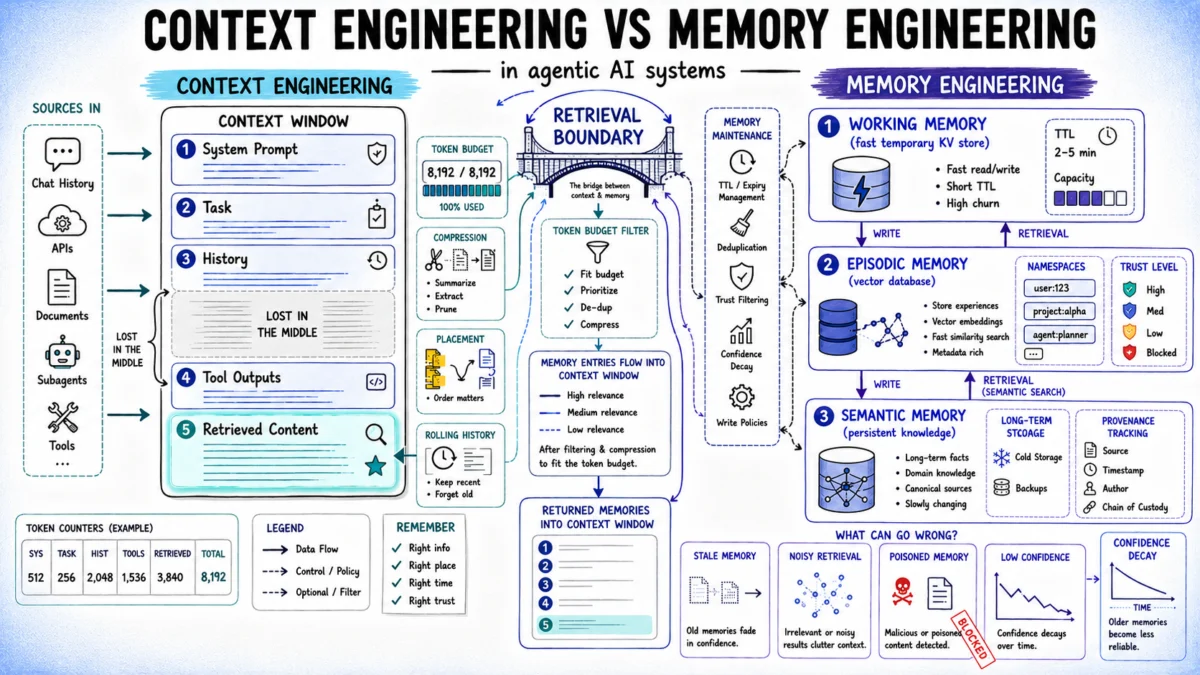

As artificial intelligence agents transition from isolated tasks to intricate, multi-session workflows and longer operational lifecycles, a recurring set of challenges has emerged, often undermining their performance and reliability. Instances where initial constraints are inexplicably dropped mid-task, irrelevant historical data resurfaces, or context from earlier, unrelated steps bleeds into current operations are becoming increasingly common. Pinpointing the exact cause of these failures is often difficult because no single component appears overtly faulty. Instead, the root of these issues frequently lies in the nuanced interplay, or lack thereof, between two critical yet often conflated disciplines: context engineering and memory engineering. While related, these fields are distinct, present different failure modes, and necessitate specialized system designs to be effectively managed.
The Rise of Agentic AI and Its Memory Dilemmas
The proliferation of AI agents, designed to autonomously execute complex tasks, represents a significant leap in AI capabilities. From personal assistants managing schedules across weeks to enterprise agents automating intricate business processes, these systems promise enhanced productivity and innovation. However, their efficacy hinges on their ability to maintain coherence, learn from past interactions, and apply relevant information precisely when needed. This is where the engineering of "understanding" (context) and "retention" (memory) becomes paramount.
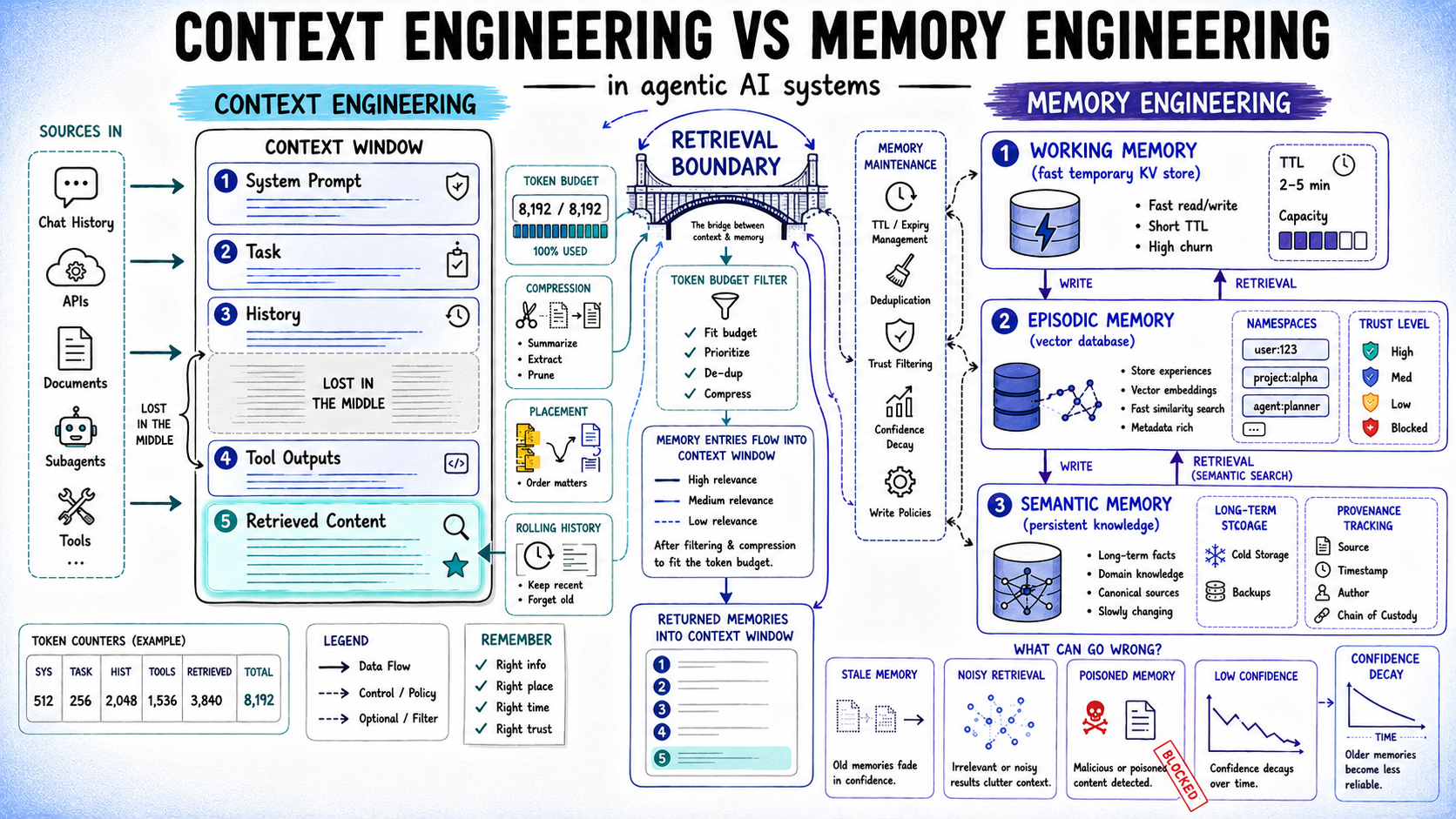
Context engineering, at its core, focuses on the design and optimization of a single inference call. It dictates what information is included in the model’s active window, how it is compressed, where it is strategically placed, and what is ultimately discarded. Critically, everything within this scope is ephemeral; once the inference call concludes, the context window is cleared, and its contents are lost. This ephemeral nature means context engineering is about immediate, task-specific relevance and optimal presentation to the large language model (LLM).
Conversely, memory engineering addresses the persistence of information beyond a single interaction. It encompasses the comprehensive systems and policies governing how information is written, stored, retrieved, updated, and governed to ensure its availability and utility for future interactions. When an AI agent recalls a user preference from a previous session, coordinates actions with another agent, or applies a learned procedural pattern, it relies heavily on robust memory engineering, not just transient context. In essence, while context engineering determines what an AI sees now, memory engineering determines what an AI remembers and can retrieve later.
Differentiating Core Aspects: Context vs. Memory
Understanding the fundamental distinctions between these two disciplines is crucial for developing resilient AI agents. Their operational scopes, data lifecycles, and primary challenges diverge significantly:
- Scope: Context engineering operates within the confines of a single LLM inference call, making its concerns immediate and short-lived. Memory engineering, however, spans across multiple calls, sessions, and even different agents, addressing long-term information management.
- Data Residence: Information managed by context engineering resides temporarily within the model’s active token window. Memory engineering leverages external, persistent stores such as vector databases, key-value stores, or relational databases.
- Primary Problem: Context engineering grapples with what to include in the current prompt and how to arrange it for optimal model attention. Memory engineering focuses on what to persist, how to retrieve it reliably, and how to maintain its trustworthiness over time.
- Failure Modes: Context engineering fails when the token window overflows, information is poorly placed (leading to the "lost in the middle" effect), or noise overwhelms the signal. Memory engineering failures include missed retrievals, data staleness, information poisoning (due to low-quality or malicious writes), and the absence of clear write/update policies.
- Engineering Surface: Context engineering involves prompt structure design, compression algorithms, and meticulous token budgeting. Memory engineering necessitates robust storage schemas, sophisticated retrieval strategies, and well-defined write and update policies.
- Data Lifespan: Contextual data exists only for the duration of a single LLM call. The lifespan of memory data varies significantly depending on its type and configured retention policies.
Context Engineering: Crafting the Optimal Inference Window
For an AI agent engaged in a multi-step workflow, each inference call requires the assembly of a highly optimized context window from a diverse array of sources. These sources can include the system prompt, task description, ongoing conversation history, outputs from external tools, retrieved documents, and even summaries from sub-agents. Context engineering is the systematic process of making design decisions that determine what each of these components contributes, in what specific form, and at what position within the window.
1. Selective Inclusion: Beyond Mere Retrieval
A common misconception is that all available information should be fed into the context window. However, this often proves counterproductive. Consider a database query returning hundreds of rows, a web search yielding five complete articles, or a code executor generating verbose logs. Injecting all this raw data can quickly bloat the context window, exceeding token limits and, more importantly, degrading the model’s reasoning quality long before the limit is reached. The decision of what to include verbatim, what to compress into key facts, and what to discard entirely is a deliberate design choice, not a default. Effective selective inclusion requires intelligent pre-processing, summarization, and filtering mechanisms. For instance, a complex API response might be summarized by a smaller, specialized LLM before its essence is passed to the main agent.
2. Structural Placement: Mitigating "Lost in the Middle"
Research, notably by Anthropic, has consistently shown that the position of information within the context window significantly impacts how reliably an LLM utilizes it. Models tend to attend more strongly to content located at the beginning and end of long contexts, while material in the middle often receives substantially less weight. This phenomenon, widely recognized as the "lost in the middle" effect, can lead to critical instructions or relevant facts being overlooked. To counteract this, hard constraints and task-critical instructions should be placed at the very top of the window. Information retrieved from memory that is most relevant to the current task should be positioned near the end of the context window. The current user query or immediate objective should typically follow the retrieved information, placing both the relevant context and the immediate goal as close as possible to the point of generation. This strategic arrangement dramatically increases the likelihood of the model effectively leveraging the information.
3. Compression on Arrival: Proactive Resource Management
Instead of waiting for the context window to approach its capacity before scrambling to truncate information, compression should be applied proactively. For example, a raw API response carrying 3,000 tokens, of which the agent genuinely requires only 150 key facts, should be summarized before it enters the context for the next step. Implementing compression at the source prevents reactive management of an impending token overflow, optimizing both performance and cost.
4. Conversation History Management: Sustaining Dialogue Coherence
Conversation history is often the fastest-growing component of an agent’s context. For long-running agents or multi-session interactions, carrying the full history into every subsequent inference call quickly becomes expensive and makes the agent less reliable due to context bloat. A well-defined compression strategy—whether a rolling window that keeps only the most recent turns, hierarchical summarization that condenses older segments, or structured state extraction that pulls out critical facts—must be applied at defined intervals, rather than only when the window overflows. This ensures that the agent retains relevant conversational threads without being overwhelmed by unnecessary verbosity.
Memory Engineering: Architecting Persistent AI Knowledge
Once an inference call is complete, memory engineering dictates what information deserves to persist and under what conditions it will be used again. This discipline addresses four distinct and critical concerns: what information to write, where to store it, how to retrieve it efficiently, and how to maintain its accuracy and relevance over time.
1. Write Policy Design: The Foundation of Quality Memory
Often overlooked, write policy design disproportionately impacts memory quality over time. While retrieval systems frequently receive the most attention, the effectiveness of retrieval is fundamentally constrained by the quality and relevance of what initially enters the memory store. A robust write policy should explicitly specify:
- What information is stored: Distinguishing between transient observations and persistent facts.
- When information is stored: Triggering writes at logical checkpoints or upon critical events.
- How information is processed before storage: Summarization, entity extraction, or structured representation.
- The associated metadata: Importance, confidence, trust level, provenance, and expiry dates.
Without explicit write policies, systems often default to storing excessive information, assigning equal trust to all entries, and retaining data indefinitely. This leads to an accumulation of low-value and outdated memories, a decline in the signal-to-noise ratio, and ultimately, degraded retrieval quality. The result is a memory system that continuously grows but becomes progressively less useful.
2. Storage Layer Selection: Matching Memory to Purpose
Different types of memory serve distinct purposes and, therefore, necessitate different storage backends, each offering specific retrieval capabilities.
- Working Memory: Stores active task state and intermediate results. Typically uses in-memory caches or short-lived key-value stores (e.g., Redis) for direct, fast lookups.
- Episodic Memory: Records past interactions, task runs, and agent decisions. Best suited for vector stores (e.g., Pinecone, Weaviate, Chroma) to enable semantic similarity searches.
- Semantic Memory: Holds persistent facts, user preferences, and domain knowledge. Often a hybrid approach using vector stores for conceptual retrieval and key-value/relational stores for exact fact lookup.
- Procedural Memory: Encodes learned workflows and successful action patterns. Can be stored in structured databases or injected directly into prompts as "recipes."
OpenAI’s distinction between retrieval-based memory and state-based memory is particularly insightful. Retrieval-based memory treats past interactions as loosely related documents, which can be brittle to phrasing variations. Structured state extraction, which involves writing typed, validated facts rather than embedding raw conversation chunks, yields more consistent results for information that needs to be applied reliably across sessions.
3. Retrieval Strategy: Intelligent Information Access
Reading from memory is rarely a single, monolithic operation. A well-designed retrieval layer employs a hierarchical approach:
- It first checks working memory for immediate, exact matches (fast, cheap).
- If nothing relevant is found, it falls back to semantic search in episodic or semantic memory.
- Before returning results, it applies metadata filters (e.g., recency, trust level).
- Finally, it injects only the most relevant and highest-value information that the current step genuinely needs. This multi-stage process ensures efficiency and precision.
4. Memory Maintenance: Preventing Degeneration
A memory store without a proactive maintenance policy will inevitably degrade over time. Entries accumulate, stale facts compete with current ones, and retrieval quality suffers as the signal-to-noise ratio plummets. Essential maintenance routines include:
- Confidence Decay: Gradually reducing the confidence score of volatile facts over time.
- Deduplication: Identifying and merging semantically similar entries.
- TTL-based Expiry: Setting time-to-live for working memory and other time-sensitive data.
- Periodic Compression: Summarizing old episodic records into higher-level session summaries to reduce storage and retrieval overhead.
A MemoryEntry schema that directly encodes aspects like memory_type, importance, confidence, trust_level, created_at, expires_at, and provenance makes the logic for write policies and maintenance routines far more robust and easier to manage. For instance, an entry might only be written to long-term memory if its importance, confidence, and trust level exceed predefined thresholds, preventing the accumulation of low-quality data.
The Retrieval Boundary: Connecting Memory and Context Engineering
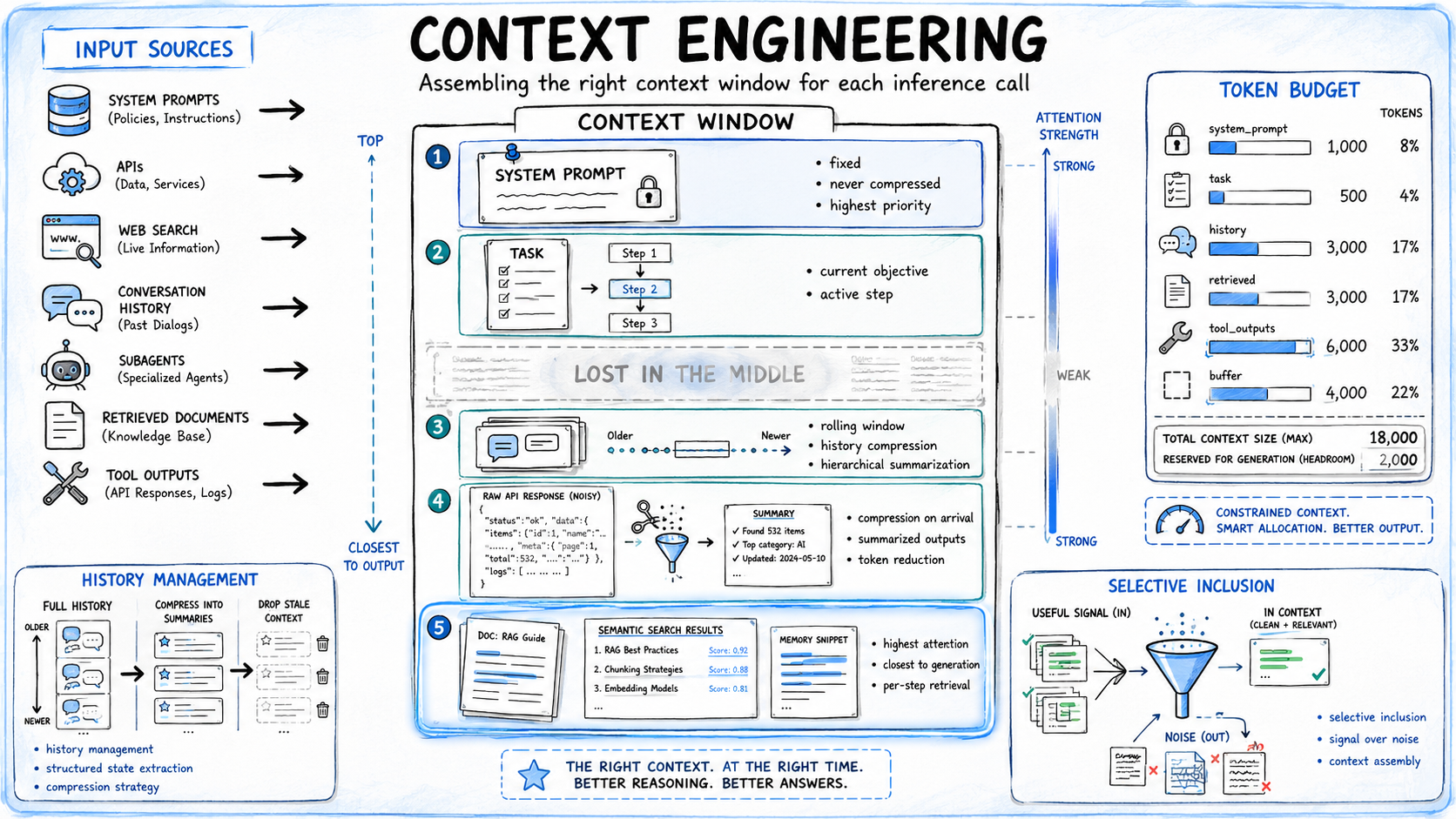
Memory engineering and context engineering, while often discussed as separate domains, are deeply interdependent in practice. Both exist to achieve the same fundamental objective: ensuring that an AI model has access to the right information at the right time.
At a high level, memory systems are responsible for producing candidate information—the raw material. Context assembly then acts as the final gatekeeper, making crucial decisions:
- What subset of the retrieved information is truly relevant to the current task?
- How should this information be structured and presented within the context window?
- Where should it be placed to maximize the model’s attention and utilization?
- How much of the retrieved information can fit within the allocated token budget?
Managing this retrieval boundary effectively is what transforms a disparate collection of memory components into a coherent, intelligent agent system.
Failure Mode #1: Retrieval Without a Context Budget
One of the most pervasive failures occurs when retrieval is treated in isolation from context assembly. A memory search might return a substantial set of relevant entries, and the context assembler, without proper budgeting, injects all of them into the prompt. As more memories are added, the context window progressively fills, leaving diminishing space for critical instructions, tool outputs, reasoning traces, and task-specific information. This often manifests as misleading symptoms: the agent "forgets" instructions, produces truncated responses, or fails to follow complex reasoning paths. In many such cases, the memory system has performed its duty correctly; the failure originates because context assembly lacks a token budgeting mechanism. A more effective approach is retrieval-aware context assembly, where the context layer allocates a token budget before retrieval begins. The retrieval layer then intelligently returns only the highest-value memories that fit within that predetermined budget, prioritizing quality and conciseness. This ensures retrieval operates within pragmatic context constraints, rather than assuming unlimited downstream space.
Failure Mode #2: Poor Placement of Retrieved Information
Even highly relevant memories can fail to influence an agent’s reasoning if they are incorrectly positioned within the context window. A common issue is treating retrieval purely as a search problem, ignoring the subsequent placement. Retrieved memories are simply appended wherever they arrive, without considering their strategic role in the current reasoning step. This problem is exacerbated in longer contexts, where attention is not uniformly distributed. Information buried deep within a long prompt can exert significantly less influence than information positioned at the beginning or end. This leads to a subtle but critical failure mode: the agent appears to "ignore" or "misinterpret" retrieved information, even if it was highly relevant. The retrieval succeeded, but the placement failed. Consequently, context assembly must optimize for both the relevance of retrieved information and its strategic placement, ensuring that critical context is positioned near the active reasoning region rather than arbitrarily appended.
Retrieval as a Step in Context Construction
Ultimately, retrieval is not merely an act of fetching data; it is the crucial first step in transforming stored memory into usable context. The objective extends beyond simply retrieving relevant information to ensuring it is the right information for the current step, in the right amount to fit within the context budget, and placed in the right location where the model can effectively process and utilize it. When memory engineering and context engineering are treated as a unified, end-to-end retrieval-to-context pipeline, rather than isolated components, agent systems achieve superior reliability, efficiency, and scalability.
Broader Implications for the Future of AI Agents
The mastery of context and memory engineering is not merely a technical detail; it is foundational to the development of truly capable, reliable, and scalable AI agents. For enterprises deploying AI, this translates directly into more consistent performance, reduced operational costs (by optimizing token usage), and enhanced user experiences. Agents capable of robust memory management can offer deep personalization, maintain complex task states over extended periods, and exhibit a form of "situational awareness" that mimics human intelligence.
Furthermore, these disciplines are critical for addressing ethical considerations. Clear write policies, provenance tracking, and trust levels embedded in memory engineering help ensure data integrity and prevent the propagation of misinformation. Proactive maintenance routines reduce the risk of agents acting on stale or irrelevant facts, thereby enhancing safety and explainability. As AI agents become more autonomous and integrate into critical workflows, the ability to predictably manage what they "know" and "remember" will be paramount for trust and accountability. The continuous evolution in these engineering practices will pave the way for a new generation of AI systems that are not just intelligent, but also consistently reliable, contextually aware, and truly capable of long-term learning and operation.
Conclusion
Context engineering and memory engineering represent two indispensable layers of a single, integrated system that governs an AI model’s knowledge, its timing, and its application. Context engineering operates at inference time, meticulously shaping the active information window for immediate use. Memory engineering operates across time, dictating what information persists and how it can be retrieved and trusted later. To achieve robust, high-performing agentic systems, both layers must be meticulously aligned: memory determines the pool of available knowledge, and context determines which part of that knowledge becomes actionable and how it is presented. The synergy between these disciplines is the bedrock upon which the next generation of intelligent, autonomous AI agents will be built.
