
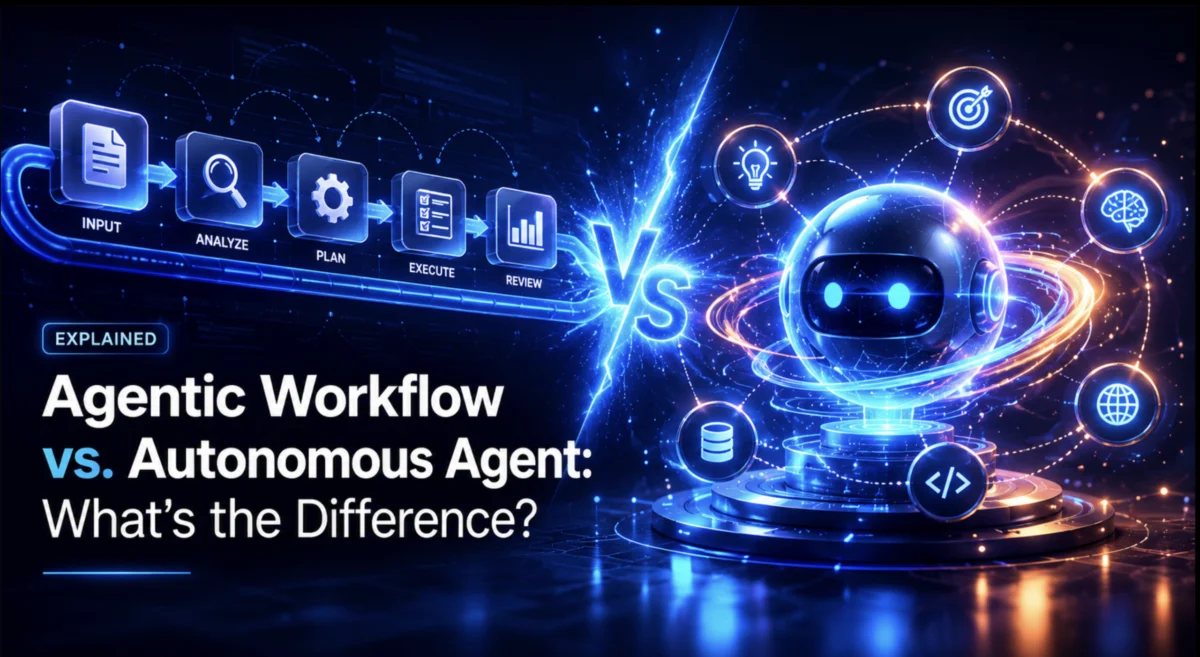

The rapid ascent of generative AI has sparked both innovation and considerable confusion within the technology landscape, particularly concerning the precise definition and application of "agentic" systems. At its core, the critical distinction between an agentic workflow and a truly autonomous agent lies in who ultimately owns the control flow: a human developer meticulously scripting operations in advance, or an AI model dynamically reasoning and directing its own process at runtime. This fundamental difference carries significant implications for system design, reliability, auditability, and practical deployment, influencing how organizations leverage AI for diverse tasks.
The Ascendance of Generative AI and Terminological Ambiguity
The technological forecast indicates a significant shift towards AI integration across industries. Projections from Deloitte suggest that by 2027, a substantial 50% of companies already utilizing generative AI will have launched agentic AI pilots or proofs of concept. This impending wave of adoption has, perhaps inevitably, led to a broad and often imprecise use of the term "agentic." It is now frequently applied to nearly any system incorporating a Large Language Model (LLM) call, blurring the lines between a rigidly structured, five-step pipeline—where one step might involve GPT for summarization—and a fully self-directing system capable of autonomously planning its entire operational path without a predefined script.
Conflating these distinct paradigms can lead to critical missteps in development and deployment. On one hand, simple, well-understood tasks might be unnecessarily over-engineered with complex, unneeded autonomy, introducing unwarranted variability and overhead. On the other, genuinely open-ended problems, requiring adaptive problem-solving, might be under-engineered by being forced into a rigid, deterministic pipeline that inevitably fails when real-world conditions deviate from the anticipated plan. Leading AI research institutions, such as Anthropic, have sought to clarify this landscape, drawing a foundational line: workflows are systems where LLMs and tools are orchestrated through predefined code paths, whereas agents are systems where LLMs dynamically direct their own process and tool usage, maintaining intrinsic control over how they accomplish a given task. This distinction forms the bedrock for understanding the spectrum of AI control.
Defining the Spectrum of AI Control: Predictability vs. Autonomy
The crucial question in designing AI systems is not merely "does this system use an LLM?"—as LLM integration is becoming ubiquitous. Instead, the pertinent inquiries revolve around operational predictability and the necessity for runtime adaptation. Developers must ask: "Does this process need to be repeatable, auditable, and explainable step-by-step?" and "Is the correct path known in advance, or must the system discover it dynamically at runtime?"
A system can extensively utilize an LLM while maintaining a fully deterministic structure. Consider a fixed pipeline where an LLM generates text in one step, but the subsequent action is hardcoded irrespective of the LLM’s output. Conversely, a system might be labeled "agentic" yet possess minimal true autonomy, perhaps operating within a tightly scripted loop with a limited set of allowed actions and a hard step limit. The presence of an LLM call is therefore not the definitive signal; rather, the ultimate ownership of the control flow is. Google Cloud’s own design-pattern documentation echoes this operational demarcation, distinguishing between deterministic workflows—characterized by clearly defined, unchanging paths—and dynamic orchestration, which involves problems where the agent must determine the optimal path to proceed, devoid of a predefined script. This distinction underpins the architectural spectrum we explore, moving from rigid control to emergent autonomy.
Deterministic Workflows: Predictability as a Foundation
At the most constrained end of the spectrum lie deterministic workflows, representing the baseline of automated processes. In these systems, the sequence of operational steps is entirely predetermined at design time by a human developer, embedded directly into the code. An LLM might be integrated into any of these steps—for instance, generating text, classifying input, or drafting a summary—but crucially, it does not possess the authority to choose the subsequent action. The overarching orchestrating code dictates the flow, regardless of the specific output generated by the LLM.
For example, a customer support system might process incoming queries through a fixed sequence: first, extract key entities, then classify the intent using an LLM, next summarize the query for an agent, and finally notify the relevant department. Even if the LLM classifies a query as "billing" or "technical," the hardcoded pipeline ensures that the summarize function always follows classify, and notify always follows summarize. The LLM’s output serves as data that flows through a predefined pipe, not as a decision point that alters the pipe’s structure.
This approach offers unparalleled predictability, auditability, and ease of debugging. Every run with identical input will yield the exact same sequence of operations, making it ideal for processes requiring strict compliance, regulatory oversight, or high reliability where variability is undesirable. While leveraging AI for specific sub-tasks, the human remains firmly in control of the overall process logic, ensuring a consistent and transparent execution path.
Orchestrated Workflows: Dynamic Routing within Predefined Paths
Orchestrated workflows occupy a middle ground, often misidentified as fully "agentic." While still relying on a graph of possible paths defined entirely in advance by a human, the specific path taken at runtime is dynamically chosen. This selection is frequently, though not exclusively, driven by an LLM call. The key differentiator here is that the LLM acts as a router, picking from a menu of pre-written branches; it does not possess the capacity to invent new branches or define novel operational sequences.
Consider an enhanced customer service system. After an initial extract step, an LLM might classify the incoming query into categories like "billing," "technical," or "general." Unlike the deterministic workflow, this classification directly influences the next step. If classified as "billing," the system routes to a handle_billing function; if "technical," it goes to handle_technical, and so forth. All these handle_ functions are predefined by a human developer within a ROUTE_MAP or similar structure. The LLM’s role is to select the appropriate, pre-existing handler based on its classification.
This paradigm aligns with Google Cloud’s "dynamic orchestration" category, distinct from genuine agents. The system indeed needs to plan and route, but this planning occurs within a fully human-designed and bounded structure. It offers greater flexibility than deterministic workflows by allowing adaptive responses to different input types, making it suitable for tasks like complex document processing, automated email triage, or initial customer interaction flows. However, the system’s capabilities are limited to the pathways explicitly coded by its human designers. If an unforeseen category of query arises, the system will default to a general handler or fail to route effectively, as the LLM cannot autonomously create a new processing branch.
Reactive Agents: Embracing Runtime Autonomy
True autonomy begins with reactive agents, exemplified by the ReAct (Reasoning plus Acting) pattern, introduced by Yao et al. in 2022. Here, the AI model itself determines, at each step, what action to take next, based on its ongoing observations from previous actions. There is no comprehensive, pre-written branch for every conceivable scenario. Instead, the agent operates in a continuous, iterative loop of thought, action, and observation until a specific exit condition is met. Crucially, the sequence of steps, their number, and the specific tools utilized are not knowable in advance; they emerge dynamically at runtime. Only the available tools are fixed; the path through them is not.
Imagine a sophisticated AI assistant designed to answer complex queries. When presented with a question like "What is the refund policy for items purchased over 60 days ago?", a reactive agent might initiate a thought process: "I need to search the knowledge base for refund policies." It then takes an action: search_knowledge_base("refund policy"). Upon observation, it receives a response: "Refunds are available within 30 days of purchase." Its next thought might be: "The knowledge base indicates 30 days, which doesn’t cover 60 days. I should clarify if there’s an exception or escalate." It might then take a new action based on this thought, perhaps escalate_to_human("Query exceeds standard refund window").
This iterative Thought -> Action -> Observation loop fundamentally distinguishes reactive agents from orchestrated workflows. In the latter, the LLM selects from a ROUTE_MAP. In ReAct, the model dynamically constructs the sequence of actions, adapting its strategy based on real-time feedback. This enables the system to tackle genuinely open-ended problems where the optimal solution path cannot be pre-programmed. Production implementations often manage the accumulated thought/observation history in a "scratchpad" and summarize tool outputs to prevent context overload and improve the model’s subsequent reasoning. While offering significant problem-solving power, reactive agents introduce non-determinism, making their behavior harder to predict and audit compared to their workflow counterparts.
Autonomous Multi-Agent Systems: Collaborative Autonomy at Scale
The furthest frontier of AI autonomy is represented by multi-agent systems, which essentially involve nested ReAct loops. In this architecture, a primary orchestrator agent runs its own ReAct loop, but some of its "actions" are calls to other specialized agents. Each of these sub-agents, in turn, operates its own complete ReAct loop internally. The orchestrator reasons about which tasks to delegate, dispatches them, observes the results returned by the sub-agents, and then continues its own decision-making process—mirroring the single-agent loop but with other agents as its "tools."
Picture the AVAILABLE_TOOLS dictionary from a single reactive agent, but instead of simple functions like search_knowledge_base or escalate_to_human, the entries might be research_agent, finance_agent, and coding_agent. Invoking one of these "tools" doesn’t return a simple string; it initiates that sub-agent’s independent Thought-Action-Observation cycle, which might involve multiple steps and tool calls before yielding a comprehensive result back to the orchestrator. Critically, no human has predetermined the sequence in which these sub-agents are called, their specific interactions, or how many times each will run. The overall behavior of the system emerges from the dynamic, runtime interactions between these autonomous entities.
Google Cloud’s documentation refers to the most extreme manifestation of this as the "swarm" pattern—a collaborative team of agents operating without any central orchestrator. Such swarms can generate exceptionally high-quality, creative solutions precisely because their interactions are unconstrained by predefined structures. However, this lack of imposed structure also constitutes their primary risk: without human-designed bounds on interaction, a swarm can fall into unproductive loops, fail to converge on a solution, or incur substantial computational costs as numerous agents execute multiple turns of reasoning and action. Multi-agent systems represent the pinnacle of flexibility and problem-solving capability for highly complex, ill-defined problems, but they come at the cost of the highest levels of complexity, non-determinism, and resource consumption.
Production Realities and Strategic Choices
The distinction between agentic workflows and autonomous agents is far from academic; it directly impacts what AI solutions are viable and successful in production environments. Despite the considerable hype surrounding fully autonomous agents, enterprise deployments in 2025 have shown that AI workflows—encompassing both deterministic and orchestrated systems—remain the dominant pattern for successful generative AI deployments. Fully autonomous multi-agent systems are, for the most part, still exploratory, confined to narrow research domains or highly specialized applications.
This preference for workflows in production environments stems directly from the axis of predictability. Autonomous agentic systems are inherently non-deterministic; identical inputs can lead to different outputs or operational paths across separate runs. This variability poses a significant liability in regulated industries, auditable processes, or any high-stakes operation where transparency and consistent behavior are paramount. If a process requires step-by-step explainability for compliance teams, regulators, or internal audit, it typically falls outside the default territory of a fully autonomous agent. Such systems would necessitate robust guardrails and human-in-the-loop checkpoints to instill the requisite trust and accountability. Moreover, the computational cost and complexity of managing highly autonomous, non-deterministic systems can quickly become prohibitive, both in terms of development resources and operational expenditure.
The prevailing trend in mature AI deployments is a hybrid approach, rather than an exclusive choice of one extreme. In these systems, a higher-level agent might be tasked with setting overarching goals and orchestrating the broader task, leveraging its autonomy to navigate ambiguous situations. However, critical, well-understood computations or sensitive decision points are often delegated to deterministic modules that have been fully specified, validated, and controlled by human developers. For instance, a medical diagnostics system might employ a reactive agent to interpret a patient’s ambiguous symptoms and dynamically decide the most appropriate sequence of diagnostic tests. This represents genuine autonomy, as the optimal testing path is not known in advance. Yet, each individual diagnostic test itself would likely run through a rigorously validated, deterministic pipeline, precisely because that component of the problem has a known correct path, and introducing variability would be detrimental to patient safety and diagnostic accuracy.
Conclusion: Navigating the Spectrum for Optimal AI Deployment
"Agentic workflow" and "autonomous agent" are not competing technologies but rather descriptive terms for different points along a single spectrum of AI control. The four stages—deterministic, orchestrated, reactive, and autonomous multi-agent—are not a hierarchy from "worse" to "better." Instead, they represent distinct answers to the fundamental question: who decides what happens next, and was that decision encoded by a human in advance, or dynamically reasoned by an AI model at runtime?
Deterministic workflows offer inherent auditability and repeatability, guaranteeing that the same input always follows the same path. Reactive and multi-agent systems relinquish this guarantee, trading it for the capacity to address problems whose complexity and solution paths cannot be fully anticipated or hardcoded beforehand. Neither property is without its trade-offs, and no single architecture is universally superior.
Ultimately, successful production-grade AI systems do not arbitrarily adopt one extreme of this spectrum. Instead, they strategically position each component of a problem at the appropriate point along the continuum. Fixed structures are implemented wherever a known correct path exists and repeatability is crucial, ensuring efficiency and reliability. Conversely, genuine autonomy is reserved for the aspects of the problem that truly lack a predefined correct path, where adaptive reasoning and dynamic problem-solving capabilities are indispensable for innovation and robustness. This balanced, nuanced approach is key to harnessing the full potential of AI while mitigating its inherent risks.
