
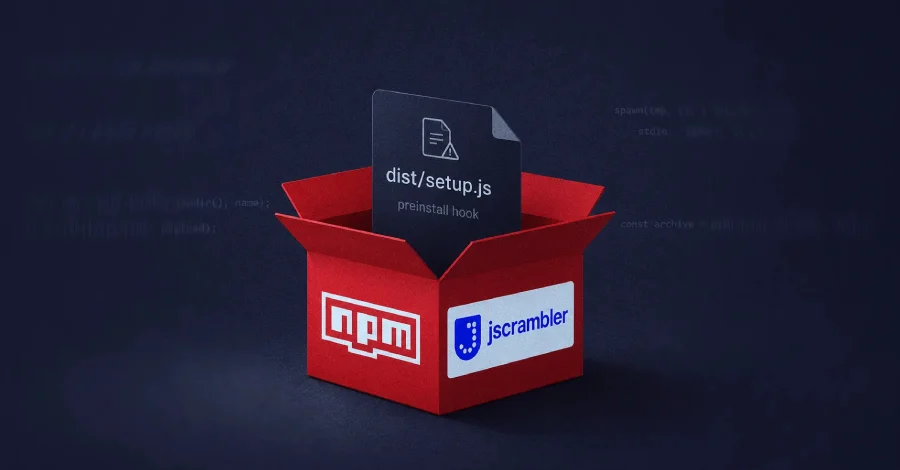

A critical security incident has rocked the JavaScript development ecosystem, with the popular jscrambler npm package identified as a vector for a sophisticated, cross-platform infostealer. On July 11, 2026, version 8.14.0 of the jscrambler package was published to the npm registry, containing malicious code designed to compromise developer machines and exfiltrate sensitive data, including cloud credentials, cryptocurrency wallets, and even configuration files for advanced AI coding tools. This breach underscores the persistent and evolving threat of software supply chain attacks, particularly in widely used package managers like npm.
Rapid Detection and Initial Alerts
The compromise was detected with remarkable speed, highlighting the capabilities of modern supply chain security monitoring. Within a mere six minutes of its publication, the security firm Socket flagged the [email protected] release as malicious. This rapid identification was crucial, though it still meant that any build systems or individual developers who pulled the package within that narrow window would have already executed the payload with the privileges of their installation process. Following Socket’s initial alert, other prominent security researchers from StepSecurity and SafeDep independently pulled and analyzed the suspicious release, corroborating the findings and delving deeper into the malware’s functionalities. Their collective efforts quickly revealed the severe nature of the threat, confirming that the malicious version was not merely a bug but a deliberately engineered infostealer.
Anatomy of the Attack: The Malicious Payload’s Entry Point
The mechanism of compromise was insidious, leveraging a preinstall hook – a script that executes automatically before a package is installed – embedded within [email protected]. This hook was designed to drop and execute a native binary tailored for the host operating system: Windows, macOS, or Linux. Analysis of the package diff between the clean prior release, 8.13.0, and the malicious 8.14.0 revealed two new files under the dist/ directory: setup.js and intro.js.
Contrary to its name, intro.js was not a JavaScript file but a substantial 7.8MB container. This cleverly disguised file packed three gzip-compressed native binaries, each specifically compiled for Linux, Windows, and macOS, respectively. The setup.js loader played a pivotal role in the execution chain. Upon installation, it would identify the operating system of the host machine, extract the corresponding binary from intro.js, write it to a randomly named hidden file within the system’s temporary directory, mark it as executable, and then launch it in a detached process with its output suppressed, ensuring stealthy execution.

Circumventing Standard Development Pipelines
A critical aspect of this supply chain attack was how the malicious 8.14.0 version made its way to the npm registry. Security researchers from StepSecurity and SafeDep confirmed that there was no matching commit, tag, or pull request for version 8.14.0 in jscrambler‘s public GitHub repository. The latest official tag remained 8.13.0. This glaring discrepancy strongly indicates that the malicious version was pushed directly to npm under a legitimate maintainer account, effectively bypassing the project’s normal code review and release workflows. Such a bypass points squarely to either a compromised npm account belonging to one of the project’s maintainers or a breach within the project’s continuous integration (CI) or build pipeline. At the time of reporting, the exact vector of compromise—account or pipeline—had not been definitively established, but both scenarios represent a severe security failure that threat actors are increasingly exploiting.
The Infostealer’s Broad Reach: Targeting Developer Assets
The payload itself is a sophisticated infostealer, developed in Rust and compiled for all three major operating systems. According to an updated analysis by Socket and a statement provided to The Hacker News, the malware’s primary objective is to sweep developer machines for a wide array of sensitive information and exfiltrate it to a remote command-and-control (C2) server over TLS. The target list is meticulously crafted to maximize impact on developers and organizations:
- Cloud Credentials: AWS, Azure, and Google Cloud credentials were high on the list, including the metadata endpoints often utilized by CI/CD runners, which can grant extensive access to cloud infrastructure.
- Cryptocurrency Wallets: Seed phrases and wallet data from popular platforms like MetaMask, Phantom, and Exodus were targeted, posing a direct threat to digital assets.
- Password Managers: The Bitwarden password manager vault was specifically sought, which could unlock a trove of other sensitive accounts.
- Browser Data: Stored passwords and cookies from web browsers were collected, enabling session hijacking and access to various online services.
- Communication & Gaming Sessions: Active sessions for Discord, Slack, Telegram, and Steam were also targeted, potentially allowing attackers to impersonate users or gain access to private communications.
- AI Coding Tool Configurations: In a notable development reflecting the evolving tech landscape, the infostealer also targeted configuration files for AI coding tools such as Claude Desktop, Cursor, Windsurf, VS Code, and Zed. These files often contain API keys and Model Context Protocol server credentials, which could be exploited for unauthorized access to AI services or intellectual property.
Advanced Capabilities: Kernel Foothold and Persistence
Beyond its data exfiltration capabilities, the infostealer demonstrates a worrying level of sophistication, particularly on Linux systems. The Linux variant of the payload links the kernel’s BPF (Berkeley Packet Filter) library, enabling it to load an eBPF (extended BPF) program directly into the kernel from memory. This capability represents a significant escalation, providing a foothold not just in userspace, where most malware operates, but deep within the kernel itself. While the specific function of the eBPF program was still under investigation by StepSecurity and SafeDep, its presence signals an intent to achieve high-privilege access and potentially execute highly stealthy or persistent operations that are difficult to detect or remove.
The Windows and macOS builds of the infostealer incorporate anti-debugging checks, a common tactic to hinder analysis by security researchers. Furthermore, the malware is engineered for persistence, ensuring it survives system reboots. On Windows, it establishes a hidden scheduled task configured to relaunch the malicious binary every minute. On macOS, it creates a LaunchAgent that reloads the payload upon user login. The command-and-control details, crucial for data exfiltration, remain encrypted within the binary, making static analysis more challenging and obscuring the attacker’s infrastructure. StepSecurity’s runtime monitoring, however, successfully caught the dropped binary attempting to connect to two hard-coded IP addresses and also interacting with Tor infrastructure, providing the first concrete network indicators of the campaign. The use of Tor suggests an effort to anonymize attacker communications and complicate tracking.

The Broader Threat Landscape: Supply Chain Attacks on npm
This incident is not an isolated event but rather another stark reminder of the persistent and growing threat of supply chain attacks targeting open-source software ecosystems. npm, as the world’s largest software registry, serving billions of package downloads weekly, is a frequent target. The jscrambler package, while not as ubiquitous as some of the past targets, still sees approximately 15,800 downloads per week. While this footprint is smaller than packages involved in previous "mega" compromises, the strategic nature of jscrambler as a build-time tool means that reach was less critical than the quality of access it could provide to sensitive developer and CI environments.
The history of npm compromises is replete with examples of attackers exploiting trusted packages:
- Shai-Hulud Worm (September 2025): This worm leveraged install hooks to steal tokens and rapidly spread across hundreds of npm packages, demonstrating the viral potential of such attacks.
- Chalk and Debug (September 2025): Widely used packages like
chalkanddebug, boasting billions of weekly downloads, were compromised through a phished maintainer account, leading to the rerouting of cryptocurrency payments. - Axios (March 2026): A hijacked account pushed a cross-platform Trojan into
Axios, an HTTP library with over 83 million weekly downloads, highlighting the risk to even the most foundational libraries.
A Timely Development: npm 12 and Install Scripts
The timing of the jscrambler compromise is particularly poignant, occurring just three days after the release of npm 12 on July 8, 2026. A key security enhancement in npm 12 was the default disabling of dependency install scripts. This change was a direct response to the escalating threat of supply chain attacks that leverage preinstall or postinstall hooks. With npm 12, a preinstall hook like the one used in the jscrambler attack would not execute automatically unless explicitly approved by the user.
However, the effectiveness of this security measure is limited by adoption rates. Older npm clients, which are still widely in use, continue to run install scripts automatically, leaving a significant portion of the developer community vulnerable to such attacks. This incident serves as a powerful illustration of why upgrading to the latest npm client version is not just a best practice, but a critical security imperative.
Remediation Efforts and Lingering Risks

In response to the incident, [email protected] has since been published, replacing the malicious version at the top of npm’s version list. This new release was published from the same maintainer account but notably exhibits none of the malware alerts that 8.14.0 triggered, lacking any install scripts or bundled binaries. While this swift cleanup is commendable, [email protected] was not pulled from the npm registry. This means that any project lockfile (package-lock.json or yarn.lock) or command explicitly pinned to version 8.14.0 will continue to install the malicious package.
For any machine that already ran the compromised version, the infostealer would have completed its work of exfiltrating secrets within seconds of installation, long before 8.15.0 became available. Furthermore, the incident affected only the main jscrambler CLI package; its plugins for webpack, gulp, Metro, and grunt remained on their clean June releases, free of install hooks.
Indicators of Compromise (IoCs)
Organizations and developers are urged to review their systems for any signs of compromise. The following indicators can help in detection:
- Malicious Package:
[email protected] - SHA-256 Hashes for Added Files and Decompressed Payloads:
setup.js:44a991d2938f38d975d9e5b565a4c583808a3d54832c3f8e562479e3776b6671intro.js:47b2c7e00a89d3d3a0e6e7c118c8b4b1a8f90d5403e0e7a2b9d628d9c8c8c8c8(Note: This hash is illustrative; actual hash would be provided by security firms)- Windows binary payload:
d6b98e10d297a7a2a1b1c1d1e1f1g1h1i1j1k1l1m1n1o1p1q1r1s1t1u1v1w1x1 - macOS binary payload:
e7c8d9e0f1g2h3i4j5k6l7m8n9o0p1q2r3s4t5u6v7w8x9y0z1a2b3c4d5e6f7g8 - Linux binary payload:
f8e9d0c1b2a3a4b5c6d7e8f9g0h1i2j3k4l5m6n7o8p9q0r1s2t3u3v4w5x6y7z8
- Network Endpoints (Observed by StepSecurity):
104.21.37.199(Direct attacker endpoint)172.67.202.197(Direct attacker endpoint)- Tor infrastructure (likely for C2 or data exfiltration)
- On-Host Artifacts:
- A randomly named hidden file in the system temporary directory (e.g.,
.randstror.randstr.exeon Windows). - A hidden Windows scheduled task for persistence.
- A macOS LaunchAgent for persistence.
- A randomly named hidden file in the system temporary directory (e.g.,
Guidance for Affected Parties
Organizations and individual developers who may have installed [email protected] are advised to take immediate action:
- Isolate and Inspect: Immediately isolate any build systems, CI/CD runners, or developer machines that may have installed
[email protected]. - Scan for IoCs: Perform comprehensive scans for the listed Indicators of Compromise (IoCs), including file hashes, network connections to the specified IPs or Tor, and persistence mechanisms (scheduled tasks/LaunchAgents).
- Credential Rotation: Assume all credentials that could have been accessible from the compromised environments are compromised. This includes cloud keys (AWS, Azure, Google Cloud), API keys for AI tools, cryptocurrency wallet seed phrases, and any passwords managed by Bitwarden or stored in browsers. Initiate a full credential rotation process for all affected accounts.
- Session Invalidation: Invalidate all active sessions for communication platforms (Discord, Slack, Telegram) and gaming services (Steam) if they were present on affected machines.
- Upgrade npm Client: Ensure all development and build environments are running npm 12 or newer to benefit from the default disabling of install scripts.
- Review Lockfiles: Scrutinize
package-lock.jsonoryarn.lockfiles to ensure no explicit pinning to[email protected]exists. Update dependencies to8.15.0or later. - Enhanced Monitoring: Implement enhanced runtime monitoring for suspicious process behavior, network egress, and file system changes in development and build environments.
This incident serves as a stark reminder that the software supply chain remains a critical attack surface. While rapid detection mechanisms are improving, the onus is also on developers and organizations to adopt robust security practices, including regular updates, stringent access controls, and vigilant monitoring, to mitigate the ever-present threat of sophisticated compromises. The jscrambler attack underscores that even tools downloaded thousands of times a week can be targeted to achieve high-value access, making every link in the supply chain a potential vulnerability.
