

Google last week launched Nano Banana 2 Lite—officially gemini-3.1-flash-lite-image—as the entry point in its image generation stack, sitting below Nano Banana 2 and well below Nano Banana Pro. It delivers text-to-image outputs in roughly four seconds, 2.7 times faster than Nano Banana 2, and is positioned as the direct replacement for the original Nano Banana (gemini-2.5-flash-image). The explicit pitch: same Google ecosystem, less money, less waiting. This strategic release aims to democratize access to advanced AI image generation, offering a compelling option for users prioritizing speed and cost-effectiveness without entirely sacrificing quality.
The model is available through Google AI Studio, the Gemini API, and the Enterprise Agent Platform—and it’s baked into consumer products including Search, the Gemini app, NotebookLM, and Google Photos. This widespread integration underscores Google’s commitment to embedding AI capabilities across its product suite, making advanced tools accessible to a broad user base, from individual creators to large enterprises. Nano Banana 2 Lite works alongside Gemini Omni Flash, Google’s new video generation model, through the Interactions API, which lets users stack up to three sequential edits within a single session. This interoperability signifies a move towards more complex and iterative content creation workflows within a unified AI framework. The Nano Banana family now reads as a clean three-tier structure: Lite for speed and cost, Nano Banana 2 for the quality-speed balance, and Nano Banana Pro for complex professional work.
Competitive Pricing and Market Positioning
At roughly $0.034 per image at 1K resolution, Nano Banana 2 Lite is positioned aggressively in the market. It is approximately half the price of its predecessor, Nano Banana 2, which runs $0.067 per image at the same resolution. This pricing strategy places the Lite model in direct competition with offerings like Seedream 5.0 Lite, which comes in at $0.031–$0.035 per image. While Reve 2.0 undercuts both at around $0.0067 per image via API, it notably lacks the broad deployment ecosystem that comes with Google’s integrated infrastructure. Qwen Image Edit also presents a free, open-source alternative for standard use cases, further intensifying the competitive landscape for AI image generation tools.
The introduction of Nano Banana 2 Lite marks a significant moment in Google’s ongoing AI development narrative. Following the ambitious rollout of the Gemini family of models, this latest iteration focuses on accessibility and efficiency. The Gemini models, first unveiled in late 2023, represented a significant leap in multimodal AI capabilities, designed to understand and operate across text, images, audio, video, and code. The subsequent refinement and stratification of these models, as seen with the Nano Banana series, indicate a strategic approach to catering to diverse user needs and market segments.

Performance Analysis: A Detailed Comparison
To assess the practical implications of this tiered approach, a comprehensive evaluation was conducted, pitting Nano Banana 2 Lite against Nano Banana 2 across several key categories: Realism, Prompt Adherence, Spatial Awareness, and Text Generation. The objective was to determine if the cost and speed benefits of the Lite model come at a quality cost that would deter specific professional workflows.
Realism: The Most Visible Trade-off
The realism test emerged as the category where the distinction between Nano Banana 2 and its Lite sibling was most pronounced. A technically demanding portrait prompt was used: a cinematic image of a 32-year-old female architect on a rooftop at sunset, wearing a beige trench coat and round glasses, holding rolled blueprints specifically in her left hand, with a defocused city skyline behind her, golden hour lighting with a soft rim light, shallow depth of field simulating a 50mm lens, a vertical 4:5 aspect ratio, realistic skin texture, and subtle film grain. This prompt was meticulously crafted to include numerous independent constraints, each representing a potential failure point for the AI.
Nano Banana 2 Lite successfully rendered the basic elements of the prompt. The subject was depicted in the correct attire and pose, wearing round glasses, holding blueprints, and situated on a rooftop with a blurred city backdrop. However, upon closer inspection, subtle but discernible differences in realism became apparent. The rendering of the subject’s hands was slightly disproportionate, and the subtle rim light was barely perceptible. While the skin texture held up at thumbnail scale, it did not withstand scrutiny upon closer examination. The final output was described as a competent stock photo, lacking the nuanced quality expected of a cinematic portrait.
In contrast, Nano Banana 2 produced an image that was photographically distinct. The subject was presented against a fully realized New York City skyline at magic hour, with bokeh city lights blooming in the background and a hint of a river visible in the distance. The depth of field was more dramatic, and the warm rim light effectively separated the subject from the background. Notably, the blueprints were depicted in her left hand, precisely as requested, a detail that Nano Banana 2 Lite also achieved. However, the overall impression from Nano Banana 2 was one of greater photographic fidelity and artistic execution.
Both models exhibited minor inconsistencies, such as subtle variations in symmetry regarding buttonholes and straps, but these were deemed negligible upon initial review. The critical takeaway for this category is that for casual social media content or rapid visual mockups, Nano Banana 2 Lite is a viable tool that effectively communicates a concept. However, for applications where the generated image serves as the final product—such as hero images, client deliverables, or portfolio pieces—the limitations of the Lite model become evident at resolutions beyond thumbnails. The concession in photographic quality is a consistent and significant trade-off made by the Lite model’s architecture.

Prompt Adherence: Precision Under Scrutiny
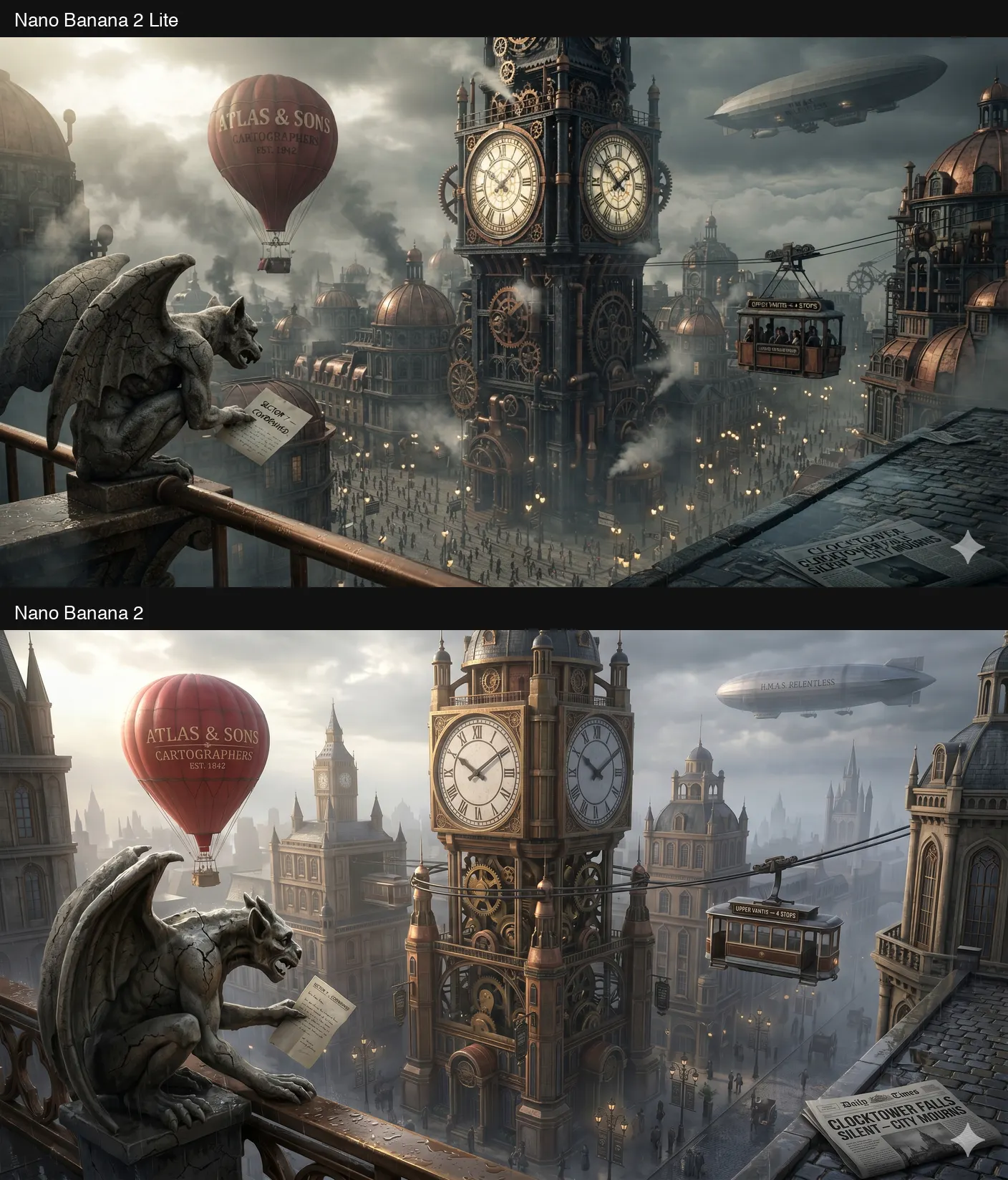
Prompt adherence was tested using a complex, multi-element scene designed to stress the models’ ability to interpret and render numerous specific details simultaneously. The prompt described a steampunk cityscape viewed from a gargoyle’s perch, incorporating a hot air balloon labeled "Atlas & Sons Cartographers, Est. 1842," a cable car with a specific named route, a gear-driven clock tower, a gargoyle holding a document labeled "Sector 7 — Condemned," a foreground newspaper with a specific headline, and a detailed Victorian street scene below. The underlying logic was that a model capable of accurately rendering ten simultaneous, specific constraints would be reliable for complex creative briefs.
Both models generated visually compelling steampunk scenes. They correctly positioned the gargoyle in the foreground, the clock tower centrally, the balloon in the sky, and a cable car traversing the frame. At a superficial glance, the differences appeared cosmetic: the Lite version was darker and moodier, while the full model was cleaner and brighter. However, the specifics revealed a more nuanced performance. In the Lite version, the balloon’s label read "Est. 1942" instead of the requested "Est. 1842," a common challenge for AI models struggling with accurate text rendering. The cable car route label was partially garbled, and the foreground newspaper headline blurred at the edges, compromising legibility of specific details. While the overall visual impression was strong, the precision in text rendering was compromised.
Nano Banana 2, conversely, achieved near-perfect adherence to the prompt’s textual details. The balloon clearly displayed "Atlas & Sons Cartographers Est. 1842." The cable car sign read "Upper Vantis — 4 Stops." While the text on the document held by the gargoyle remained illegible, a common limitation across many AI models, the foreground newspaper headline was rendered as "Clocktower Falls Silent — City Mourns" in clean, readable type. All named elements were present with their correct labels and in legible form. The brighter, more editorial lighting of Nano Banana 2 proved advantageous, ensuring that labeled details remained readable rather than being obscured by atmospheric effects.
For casual users, a minor transposition error in a fictional establishment date might go unnoticed. However, for concept artists, worldbuilders, and narrative illustrators who rely on these models to convey specific creative logic, such inaccuracies are immediately apparent. The Lite model’s tendency to blur or transpose specific in-image text labels, while not a catastrophic failure, introduces a manual correction step that can significantly compound workflow inefficiencies at scale. This highlights a critical distinction: while Nano Banana 2 Lite excels at capturing the overall aesthetic, Nano Banana 2 demonstrates a superior ability to translate detailed textual instructions into visual reality, a crucial factor for narrative-driven creative endeavors.
Spatial Awareness: Subtle Depth Differences
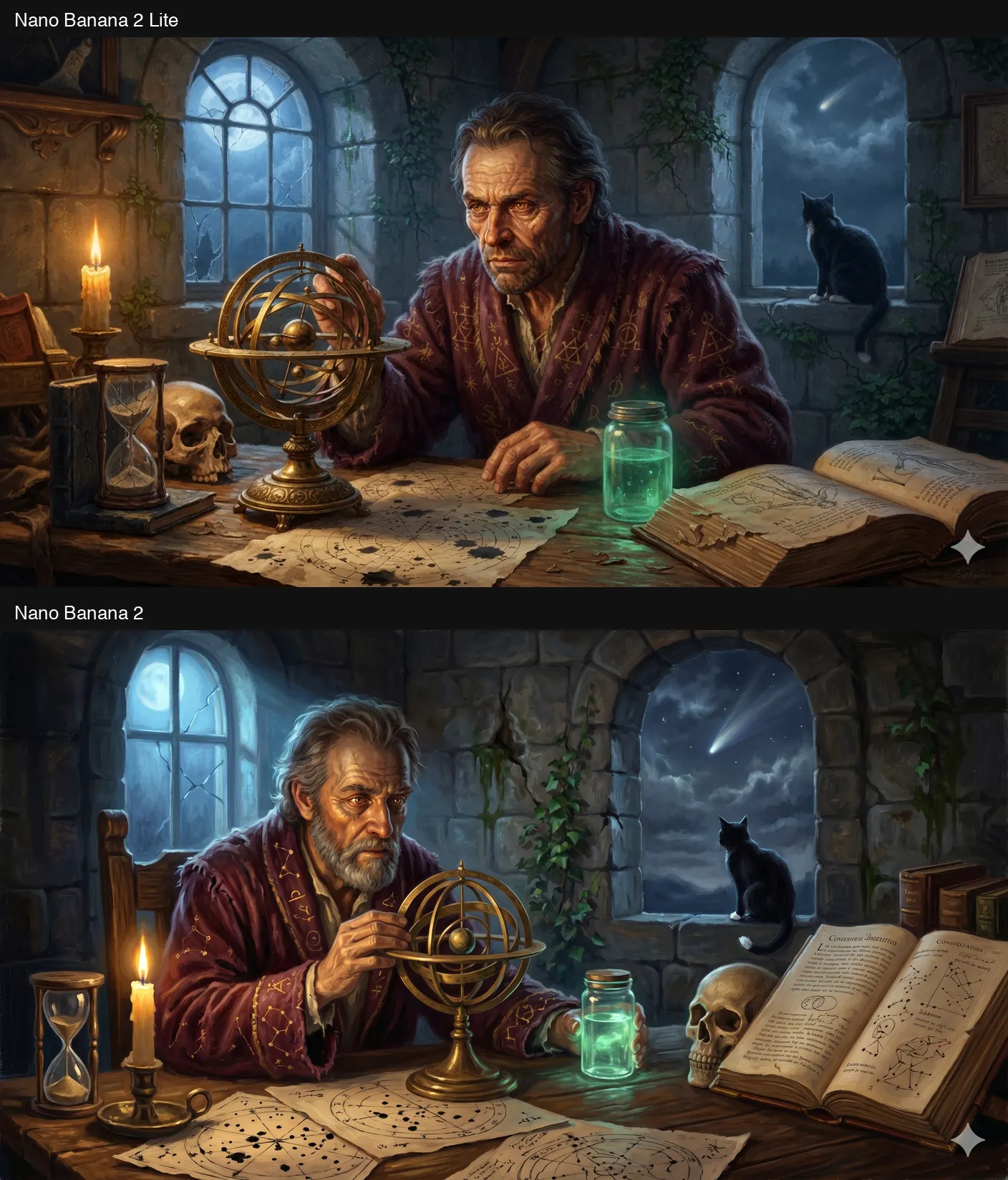
The spatial awareness test evaluated how each model handles multi-depth scene composition, requiring convincing three-dimensional layering to create a coherent scene rather than a mere assemblage of elements. The prompt depicted a medieval alchemist at a cluttered wooden desk, surrounded by an armillary sphere, a lit candle, an hourglass, a skull, star charts, and a glowing green jar. A black cat was silhouetted in an arched window behind him, with the scene set against a background of moonlit night sky.
Both models successfully interpreted the fundamental spatial grammar of the scene. Foreground objects were rendered at appropriate scales with accurate shadow detail. The alchemist occupied the mid-ground with correct occlusion relationships to surrounding objects. The arched window and moonlit sky effectively conveyed a sense of recession into the background. Neither model introduced spatial contradictions or collapsed depth planes, establishing the front-to-back architecture of the scene correctly.

The differences, though subtle, were real. Nano Banana 2’s output exhibited richer atmospheric depth. The candlelight naturally faded towards the stone walls, and the background haziness read as genuine atmospheric depth rather than mere digital softening. The overall scene possessed a painterly warmth that suggested volumetric space. In contrast, the Lite version’s depth, while structurally sound, appeared slightly compressed. The background felt more like a stage flat than a receding room with palpable air. This observation led to the assessment that the Nano Banana 2 image, in this instance, felt akin to the Lite version with a specialized fine-tuning layer (like a LoRA) applied during sampling.
Across this category, the gap between the two models was the smallest. For applications such as storyboards, game asset concepts, and most editorial illustration contexts, both models demonstrated adequate spatial reasoning. The Lite model’s slightly flatter depth rendering became significant primarily in high-resolution outputs or detailed compositional analyses, and even then, the distinction was arguable. For the vast majority of practical workflows, Nano Banana 2 Lite was deemed a viable substitute in terms of spatial composition.
Text Generation: An Unexpected Strength
The text generation test yielded the most counterintuitive result of the evaluation. The prompt described a gritty nighttime hardware store scene, demanding the accurate rendering of numerous simultaneous text elements across varying scales and styles. This included a hand-painted main sign with the store name, founding date, and product categories; graffiti on the façade; window decals for hours and services; a concert poster with band name, venue, date, and ticket prices; a city council meeting notice; a lost cat notice with a phone number; political stickers on a phone booth; and a street parking restriction on the curb. The complexity stemmed from the requirement for each text element to be correctly rendered while the overall image maintained coherence as a photograph.
Remarkably, Nano Banana 2 Lite delivered an exceptionally impressive result, especially considering its speed and cost. The generated image featured legible and accurate text for: "KELLERMAN’S HARDWARE & SUPPLY CO. — SINCE 1931 — TOOLS, ROPE, PAINT" on the main sign; graffiti reading "STILL HERE"; window signs for "OPEN 7 DAYS / WE BUY SCRAP — ASK FOR RAY / CLOSED"; a concert poster for "THE DREDGE PALE MOUTH / SUNDAY JUNE 4 / DOORS 9PM / THE ANCHOR CLUB / $12 ADV — $15 DOOR"; stickers reading "THIS MACHINE KILLS FASCISTS" and "JESUS SAVES"; a lost cat notice with a specific and legible phone number. Every single text element was correctly rendered and readable simultaneously within a single image.
The primary caveat for the Lite model’s text generation was a slight reduction in realism. Some posters appeared as if rendered by an editor with less finesse in Photoshop rather than as genuine elements of the scene, lacking natural imperfections or signs of deterioration. However, this was deemed a minor issue in the context of such a strong textual performance for a cost-effective and rapid generation tool.
Nano Banana 2’s version also performed strongly, with most text correctly placed and legible, contributing to a convincing nighttime scene. However, the full model’s characteristically darker, moodier atmospheric rendering, while often an asset, worked against it in this specific scenario. Several smaller sticker texts fell into shadow, diminishing their legibility. The Lite model’s brighter, more neutral lighting, which was a liability in portrait work, proved to be a clear advantage here, ensuring that all text elements were readable.
Despite this advantage for the Lite model in legibility, the evaluation concluded that for text-heavy generation tasks—such as signage mockups, editorial graphics, product concepts with labeled elements, or infographic-style compositions—Nano Banana 2 Lite performed below Nano Banana 2. The analysis suggested that the Lite model either over-prioritized visuals, leading to garbled text, or focused excessively on text to the detriment of its realistic placement within the scene. This counterintuitive finding highlights the complex interplay between different AI capabilities and the specific demands of various creative tasks.
Conclusions: A Tool for Specific Needs
Nano Banana 2 Lite is not a straightforward downgrade from Nano Banana 2; rather, it is a specialized tool with a defined performance ceiling. This ceiling is most evident in scenarios where photographic quality is the paramount deliverable, but it holds surprisingly steady across other applications.
For cinematic portraiture, sophisticated lighting physics, rendering fine material textures, and achieving skin rendering quality suitable for close inspection, the difference between the two models is clearly discernible. Style transfer also experiences a meaningful hit, not in rendering quality per se, but in contextual comprehension. While the Lite model can execute a subject effectively, it struggles to fully capture the visual environment in which that subject resides. Prompt adherence degrades specifically concerning the accuracy of labeled text within images—a narrow failure mode, perhaps, but one that carries significant weight in worldbuilding, concept art, and any workflow where specific in-image language is crucial.
Conversely, areas where the Lite model performs well—and in some cases, even better—include specificity and spatial scene architecture. If a prompt requires a high degree of focus on particular elements, the Lite model ensures their inclusion. Spatial scene architecture and basic compositional competence are also robust. The text generation result warrants particular emphasis: for workflows involving signage mockups, branded graphics, editorial composites with text-heavy elements, or any pipeline requiring multiple readable text strings within a single image, Nano Banana 2 Lite is a compelling first choice. Its default brighter rendering, a drawback in portraiture, becomes an advantage when legibility is the primary metric. Spatially, it handles multi-depth scenes adequately for the vast majority of professional contexts.
From a cost perspective, Nano Banana 2 Lite’s pricing of approximately $0.034 per image at 1K resolution positions it as a highly competitive option. It is roughly half the cost of Nano Banana 2 ($0.067 per image) and directly challenges Seedream 5.0 Lite ($0.031–$0.035 per image). While Reve 2.0 offers a significantly lower API price point of around $0.0067 per image, it lacks the extensive deployment footprint of the Nano Banana ecosystem, which is integrated into widely used Google products like Search, NotebookLM, Google Photos, and the Gemini app.
For teams already operating within Google’s infrastructure, this seamless integration eliminates platform-switching costs that pure API alternatives cannot match. Consequently, if a user’s specific use cases do not fall into the high-fidelity photographic quality bucket, Nano Banana 2 Lite earns its place in the lineup and may even prove to be a superior option compared to its more powerful counterpart. The strategic segmentation of the Nano Banana family demonstrates Google’s intent to provide tailored AI solutions that balance performance, cost, and accessibility for a diverse range of users and applications.
