

The Anatomy of the Re-Activation Incident
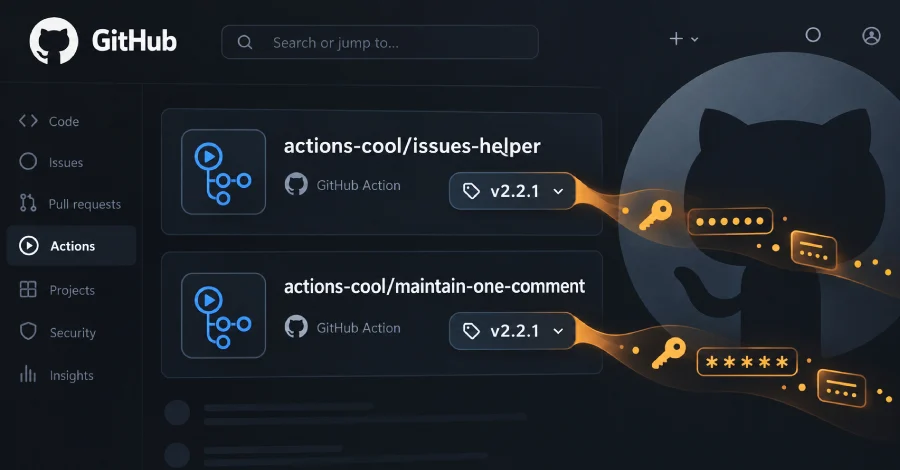
The two GitHub Actions in question were originally compromised on May 18, 2026, as part of a targeted campaign designed to harvest sensitive credentials from continuous integration and continuous deployment (CI/CD) pipelines. After initially being identified and shuttered by GitHub staff, the repositories underwent an unexplained change in status on September 16, 2026. Between 11:09 a.m. and 6:16 p.m. GMT+2, the repositories were once again accessible, allowing any automated workflow referencing these actions via mutable version tags to pull the malicious code automatically.
Researchers at Socket, a firm specializing in supply chain security, first identified the re-exposure. According to Karlo Zanki, a researcher at the firm, the primary danger stemmed from the fact that the release tags associated with the actions had not been scrubbed or reverted to their pre-compromise states. Because these tags still pointed to the malicious content injected during the May incident, any build process utilizing these actions resumed the execution of the payload without requiring any intervention from the original threat actors.
Chronology of the Mini Shai-Hulud Campaign
The Mini Shai-Hulud campaign represents a sophisticated, persistent threat to the open-source software ecosystem. The timeline of this activity demonstrates the calculated nature of the attackers:

- May 18, 2026: The initial compromise occurs. Malicious code is injected into specific GitHub Actions, designed to exfiltrate CI/CD secrets—such as API keys, deployment tokens, and cloud credentials—to an attacker-controlled server identified as
t.m-kosche[.]com. - May 2026: Security researchers link the GitHub Actions compromise to a broader cluster of malicious activity, including the injection of malicious packages into the @antv npm ecosystem. This cross-platform coordination suggests a highly organized threat actor.
- Late May 2026: GitHub takes administrative action to disable the affected repositories, effectively halting the exfiltration of credentials from impacted workflows.
- September 16, 2026: The repositories are inadvertently re-enabled. The malicious code remains intact, posing an immediate risk to any projects that had not yet migrated away from these actions or pinned them to a secure commit hash.
- September 2026 (Post-Incident): GitHub re-implements the block on the repositories, displaying a notice that the accounts were disabled for violations of the platform’s Terms of Service.
The Risks of Mutable Versioning
The core of this security failure lies in the common practice of "mutable versioning." In many GitHub Action workflows, developers use tags like v1 or latest. These tags are inherently fluid; they point to whichever commit the repository owner has designated as that version. If a repository is compromised, the threat actor can update the code associated with an existing, stable tag.
When users call these actions in their workflows, the platform fetches the latest content associated with that tag. Because the tags in this specific incident were never reverted by the repository owners, the "latest" version remained the malicious code from May. Organizations that relied on these actions were essentially running a time bomb, waiting for the repositories to become public again so that their automated systems could ingest the infection.
Philipp Burckhardt, head of threat intelligence at Socket, noted during the initial investigation that the campaign was far more than a simple repository hijack; it was a strategic effort to compromise the supply chain at scale. By embedding the malicious code into automated housekeeping tools—such as scripts that close inactive issues or manage pull request comments—the attackers ensured that the payload would execute with high frequency, increasing the likelihood of successful credential theft.
Implications for CI/CD Security
This incident serves as a sobering reminder that security in a modern development environment cannot rely solely on the platform provider to police malicious content. The fact that the threat was "reactivated" without any new code being published or new infrastructure being deployed demonstrates the persistence of supply chain vulnerabilities.

The security community has long advocated for the use of immutable references, yet adoption remains inconsistent. Pinning an action to a full commit SHA (Secure Hash Algorithm) effectively locks the workflow to a specific, verified snapshot of the code. If an upstream repository is compromised and the tags are updated to point to malicious content, a project using SHA pinning remains unaffected because its configuration explicitly ignores the new, untrusted commits.
Recommended Mitigation Strategies
For organizations looking to secure their CI/CD pipelines against similar threats, industry experts recommend a transition toward a "zero-trust" approach to external dependencies. Key recommendations include:
- Commit SHA Pinning: Move away from version tags (
v1,v2) and instead use the full 40-character commit SHA. This ensures that the code executed is exactly what the developer audited and approved. - Audit Workflow Dependencies: Regularly review the list of external actions used in build pipelines. Ask whether each action is necessary and whether it is maintained by a trusted source.
- Use Private Mirrors: For critical infrastructure, consider mirroring verified versions of GitHub Actions into an internal, private repository. This prevents reliance on public, third-party repositories that could be subject to sudden administrative changes or unauthorized modifications.
- Least Privilege Access: Ensure that the secrets available to CI/CD workflows are scoped as narrowly as possible. Even if an action is compromised, limiting the blast radius of stolen credentials can prevent a minor incident from escalating into a full-scale platform breach.
- Automated Security Scanning: Deploy tools that specifically monitor for supply chain anomalies, such as unexpected network calls from within CI/CD runners or unauthorized modifications to workflow files.
Broader Industry Analysis
The Mini Shai-Hulud incident is emblematic of the growing trend of "silent" supply chain attacks. Unlike ransomware, which announces its presence, these attacks are designed to dwell within the build environment, exfiltrating data in the background while the software build continues to function normally.
The ease with which these repositories were restored—and the fact that the malicious code persisted—points to a potential gap in how platforms manage "disabled" content. When a repository is taken down for security reasons, the expectation is that the content is effectively quarantined. The September incident suggests that, in some cases, the restoration of access may not be accompanied by a thorough remediation of the underlying code, leaving the "quarantined" content ready to be consumed by the unsuspecting public the moment the block is lifted.

This event has prompted renewed calls for GitHub to implement more robust safeguards for its Actions marketplace. Suggestions include mandatory code signing for actions, improved visibility into tag modifications, and automated alerts to repository maintainers when security-related blocks are lifted.
As software development cycles continue to accelerate, the pressure to integrate third-party tools quickly often outweighs the need for rigorous security vetting. However, the Mini Shai-Hulud campaign proves that the cost of this convenience is high. Developers and security teams must recognize that the integrity of their software is only as strong as the most obscure action in their workflow. The shift from "trusting the tag" to "verifying the hash" is not merely a best practice; it is becoming a fundamental necessity for protecting the modern software supply chain from a class of threats that is becoming increasingly automated, persistent, and difficult to detect.
