
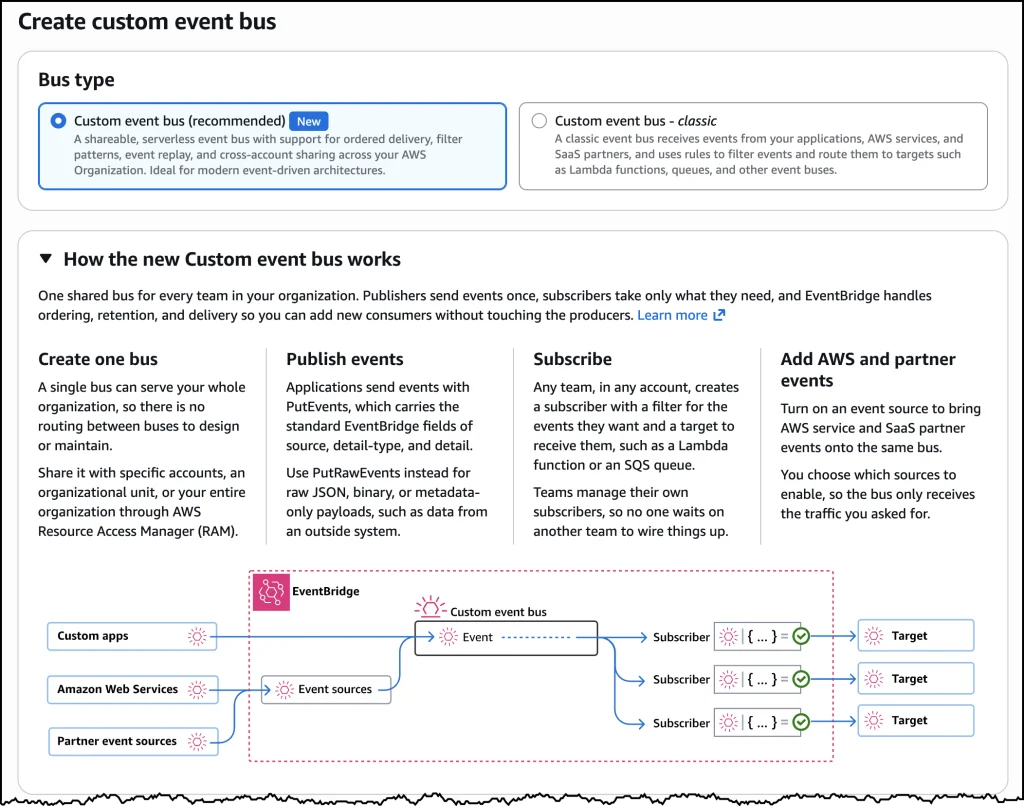

The modern software engineering landscape has increasingly shifted toward event-driven architectures (EDAs) as organizations seek to build highly scalable, decoupled, and responsive cloud applications. At the center of this movement for many enterprise technology stacks is Amazon EventBridge, a serverless event bus that simplifies the integration of disparate applications using data streams from various internal services, software-as-a-service (SaaS) applications, and custom sources. However, as cloud adoption matures within large enterprises, structural scaling hurdles frequently emerge. To address these operational friction points, Amazon Web Services (AWS) has officially announced the launch of an enhanced custom event bus for Amazon EventBridge, a purpose-built solution engineered to support complex, multi-account enterprise environments without sacrificing administrative visibility or compounding operational costs.
Main Facts of the Release
The newly introduced enhanced custom event bus fundamentally redesigns how organizations scale their event-driven applications across multiple distinct AWS accounts and development teams. Traditionally, engineering organizations initiating their cloud journeys begin with a singular custom event bus housed within a single account, an architecture that proves remarkably efficient when managed by a cohesive team. Yet, as corporate adoption accelerates, adhering to AWS multi-account security and governance best practices necessitates that distinct business units operate within isolated environments.
To bridge these organizational silos, platform engineering teams have historically been forced to construct intricate webs of cross-account rules or multi-bus configurations. This workaround inadvertently reintroduces the very operational complexity that serverless frameworks are meant to eliminate. Platform administrators routinely lose critical oversight regarding which downstream consumers are subscribing to specific event streams, while compounding financial charges for cross-account and bus-to-bus routing escalate quickly. Furthermore, applications requiring strict event sequencing—such as financial transaction processing or real-time logistics tracking—were historically required to engineer complex workarounds or implement entirely separate messaging technologies.
The newly released enhanced custom event bus directly resolves these architectural compromises by allowing organizations to deploy a single, centralized, and shared event bus spanning all AWS accounts within an enterprise cloud footprint. Key technical capabilities introduced in this release include native ordering guarantees, a streamlined and consolidated Subscriber resource model, advanced content-based deduplication, native payload deserialization for formats like Apache Avro and Protocol Buffers, and a decoupled ingress-and-egress pricing model designed to optimize economics at scale.
Background Context and Evolution of Serverless Event Routing
To fully appreciate the significance of this architectural advancement, one must examine the historical evolution of cloud-native messaging and event routing. When Amazon EventBridge first emerged as a serverless event bus—evolving from its predecessor, Amazon CloudWatch Events—it provided developers with a straightforward, highly reliable mechanism to route events using a publish-subscribe (pub-sub) model. By abstracting away provisioning, scaling, and patch management, EventBridge empowered engineering teams to focus exclusively on business logic rather than infrastructure maintenance.

Nevertheless, as organizations migrated monolithic systems into hundreds or even thousands of microservices distributed across dozens of AWS accounts, the limitations of the classic event bus model became apparent. Enterprise governance models dictate that production workloads, staging environments, and experimental sandboxes must remain strictly segregated for compliance and security auditing. When Team A needed to publish telemetry data that Team B consumed in a separate account, engineers had to explicitly configure resource-based policies, target ARNs, and cross-account IAM permissions. As the scale of microservices grew from tens to thousands, managing these discrete policy permutations transformed into a significant administrative burden for centralized platform teams.
Moreover, the classic event bus architecture operated strictly under an at-least-once delivery model without native sequencing guarantees across arbitrary data payloads. For standard telemetry, log ingestion, or asynchronous notification systems, out-of-order delivery poses no operational threat. However, for transactional workloads, IoT telemetry streams, and inventory management systems where event sequence dictates ultimate system state, developers were compelled to insert intermediary queuing mechanisms—such as Amazon Simple Queue Service (Amazon SQS) queues paired with AWS Lambda concurrency controls—to artificially enforce order, thereby increasing architectural overhead, latency, and operational expense.
Chronology of Development and Strategic Rollout
The rollout of the enhanced custom event bus represents a multi-year engineering initiative by AWS to gather telemetry, customer feedback, and architectural pain points from enterprise users operating at extreme scale. Throughout the development lifecycle, AWS enterprise architecture consultants observed that large-scale financial institutions, global e-commerce platforms, and logistics enterprises were spending disproportionate engineering hours maintaining custom middleware to route and sequence events across organizational boundaries.
Following extensive internal beta testing and iterative design phases with select global enterprise partners, AWS initiated the general availability deployment of the enhanced custom event bus. The feature has launched simultaneously across a wide array of strategic global infrastructure regions, including US East (N. Virginia, Ohio), US West (Oregon), Europe (Ireland, Frankfurt, Stockholm, Spain), and Asia Pacific (Hong Kong, Malaysia, Mumbai, Singapore, Sydney, Thailand, Tokyo).
Administrators and platform engineers can provision the new resource immediately utilizing standard infrastructure-as-code (IaC) tooling, the AWS Command Line Interface (AWS CLI), AWS Management Console workflows, or directly via programmatic EventBridge APIs. Notably, AWS has ensured complete backward compatibility: existing workloads leveraging classic event buses will continue to function uninterrupted under the designated "Custom event bus — classic" nomenclature, allowing organizations to adopt the enhanced architecture at their own measured operational pace.
Technical Deep Dive: Organization-Wide Sharing and Resource Access Integration
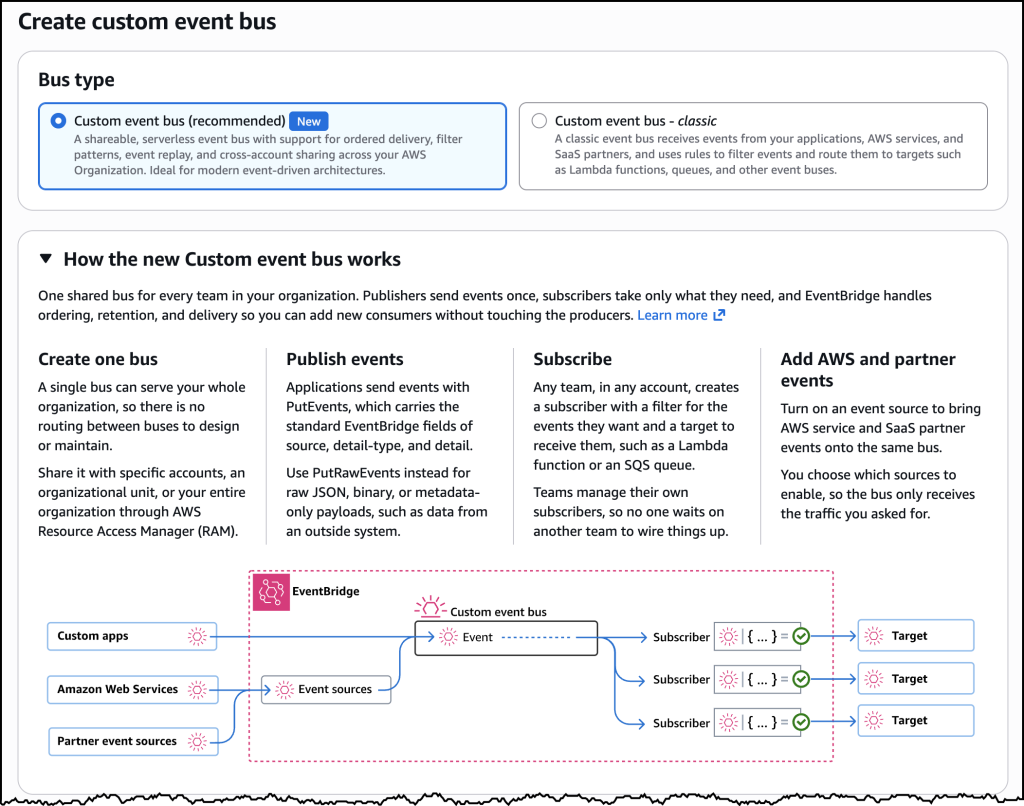
At the core of the enhanced event bus is a seamless integration with AWS Resource Access Manager (AWS RAM). Platform teams can establish a solitary, organization-wide event bus and configure sharing policies that restrict access exclusively to designated organizational units (OUs), specific AWS accounts, or granular IAM roles and users.

This native sharing framework eliminates the manual overhead of writing complex resource policies or configuring intricate bus-to-bus message forwarding chains. Publishers can broadcast events to the centralized bus without needing any prior knowledge of which internal teams, business units, or downstream microservices intend to consume them. Conversely, subscribers independently establish their own event consumption pipelines, filter criteria, and target configurations. To prevent systemic resource exhaustion and maintain predictable performance envelopes, AWS has established a default provisioning quota of 10,000 distinct Subscribers per enhanced event bus, with provisions for enterprises to request quota increases through standard support channels.
Addressing the Sequencing Challenge: Native Event Ordering
One of the most consequential architectural enhancements introduced in this release is the native support for event ordering and synchronous target invocation. While asynchronous, out-of-order processing remains the gold standard for decoupled microservices, specific vertical applications—such as supply chain tracking, where real-time vehicle telemetry must be processed in strict chronological order—suffer severe data integrity corruption if messages arrive out of sequence.
The enhanced custom event bus resolves this dilemma by allowing publishers to inject an EventGroupId attribute into outgoing event payloads. EventBridge intelligently routes all events sharing an identical EventGroupId in strict sequential order to subscriber targets configured for ordered delivery. Meanwhile, other concurrent subscribers attached to the same bus can process decoupled events asynchronously without incurring blocking delays.
To facilitate this structured processing model without intermediary message queues, the enhanced bus supports synchronous invocation modes for downstream targets such as AWS Lambda. Synchronous invocation verifies that a target function has successfully processed an event before acknowledging receipt back to the bus, effectively deprecating the historical pattern of placing an Amazon SQS buffer between an event bus and a compute layer solely to guarantee execution order.
Consolidated Subscriptions and Advanced Data Transformation
Operational management of event routing rules has also been significantly streamlined through the introduction of the unified Subscriber resource. Historically, configuring event filtering, target routing, dead-letter queue (DLQ) destinations, and retry policies required managing multiple disparate AWS resources, including EventBridge rules, targets, and custom IAM execution roles.
The new Subscriber resource consolidates these components into a single, cohesive, manageable administrative unit. Each Subscriber encapsulates the exact filter pattern defining desired events, the designated target architecture, and customized failure-handling behaviors. Furthermore, Subscribers incorporate variable start-time options, simplifying administrative workflows when onboarding new engineering teams or executing historical event replays for application debugging and state hydration.
To further reduce compute overhead at the consumer level, the enhanced bus integrates advanced data transformation and validation utilities. Publishers can leverage content-based deduplication, wherein EventBridge programmatically analyzes and hashes incoming payloads to automatically detect and discard accidental retries occurring within a five-minute window, effectively delivering exactly-once delivery semantics for upstream sources lacking native idempotency tokens. Additionally, subscribers can utilize built-in JSONata expressions to reshape payloads mid-transit, extracting, renaming, or computing fields to match downstream API schemas. For organizations standardizing on serialization frameworks like Apache Avro or Protocol Buffers, EventBridge provides native deserialization capabilities, enabling fine-grained filtering and routing across complete binary payloads without requiring consumers to write custom parsing code.
Pricing Model Transformation
Financial structuring for the enhanced custom event bus departs from the traditional per-event ingestion model by introducing a throughput-based ingress and egress pricing architecture. Under this updated framework, event publishers incur costs based strictly on the volume of events ingested into the central bus, while subscribers pay proportionally for the volume of events successfully delivered to their configured targets.
Industry analysts note that this shift directly addresses the unpredictable cost scaling observed in multi-bus architectures, where cumulative cross-account forwarding charges frequently introduced budget overruns for fast-growing engineering organizations. By aligning infrastructure costs directly with actual data ingestion and consumption utility, enterprises gain clearer financial visibility and more accurate internal cost allocation capabilities.
Implications and Industry Analysis
The release of the enhanced custom event bus marks a mature evolution in AWS’s serverless strategy, signaling a definitive shift from treating event routing as a collection of isolated routing primitives to viewing it as a core enterprise-wide data fabric. By addressing the friction points of multi-account governance, event ordering, and cross-team visibility, AWS has effectively lowered the architectural barrier to entry for large-scale enterprise serverless adoption.
Industry observers and cloud architects anticipate that this feature will accelerate the migration of mission-critical transactional and logistical workloads to serverless environments, where teams previously hesitated due to sequencing and governance hurdles. As enterprises continue to decentralize software development across autonomous product teams, centralized yet flexibly shared event infrastructures like the enhanced custom event bus will likely become the bedrock of modern, scalable cloud-native engineering.
