

The Evolution of RAG and the Chunking Bottleneck
The integration of RAG has fundamentally altered how organizations manage proprietary data. By grounding LLM outputs in verified documentation, companies reduce the risk of misinformation. However, the early stages of RAG development were characterized by "naive chunking," where text was indiscriminately sliced into equal character lengths. Historical data from early 2023 performance benchmarks indicated that such methods often severed critical semantic links, resulting in a 30% to 40% drop in retrieval precision.
As the industry moved toward more sophisticated architectures, the focus shifted from mere storage to intelligent retrieval. The evolution of this field can be charted through a distinct timeline: in early 2023, fixed-size windows were the industry standard; by late 2023, developers began experimenting with recursive splitting based on punctuation; and as of 2024, the field has moved toward semantic and agentic chunking, which utilize LLMs themselves to determine where one idea ends and another begins.
The Anatomy of a Decision Tree
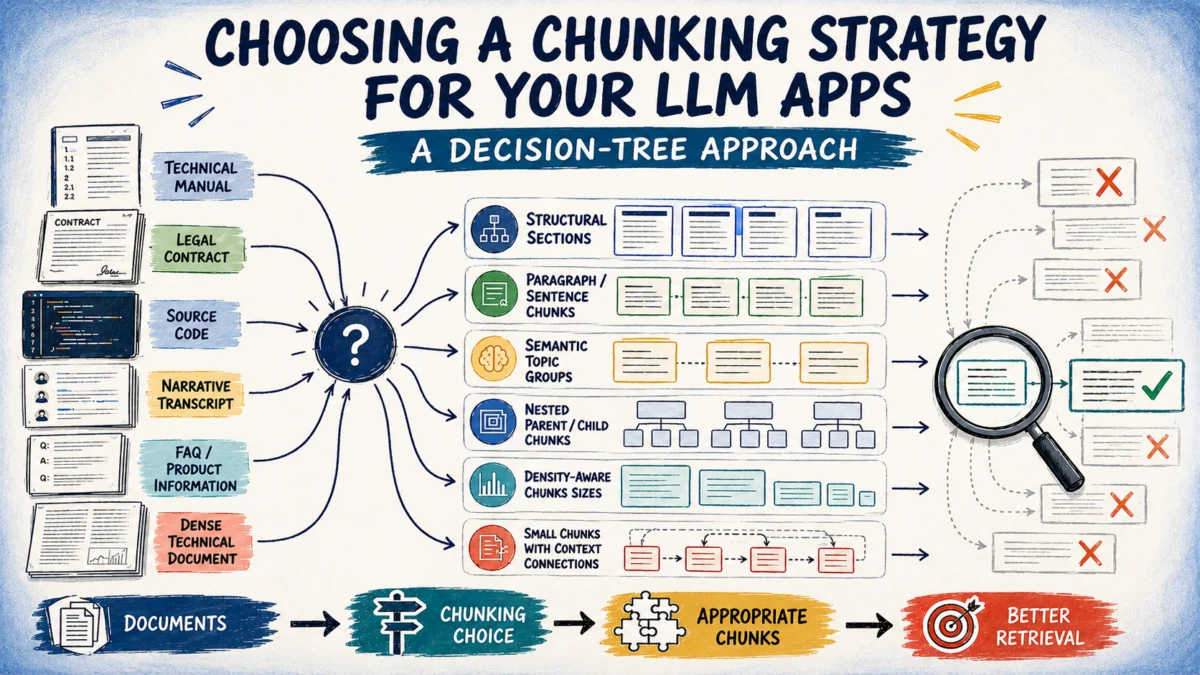
To standardize the selection process, developers are now utilizing structured decision trees to evaluate document properties. This systematic approach forces a move away from trial-and-error, instead anchoring decisions in the physical reality of the data. The first branch in this logical framework asks a binary question: does the document require intervention at all? If a document—such as an FAQ page or a concise policy memo—is small enough to fit within an embedding model’s context window, segmentation is technically redundant. Over-processing in these instances introduces unnecessary computational overhead and can degrade the signal-to-noise ratio during vector search.
When segmentation is deemed necessary, the second pivot involves an assessment of structural integrity. If a document is rich in Markdown headers, HTML tags, or specific code-base demarcations, document-based chunking is the most efficient path. By respecting these natural breakpoints, the system preserves the logical hierarchy of the text. Failure to observe these boundaries often results in "context fragmentation," where the retrieval engine returns a snippet that is technically relevant to a keyword but lacks the explanatory surrounding text necessary to be useful to the user.
Strategic Nuances: Context, Density, and Cost
For more complex data, such as legal contracts or technical specifications, the dependencies are often global rather than local. In these cases, late chunking has emerged as a high-performance alternative. By embedding the entire document using a long-context model before generating sub-chunks, the system ensures that each individual segment retains a "latent memory" of the document’s overall context.
The decision-making process must also account for the information density of the corpus. Adaptive chunking is required when a document shifts rapidly between high-density data, such as financial tables, and low-density narrative summaries. Using a uniform chunk size for both leads to either over-simplification of the data or excessive fragmentation of the narrative. Similarly, for organizations managing vast, heterogeneous libraries, agentic chunking acts as a sophisticated triage layer. In this model, an LLM acts as an autonomous overseer, analyzing the document type—whether it is a white paper, a chat transcript, or a code repository—and selecting the optimal chunking strategy on a per-document basis.
Empirical Analysis of Retrieval Failure
Industry reports from 2025 suggest that approximately 65% of RAG retrieval failures can be traced back to suboptimal preprocessing. Common symptoms of this failure include the "cut-off" phenomenon, where chunks terminate mid-sentence or mid-table, rendering the LLM unable to synthesize a coherent response.
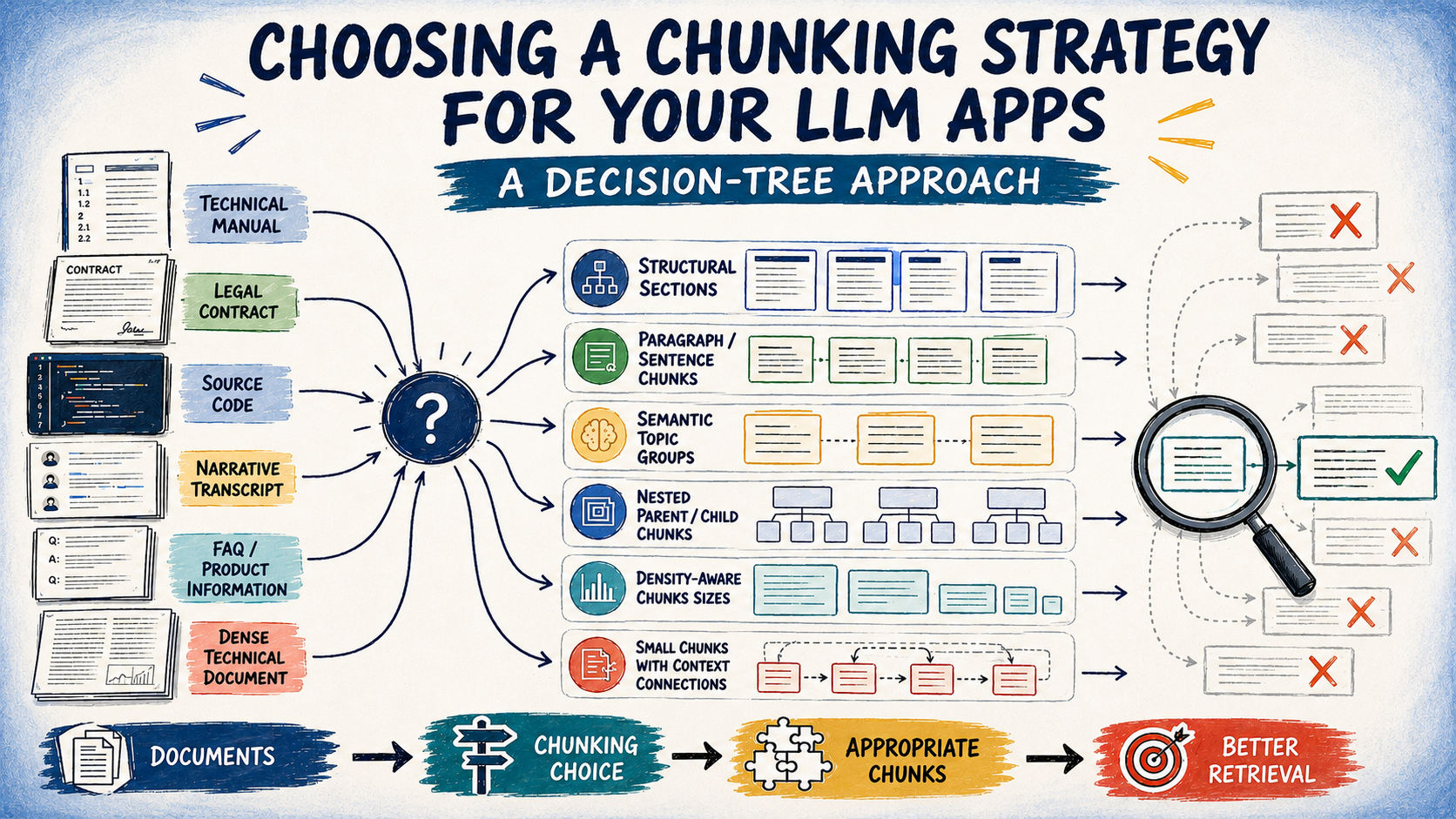
Data analysts often monitor specific metrics to identify when a strategy is failing:
- Retrieval Precision: The percentage of chunks returned that are truly relevant to the query.
- Contextual Completeness: The ability of the chunk to stand alone without requiring the user to look at adjacent segments.
- Compute-to-Utility Ratio: The cost of the indexing process relative to the improvement in answer accuracy.
When these metrics drift, it is usually an indicator that the chosen strategy is misaligned with the document’s structure. For instance, if an organization uses semantic chunking on a document that is highly repetitive, the system may generate an inconsistent number of chunks, leading to unpredictable indexing costs.
Implementation Guidelines and Professional Standards
For engineering teams, the implementation of these strategies follows a rigorous cycle of validation. The first step is the deployment of a "baseline" strategy, typically recursive chunking, which serves as a reliable default for uniform document sets. Only when the baseline fails to meet specific quality thresholds—often identified through a series of "gold-standard" evaluation queries—should teams introduce higher-complexity methods like hierarchical or LLM-based chunking.
The cost of these more advanced methods is non-trivial. LLM-based chunking, while superior in identifying logical breakpoints, incurs the highest computational cost per document. Consequently, this strategy is generally reserved for high-stakes domains, such as medical record analysis or legal discovery, where the cost of a retrieval error is substantially higher than the cost of additional compute cycles.
Broader Implications for AI Infrastructure
The shift toward more nuanced chunking reflects a broader trend in AI development: the transition from "model-centric" to "data-centric" AI. As models reach a plateau in terms of raw parameter counts and architectural improvements, the differentiator in system performance has become the quality of the data ingestion pipeline.
Looking forward, the industry is moving toward automated, self-tuning chunking systems that dynamically adjust their strategies based on real-time feedback from user queries. This "closed-loop" approach, where the system monitors its own retrieval performance and updates its chunking parameters accordingly, represents the next frontier in RAG optimization.
Conclusion: Matching Strategy to Utility
The process of choosing a chunking strategy is not a one-time configuration, but a continuous requirement for system maintenance. By utilizing a clear decision tree, developers can ensure that their RAG systems remain both performant and cost-effective. The primary objective remains constant: to bridge the gap between the chaotic nature of human-written documents and the structured requirements of vector databases.
Ultimately, the most successful RAG implementations are those that view chunking as an exercise in information design. Whether opting for the simplicity of fixed-size windows or the complexity of agentic analysis, the focus must remain on preserving the semantic integrity of the data. As the landscape of LLM applications continues to expand, the ability to effectively structure and segment information will remain a core competency for any organization seeking to harness the full potential of artificial intelligence. In the final assessment, the quality of an LLM’s response is only as good as the context it is provided; by refining the chunking strategy, developers ensure that the foundation of their system is as robust as the intelligence they are trying to build.
