

The semiconductor manufacturing industry has reached a critical inflection point as leading-edge system-on-chip (SoC) designs transition into deep submicron nodes, pushing the physical limits of traditional lithography. As the industry moves toward the Angstrom era, the complexity of patterning has scaled exponentially, necessitating a fundamental shift in how silicon features are printed and verified. At the center of this evolution is Extreme Ultraviolet (EUV) lithography, a technology that utilizes high-power pulsed lasers to create plasma light sources and sophisticated reflective optics to project intricate mask patterns onto silicon wafers. However, as error budgets for the world’s most advanced chips tighten to sub-nanometer levels, the industry is now looking toward High-Numerical Aperture (High-NA) EUV to maintain the momentum of Moore’s Law and provide the resolution necessary for the next generation of computing.
The Convergence of Innovation in San Jose: A Chronology of SPIE 2026
In late February 2026, San Jose, California, served as the global epicenter for lithography research and development. The week was anchored by two major events that brought together the world’s foremost experts in optics, photonics, and semiconductor manufacturing.
The proceedings began with the SPIE Advanced Lithography + Patterning 2026 conference, held from February 22 to February 26. This year’s event carried particular historical significance, marking the 50th anniversary of the international society for optics and photonics’ premier annual gathering. Over five decades, this conference has evolved from a small gathering of optics specialists into a massive industrial summit where breakthroughs in EUV, metrology, and process integration are first unveiled to the public.
Parallel to the SPIE sessions, the Synopsys Lithography VIP Symposium took place on February 23. This specialized forum focused on the practical application of emerging technologies—specifically graphics processing unit (GPU) acceleration and artificial intelligence (AI)—in the realm of computational lithography. The symposium culminated in a high-stakes panel discussion titled "AI/ML in Mask Synthesis: Hype vs. Reality," which sought to delineate between speculative technological promises and the concrete, verifiable gains in yield and engineering efficiency currently being realized on the factory floor.
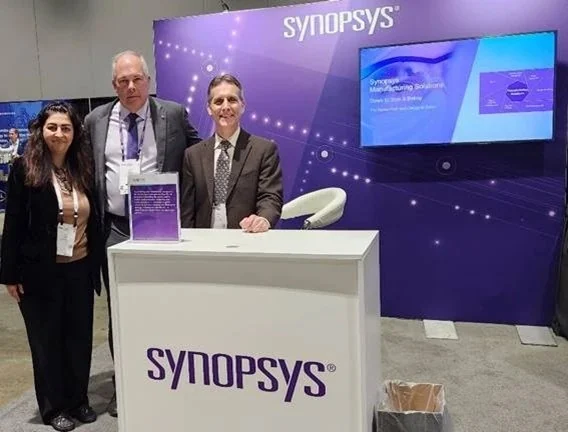
Throughout the week, Synopsys emerged as a dominant voice in the technical discourse, contributing a dozen research papers and presentations that addressed the most pressing bottlenecks in modern semiconductor fabrication.
Navigating the Technical Hurdles of High-NA EUV
As the industry transitions from standard 0.33 NA EUV to 0.55 High-NA EUV, engineers are grappling with a new set of physics-based challenges. High-NA EUV offers the promise of extending single-patterning capabilities to much finer resolutions, but it introduces significant architectural changes, most notably anamorphic optics. These optics provide different magnifications in the X and Y directions, effectively halving the exposure field size compared to standard EUV tools.
For large-scale chip designs, this reduced field size necessitates a "stitching" approach, where two separate exposures must be precisely aligned and joined on the wafer. This requirement has sparked a revolution in design rules. Experts at the symposium emphasized that "stitch-aware" physical design is no longer optional; it is a prerequisite for manufacturing viability. Without advanced Optical Proximity Correction (OPC) and Resolution Enhancement Technology (RET), the variations at the stitch boundary can lead to catastrophic yield loss.

Breakthroughs in Machine Learning for OPC Modeling
One of the most discussed technical contributions at the conference was a paper presented by Synopsys’ Zhiru Yu, titled "Machine learning enhanced optical proximity correction modeling for high-NA EUV lithography." The research tackled the daunting task of modeling for an 18 nm pitch line-space array with a 9 nm after-development inspection critical dimension (ADI-CD). In such a regime, the allowable error margin is less than 1 nm across all variation sources.
Traditional compact models often struggle to account for the anisotropic optics and complex background reflections inherent in High-NA systems. The Synopsys team demonstrated a hybrid approach, integrating a machine learning-based Convolutional Neural Network (CNN) with traditional compact modeling. This "best of both worlds" strategy allowed the system to capture localized proximity behaviors with unprecedented fidelity.
The data presented showed that this AI-enhanced model could successfully predict contours in the critical stitching regions and black-border contexts. By accounting for long-range effects, including behaviors related to metal oxide resists (MOR), the team achieved the required prediction accuracy without the common pitfall of "overfitting," where a model becomes too specific to its training data and fails in real-world applications.
Co-Optimization and Inverse Lithography Technology (ILT)
Addressing the stitching challenge from a different angle, Thuc Dam of Synopsys presented research on co-optimized double exposure stitching. The core of this approach lies in Inverse Lithography Technology (ILT), a mathematically rigorous method of calculating the optimal mask shape required to produce a desired on-wafer pattern.
By simultaneously optimizing the two stitched exposures and their respective masks, the research demonstrated a significant expansion of the "process window"—the range of manufacturing variables within which a chip can be successfully produced. The presentation highlighted how this co-optimization mitigates Edge Placement Error (EPE) and reduces sensitivity to overlay errors at the stitch boundary. For manufacturers, this means that the inevitable minor misalignments of the lithography tool are less likely to result in functional defects, directly translating to higher profit margins per wafer.
The Battle Against Mask Defects: A Collaborative Effort with Intel
Mask integrity remains a primary concern for EUV adoption, as even a microscopic defect can be repeatedly printed across thousands of wafers. Joseph M. Rodriguez of Intel presented a collaborative paper with Synopsys titled "Rigorous modeling and repair of EUV multilayer defects."
The research focused on "buried" multilayer defects—imperfections deep within the reflective layers of the EUV mask that are notoriously difficult to detect and mitigate. Using the Synopsys S-Litho model, the team performed full 3D electromagnetic simulations to visualize how these defects interact with light across various depths and feature types.
The practical outcome of this study was a simulation-guided defect repair flow. By predicting exactly how a defect would distort the aerial image, the team could recommend specific repairs to compensate for reflectivity loss. When tested on production-grade EUV masks, the post-repair measurements showed that the critical dimension (CD) deltas were reduced to less than 6%, effectively "healing" the mask and matching the performance of a defect-free reference.

Operational Efficiency and the Science of Sampling
Beyond the physics of light and masks, the symposium addressed the massive data challenge inherent in modern metrology. Vito Dai of Synopsys introduced a novel methodology for "near-optimal sampling" of physical design layouts.
In a typical advanced SoC, there are billions of patterns. Testing every single one is computationally and physically impossible, yet missing a "rare" pattern that causes a failure is not an option. Dai’s research introduced a "pattern coverage" metric based on range patterns, allowing engineers to quantify exactly how much of a design’s diversity has been sampled. This algorithm prevents "oversampling" of redundant, common patterns while ensuring that unique, high-risk geometries are identified for metrology and machine learning training. This efficiency gain is vital for reducing the "turnaround time" (TAT) from design completion to mass production.
Industry Implications and the Road Ahead
The collective findings presented at SPIE 2026 suggest that the semiconductor industry is successfully navigating the transition to High-NA EUV, but the cost of entry is rising. High-NA lithography tools, currently pioneered by ASML, represent some of the most expensive and complex machinery ever created, with price tags exceeding $350 million per unit. To justify this investment, EDA (Electronic Design Automation) software must work in lockstep with the hardware.
The consensus among industry leaders in San Jose was clear: the future of chip manufacturing is increasingly defined by "computational lithography." The integration of GPU acceleration is no longer a luxury but a necessity to handle the massive workloads required for ILT and OPC. Furthermore, the "Reality" side of the AI debate has firmly taken hold; while AI may not replace the fundamental physics of optics, its ability to refine models and accelerate verification is now a cornerstone of the manufacturing flow.
As Synopsys and its partners like Intel continue to refine these workflows, the path toward 2nm and 1.4nm nodes becomes clearer. The innovations discussed during the 50th anniversary of SPIE Advanced Lithography + Patterning underscore a broader trend: as the physical dimensions of transistors shrink toward the atomic scale, the "digital twin" of the manufacturing process—driven by simulation, AI, and rigorous modeling—becomes the most important tool in the fab.
The industry now looks forward to the continued evolution of these technologies, with expectations that the methodologies debuted this year will be standard practice in high-volume manufacturing facilities across the globe by 2027. Synopsys remains committed to this collaborative ecosystem, driving the software innovations that make the world’s most advanced hardware possible.
