
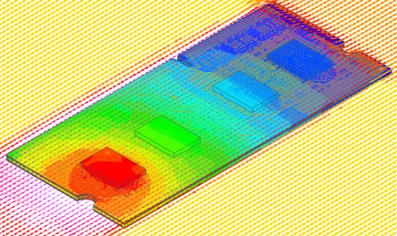

As the global demand for high-performance computing (HPC) and artificial intelligence (AI) continues to surge, the semiconductor industry has reached a critical juncture in thermal management. For years, the standard approach to cooling data center racks and consumer electronics involved forced-air systems—large, powerful fans that circulated ambient air across every component on a printed circuit board (PCB). However, the advent of ultra-high-power chips, such as modern Graphics Processing Units (GPUs) and Application-Specific Integrated Circuits (ASICs) that now exceed 700 to 1,000 watts of Thermal Design Power (TDP), has necessitated a transition to liquid cooling. While liquid cooling is exceptionally efficient at removing heat from these "hot spots," it is inadvertently creating a secondary thermal crisis for the surrounding components that were previously dependent on the incidental airflow generated by legacy cooling systems.
When a system designer swaps a massive heat sink and fan assembly for a liquid-cooled cold plate, the localized temperature of the primary processor drops significantly. Yet, the secondary chips on the board—memory modules, voltage regulators, and network controllers—are suddenly left in a stagnant air environment. Without the "broad-brush" cooling effect of moving air, these secondary components, often referred to as "warm chips," are beginning to exceed their thermal envelopes, leading to premature hardware failure and system instability.
The Physics of Reliability: Why Temperature Matters
In the realm of semiconductor engineering, heat is rarely the direct cause of a system crash; rather, it is the catalyst for mechanical failure. Robin Bornoff, innovation roadmap manager at Siemens Digital Industries Software, notes that temperature is a leading indicator of reliability because of subsequent thermomechanical phenomena. When a component heats up, the materials within it expand at different rates based on their specific coefficients of thermal expansion.
If a PCB or a chip package experiences excessive thermal gradients, the resulting physical stress can cause the board to bend. Over time, this repeated bending leads to fractures in the microscopic C4 (Controlled Collapse Chip Connection) bumps or solder balls that connect the silicon die to the substrate. Once these physical connections are severed, the circuit fails entirely. In a liquid-cooled environment where the primary GPU is kept at a chilly 40°C while a neighboring memory chip climbs toward 95°C, the resulting thermal stress across the board can be more damaging than if the entire system were uniformly warm.
A Chronology of Thermal Management Evolution
To understand the current challenge, one must look at the historical progression of electronic cooling.
- The Passive Era (Pre-1990s): Most integrated circuits generated negligible heat, requiring only natural convection or simple metal fins (heat sinks) to dissipate energy into the surrounding air.
- The Active Air Era (1990s–2010s): As clock speeds increased, CPUs began requiring dedicated fans. This era saw the rise of the "shroud" design, where air was funneled through the entire chassis, cooling everything from the main processor to the smallest capacitors.
- The Hybrid/Liquid Era (2015–Present): With the AI boom, air reached its physical limit. Air can only carry so much heat per cubic meter. Liquid, which has a much higher heat capacity, became the standard for top-tier data center deployments.
- The Micro-Cooling Era (Emerging): We are now entering a phase where cooling is no longer a "one size fits all" system-level solution but a bespoke, component-level requirement.
The "Thermal Bookkeeping" Challenge
The shift toward heterogeneous cooling requires a rigorous new approach to what engineers call "thermal bookkeeping." In a traditional air-cooled system, the thermal analysis was relatively straightforward: ensure the total CFM (cubic feet per minute) of the fans could handle the total wattage of the board. Today, engineers must perform holistic simulations to identify "thermal shadows"—areas where liquid cooling blocks airflow or where stagnant air pockets form.

Jeff Tharp, senior product manager for Thermal Integrity in Electronics at Synopsys, explains that establishing an operating temperature requires balancing the rate of heat production with the rate of dissipation. However, this is rarely a linear calculation. Marc Swinnen, director of product marketing at Synopsys, points out a "chicken-and-egg" problem: the wattage a chip produces is dependent on its temperature (due to leakage current), but its temperature is dependent on the wattage. In a board where liquid and air cooling coexist, these interactions become incredibly complex, requiring multiple iterations of simulation to ensure that "warm chips" do not transition into "hot chips" that the system isn’t equipped to handle.
Micro-Cooling Solutions: Vapor Chambers and Heat Pipes
For components that do not justify the cost or complexity of a full liquid-cooling loop, engineers are increasingly turning to passive micro-cooling technologies like vapor chambers and heat pipes. These devices utilize phase-change materials to move heat away from sensitive areas without the need for external pumps.
A heat pipe is a vacuum-sealed copper tube containing a small amount of liquid. When the "evaporator" end of the pipe touches a hot chip, the liquid turns into vapor and travels to the "condenser" end, where it releases heat and turns back into liquid. Satya Karimajji, a senior engineer at Synopsys, describes this as a mini-liquid-cooling setup that relies on capillary action rather than mechanical pumps.
Vapor chambers operate on a similar principle but function as flat plates. They are particularly effective at spreading heat across a wide surface area, making them ideal for thin applications like laptops or high-density server blades where there is no room for a traditional tower-style heat sink.
The MEMS Revolution: Active Cooling at the Micron Scale
Perhaps the most innovative response to the lack of airflow in liquid-cooled systems is the development of MEMS (micro-electromechanical system) fans. Companies like xMEMS are repurposing technology originally designed for high-end audio speakers to create miniature, solid-state fans that can be mounted directly on top of a chip package.
These MEMS units use the piezoelectric effect—applying voltage to a silicon diaphragm to create movement. While this movement creates sound waves in speakers, it can be modulated to create high-velocity airflow in cooling applications. According to Mike Housholder, vice president of marketing at xMEMS, these units can produce directed airflow to specific hot spots that a broad-blast fan would miss.
One of the primary advantages of MEMS cooling is its acoustic profile. Traditional rotary fans are noisy and prone to mechanical wear. In contrast, xMEMS units operate at frequencies above 40 kHz—well beyond the range of human hearing. At a distance of just three centimeters, the mechanical noise is effectively zero, and the airflow noise is measured at a whisper-quiet 18 dBA. For systems like smart glasses, tablets, or high-density SSDs (solid-state drives), these micro-fans provide a way to introduce "active" cooling into a space that was previously considered too small for a fan.

Data Center Implications and SSD Stability
The first major battleground for these micro-cooling technologies is the data center storage market. Modern NVMe SSDs are reaching speeds that generate significant heat, often exceeding 15 to 20 watts during heavy write cycles. In a liquid-cooled server rack, these SSDs are often tucked away in bays that receive zero airflow.
To combat this, manufacturers are exploring "active heat sinks"—a hybrid of traditional metal fins and MEMS fans. Because MEMS fans can generate high backpressure, they can push air through much denser fin arrays than a standard fan could. This allows for a massive increase in surface area without increasing the physical footprint of the drive. The result is a drive that can maintain peak performance without thermal throttling, even in a stagnant-air environment.
Industry Analysis: The Path Forward
The transition to liquid cooling is inevitable for the high-end computing market, but the "uncooled chip" problem highlights a lack of maturity in system-level thermal design. As the industry moves toward 3D-ICs (three-dimensional integrated circuits) and chiplet architectures, the thermal density will only increase.
Industry analysts suggest that we will soon see a "tiered" approach to thermal management:
- Tier 1 (700W+): Direct-to-chip liquid cooling or full immersion.
- Tier 2 (50W–200W): Advanced vapor chambers and large-scale heat pipes.
- Tier 3 (5W–50W): MEMS-based micro-cooling and active heat sinks.
- Tier 4 (<5W): Traditional passive dissipation.
This tiered approach will require a paradigm shift in how PCBs are designed. Instead of being an afterthought, thermal management must be integrated into the earliest stages of the floorplanning process.
Conclusion
The "cooling gap" created by the move to liquid systems represents one of the most significant engineering challenges of the decade. As primary processors get cooler, the rest of the board is getting hotter, threatening the very reliability that liquid cooling was supposed to protect. However, through a combination of sophisticated simulation tools, phase-change materials, and the emerging field of MEMS-based active cooling, the industry is finding ways to bring airflow back to the components that need it most.
As we look toward the future, the success of the next generation of AI and HPC hardware will depend not just on how fast we can make the processors, but on how holistically we can manage the heat they—and their neighbors—produce. The era of the "universal fan" may be ending, but the era of precision, component-level thermal management has just begun. Regardless of the cooling medium—be it air, liquid, or phase-change vapor—the mandate for engineers remains the same: identify the heat, track its path, and dissipate it before the mechanical limits of the hardware are reached.
