

The terms "virtual server" and "physical server" do not refer to a state of tangible or intangible existence but rather to the way the machines are structured. All digital data and systems have to exist and be hosted somewhere in the real world. A platform that runs on the cloud, your personal accounts, a company website you visit online, or an app on your phone can all be traced back to where they are hosted: a real machine. This foundational understanding is crucial for anyone navigating the complexities of modern IT infrastructure, from individual users to large enterprises.
The Tangible Foundation: What is a Physical Server?
A physical server, often referred to as a bare metal server, is a discrete piece of hardware. It comprises all the essential components required for computing operations: a central processing unit (CPU), potentially a graphics processing unit (GPU), random-access memory (RAM), storage devices (like hard drives or SSDs), a power supply unit, network interfaces for connectivity, and an operating system. These machines are purpose-built for continuous operation, designed to run 24/7 and dedicated to serving other computers or devices with specific applications and services. This can include hosting websites, managing databases, facilitating email services, or running complex enterprise applications.
Whether a physical server is a compact desktop unit or a large, rack-mounted enterprise-grade machine, its classification remains the same. These servers can be owned and operated by organizations within their own data centers, providing a high degree of control and security, or they can be accessed through cloud service providers, offering a blend of dedicated hardware with outsourced management. The defining characteristic of a physical server is its exclusive claim to all the machine’s resources. This direct access to hardware translates into unparalleled performance potential and a robust security posture, as there are no layers of abstraction to compromise.
Key Features of Physical Servers:
- Exclusive Resource Allocation: All computational power, memory, storage, and network bandwidth are dedicated solely to the tasks running on that specific server.
- Maximum Performance Potential: Direct hardware access allows for unthrodden performance, critical for highly demanding applications.
- Enhanced Security and Isolation: Without virtualization layers, the attack surface can be smaller, and isolation is inherent.
- Full Hardware Control: Organizations have complete command over the hardware configuration and maintenance.
- Longer Lifespan and Durability: Physical servers are typically built with robust components designed for extended operational life.
Historical Context and Use Cases for Physical Servers:
In the nascent stages of the internet and the widespread adoption of digital systems in the early 2000s, physical servers were the undisputed backbone of virtually all IT infrastructure. Companies would procure and house their own servers, often dedicating individual machines to specific functions like web hosting, email, or application serving. This era was characterized by a direct, one-to-one relationship between a server’s hardware and its intended purpose.
While the landscape has dramatically shifted with the advent of virtualization and cloud computing, physical servers continue to play a vital role in modern IT architectures. They are indispensable for workloads that demand peak performance, stringent security, or complete hardware isolation.
Popular use cases for physical servers include:
- High-Performance Computing (HPC): Scientific research, complex simulations, and large-scale data analysis often require the raw power and direct hardware access that only physical servers can provide.
- Critical Databases: Enterprise-level databases handling sensitive financial transactions or vast amounts of customer data benefit from the predictable performance and security of dedicated physical hardware.
- Resource-Intensive Applications: Applications that are not well-suited for virtualization, or those with very specific hardware requirements, are prime candidates for physical server deployment.
- Gaming Servers: For online gaming, low latency and consistent performance are paramount, making physical servers a preferred choice for many game developers and hosting providers.
- Virtualization Hosts: Ironically, physical servers are often the foundation upon which virtual server environments are built. A powerful physical server can host multiple virtual machines.
- Legacy Systems: Some older, critical applications may be incompatible with modern virtualization technologies, necessitating their continued operation on physical hardware.
Industries Relying on Physical Servers:
Sectors that prioritize absolute reliability, uncompromising performance, and stringent security measures frequently opt for physical servers. These include:
- Financial Services: For trading platforms, core banking systems, and fraud detection, where even milliseconds of delay or a minor security breach can have catastrophic consequences.
- Healthcare: For managing patient records, running diagnostic equipment, and facilitating critical medical research, where data integrity and uptime are paramount.
- Government and Defense: For classified data, national security systems, and critical infrastructure management, where extreme security and control are non-negotiable.
- Aerospace: For complex engineering simulations, flight control systems, and design processes that demand immense computational power and accuracy.
- Logistics and Supply Chain: For real-time tracking, inventory management, and route optimization, where efficiency and data accuracy are crucial.
- Manufacturing: For controlling automated production lines, running simulations for product design, and managing large-scale industrial processes.
- Media and Entertainment: For rendering high-definition graphics, managing massive media libraries, and supporting live streaming events where performance and scalability are key.
The Abstracted Powerhouse: What is a Virtual Server?
A virtual server, often referred to as a Virtual Machine (VM), is essentially a software-based emulation of a physical server. It leverages virtualization technology to partition a single physical server into multiple isolated virtual environments. Each VM operates as an independent server, possessing its own operating system, applications, and allocated resources such as CPU, RAM, and storage. This is the cornerstone of cloud computing, enabling cloud providers to efficiently allocate and manage vast pools of hardware resources to numerous customers.
Imagine a powerful physical server, equipped with cutting-edge hardware and software, boasting substantial computing power, extensive storage, remarkable speed, and robust reliability and security. Instead of dedicating this entire machine to a single user or application, virtualization allows it to be segmented. A single physical server can be transformed into numerous virtual servers, each sharing the underlying hardware resources. Each VM is then assigned a specific portion of these resources, functioning as an isolated entity. This principle of resource pooling and allocation at scale is what drives the global growth and efficiency of cloud computing services.
Key Features of Virtual Servers:
- Resource Efficiency and Scalability: Multiple VMs can run on a single physical server, maximizing hardware utilization and allowing for rapid scaling of resources up or down as needed.
- Cost-Effectiveness: By sharing hardware, the cost per server instance is significantly reduced, making it an attractive option for businesses of all sizes.
- Flexibility and Agility: VMs can be provisioned, cloned, moved, and decommissioned in minutes, offering unparalleled agility in IT operations.
- Isolation and Security: While sharing hardware, VMs are logically isolated from each other, preventing one VM’s issues from affecting others.
- Disaster Recovery and Business Continuity: Features like snapshots and live migration simplify backup and recovery processes, enhancing resilience.
The Ubiquitous Use Cases of Virtual Servers:
The applications for virtual servers are virtually limitless, permeating nearly every aspect of modern digital life. From the smallest startup to the largest multinational corporation, virtual servers underpin a vast array of services and applications. Even everyday users interact with virtual servers constantly without necessarily realizing it, whether browsing websites, accessing social media, or using cloud-based applications.
Some of the most popular use cases for virtual servers include:
- Web Hosting: The vast majority of websites today are hosted on virtual servers, offering scalability and cost-effectiveness for businesses of all sizes.
- Application Development and Testing: Developers can quickly spin up and tear down virtual environments to test new applications and software without impacting production systems.
- Database Management: Virtual servers are widely used to host databases, providing flexibility and the ability to scale resources based on demand.
- Cloud Computing Services: All major cloud platforms (AWS, Azure, Google Cloud) are built upon extensive virtual server infrastructure.
- Email Servers: Managing email services for organizations of various sizes.
- File Servers: Providing centralized storage and access to shared files.
- Virtual Desktops: Virtual Desktop Infrastructure (VDI) allows users to access their desktop environments from any device, hosted on virtual servers.
- Big Data Analytics: Processing and analyzing large datasets often leverages the scalability of virtual server environments.
- Machine Learning and AI: Training complex models and deploying AI applications can be done efficiently on virtualized infrastructure.
Bridging the Divide: Virtual Servers vs. Physical Servers
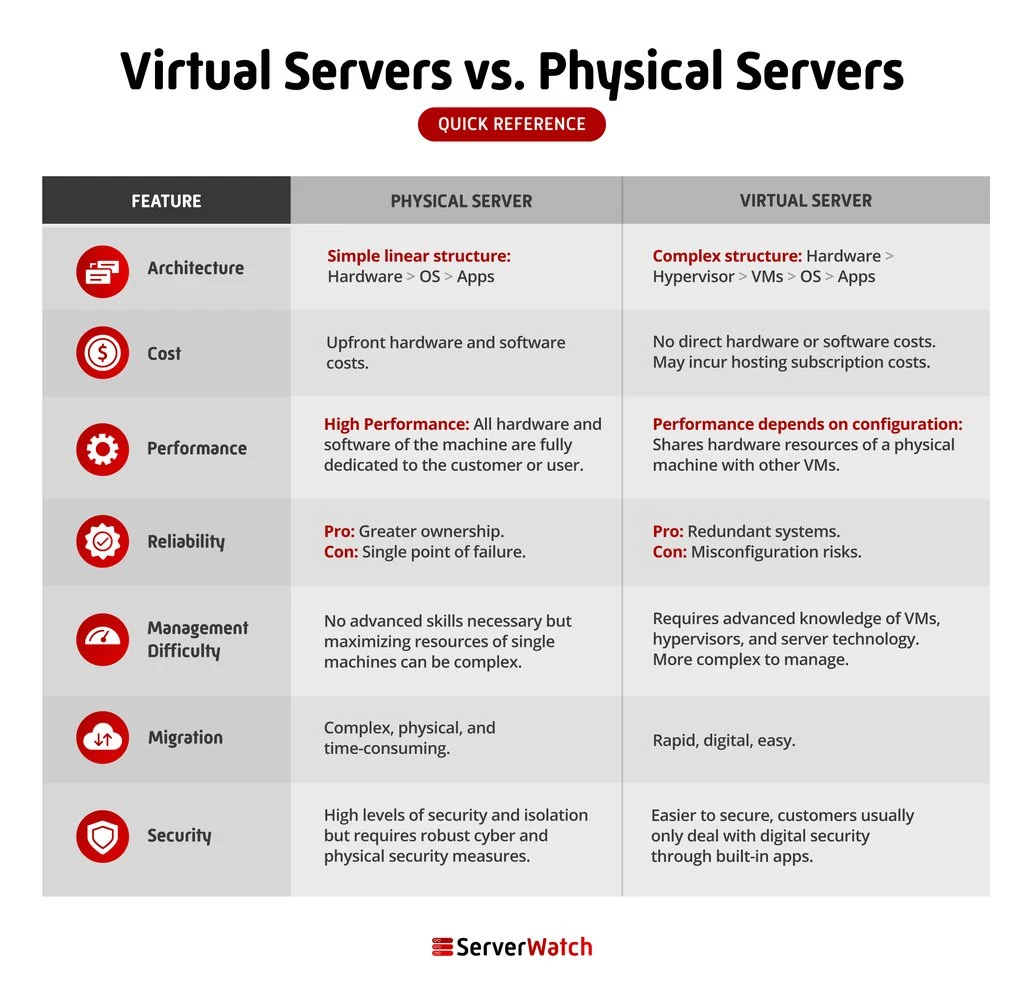
The fundamental distinction between physical and virtual servers lies in their architecture. While a physical server is a tangible piece of hardware, a virtual server is a software construct that runs on top of physical hardware. This architectural difference gives rise to a cascade of other disparities in cost, performance, reliability, management, and security.
Architecture: The Core Difference
The primary difference, as highlighted, is how the machines are structured. Physical servers are the bare metal foundation, while virtual servers are abstractions created through virtualization software (hypervisors) that allow multiple isolated operating system instances to run on a single physical machine. This abstraction layer introduces a degree of overhead but unlocks immense flexibility and efficiency.
Cost Considerations: Efficiency at Scale
Virtualization technology, while complex, offers significant cost advantages, particularly when implemented at scale. The ability to consolidate multiple workloads onto fewer physical machines dramatically reduces hardware acquisition costs, power consumption, cooling requirements, and physical space. While the initial investment in virtualization software and expertise might be higher, the long-term savings are substantial.

Furthermore, when utilizing virtual servers from cloud providers, businesses offload many of the direct costs associated with physical server ownership. This includes maintenance, hardware replacement, energy bills, and the risk of physical damage from events like natural disasters, theft, or power outages. The vendor assumes these responsibilities, allowing businesses to focus on their core operations.
Performance: A Nuanced Comparison
The performance comparison between physical and virtual servers is not a simple win for one over the other. It is a nuanced race influenced by numerous factors. A well-configured physical server with dedicated, high-end components will often outperform a virtual server sharing resources, especially for extremely demanding, latency-sensitive applications. However, modern virtualization technologies have significantly closed this gap.
The performance of a virtual server is heavily dependent on the underlying physical hardware, the efficiency of the hypervisor, the configuration of the VM itself (allocated CPU cores, RAM, storage IOPS), and the network infrastructure. For many common workloads, the performance difference is negligible, and the flexibility offered by virtual servers outweighs any marginal performance advantage of a physical server. In some cases, a virtual server might even offer better performance due to optimized resource allocation and the ability to quickly scale resources.
Reliability: Engineered for Uptime
Reliability, much like performance, is not an inherent trait of one over the other but rather a result of design and configuration. Both physical and virtual servers can be engineered for exceptional reliability. Physical servers can be built with redundant power supplies, RAID storage, and robust cooling systems. Virtualization platforms offer advanced features like live migration (moving a running VM from one physical host to another without downtime), high availability (automatically restarting VMs on a different host if the primary host fails), and fault tolerance.
The reliability of a virtual server is also tied to the reliability of the underlying physical infrastructure and the virtualization platform itself. Reputable cloud providers invest heavily in redundant hardware, power, and networking to ensure high uptime for their virtual server offerings.
Management Difficulty: Outsourcing and Simplification
Server management for both physical and virtual servers can be complex, involving operating system updates, security patching, software installation, and performance monitoring. However, when opting for cloud-based virtual servers, many of these management tasks are outsourced to the service provider. This significantly reduces the burden on internal IT teams. For on-premises virtualized environments, while the virtualization layer adds complexity, management tools can streamline the process of managing multiple VMs from a central console. Physical servers require direct, hands-on management of hardware and software.
Migration: Agility in Transition
Migration is a significant differentiator. Virtual servers are demonstrably easier to migrate than physical servers. The ability to copy a VM image, clone it, or use live migration tools allows for rapid movement between physical hosts or even data centers with minimal disruption. This agility is crucial for upgrades, hardware refreshes, or disaster recovery planning.
Migrating a physical server, conversely, is a far more involved process. It typically requires a complete system backup, potential hardware compatibility checks, and a manual reinstallation and reconfiguration on the new physical hardware. This can be a time-consuming and error-prone undertaking.
Security: Layers of Protection
Both virtual and physical servers can achieve high levels of security, but the approach and potential vulnerabilities differ. Physical servers offer inherent isolation, and security measures can focus on physical access controls, network segmentation, and robust firewalls. The attack surface is generally more contained.
Virtual servers introduce the virtualization layer as a potential point of vulnerability. A compromised hypervisor could theoretically impact all VMs running on it. However, modern hypervisors are highly secure and regularly patched. Security for virtual servers involves securing the VMs themselves, the hypervisor, and the underlying physical infrastructure. Cloud providers invest heavily in multi-layered security defenses to protect their virtual server environments. Both types of servers benefit from strong access controls, encryption, regular patching, and robust network security practices.
The Bottom Line: Choosing the Right Server for Your Business
The decision between virtual and physical servers is not a one-size-fits-all answer. Both technologies have distinct advantages and disadvantages, and the optimal choice hinges entirely on a business’s unique needs, priorities, and resources.
Virtual servers generally represent the more versatile and cost-effective solution for the majority of businesses. Their affordability, inherent scalability, rapid deployment capabilities, and access to the latest technological advancements make them ideal for a wide range of applications, from web hosting and application development to cloud services and data analytics. The ease of management and the ability to adapt quickly to changing demands are significant benefits.
However, physical servers remain the superior choice for businesses with specific, uncompromising requirements. These include organizations that demand the absolute highest levels of performance for highly specialized, resource-intensive applications, or those that require complete control over their hardware and an exceptionally high degree of isolation for security-sensitive data and operations. Industries where the cost of a potential breach or performance degradation is astronomically high will often lean towards the dedicated resources and inherent isolation of physical servers.
Ultimately, a hybrid approach, leveraging both virtual and physical servers, is often the most strategic solution. This allows businesses to benefit from the scalability and cost-efficiency of virtual servers for most of their operations while reserving the power and security of physical servers for their most critical and demanding workloads. Understanding the fundamental differences and their implications is the first step in making an informed decision that will shape the technological foundation of any organization.
