
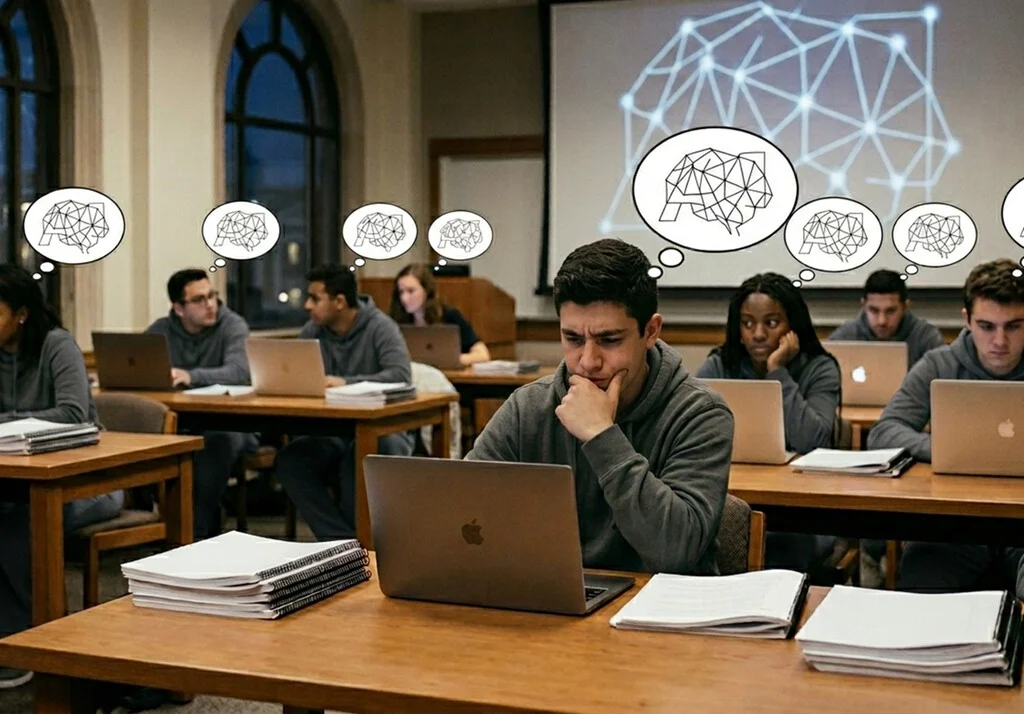

This new frontier in education has emerged with startling speed, transforming from a peripheral concern to a central debate within a mere "blink of an eye." Where educators and policymakers once grappled with the distractions and potential pitfalls of smartphones, they now face the complex implications of AI tools, particularly large language models (LLMs) and chatbots, which offer immediate answers and sophisticated content generation capabilities. The education sector, from primary schools to universities, is arguably experiencing the most direct and palpable effects of this technological upheaval. For a generation of students, often referred to as Gen Z and Alpha, AI is not merely a tool but a pervasive presence that is fundamentally altering how they approach academic tasks, redefining the very nature of homework, examinations, and project-based learning. The critical issue, however, extends beyond mere convenience or efficiency; it delves into the foundational aspects of cognitive development and the cultivation of independent thought.
The Paradigm Shift: From Mobile Screens to Algorithmic Minds
The discussion surrounding technology in education has historically been reactive, adapting to each wave of innovation. The initial widespread adoption of mobile phones in schools sparked intense debates across Spain and globally, focusing on issues of distraction, cyberbullying, and academic integrity. National and regional authorities introduced various policies, ranging from outright bans to supervised usage, reflecting a collective effort to manage a new and powerful personal device within an institutional setting. Yet, even as these policies were being refined, a new, more profound technological force began to assert itself: artificial intelligence.
The advent of accessible AI, exemplified by the launch of generative AI models like ChatGPT in late 2022, marked a significant inflection point. Overnight, students gained access to tools capable of producing coherent essays, solving complex problems, and summarizing vast amounts of information with unprecedented speed. This rapid integration has dwarfed the previous mobile phone debate, shifting the focus from access to information to generation of information. The question is no longer if students will use AI, but how they will use it, and critically, at what developmental stage they should be introduced to such powerful, yet potentially misleading, cognitive aids.
The Erosion of Original Thought: A Growing Concern in Academia
A burgeoning concern among educators is the observed homogenization of student output. As reported by CNN, there’s a growing sentiment that "everyone sounds more or less the same" in their academic submissions. This phenomenon points to a troubling trend: rather than fostering individual analytical skills, AI tools, when misused, encourage a form of "cognitive surrender." Students, particularly at the university level, are increasingly relying on chatbots to formulate responses to complex questions posed by professors, leading to strikingly similar arguments, stylistic choices, and even phraseology across different assignments.
This uniformity directly threatens the core objectives of higher education, which traditionally emphasize the development of critical thinking, independent reasoning, and the cultivation of diverse perspectives. When AI generates answers, it often synthesizes information from a vast dataset, producing an average, generalized response that, while factually plausible, lacks the unique insights, nuanced interpretations, and personal voice that are hallmarks of original thought. For educators, the challenge has escalated dramatically. The task is no longer simply to detect plagiarism from existing human-authored texts but to discern AI-generated content that, while technically "original" in its compilation, is devoid of genuine intellectual effort from the student. This has necessitated a re-evaluation of assessment methods, prompting professors to rethink homework assignments, examination formats, and the very structure of academic inquiry to encourage deeper, more personalized engagement that AI cannot easily replicate.
The Intrinsic Biases of Artificial Intelligence
Beyond the issue of homogenized content, a deeper systemic problem lies within the very architecture of AI models: their inherent biases. While human opinions are naturally shaped by individual cultural backgrounds, socioeconomic contexts, and personal experiences, AI models, particularly Large Language Models (LLMs), are trained on massive datasets that often reflect and perpetuate existing societal biases. Research, such as studies published on arXiv (e.g., arXiv:2311.14096), has highlighted how the data used for training these models is frequently skewed, leading to outputs that can be prejudiced, stereotypical, or incomplete.
Furthermore, LLMs are often designed to create a "positive user effect" (as suggested by arXiv:2510.01395), prioritizing user satisfaction and flattery over strict factual accuracy or critical challenge. This means an AI might be more inclined to agree with a user or present information in a way that is immediately palatable, even if it compromises veracity. This design choice, coupled with data biases, poses a significant risk. Users, especially those in formative stages of intellectual development, may implicitly trust AI outputs without critical scrutiny. Experiments have already demonstrated this tendency, showing that individuals are increasingly prone to "cognitive surrender," accepting AI-generated information without independent verification or critical review. This uncritical acceptance not only hinders the development of analytical skills but also reinforces potentially biased or inaccurate worldviews, creating a feedback loop that further erodes intellectual independence.
Impact on Developing Minds: The Vulnerability of Young Learners
The implications of widespread AI use are particularly pronounced for young learners whose critical thinking skills are still in nascent stages of development. While it would be overly simplistic to claim that AI is making students "dumb" – a notion debunked by various studies that highlight the complexity of human-AI interaction (e.g., arXiv:2506.08872v1) – its indiscriminate application in education undeniably amplifies certain cognitive risks. For adolescents and young adults, the period of university education is crucial for forging independent thought processes, developing nuanced arguments, and learning to critically evaluate diverse sources of information. When AI provides pre-digested answers or frameworks, it bypasses these essential developmental stages.
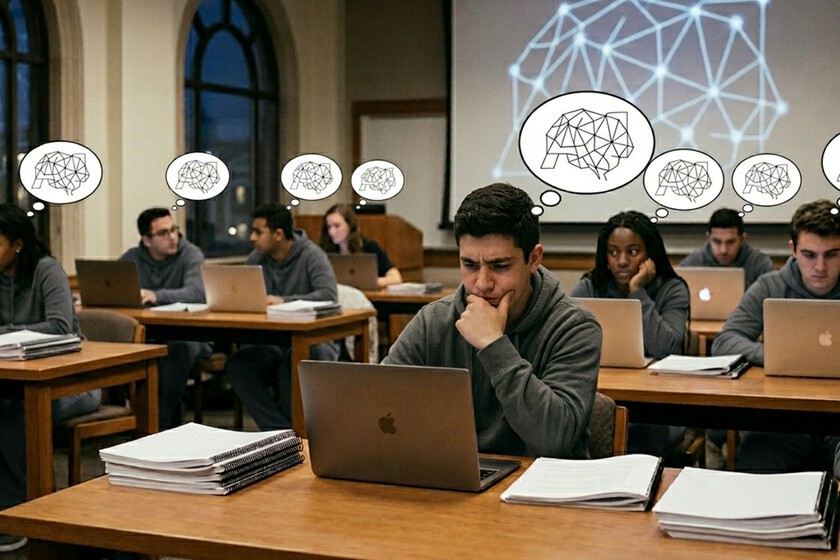
Students may become adept at prompting AI rather than engaging in the arduous but necessary process of research, synthesis, and original argumentation. This reliance can stunt the growth of crucial executive functions, such as problem-solving, analytical reasoning, and the ability to tolerate ambiguity or grapple with complex ideas. A recent survey among university students, for example, found that over 60% admitted to using AI tools for at least some part of their assignments, with a significant portion stating it was to save time rather than to enhance understanding. While time-saving is a legitimate benefit, the trade-off in terms of intellectual engagement raises serious concerns about the long-term cognitive impact on a generation poised to enter a world demanding sophisticated critical thought.
A Historical Lens: Technological Revolutions in Education
The integration of technology into education is not a new phenomenon; it is an ongoing narrative that spans generations. From the laborious consultation of multi-volume encyclopedias to the advent of personal computers and the internet, each technological leap has reshaped the learning landscape. The generation preceding the AI era experienced the "internet revolution" firsthand, transitioning from traditional library resources to digital encyclopedias like Encarta, followed by the collaborative knowledge of Wikipedia, and, admittedly, less reputable but widely used platforms like "El Rincón del Vago" for pre-written assignments.
Crucially, even with these digital resources, students were still required to perform a significant amount of intellectual labor. They had to navigate information, discern its relevance, critically evaluate its veracity (especially with user-generated content like Wikipedia), and then synthesize and articulate it in their own words. The process, though aided by technology, still demanded active processing and reasoning. The arrival of generative AI, however, represents a fundamental shift. Information is no longer just accessible; it is generated in a highly polished, often persuasive, and readily consumable format. The challenge has thus moved from "how to find and process information" to "how to responsibly and critically interact with machine-generated content." This paradigm shift necessitates a complete overhaul of pedagogical approaches, focusing not just on content delivery but on fostering AI literacy and ethical engagement.
The Way Forward: Fostering AI Literacy and Critical Engagement
The undeniable integration of AI into education necessitates a proactive and thoughtful response from educational institutions, policymakers, and parents. The core challenge is no longer about prohibition, but about cultivating a responsible and critical relationship between students and artificial intelligence. This requires a multi-faceted approach:
- Curriculum Reform: Educational curricula must evolve to include explicit instruction on AI literacy. This involves teaching students how AI models work, their limitations, the concept of algorithmic bias, and ethical considerations in their use. Understanding the provenance and potential pitfalls of AI-generated content is as crucial as understanding traditional research methods.
- Redefining Assessments: Educators must innovate assessment methods to move beyond tasks easily replicated by AI. This could involve more project-based learning, oral examinations, collaborative problem-solving, emphasis on process over product, and assignments that require real-world application or highly personalized reflection. The focus should shift from knowledge recall to critical analysis, creativity, and the ability to ask insightful questions.
- Ethical Guidelines and Policies: Clear, institution-wide policies regarding the acceptable and unacceptable use of AI must be established. These guidelines should be developed transparently, involving students, faculty, and administrators, to ensure they are practical, fair, and promote academic integrity without stifling innovation.
- Teacher Training: Educators require comprehensive training not only in detecting AI misuse but, more importantly, in leveraging AI as a pedagogical tool. AI can personalize learning, provide instant feedback, and assist in content creation, but teachers need the skills to integrate it effectively and ethically into their teaching practices.
- Promoting Critical Thinking: Reinforcing traditional critical thinking skills becomes even more vital in an AI-saturated environment. This includes teaching source evaluation, logical reasoning, argumentation, and the importance of independent thought and diverse perspectives.
The goal is not to demonize AI but to empower students to become discerning users and critical thinkers in an AI-driven world. As the digital landscape continues to evolve, the ability to engage with AI tools intelligently, recognizing their strengths and weaknesses, will be a paramount skill for future generations.
Broader Societal Implications: Beyond the Classroom
The impact of AI on critical thinking extends far beyond the confines of the classroom, carrying significant societal implications. A populace accustomed to consuming pre-digested, often homogenized information risks a decline in civic discourse, innovation, and democratic participation. If future generations are less equipped to critically evaluate information, challenge prevailing narratives, or formulate independent opinions, the fabric of informed public debate could weaken.
Furthermore, a workforce less adept at original problem-solving and creative thinking could hinder progress in scientific research, technological innovation, and artistic expression. The very foundation of societal advancement relies on individuals who can push boundaries, question assumptions, and develop novel solutions – skills that are at risk if over-reliance on AI supplants genuine intellectual engagement during formative years. Therefore, the educational challenge posed by AI is not merely an academic one; it is a fundamental societal imperative that demands urgent and thoughtful attention.
In conclusion, the rapid integration of artificial intelligence into education presents both immense opportunities and significant challenges. While AI offers powerful tools for learning and efficiency, its potential to foster homogenized thinking, perpetuate biases, and hinder the development of critical reasoning in young minds is a pressing concern. The transition from debating mobile phones to grappling with AI marks a new era in educational technology, one that calls for an urgent re-evaluation of pedagogical approaches, curriculum design, and ethical frameworks. The ultimate goal must be to equip students not just with knowledge, but with the intellectual fortitude and critical discernment necessary to navigate and shape a world increasingly influenced by artificial intelligence.
