

Portal Space Systems, a Seattle-area aerospace innovator specializing in the emerging field of dynamic space operations, has successfully closed a $50 million Series A funding round. This significant capital injection is earmarked for the acceleration of the company’s maneuverable spacecraft programs, the expansion of its engineering and operations teams, and the scaling of its manufacturing infrastructure in Bothell, Washington. The round highlights a pivotal shift in the space industry, moving away from static orbital assets toward agile, responsive systems capable of navigating an increasingly contested and crowded extraterrestrial environment.
The funding round was co-led by Geodesic Capital and Mach33, with significant participation from a consortium of high-profile venture firms including Booz Allen Ventures, ARK Investments, AlleyCorp, and FUSE. The diversity of the investor pool—ranging from defense-oriented firms like Booz Allen to growth-focused entities like ARK—underscores the dual-use potential of Portal’s technology, which serves both national security requirements and the burgeoning commercial satellite economy.
Strategic Milestones and Recent Flight Heritage
The Series A announcement follows a critical technical milestone for Portal Space Systems. The company recently achieved flight heritage for its core avionics systems through an in-orbit demonstration conducted in partnership with Momentus. Portal’s flight computer and power systems were integrated into the Vigoride 7 vehicle, which launched as part of SpaceX’s Transporter-16 mission. This successful deployment allowed the company to validate its hardware in the harsh environment of Low Earth Orbit (LEO), providing the necessary data to proceed with more complex mission profiles.
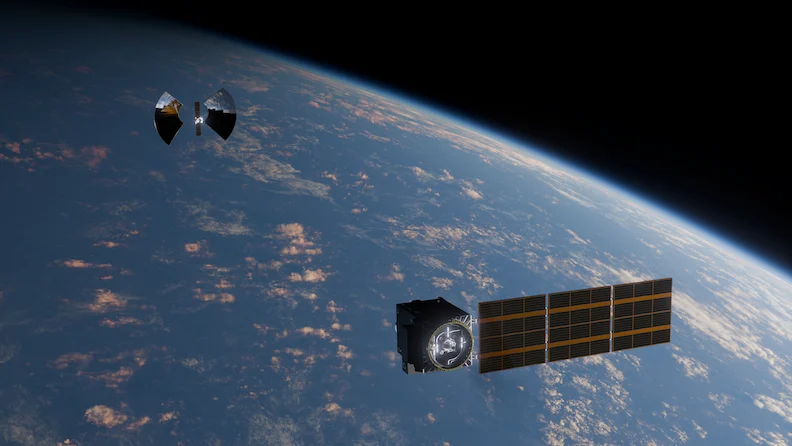
Building on this momentum, Portal is now preparing for the launch of its first Starburst spacecraft. The Starburst is an ESPA-class (EELV Secondary Payload Adapter) vehicle designed for rapid maneuverability. It is currently manifested on SpaceX’s Transporter-18 mission, scheduled for the fourth quarter of this year. The Starburst represents the company’s "vanguard" product, intended to demonstrate the high-thrust, high-efficiency capabilities of their proprietary propulsion systems. Following the Starburst, Portal plans to debut the Supernova, a larger and more capable spacecraft platform, with a target launch window in 2027.
The Technological Edge: Solar Thermal Propulsion
At the heart of Portal Space Systems’ value proposition is its solar thermal propulsion technology. For decades, satellite operators have been forced to choose between two extremes: chemical propulsion, which offers high thrust but low fuel efficiency, and electric (ion) propulsion, which is highly efficient but produces very low thrust. Solar thermal propulsion seeks to bridge this gap, offering a "best of both worlds" solution that enables what industry experts call "maneuverability without regret."
Solar thermal systems work by concentrating sunlight to heat a propellant—often a simple, non-toxic substance—to extreme temperatures. The expanding gas is then exhausted through a nozzle to generate thrust. This method provides significantly more "delta-v" (change in velocity) than traditional electric thrusters, allowing a satellite to change orbits or dodge debris in minutes rather than weeks. For defense applications, this capability is essential for responding to adversarial threats or repositioning assets to cover emerging theaters of conflict.
Jeff Thornburg, CEO and founder of Portal Space Systems, emphasized that the current geopolitical climate has made maneuverability a non-negotiable requirement for space assets. Thornburg, a veteran of SpaceX and Stratolaunch, noted that the ability to adapt to changing missions in real-time is the next frontier of space superiority.
A Growing Imperative: Countering Adversarial Maneuvers
The urgency surrounding Portal’s mission is driven by a stark change in how major world powers view the space domain. In recent years, U.S. Space Force officials have sounded the alarm regarding the development of "on-orbit warfare" capabilities by China and Russia. General Michael Guetlein, Vice Chief of Space Operations for the U.S. Space Force, recently detailed instances of Chinese satellites demonstrating "dogfighting" maneuvers—active, aggressive repositioning designed to intercept or interfere with other orbital assets.
General Stephen Whiting, Commander of U.S. Space Command, has similarly advocated for a shift toward "dynamic space operations." Traditionally, satellites were designed to remain in a fixed orbital slot for 10 to 15 years. However, in a contested environment, a static satellite is a vulnerable target.
"All roads lead to being able to move more quickly and do it time and time again," Thornburg stated. He noted that defense customers are no longer interested in "science projects" but are instead seeking mission-ready capabilities that can be deployed at scale to counter adversarial maneuvering and protect critical infrastructure.
Investment Rationale and Market Gap
The $50 million investment reflects a conviction among venture capitalists that the "New Space" economy is entering a phase of tactical maturity. Aaron Burnett, CEO of Mach33, characterized the investment as a response to a "structural gap" in the current propulsion market. Mach33, which also holds stakes in SpaceX and Stoke Space, wrote its largest single check to date for this round.
In a joint statement with research associate Vlad Saigau, Burnett highlighted the sheer scale of the upcoming orbital landscape. With an estimated 1.2 million orbital assets planned for the coming decade, the need for active thermal and positional management is expected to skyrocket. This includes not only military satellites but also commercial orbital data centers and large-scale communication constellations that require constant station-keeping and debris avoidance.
Travis Bales, Director of Booz Allen Ventures, echoed these sentiments, noting that Portal addresses a "critical gap in orbital warfare." By investing in Portal, Booz Allen—which has also backed firms like Starfish Space and Albedo—is positioning itself at the center of the "Tactically Responsive Space" movement, a Pentagon priority aimed at launching and maneuvering assets on short notice.
Scaling Operations: The Bothell Manufacturing Facility
A significant portion of the Series A funding is dedicated to the physical expansion of Portal’s manufacturing footprint. The company is currently preparing to move into a new 52,000-square-foot facility in Bothell, Washington. This location is strategically chosen, as the Seattle metropolitan area has become a premier hub for aerospace engineering, home to major players like Blue Origin and Boeing, as well as a dense network of specialized suppliers.
The new facility is designed to transition Portal from a development-focused startup to a high-volume production house. According to Thornburg, once the facility is fully operational, it will have the capacity to support the simultaneous production of 12 Supernova spacecraft and 16 Starburst spacecraft.
To support this production ramp-up, Portal is aggressively hiring. The company currently employs approximately 40 specialists in aerospace engineering, mission operations, and supply chain management. Thornburg expects to double this headcount to 80 or more by the end of 2024. The hiring blitz focuses on senior engineering roles capable of refining the solar thermal hardware and software developers who can automate the complex mission planning required for high-maneuverability fleets.
Chronology of Development and Future Outlook
The trajectory of Portal Space Systems reflects the rapid acceleration of the private space sector.
- Initial Phase: Development of solar thermal propulsion prototypes and the "Starburst" ESPA-class design.
- May 2025: Partnership with Momentus finalized for avionics testing.
- Early 2026: Successful launch and operation of avionics on the SpaceX Transporter-16 mission via the Vigoride 7 vehicle.
- April 2026: Closing of $50 million Series A funding round.
- Q4 2026 (Projected): First full Starburst spacecraft launch on SpaceX Transporter-18 to demonstrate rapid maneuvering.
- 2027 (Projected): Debut of the Supernova spacecraft, offering enhanced payload capacity and extended mission endurance.
The long-term implications of Portal’s success could redefine the economics of space. If satellites can be easily moved and repositioned, the "single-use" nature of orbital assets may begin to fade. Furthermore, the ability to actively maneuver allows for better management of the growing space debris problem, as satellites can more effectively steer clear of junk or even participate in active debris removal missions.
As the U.S. Department of Defense continues to integrate "dynamic space operations" into its doctrine, companies like Portal Space Systems are no longer peripheral players but are becoming central to the architecture of national security. The $50 million Series A round provides the runway necessary to prove that the future of space is not just about getting to orbit, but about what a spacecraft can do once it arrives. By solving the maneuverability challenge, Portal is setting the stage for a more resilient, active, and secure presence in the final frontier.
