
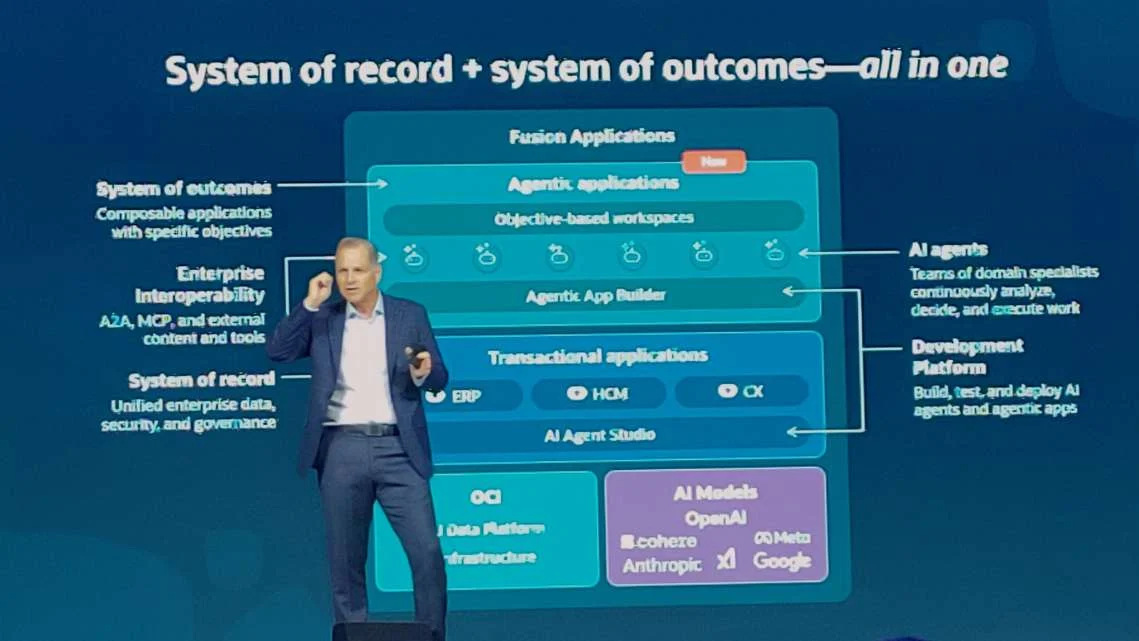

Oracle Corporation has significantly accelerated its roadmap for artificial intelligence integration across its enterprise software suite, unveiling a series of "agentic" applications designed to automate complex business workflows. Following a sequence of global summits, including Oracle AI World events in London and New York City, the technology giant has introduced 22 new agentic applications specifically tailored for finance, supply chain, and human capital management. These developments mark a strategic pivot from traditional generative AI chatbots toward autonomous agents capable of reasoning across broad datasets and executing multi-step tasks within the Oracle Fusion Cloud platform.
The expansion comes as enterprise customers increasingly demand predictable pricing and robust security frameworks for AI deployments. By leveraging its proprietary Oracle Cloud Infrastructure (OCI), the company argues it can offer a level of cost stability and performance efficiency that remains elusive for competitors reliant on third-party hardware abstractions. As organizations transition from AI experimentation to production-scale deployment, Oracle’s strategy emphasizes the convergence of infrastructure control, data residency, and vertical-specific application logic.
Chronology of Oracle’s Agentic AI Rollout
The current momentum behind Oracle’s AI strategy is the result of a coordinated multi-city launch schedule designed to demonstrate both the breadth and depth of its generative AI capabilities.
In early 2026, during Oracle AI World London, the company first introduced the concept of "agentic apps" within the Fusion system. These applications were presented not as standalone tools, but as integrated components of the system of record, designed to produce specific business outcomes rather than just text-based responses. Derek du Preez and other industry analysts noted that this "agentic fusion play" represented an attempt to bridge the gap between back-office data and autonomous decision-making.
The momentum continued into the Oracle AI World NYC event in April 2026. Here, Oracle EVP of Application Development Steve Miranda and other senior executives detailed the expansion of these agents into specialized domains. The New York announcement specifically highlighted new agentic capabilities for finance and supply chain management, addressing critical functions such as automated resource planning, change management, and procurement optimization. This timeline underscores a rapid iteration cycle, with Oracle moving from conceptual frameworks to live enterprise tools within a matter of weeks.
Infrastructure as a Catalyst for AI Cost Control
A central pillar of Oracle’s value proposition is the vertical integration between its application layer and its underlying infrastructure. Nathan Thomas, Senior Vice President of Product Management at OCI, posits that the architecture of Oracle’s cloud provides a structural advantage in managing the high costs associated with AI inference and training.
Unlike many hyperscale competitors, Oracle has invested in "off-box virtualization," a method of moving virtual components entirely out of the hardware. This architectural choice reduces the overhead on the CPU and GPU, allowing more of the silicon’s power to be dedicated to the actual AI workload. Thomas, who previously held roles at AWS and Google, noted that this structural difference is critical for maintaining high-performance RDMA (Remote Direct Memory Access) networking.
RDMA networking is essential for multi-tenant scale, particularly for customers running large-scale clusters for model training or high-volume inference. By optimizing these attributes, Oracle claims it can offer a bill reduction of 10% to 30% compared to traditional cloud environments. For smaller enterprise customers, these efficiencies manifest as lower costs for inference—the process of running a trained model to get a result—which remains the most significant ongoing expense in the AI lifecycle.
Furthermore, Oracle’s strategy encourages "model flexibility." Rather than forcing customers to use the most expensive frontier models for every task, the OCI Enterprise AI offering allows users to swap in open-source (OSS) models, such as Meta’s Llama or smaller, specialized language models. This approach recognizes that many enterprise workflows—such as scanning inbound leads or checking supplier tax statuses—do not require the massive parameter counts of flagship models. By running smaller models locally within their own tenancy, customers can ensure data residency while significantly lowering their operational expenditure.
Security, Accuracy, and the Banking Sector
For highly regulated industries, the primary barrier to AI adoption is not cost, but the twin concerns of security and data accuracy. At the NYC keynote, Mark Hura, President of Oracle Global Field Operations, discussed these challenges with Rick Hair, CIO of Corporate Technology at M&T Bank.
In the banking sector, "hallucinations"—the tendency of AI to generate false information—are unacceptable. Hair emphasized that data security is "job one" for financial institutions. The integration of AI agents directly into the Oracle database layer allows for the application of existing security governance, identity management, and access controls to AI-driven processes.
M&T Bank’s approach reflects a broader trend among large enterprises: a "controlled embrace" of AI. Rather than a blanket rollout, the bank is deploying AI on a use-case-by-use-case basis, leveraging the data already resident within the Oracle ecosystem. This ensures that the AI operates within a "walled garden" of trusted corporate data, mitigating the risks associated with public AI models that may ingest sensitive information.
Vertical Impacts: Construction and Resource Planning
The utility of agentic AI is also being realized in the construction and engineering sectors. Terry Robbins, CTO of the STO Building Group, highlighted how Oracle’s Primavera Cloud is evolving from a standalone scheduling tool into an integrated AI-driven ecosystem.
In construction, project success is dictated by the precision of material delivery and labor turnover schedules. STO Building Group is looking to AI to "envelope" these standalone schedules into broader resource planning and change management systems. The goal is to create a unified environment where a change in a material submittal automatically triggers a reasoning agent to adjust the entire project timeline and resource allocation.
Robbins noted that while point solutions—such as AI-driven drone capture for site monitoring—are valuable, the real challenge lies in scale and integration. For AI to reach peak value in the industrial sector, it must be able to reason across disparate data sources, from HR systems (HCM) to project management software, without requiring manual data transfers between silos.
The Partner Ecosystem and the "Explosion" of Vertical Apps
Oracle’s strategy also heavily relies on its partner network to build specialized vertical agents. Chris Leone, EVP of Development for Oracle Cloud HCM and SCM, argued that building on the Fusion platform is significantly more efficient for partners than trying to build standalone AI apps and connecting them via APIs.
Leone pointed out that building an autonomous agent involves more than just hosting a model. It requires managing permissions, reasoning over unstructured data, and connecting to various MPCs (Multi-Party Computations) and APIs. By building directly on the Fusion Apps platform, partners inherit the underlying security and data context of the Oracle suite.
Leone predicted a surge in partner-led innovation, stating that the ability to deploy agentic applications in minutes—rather than months—will disrupt how vertical software is delivered. This "partner play" is intended to prevent third-party "point solutions" from siphoning off workloads, instead keeping the data and the logic within the Oracle ecosystem.
Strategic Recommendations for AI Governance
As organizations navigate this new landscape, Oracle executives are offering specific guidance on "AI readiness." Natalia Rachelson, Group Vice President of Cloud Applications Development, suggests that the biggest risk to enterprises is not the technology itself, but the "red tape" of internal governance.
Rachelson noted that many companies are "hamstrung" by AI governance boards that evaluate every individual feature. Her recommendation is for organizations to approve the underlying platform—such as Oracle Fusion—at a foundational level. Once the data privacy and security framework of the platform is vetted, individual AI agents can be deployed iteratively.
Key recommendations for enterprise leaders include:
- Start Small, Go Fast: Identify high-friction, low-risk manual tasks—such as verifying the nonprofit status of suppliers—and automate them with simple agents.
- Focus on Data Context: The value of an agent is derived from the data it can access. Ensuring a clean "system of record" is a prerequisite for effective AI.
- Iterative Deployment: Treat AI as an evolving capability rather than a static product. Use-case design should be flexible enough to incorporate new models as they become available.
Broader Market Implications and Analysis
Oracle’s recent performance in the equities market, leading a rally in software stocks, suggests that investors are responding positively to this "long game" strategy. While the market has been prone to fluctuations based on AI "hype" cycles, Oracle’s focus on the intersection of infrastructure and SaaS applications provides a more tangible roadmap for revenue generation.
The broader implication for the software industry is a shift in how "value" is defined. In the previous era of SaaS, value was derived from the ease of data entry and record-keeping. In the agentic era, value is derived from the "system of outcomes"—where the software does not just store the data, but acts upon it to solve business problems.
As 2026 progresses, the industry will be watching to see if Oracle’s 7,000+ generative AI customers can successfully transition from pilot programs to full-scale agentic operations. The success of this transition will likely determine whether the current software rally is a temporary peak or the beginning of a sustained period of AI-driven growth. For now, Oracle’s emphasis on infrastructure-led cost control and integrated security provides a compelling blueprint for enterprise AI adoption in a cautious economic climate.
