

The telecommunications industry is currently undergoing one of its most significant architectural shifts since the transition from analog to digital cellular networks: the move from physical, removable SIM cards to the embedded SIM, or eSIM. This transition represents more than just a change in form factor; it is a fundamental reimagining of how mobile devices connect to networks, offering unprecedented flexibility for consumers, new design possibilities for manufacturers, and a logistical overhaul for mobile network operators (MNOs). As of 2024, the adoption of eSIM technology has reached a critical mass, driven by the elimination of physical SIM slots in major flagship devices and the increasing demand for seamless international roaming.
The Technical Foundation: What Defines an eSIM?
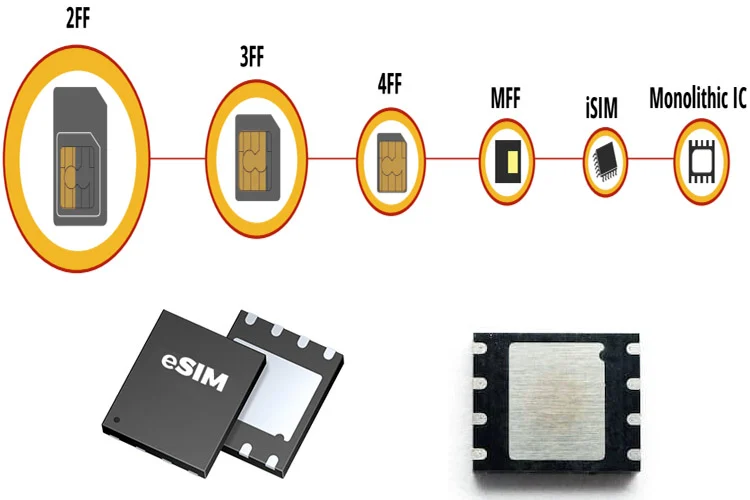
An eSIM, technically known as an eUICC (Embedded Universal Integrated Circuit Card), is a specialized chip soldered directly onto a device’s motherboard during the manufacturing process. Unlike the traditional SIM (Subscriber Identity Module) card, which is a piece of plastic containing a microprocessor that must be physically inserted and removed, the eSIM is a permanent hardware component. It measures approximately 5mm by 6mm—significantly smaller than even a Nano-SIM—allowing device manufacturers to reclaim internal space for other components such as larger batteries, improved thermal management systems, or additional sensors.
The core functionality of an eSIM revolves around Remote SIM Provisioning (RSP). This technology allows a mobile operator to "send" a SIM profile to a device over-the-air (OTA). This profile contains the same data found on a physical SIM card, including the International Mobile Subscriber Identity (IMSI), authentication keys, and network-specific configurations. Because the eSIM is rewritable, it can store multiple profiles simultaneously, though typically only one or two can be active at any given time depending on the device’s modem capabilities.
A Chronology of the SIM Evolution
To understand the impact of the eSIM, one must look at the timeline of SIM technology, which has consistently moved toward miniaturization and integration:
- 1991 (Full-size SIM): The first SIM cards were the size of a credit card, designed for early mobile phones that were often car-mounted.
- 1996 (Mini-SIM): The standard "large" SIM card used in early 2000s handsets.
- 2003 (Micro-SIM): Introduced to save space as phones became more feature-rich.
- 2012 (Nano-SIM): The final stage of physical SIM cards, which removed almost all plastic padding around the chip.
- 2016 (The Dawn of eSIM): The GSMA released the first eSIM specifications for smartwatches and tablets. The Samsung Gear S2 Classic 3G was one of the first commercial devices to utilize it.
- 2018 (Mainstream Adoption): Apple integrated eSIM technology alongside a physical slot in the iPhone XS and XR, introducing the "Dual SIM" era to the mass market.
- 2022-Present (The eSIM-Only Era): Apple launched the iPhone 14 in the United States as an eSIM-only device, removing the physical tray entirely. This move acted as a catalyst, forcing carriers globally to accelerate their eSIM infrastructure.
Market Data and Industry Growth Projections
According to data from GSMA Intelligence, the number of eSIM-enabled consumer devices surpassed 1 billion units in 2023. Projections suggest that by 2030, nearly 75% of all smartphone connections will be via eSIM. This growth is not limited to smartphones; the Internet of Things (IoT) sector is a primary driver. In industrial applications, where devices like smart meters or shipping containers are deployed in harsh environments, a physical SIM card is a point of failure due to corrosion or vibration. The soldered nature of the eSIM provides a robust solution for these "set-and-forget" devices.
Furthermore, a 2023 report by Juniper Research indicates that the value of the global eSIM market is expected to rise from $4.7 billion in 2023 to over $16 billion by 2027. This 240% increase highlights the rapid pivot by mobile network operators to support digital-first onboarding.
Strategic Advantages for Stakeholders
The transition to eSIM offers distinct benefits across the telecommunications value chain:
For Consumers:
- Convenience in Travel: Travelers can purchase a local data plan online and activate it instantly upon landing, avoiding the high costs of international roaming or the search for a physical SIM kiosk in a foreign airport.
- Enhanced Security: If a device is stolen, a physical SIM card can be easily removed to prevent tracking or to use the phone on another network. An eSIM cannot be removed, making it easier for owners and law enforcement to track the device as long as it remains powered.
- Multiple Profiles: Users can maintain a work number and a personal number on a single device without needing to carry two phones.
For Manufacturers:
- Design Flexibility: Removing the SIM tray improves structural integrity and makes it easier to achieve high IP (Ingress Protection) ratings for water and dust resistance.
- Internal Real Estate: The space saved can be utilized for larger haptic engines or improved camera optics.
For Network Operators:
- Lower Logistical Costs: MNOs save billions annually on the production, packaging, and shipping of plastic SIM cards.
- Digital Onboarding: Carriers can acquire customers through apps, reducing the need for physical retail storefronts and manual processing.
Technical Implementation: Activation and Management
Activating an eSIM is designed to be a frictionless process, though it differs slightly between operating systems.
On iOS Devices:
Apple has introduced several methods for activation. The most common is the "eSIM Carrier Activation," where the carrier assigns the eSIM to the device’s IMEI when it is purchased. Upon turning the phone on, the user simply follows the on-screen prompts. Alternatively, users can use the "eSIM Quick Transfer" to move a SIM profile from an old iPhone to a new one via Bluetooth, or scan a QR code provided by the carrier in the Cellular Settings menu.
On Android Devices:
The process on Android, particularly for Samsung Galaxy and Google Pixel devices, involves navigating to the "Network & Internet" or "Connections" menu. Users select "SIM Manager" or "Mobile Network" and choose "Add eSIM." Like iOS, this usually involves scanning a QR code or entering an activation code provided by the MNO. Some carriers also support "Discovery" services where the device automatically pings a server to find any pending eSIM profiles associated with its ID.
Comparative Analysis: eSIM vs. Traditional SIM
While the eSIM offers numerous advantages, a factual comparison reveals certain trade-offs that consumers must consider.
| Feature | Physical SIM Card | eSIM |
|---|---|---|
| Swapping Devices | Easy; physically move the card. | Requires a digital transfer process or new QR code. |
| Space Efficiency | Low; requires a slot and tray mechanism. | High; embedded directly on the board. |
| Durability | Prone to damage, loss, or wear. | Highly durable; no moving parts. |
| Security | Low; easily removed if stolen. | High; tied to the hardware. |
| Initial Setup | Requires physical delivery or store visit. | Instantaneous digital delivery. |
One of the primary criticisms of eSIM technology is the "friction" involved in switching phones frequently. For enthusiasts or developers who move their SIM between devices daily, the digital re-activation process can be more time-consuming than simply moving a plastic card. However, for the average consumer, the set-it-and-forget-it nature of the eSIM is generally viewed as an upgrade.
Global Connectivity and the Impact on Roaming
The eSIM has disrupted the traditional roaming market. Third-party providers like Airalo, Holafly, and Nomad have emerged, offering data-only eSIM profiles for hundreds of countries. This has forced traditional carriers to rethink their roaming packages, which were historically high-margin products. By allowing consumers to bypass expensive carrier roaming in favor of local-rate data through an app, the eSIM has democratized international connectivity.
Industry analysts note that this shift is particularly impactful in the European Union and Southeast Asia, where cross-border travel is frequent. The ability to download a "Regional eSIM" that covers an entire continent further simplifies the user experience.
Broader Implications and Future Outlook: The Rise of iSIM
The next step in this evolution is the iSIM (Integrated SIM). While the eSIM is a separate chip on the motherboard, the iSIM integrates the SIM functionality directly into the device’s primary processor (SoC). In 2023, Qualcomm and Thales announced the first commercially ready iSIM on the Snapdragon 8 Gen 2 platform. The iSIM further reduces power consumption and saves even more space, potentially paving the way for ultra-thin wearables and even smaller IoT sensors.
As 5G networks continue to expand, the eSIM/iSIM will be vital. The massive machine-type communications (mMTC) supported by 5G—which envisions millions of connected devices per square kilometer—cannot rely on physical SIM cards. The automation of network credentials through embedded technology is the only scalable path forward.
Conclusion
The transition to eSIM technology marks the end of the "plastic era" of telecommunications. While the physical SIM card served the industry for over three decades, its limitations in the face of modern design and global mobility have become apparent. Through standardized remote provisioning and widespread hardware support, the eSIM has simplified the user journey, enhanced device security, and opened new avenues for international travel. As manufacturers continue to phase out the physical SIM slot and the industry moves toward iSIM integration, the digital-first approach to connectivity will become the universal standard, fundamentally changing how the world stays connected.
