
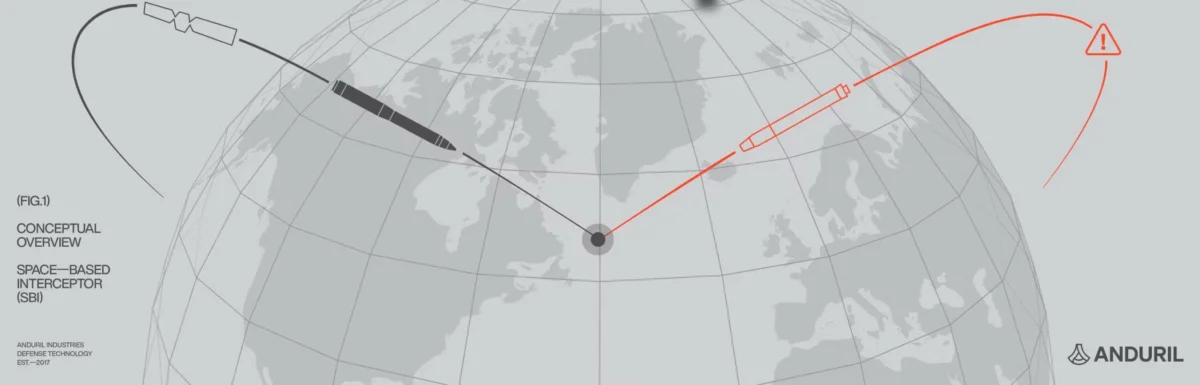

Anduril Industries has officially announced a high-level consortium of aerospace and technology partners to support its recent contract with the United States Space Force, marking a significant milestone in the development of the next generation of orbital defense systems. By aligning with Impulse Space, Inversion Space, K2 Space, Sandia National Laboratories, and Voyager Technologies, Anduril aims to integrate a diverse array of commercial innovations and specialized government expertise to prototype advanced technologies for space-based interceptors (SBI). This collaborative effort is a direct response to a recent award from the U.S. Space Force’s Space Systems Command (SSC) under an Other Transaction Authority (OTA) contract, which is part of the broader $3.2 billion "Golden Dome" initiative.
The Golden Dome program represents the Department of Defense’s strategic pivot toward a layered, resilient, and highly responsive missile defense architecture capable of countering modern threats, including hypersonic glide vehicles and advanced ballistic missiles. As the orbital domain becomes increasingly contested, the partnership led by Anduril signifies a shift in how the U.S. military procures and develops space-based hardware—moving away from decades-long development cycles and toward a rapid, "software-first" modular approach.
The Strategic Vision Behind the Golden Dome Initiative
The U.S. Space Force’s Golden Dome initiative is designed to address the vulnerabilities of traditional ground-based and sea-based missile defense systems. In an era where adversaries are developing weapons that can maneuver at five times the speed of sound or greater, the "high ground" of space offers a unique vantage point for interception. Space-based interceptors are designed to engage threats during their boost or mid-course phases, potentially neutralizing missiles before they can deploy decoys or begin complex evasive maneuvers.
Anduril’s role as a prime contractor for this prototyping phase highlights the company’s growing influence in the defense sector. Gokul Subramanian, Senior Vice President of Engineering for Anduril Industries, emphasized that the collaboration is built upon the principle of "best-of-breed" capabilities. By combining Anduril’s internal expertise in autonomous systems and command-and-control software with the specialized hardware of its partners, the team aims to deliver a scalable solution that can be deployed at a fraction of the cost of legacy systems.
Profiling the Collaboration Team: Expertise and Capabilities
Each member of the Anduril-led team brings a specific, critical capability to the SBI program, ranging from high-energy propulsion to heavy-lift satellite platforms.
Impulse Space: Orbital Mobility and Precision Maneuvering
Impulse Space, founded by SpaceX founding member Tom Mueller, specializes in in-space mobility. For a space-based interceptor to be effective, it must be capable of rapid and precise repositioning. Impulse Space has previously worked with Anduril to integrate payloads onto its "Mira" spacecraft, a vehicle designed for last-mile delivery and complex orbital adjustments. Their expertise in high-precision rendezvous and proximity operations (RPO) is essential for the SBI mission, where an interceptor must align its trajectory with a high-speed incoming threat in the vastness of geosynchronous orbit (GEO) or low Earth orbit (LEO).
Inversion Space: Advanced Reentry and Physical Delivery
Inversion Space focuses on the "downward" aspect of orbital mechanics. The company builds reentry vehicles that allow for the physical return of assets or the delivery of payloads from space to Earth—or potentially to other points within the orbital environment. Justin Fiaschetti, CEO of Inversion Space, noted that advanced reentry technology provides a physical dimension to the speed of space-based operations. For the SBI program, this could translate to the development of kinetic kill vehicles or returnable sensor platforms that must survive extreme thermal and aerodynamic stresses.
K2 Space: Heavy-Lift Satellites and High Power
K2 Space is addressing the requirement for "mass and power" in orbit. While the industry has trended toward miniaturization, certain missions—like hosting interceptor systems—require substantial physical infrastructure. K2 Space’s "Mega-class" satellites are designed to host payloads of up to 3,000 kg and provide a peak payload power of 30 kilowatts. This high power-to-mass ratio is vital for the sensors and communication arrays necessary to track and target hypersonic threats in real-time.
Sandia National Laboratories: Decades of Weapons Heritage
As a federally funded research and development center, Sandia National Laboratories provides the team with a bridge to the nation’s deepest scientific resources. Sandia has spent decades at the forefront of nuclear weapons development, hypersonics research, and materials science. Scott McEntire, Sandia’s Senior Hypersonics Manager, stated that the lab will apply its extensive history in advanced weapons development to ensure the SBI prototypes meet the rigorous lethality and reliability standards required by the Space Force.

Voyager Technologies: Energetics and Communications
Voyager Technologies, a subsidiary of Voyager Space, provides the foundational components that power and connect the architecture. During a recent investor call, Voyager CEO Dylan Taylor highlighted the significance of the award, noting that the company’s technology in energetics, propulsion, and digital avionics is central to the Golden Dome architecture. Voyager’s ability to provide secure, high-bandwidth communication links and efficient propulsion systems ensures that the distributed network of interceptors can function as a cohesive unit.
A Chronology of the Space-Based Interceptor Resurgence
The concept of space-based interceptors is not new; it traces its roots back to the 1980s Strategic Defense Initiative (SDI), often referred to as "Star Wars." However, the technology of that era was hindered by exorbitant costs, massive hardware requirements, and the limitations of 20th-century computing.
The timeline of the current SBI resurgence began in the late 2010s as the U.S. Department of Defense identified a "capability gap" regarding hypersonic weapons developed by near-peer adversaries.
- 2019: The Missile Defense Review explicitly called for the investigation of space-based interceptors as a necessary layer for modern defense.
- 2022-2023: The U.S. Space Force and the Space Development Agency (SDA) began proliferating LEO constellations for tracking (the "Tracking Layer").
- April 2024: The Space Force awarded $3.2 billion in OTA contracts to 12 companies, including Anduril, to begin the prototype phase of the SBI program under the Golden Dome umbrella.
- May 2024: Anduril officially announced its consortium of partners, signaling the start of the technical integration phase.
Technical Challenges and the Kinetic Kill Paradigm
The core technical challenge of the SBI program is the concept of "kinetic kill"—the ability to destroy an incoming missile by colliding with it at orbital speeds, effectively "hitting a bullet with a bullet." Unlike ground-based interceptors, which must fight gravity to reach their targets, space-based interceptors are already in a high-energy state. However, this advantage comes with the difficulty of managing orbital mechanics, where every maneuver consumes propellant and changes the vehicle’s long-term trajectory.
The integration of Anduril’s "Lattice" software platform is expected to be a game-changer in this regard. Lattice is an AI-driven operating system that fuses data from thousands of sensors to provide a real-time "common operating picture." In the context of SBI, Lattice would theoretically coordinate the sensors on a K2 Space satellite, the propulsion systems of an Impulse Space vehicle, and the targeting data from Sandia-developed sensors to execute an autonomous interception.
Geopolitical Implications and Market Impact
The formation of this team and the acceleration of the Golden Dome program carry significant geopolitical weight. The U.S. move toward space-based interceptors is viewed as a deterrent against the use of Fractional Orbital Bombardment Systems (FOBS) and other "grey zone" space weapons. By establishing a credible defense in orbit, the U.S. aims to maintain the stability of the space domain and protect both military and commercial assets.
From a market perspective, this announcement solidifies the role of "New Space" companies as primary defense contractors. Historically, a project of this magnitude would have been dominated by the "Big Five" defense giants. Anduril’s ability to lead a team of agile, commercially-driven firms suggests that the Space Force is prioritizing speed and innovation over traditional bureaucratic processes.
For investors and industry analysts, the involvement of Voyager Technologies and the technical specifications provided by K2 Space offer a glimpse into the future of the space economy. The demand for high-power satellite buses and in-space mobility is no longer limited to telecommunications; it is now a fundamental requirement for national security.
Conclusion and Future Outlook
The Anduril-led collaboration represents a bold step into a new era of orbital security. By leveraging the specialized strengths of Impulse, Inversion, K2, Sandia, and Voyager, Anduril is attempting to solve one of the most complex engineering challenges in modern history. As the prototype phase progresses, the industry will be watching closely to see if this "team of innovators" can deliver a functional, affordable, and scalable space-based interceptor system.
While the details of the specific roles remain largely classified, the public statements from the involved CEOs reflect a high degree of confidence in the Golden Dome architecture. The success of this program could not only redefine missile defense but also set a new standard for how the United States utilizes the final frontier to ensure global stability. The coming months will likely see further testing and integration milestones as the team moves from conceptual design to hardware-in-the-loop demonstrations.
