
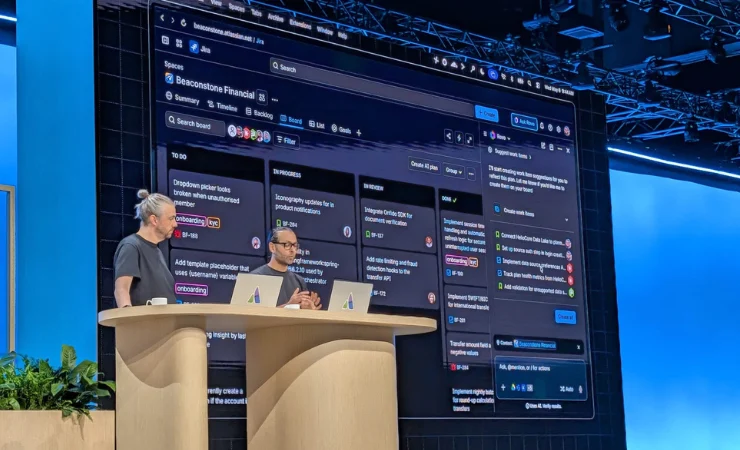

The annual Atlassian Team ’26 conference opened with a definitive shift in the company’s strategic trajectory, moving beyond simple task management to position itself as the foundational infrastructure for the "AI-native" era. At the heart of the keynote delivered by CEO Mike Cannon-Brookes and Chief Product Officer Sherif Mansour was a singular thesis: as artificial intelligence models become commoditized, the primary competitive advantage for any enterprise will reside in its unique organizational context. Atlassian is positioning its suite of tools not as a way to eliminate organizational complexity, but as a sophisticated lens through which that complexity can be visualized, analyzed, and managed by both human employees and autonomous agents.
The Paradigm Shift: Context as the Essential Fuel for Intelligence
The cornerstone of the keynote was the introduction of a new formula for business acceleration: Context multiplied by Intelligence. Mike Cannon-Brookes argued that by 2026, raw model capability has effectively reached a plateau of accessibility, where enterprises can "buy smarts by the token." In this environment, the differentiator is no longer the LLM (Large Language Model) itself, but the institutional memory—the "connective tissue" of every failed project, partial rollout, and incident thread—that informs how a company actually functions.
To capture this, Atlassian has doubled down on the Teamwork Graph (TWG). Unlike a traditional database or a static file repository, the TWG is designed to serve as a dynamic map of an organization’s work, people, and tools. It integrates data from tickets, Confluence pages, whiteboards, meeting transcripts, git repositories, Human Resources Information Systems (HRIS), and even inferred skill sets. According to internal data shared during the event, Atlassian is currently ingesting multiple billions of objects every week into the graph, with a technical target of propagating any organizational change throughout the system within 10 minutes.
This infrastructure is already seeing significant scale in production. Customers are currently running approximately 5 million agent invocations per month on top of this contextual layer. Cannon-Brookes emphasized that the strategic choice for modern leaders is determining what constitutes "context," who maintains control over it, and how it can be interrogated to ensure accuracy.
Chronology of the Keynote: From Institutional Memory to Autonomous Execution
The keynote followed a logical progression from data ingestion to user interaction and, finally, to autonomous execution.
Rovo and the Dual-Layer Memory System
The first major demonstration focused on Rovo, Atlassian’s AI-powered assistant. The demo illustrated a scenario involving a 20-year customer relationship with data scattered across Salesforce, Jira, Confluence, Loom, and Microsoft Teams. To address the challenge of "data sprawl," Atlassian introduced a dual-layer memory architecture for Rovo:
- Implicit Memory: Automatically updated via the Teamwork Graph, allowing the AI to learn the nuances of an individual’s role and the company’s history.
- Explicit Memory: A user-controlled layer where specific facts, preferences, and constraints can be manually set, inspected, or deleted to satisfy legal and privacy requirements.
In a live test, Rovo synthesized 20 years of interactions from 61 different sources in approximately three minutes, generating a comprehensive briefing that included stakeholder maps and real-time charts built from Salesforce data.
Code Intelligence and Technical Archaeology
Following the focus on general business data, the keynote pivoted to technical infrastructure. Atlassian showcased a new code search connector capable of spanning Bitbucket Data Center, Bitbucket Cloud, and GitHub. This tool allows for semantic search across vast codebases—demonstrated by a query that scanned 11 million files and 1.5 billion lines of code in real time to identify UI inconsistencies.
A particularly notable moment involved "technical archaeology," where the system identified 21-year-old "TODO" comments in the Confluence codebase. This segment highlighted a core Atlassian philosophy: AI should not just refactor code, but provide the visibility required for engineering leadership to make informed decisions about technical debt and legacy systems.
Jira as the AI Control Plane
The final stage of the presentation reimagined Jira as more than a backlog. In the "AI-native" vision, Jira serves as the orchestration layer where work is divided between humans and agents. The demo showed Jira (via Rovo) taking a vague business requirement, inspecting the codebase, proposing an architecture, estimating the token costs for the work, and then assigning tasks to both human developers and autonomous agents like Claude Code.
Technical Supporting Data and Benchmarks
Atlassian provided several key metrics to substantiate the performance of its new agentic workflows. The company reported that by utilizing the Teamwork Graph CLI—a toolset containing over 300 graph-aware commands spanning 380 different tools—AI agents can perform with significantly higher efficiency.
In internal benchmarking comparing Claude Code with and without the Teamwork Graph integration, Atlassian claimed:
- Accuracy: A 44% increase in the accuracy of results when the agent had access to the full organizational context provided by the graph.
- Cost Efficiency: A 48% reduction in token usage, as the model does not need to use its reasoning capabilities to "guess" or "rediscover" context that is already indexed and provided by the CLI.
These figures suggest a shift in the Return on Investment (ROI) conversation regarding AI. Rather than simply pursuing "better" AI, the focus is shifting toward "cheaper and more accurate" AI through superior data grounding.
Official Responses and Inferred Market Reactions
While the keynote was a showcase of capability, it also contained a sobering message for leadership. Cannon-Brookes noted that "work will always be a little bit messy," and that Atlassian’s goal is to provide the instruments to see that mess clearly, rather than to magically automate it away.
Industry analysts attending the event observed that this approach places a significant burden of responsibility on the customer. By rendering organizational "fossils" and abandoned projects legible, Atlassian is forcing a level of transparency that many traditional enterprises have historically avoided. Reactions from engineering leaders on the sidelines of the event suggested a mix of optimism regarding the speed of information retrieval and caution regarding the governance of "explicit memories." Legal teams, in particular, are expected to scrutinize the ability to override or delete AI-stored facts, making the transparency of the Teamwork Graph a critical feature for compliance.
Broader Impact and Implications for the Enterprise
The implications of the Team ’26 announcements extend beyond the Atlassian ecosystem. By positioning Jira as an "AI control plane," Atlassian is challenging the traditional boundaries of Project Management and DevOps.
1. The Death of the "Clean Slate" Myth
The keynote effectively debunked the idea that becoming AI-native requires a total system overhaul. Instead, Atlassian’s tools suggest that the path forward involves layering intelligence over existing "sediment." This acknowledges the reality of enterprise IT, where 20-year-old code and decade-old documentation are facts of life.
2. Accountability in Autonomous Workflows
With Jira acting as the audit trail for both human and agent actions, the question of accountability becomes structural. If an agent executes a task based on "bad institutional memory" found in the Teamwork Graph, the platform provides the lineage to trace that error back to its source. This creates a new category of "context maintenance" as a vital business function.
3. The Shift from Search to Synthesis
The shift from Rovo as a search tool to Rovo as a synthesis tool (as seen in the 20-year relationship briefing) indicates that the value of AI is moving toward the "briefing" model. In this model, the AI doesn’t just find a document; it understands the relationship between the document, the person who wrote it, and the project it belongs to.
Conclusion: The Mandate for the AI-Native Organization
Mike Cannon-Brookes closed the session with a provocative call to action, stating that organizations cannot "wait and see" their way through an existential technology shift. The message was clear: Atlassian has built the instruments to map the chaos of modern work, but the utility of those instruments depends entirely on a leader’s willingness to act on what they reveal.
The "AI-native" organization, as defined at Team ’26, is not one that has automated all its employees, but one that has rendered its internal knowledge so legible that agents and humans can collaborate with unprecedented precision. The future of work, according to Atlassian, belongs to those who own their context and have the courage to look at the "fossils" in their own codebase. As the conference continues, the focus will likely shift to how these tools handle the nuances of data privacy and the cultural shift required to manage a workforce that includes both biological and digital contributors.
