
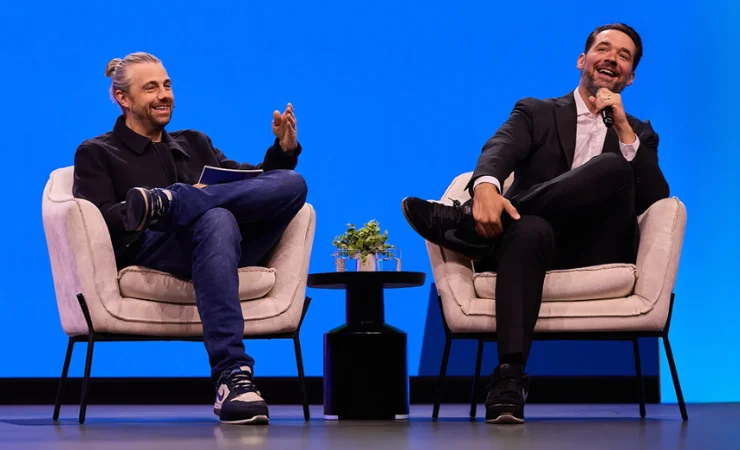

The intersection of artificial intelligence, the search for digital authenticity, and the burgeoning commercial space economy took center stage at the closing keynote of Team ’26, Atlassian’s flagship conference. Alexis Ohanian, the co-founder of Reddit and current lead at venture capital firm Seven Seven Six, joined Atlassian co-CEO Mike Cannon-Brookes to discuss a roadmap for the next decade of technological evolution. Ohanian, whose career began with a transformative moment at a Waffle House in the American South, argued that the rise of AI will paradoxically lead to a "human renaissance," where provable humanity and physical-world innovations become the most valuable commodities in the global market.
The Genesis of a Digital Architect
The narrative of Ohanian’s career serves as a microcosm for the broader evolution of the internet. Before becoming a titan of venture capital, Ohanian was a college student at the University of Virginia who, during a meal at a Waffle House, realized his trajectory toward a legal career was a mismatch for his ambitions. Alongside his roommate Steve Huffman, he founded Reddit in 2005. The platform was initially conceived as a simple "front page" for the internet, where users could submit links and vote on their relevance.
Under the guidance of Y Combinator’s Paul Graham, Reddit grew from a niche forum into a global powerhouse. However, Ohanian noted that the platform’s greatest long-term value was perhaps accidental: the creation of a massive, structured repository of human conversation. As large language models (LLMs) like OpenAI’s GPT-4 and Google’s Gemini require vast amounts of high-quality data to mimic human thought and speech, Reddit’s decades of archives have become the premier training ground for the AI revolution. In early 2024, Reddit reportedly signed a data-licensing deal with Google worth approximately $60 million per year, highlighting the immense commercial value of human-generated discourse in an era dominated by machine learning.
The Proof-of-Humanity Problem in an AI-Saturated World
A significant portion of the Team ’26 keynote focused on the "proof-of-humanity" crisis. As generative AI becomes capable of producing indistinguishable text, images, and video, the digital landscape is facing a trust deficit. Ohanian posited that the next wave of social media will not be defined by scale, but by the ability to prove that the entity on the other side of the screen is a biological human.
Ohanian criticized current attempts to solve this via invasive biometrics, such as retina scans, suggesting instead that "provable humanity" will emerge from shared physical effort and community-specific verification. He cited the fitness tracking app Strava as a primary example. Because Strava’s data is tied to physical movement—GPS-verified runs and cycles—it possesses an inherent layer of authenticity that text-based platforms lack.
"The Strava network is fundamentally, provably human," Ohanian explained. He suggested that if such platforms expanded into social forums, they would create an "overnight" human-centric network. This shift represents a move back toward decentralization. While Reddit centralized thousands of disparate forums into one platform, the future may see a splintering back into niche, verified communities where the "noise" of AI bots is filtered out by the "signal" of physical activity or verified expertise.
From Bits to Atoms: The Seven Seven Six Investment Thesis
Since launching Seven Seven Six in 2020, Ohanian has shifted his focus from "bits" (software and social media) to "atoms" (hardware, deep tech, and space). This shift reflects a broader trend in the venture capital world, where investors are increasingly looking toward "frontier tech" to solve systemic global issues.
Ohanian observed that today’s founders are markedly different from the "move fast and break things" generation of the mid-2000s. He noted that contemporary entrepreneurs are often driven by a sense of urgency regarding global stakes, including climate change, national security, and the limits of terrestrial manufacturing.
Seven Seven Six has built a portfolio that reflects this "science fiction made real" approach. The firm’s strategy involves backing founders who are deeply empathetic toward the problems they are solving and who possess the technical grit to build in high-stakes environments. Ohanian argued that while software will continue to be optimized by AI, the real wealth creation and societal impact of the next twenty years will occur in the physical world, powered by AI-driven robotics and advanced manufacturing.
The Orbital Economy and the Rise of Stoke Space
One of the most ambitious sectors in Ohanian’s portfolio is space technology. He highlighted Stoke Space, a company founded six years ago that aims to compete directly with industry leaders like SpaceX. Unlike traditional rocket companies, Stoke Space is focusing on 100% reusability, including the upper stage of the rocket, which typically burns up in the atmosphere.
The goal of Stoke Space is to enable a "rapid-turnaround" launch cadence, with rockets potentially going up multiple times a day. The economic implications of this are vast. Currently, the "cost per kilogram" to reach orbit remains a significant barrier for many industries. If Stoke Space and similar competitors can successfully lower this barrier, it opens the door for the "orbital economy."
Ohanian detailed specific use cases that are currently in development:
- Pharmaceutical Manufacturing: Certain protein crystals and chemical compounds can only be grown in the near-perfect vacuum and microgravity of space. Removing gravity from the equation allows for the creation of purer, more effective medicines.
- Biotech and Artificial Retinas: Ohanian mentioned a portfolio company working on "space eyeballs"—artificial retinas that require zero-gravity conditions for manufacturing. This technology could potentially restore sight to millions, with costs plummeting as space access becomes more frequent.
- Data Centers in Orbit: With the energy demands of AI data centers skyrocketing on Earth, the prospect of placing high-density computing in space—where cooling is easier and solar energy is constant—is becoming a viable discussion point.
AI as the "Unsexy" Catalyst for Deep Tech
While the public often focuses on the creative capabilities of AI, Ohanian emphasized its role in the "unsexy" aspects of hardware development. In the construction of rockets and medical devices, AI is being used to manage complex supply chains, optimize part orders, and run simulations that were previously too computationally expensive.
"The way to build those rockets is going to have software and robotics that just wouldn’t have been possible without AI," Ohanian said. He argued that AI is the essential tool that will allow human engineers to bridge the gap between science fiction and commercial reality. This synergy between human vision and machine efficiency is what Ohanian believes will drive the next industrial revolution.
National Security and the Geopolitical Imperative
The conversation at Team ’26 also touched on the geopolitical necessity of American leadership in space. Ohanian framed the "Final Frontier" not just as a commercial opportunity, but as a national security imperative. As nations like China rapidly expand their lunar and orbital capabilities, the development of a robust, privately-led American space sector is critical for maintaining technological parity.
Ohanian predicted that within the next three years, the public will be "gobsmacked" by the sheer volume of activity in Low Earth Orbit (LEO). This includes not only satellite constellations like Starlink but also the first wave of commercial space stations and automated manufacturing hubs.
Analysis: The Human Element in a Post-AI Economy
Ohanian’s outlook provides a stark contrast to the doomsday scenarios often associated with AI. His "human-centric" view suggests that as AI commoditizes intelligence and content creation, the value of "human imperfection" will rise. He used the example of professional sports, noting that nobody wants to watch a "perfect" robot hit 18 holes-in-one in a golf tournament. The drama, the stakes, and the connection come from the possibility of human error and the triumph of the human spirit.
This philosophy extends to the workplace. As Atlassian’s "Team" conference focuses on collaboration, Ohanian’s insights suggest that the future of work will involve humans moving away from "boring background stuff"—now handled by AI—and toward high-level problem solving, empathy-driven leadership, and physical-world innovation.
Conclusion: A Vision of Coexistence
The keynote concluded with a sense of optimism. From the humble beginnings of a Waffle House epiphany to the heights of orbital manufacturing, Ohanian’s journey mirrors the trajectory he expects for the global economy. The integration of AI into our lives does not necessarily mean the displacement of humanity; rather, it provides the tools to explore new frontiers that were previously unreachable.
As Ohanian and Seven Seven Six continue to fund the "dope stuff"—from space eyeballs to reusable rockets—the message for the attendees at Team ’26 was clear: the future belongs to those who can leverage AI to enhance, rather than replace, the uniquely human qualities of empathy, creativity, and physical presence. The next decade will be defined by how well we can prove our humanity in a world of machines, and how far that humanity can take us into the stars.
