

Amazon Web Services (AWS) has announced a significant enhancement to its Amazon Elastic Container Service (ECS) Managed Instances, introducing dedicated managed daemon support designed to streamline operational workflows and bolster the reliability of containerized applications. This new capability, building upon the ECS Managed Instances experience first unveiled in September 2025, empowers platform engineers with unprecedented independent control over essential software agents like monitoring, logging, and tracing tools. The development is poised to significantly reduce operational overhead, improve system consistency, and foster greater agility within modern cloud environments, particularly for organizations operating at scale.
Background and the Evolving Landscape of Container Orchestration
The journey towards modern application deployment has been marked by a relentless pursuit of efficiency, scalability, and resilience. Containerization, spearheaded by technologies like Docker, revolutionized how applications are packaged and deployed, paving the way for microservices architectures. However, the benefits of containers and microservices—such as faster development cycles, improved fault isolation, and independent scaling—also introduced new complexities, particularly in managing the underlying infrastructure and the myriad of operational tools required to keep these systems healthy and observable.
Amazon ECS has long been a cornerstone of container orchestration for many enterprises leveraging AWS. It provides a highly scalable, high-performance container management service that supports Docker containers and allows users to easily run applications in a managed cluster. The introduction of ECS Managed Instances in September 2025 was a pivotal step, simplifying the management of EC2 instances used as capacity providers for ECS clusters. This feature automated tasks such as instance provisioning, scaling, and patching, allowing engineers to focus more on application logic rather than infrastructure upkeep.
However, a persistent challenge remained: the management of operational agents. In a typical containerized environment, applications require companion agents for monitoring performance (e.g., Datadog, Prometheus node exporter), collecting logs (e.g., Fluent Bit, Splunk Universal Forwarder), and tracing distributed requests (e.g., OpenTelemetry, AWS X-Ray agents). Historically, these agents were often tightly coupled with application deployments. This meant that updating a monitoring agent, for instance, necessitated coordination with application development teams, modifications to application task definitions, and often, the redeployment of entire applications. For organizations managing hundreds or even thousands of services, this process represented a substantial operational burden, consuming valuable engineering hours and introducing potential points of failure. Industry analyses have frequently highlighted that a significant portion of engineering time is diverted to operational tasks, often at the expense of innovation. A study by the Cloud Native Computing Foundation (CNCF) in a prior year, for example, indicated that operational complexity is a top concern for organizations adopting cloud-native technologies.
The Innovation: Decoupled Lifecycle Management for Daemons
The new managed daemon support directly addresses this operational bottleneck by introducing a dedicated construct for operational tooling. This fundamental shift enables a "separation of concerns" that is critical for large-scale, dynamic environments. Platform engineering teams can now define, deploy, and update monitoring, logging, and tracing agents independently of application development cycles.
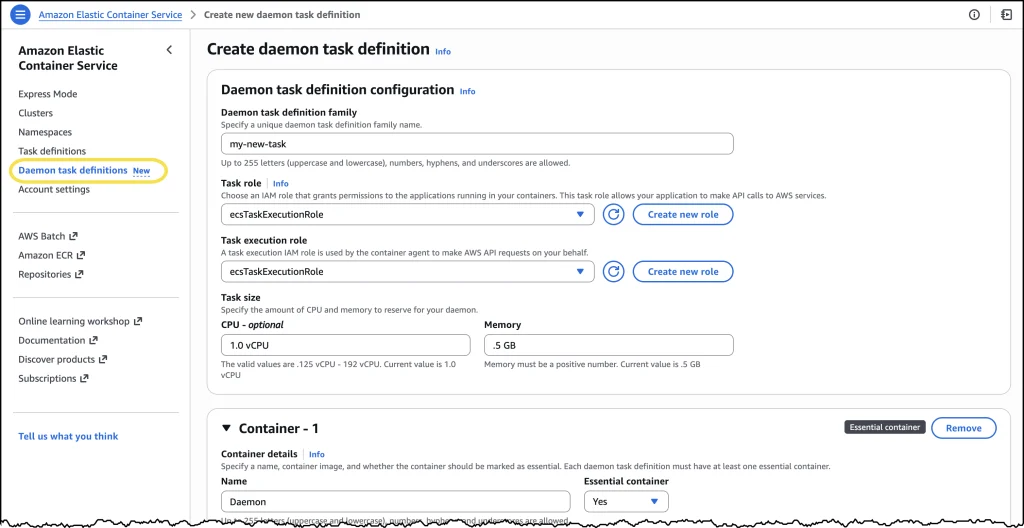
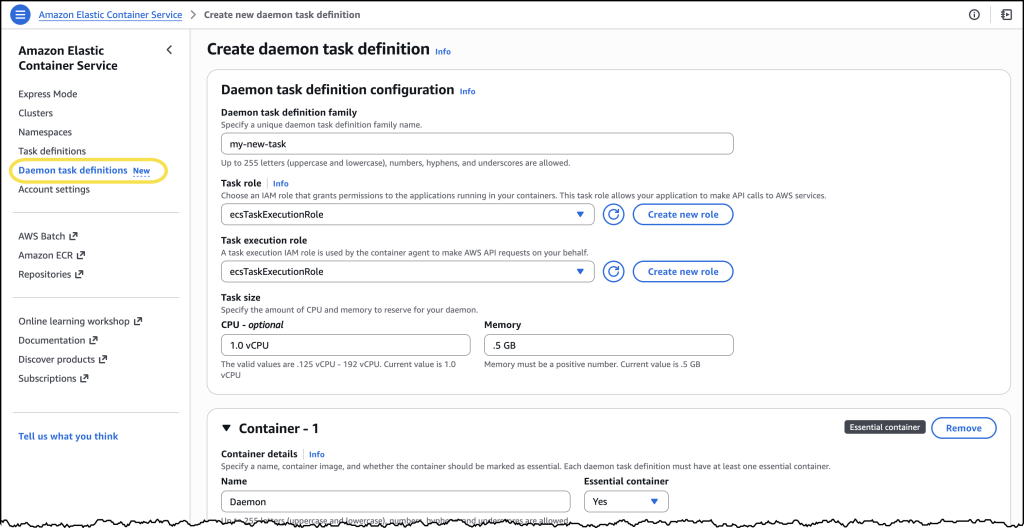
At its core, this feature introduces a new daemon task definition within ECS. This definition is distinct from application task definitions, allowing platform teams to specify the exact configuration, resource requirements (CPU and memory), and deployment parameters for their operational agents. This decoupling means that an update to a security agent no longer requires the application team to rebuild or redeploy their service. The benefits are multifold:
- Independent Control: Platform engineers gain autonomous control over their infrastructure-level tooling. This fosters specialization, allowing application teams to focus on business logic while platform teams ensure robust observability and security.
- Consistent Enforcement: The system guarantees that every instance within a designated capacity provider consistently runs the required daemons. This eliminates "shadow IT" or inconsistencies in agent deployments, ensuring comprehensive host-level monitoring and compliance across the fleet.
- Improved Reliability: Daemons are guaranteed to start before application tasks and drain last during instance termination or updates. This "start before stop" mechanism is crucial for maintaining continuous data collection. It ensures that logging, tracing, and monitoring agents are always active when an application begins processing requests and remain active until the application has fully shut down, preventing critical gaps in operational data.
Key Benefits for Modern Cloud Operations
The implications of managed daemon support extend across various facets of cloud operations:
-
Enhanced Operational Efficiency and Agility: By decoupling agent lifecycles, organizations can significantly reduce the coordination overhead between platform and application teams. This accelerates the deployment of new operational tools, simplifies updates, and allows for quicker responses to security vulnerabilities or new monitoring requirements. Platform teams can push out updates to their agents on demand, without needing to coordinate complex application redeployments. This agility is vital in rapidly evolving cloud environments where new threats and performance bottlenecks emerge constantly.

-
Increased Reliability and Consistency: The guarantee that daemons start before applications and drain last dramatically improves the reliability of operational data collection. No longer will an application spin up without its corresponding monitoring or logging agent being fully operational. This consistency is paramount for accurate incident response, performance analysis, and compliance auditing. Furthermore, the ability to define resource parameters for daemons separately prevents resource contention with application tasks, leading to more stable overall system performance.
-
Improved Security Posture: Many security agents require deep visibility into the host operating system. The managed daemon feature supports advanced host-level access capabilities, including the configuration of daemon tasks as privileged containers, the addition of specific Linux capabilities, and the mounting of paths from the underlying host filesystem. This enables security teams to deploy robust agents that can monitor system calls, network traffic at the kernel level, and file system integrity, thereby strengthening the overall security posture of the containerized environment without complex workarounds.
-
Optimized Resource Utilization: Each instance runs exactly one copy of a managed daemon, which is then shared across multiple application tasks running on that instance. This contrasts with sidecar patterns, where each application task might get its own agent, potentially leading to redundant resource consumption. By centralizing daemon management and ensuring a single instance-level deployment, resources are utilized more efficiently, contributing to cost optimization.
A Closer Look: Implementation and Features
The practical implementation of managed daemons is designed for ease of use and flexibility. Platform engineers can manage these daemons directly through the Amazon ECS console, where a new "Daemon task definitions" option is available in the navigation pane. This dedicated section allows for the creation and management of daemon configurations, separate from standard application task definitions.
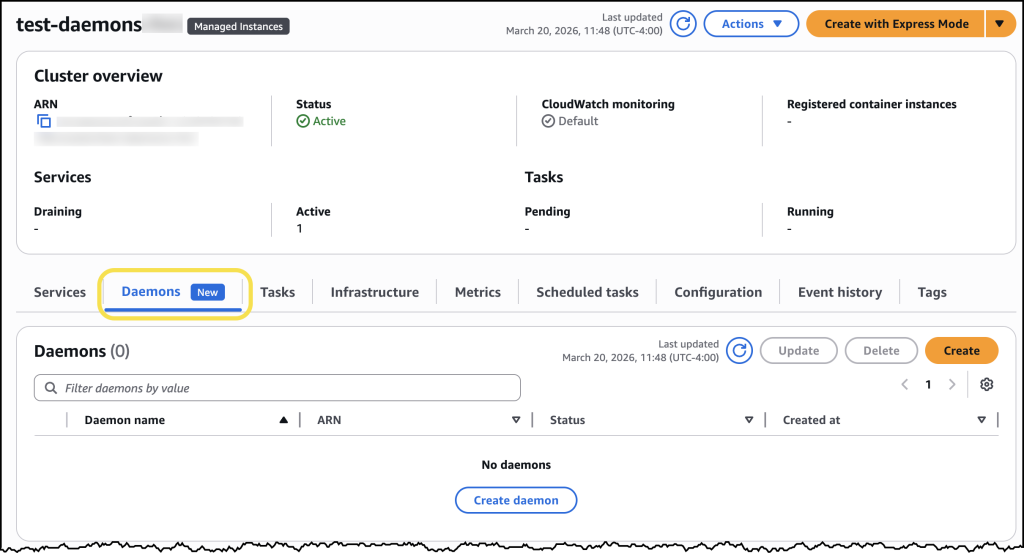
Once a daemon task definition is created (e.g., for the Amazon CloudWatch Agent, configured with specific CPU and memory parameters and an image URI), it can be deployed to an ECS cluster. A new "Daemons" tab within the cluster view facilitates the creation and management of daemon deployments. Engineers can choose to deploy daemons across multiple capacity providers or target specific ones, offering fine-grained control over their operational tooling rollout strategy.
One of the most powerful features is the automatic handling of rolling deployments. When a daemon is updated, ECS orchestrates a seamless replacement process:
- New instances are provisioned with the updated daemon.
- The updated daemon starts first on these new instances.
- Application tasks are then migrated to the new instances.
- Finally, the old instances (with the outdated daemon) are terminated, ensuring the old daemon drains last.
This "start before stop" approach, combined with configurable drain percentages, ensures continuous daemon coverage and uninterrupted data collection during updates, eliminating any gaps in monitoring or logging data. The system also supports automatic rollbacks, providing a safety net for daemon updates.
Technically, the daemon_bridge network mode is introduced, allowing daemons to communicate with application tasks while maintaining isolation from application networking configurations. This isolation is vital for security and stability, preventing daemon-related network issues from impacting core application functionality.
Broader Industry Implications and Future Outlook
This announcement from AWS underscores a growing trend in cloud-native development: the increasing specialization and abstraction of infrastructure concerns. As container orchestration platforms mature, there’s a clear move towards providing higher-level primitives that simplify complex operational patterns. Managed daemon support is a prime example, effectively externalizing a common operational challenge into a first-class platform feature.
This will undoubtedly impact the roles of DevOps and Platform Engineering teams. Instead of spending time crafting complex deployment scripts or custom solutions for agent management, these teams can now leverage a native ECS capability, freeing them to focus on more strategic initiatives like optimizing cost, enhancing security policies, or developing internal developer platforms. It also aligns with the broader industry movement towards "shift-left" operational responsibilities, where reliability and observability are baked into the platform layer rather than being bolted on at the application level.
Looking ahead, this development sets a precedent for how cloud providers might continue to abstract away operational complexities. We could see similar managed constructs for other auxiliary services, further streamlining the experience of running sophisticated, resilient applications in the cloud. This evolution is crucial for enterprises striving for operational excellence and developer productivity in an increasingly complex digital landscape.
Statements and Availability
An AWS spokesperson, commenting on the launch, stated, "Our customers consistently tell us that operational complexity is a significant hurdle to innovation. With managed daemon support for Amazon ECS Managed Instances, we’re empowering platform engineers to take independent control of their critical operational tooling, ensuring consistency, reliability, and ultimately, freeing up valuable developer time. This is a direct response to customer feedback and a testament to our commitment to simplifying cloud operations at scale."
A leading analyst from Gartner, speaking on the condition of anonymity due to policy, remarked, "This feature represents a mature evolution of container platforms. The ability to cleanly separate the lifecycle of operational agents from application code is a game-changer for large enterprises. It will significantly reduce the friction typically associated with maintaining observability and security across vast microservices landscapes, offering substantial long-term benefits in terms of cost and agility."
Managed daemon support for Amazon ECS Managed Instances is available immediately in all AWS Regions. There is no additional cost associated with using the managed daemon feature itself; customers only pay for the standard compute resources consumed by their daemon tasks, aligning with AWS’s pay-as-you-go model. Detailed documentation and API references are available on the Amazon ECS developer guide, enabling platform teams to integrate this new capability into their existing workflows without delay. This strategic enhancement solidifies Amazon ECS’s position as a robust and developer-friendly platform for orchestrating containerized workloads, further bridging the gap between application development and operational excellence.
