

All digital data and systems, from cloud-based platforms and personal online accounts to company websites and mobile applications, ultimately reside on tangible hardware. The terms "virtual server" and "physical server" describe not a state of existence, but rather the architectural approach to how these machines are structured and utilized. While both serve the fundamental purpose of hosting and processing information, their underlying mechanics, benefits, and drawbacks present distinct pathways for businesses and individuals navigating the digital landscape.
The Foundation: Physical Servers
A physical server, often referred to as a bare metal server, is a self-contained machine encompassing all essential components for operation: a chassis, central processing unit (CPU), graphics processing unit (GPU), random-access memory (RAM), storage devices, a power supply unit, network interfaces, and the operating system along with server application software. These machines are engineered for continuous operation, typically running 24/7, and are dedicated to serving other computers rather than general user computing. This dedicated purpose makes them ideal for demanding tasks such as hosting websites, managing databases, or facilitating complex network services.
The physical form factor of a server, whether it’s a compact desktop unit or a large rack-mounted appliance, does not alter its classification as a physical server. Organizations can maintain these servers privately within their own facilities, offering direct control over hardware and infrastructure, or access them through cloud vendors who provide dedicated physical hardware.
Key Characteristics of Physical Servers
The primary differentiator of a physical server is its exclusive claim to all machine resources. This dedicated allocation translates into significant advantages in terms of security and raw power. Key features include:
- Exclusive Resource Allocation: All processing power, memory, and storage are dedicated solely to the tasks running on that specific server. This prevents resource contention and ensures predictable performance.
- High Performance Potential: With direct access to hardware, physical servers can achieve peak performance for compute-intensive workloads without the overhead of virtualization layers.
- Enhanced Security: The isolation of a physical server from other tenants, especially when privately hosted, can offer a higher baseline of security against certain types of network-based threats.
- Direct Hardware Control: Administrators have complete control over the hardware configuration, enabling fine-tuning for specific application requirements.
- Predictable Performance: Without the need to share resources or contend with the hypervisor, performance is generally more consistent and predictable.
Historical Context and Evolution of Physical Servers
In the early 2000s, the digital infrastructure was predominantly powered by physical servers. The prevailing model involved individual companies hosting their own dedicated machines to drive their IT systems. This era saw a proliferation of enterprise data centers, each housing a fleet of these specialized computers. For instance, a financial institution might have dedicated physical servers for its trading platforms, its customer databases, and its internal communication systems. Each of these functions would reside on a separate, physically distinct machine, meticulously managed by internal IT teams.
This approach offered a high degree of control and a clear understanding of where data resided and how it was processed. However, it also came with significant capital expenditures, ongoing maintenance costs, and challenges in scaling resources up or down quickly in response to fluctuating demand. The physical footprint of these data centers grew, as did the associated energy consumption and cooling requirements.
Modern Use Cases for Physical Servers
While the landscape has shifted significantly with the rise of virtualization, physical servers still play a crucial role in modern IT infrastructure, particularly for workloads that demand the utmost in performance, security, and dedicated resources. Today, a substantial portion of global server workloads are managed by virtual machines (VMs), but physical servers remain indispensable for specific, demanding applications.
Popular use cases for physical servers include:
- High-Performance Computing (HPC): For complex scientific simulations, large-scale data analysis, and rendering farms, the raw power and direct hardware access of physical servers are often essential.
- Database Hosting: Mission-critical databases that require the highest levels of performance, low latency, and dedicated I/O capabilities often benefit from the direct hardware access of a physical server.
- Legacy Applications: Older applications that may not be compatible with virtualization technologies or that have specific hardware dependencies still rely on physical server environments.
- Dedicated Gaming Servers: For online gaming platforms requiring minimal latency and maximum player capacity, dedicated physical servers offer superior performance.
- Resource-Intensive Virtualization Hosts: In some scenarios, powerful physical servers are used to host multiple virtual machines, effectively serving as the "bare metal" foundation for a virtualized environment.
Industries Relying on Physical Servers
Sectors that prioritize unwavering reliability, superior performance, stringent security, and absolute control frequently turn to physical servers. These include:
- Financial Services: For high-frequency trading platforms, core banking systems, and sensitive financial data management, the performance and security of physical servers are paramount.
- Healthcare: Handling sensitive patient records and powering critical medical imaging systems often necessitates the dedicated resources and robust security of physical servers.
- Government and Defense: National security applications, classified data processing, and critical infrastructure control systems demand the isolation and security guarantees of bare metal hardware.
- Aerospace: Complex design simulations, flight control systems, and sensitive research projects benefit from the dedicated processing power and reliability of physical servers.
- Manufacturing: Industrial control systems, real-time production monitoring, and specialized design software often require the direct hardware access and predictable performance of physical servers.
- Logistics and Public Services: Critical infrastructure management and large-scale operational systems that demand high availability and predictable performance.
- Media and Entertainment: For large-scale video rendering, streaming infrastructure, and high-fidelity content creation, physical servers offer the necessary processing power.
These industries place a premium on the reliability, performance, security, isolation, and direct ownership that physical servers provide, often outweighing the cost efficiencies offered by virtual solutions for their most critical operations.
The Revolution: Virtual Servers
A virtual server, in essence, is a software-based emulation of a physical server. It is typically created by partitioning the resources of a single, powerful physical server to host multiple independent virtual environments. This process, known as virtualization, is the cornerstone of modern cloud computing, enabling cloud providers to efficiently allocate and scale computing resources across vast pools of hardware, maximizing utilization and offering services at global scales.
Imagine a state-of-the-art physical server, equipped with immense computing power, extensive storage, lightning-fast processing speeds, and robust security features. Instead of dedicating this entire machine to a single client, virtualization software (a hypervisor) divides its resources into several distinct segments. Each segment can then be configured to operate as an independent virtual server, or Virtual Machine (VM). A customer might then rent one of these VMs to host a website, another for managing a database, and a third for running a specific application.
Each VM is allocated its own dedicated portion of the physical server’s CPU, RAM, and storage, and runs its own isolated operating system and applications. This creates the illusion of a dedicated physical machine for each user, even though they are sharing the underlying hardware. At a large scale, this principle is the engine driving the growth and ubiquitous availability of cloud computing services.
Key Characteristics of Virtual Servers
Virtual servers offer a distinct set of advantages, largely stemming from their flexible and dynamic nature:
- Resource Efficiency and Cost-Effectiveness: By sharing the resources of a single physical server among multiple virtual servers, virtualization significantly reduces hardware costs and improves overall resource utilization.
- Scalability and Flexibility: Virtual servers can be easily provisioned, scaled up or down, and migrated, offering unparalleled agility in adapting to changing business needs.
- Rapid Deployment: New virtual servers can be created and deployed in minutes, compared to the days or weeks required to procure and set up a physical server.
- Disaster Recovery and Business Continuity: Virtualization simplifies backup and recovery processes, making it easier to restore operations in the event of hardware failure or other disruptions.
- Isolation: While sharing hardware, each virtual server operates in its own isolated environment, preventing interference between different tenants or applications.
The Proliferation of Virtual Server Use Cases
The applications for virtual servers are virtually limitless, permeating nearly every facet of the digital world. From large enterprises to individual users, virtual servers are indispensable. Regular internet users interact with virtual servers daily, often without explicit awareness, when browsing websites, logging into online platforms, or using mobile applications.
Some of the most popular use cases for virtual servers include:
- Web Hosting: The vast majority of websites today are hosted on virtual servers, offering scalable and cost-effective solutions for businesses of all sizes.
- Application Hosting: Deploying and running a wide range of business applications, from customer relationship management (CRM) software to enterprise resource planning (ERP) systems.
- Database Management: Hosting databases for applications, websites, and data analytics platforms.
- Development and Testing Environments: Providing isolated environments for developers to build, test, and deploy software without impacting production systems.
- Cloud Computing Services: The foundation of Infrastructure as a Service (IaaS), Platform as a Service (PaaS), and Software as a Service (SaaS) offerings.
- Virtual Desktops: Providing users with remote access to their desktop environments, enhancing flexibility and security.
- Big Data Analytics: Processing and analyzing large datasets in scalable and flexible environments.
- Machine Learning and AI Training: Providing the computational power and flexibility needed for training complex AI models.
Beyond these common applications, virtual servers are integral to advanced computing paradigms like virtual desktop infrastructure (VDI), enabling remote workforces, and powering high-performance computing (HPC) clusters.
Virtual Servers Versus Physical Servers: A Comparative Analysis
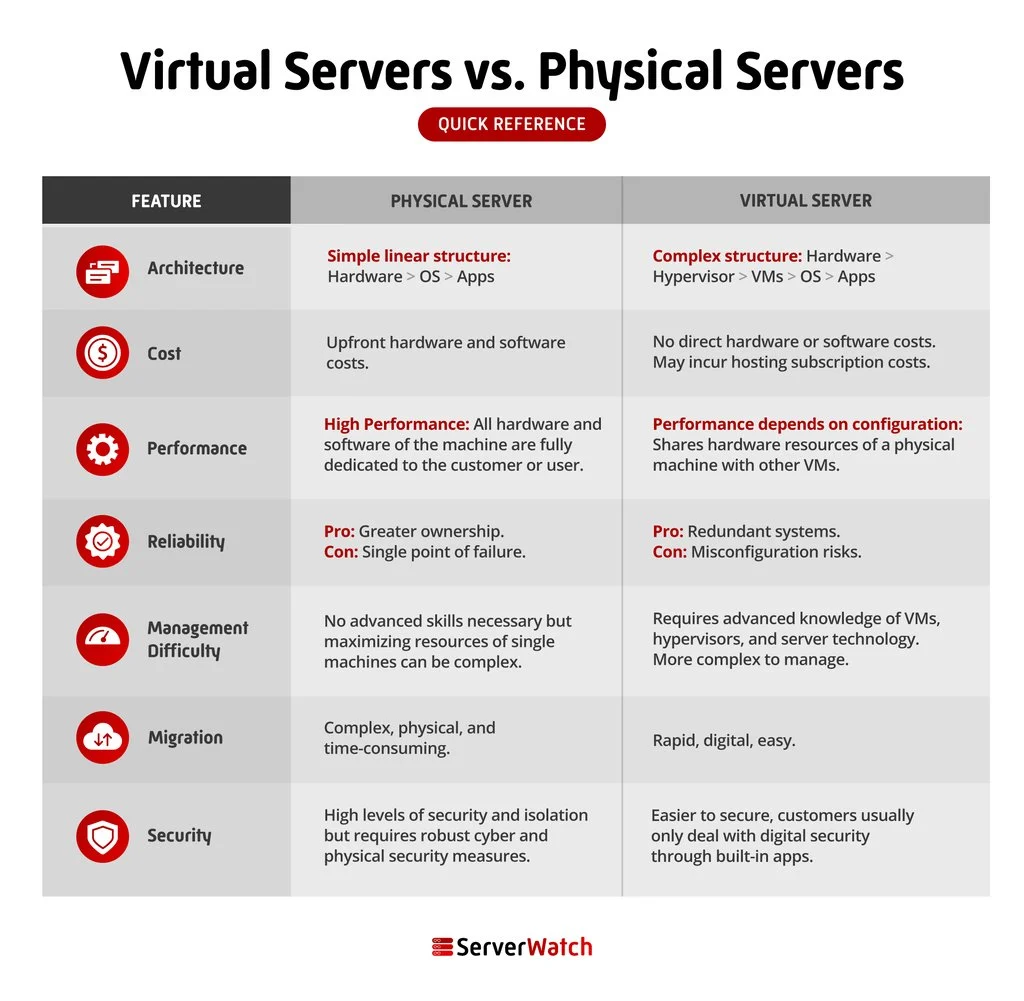
The fundamental distinction between virtual and physical servers lies in their architecture and how resources are managed. This leads to significant differences in cost, performance, reliability, management, migration, and security.
Architecture
The core architectural difference is straightforward: a physical server is a singular, dedicated piece of hardware. A virtual server, conversely, is a software construct that resides on and shares the resources of a physical server, made possible by a hypervisor. This architectural divergence dictates many of the subsequent comparisons.
Cost Dynamics
While virtualization technology can be complex and requires sophisticated software, it generally proves more cost-efficient, especially when deployed at scale. The initial capital outlay for physical servers can be substantial, encompassing not only the hardware but also the infrastructure to house and power them. Virtual servers, particularly through cloud providers, operate on a pay-as-you-go or subscription model, reducing upfront investment.
Furthermore, users of cloud-based virtual servers often offload the responsibilities of hardware maintenance, physical security, energy consumption, and the risks associated with natural disasters. For a physical server, businesses are responsible for all these factors, from the electricity bill to replacing a burned-out power supply, and the potential for data loss due to a fire or flood.
Performance Considerations
The performance race between physical and virtual servers is often nuanced and depends heavily on specific configurations, hardware capabilities, software optimizations, and network infrastructure. In scenarios demanding absolute maximum performance with no overhead, a finely tuned physical server can theoretically outperform a virtual counterpart. This is because it has direct access to hardware without the intermediary layer of the hypervisor.
However, modern virtualization technologies have significantly narrowed this gap. For many common workloads, the performance difference is negligible, and the ability to scale resources dynamically with virtual servers often provides a more practical advantage. For instance, a virtual server can be quickly provisioned with more CPU cores or RAM during peak demand, a process that would be far more cumbersome with a physical machine. The key is understanding the specific performance requirements of the application.
Reliability and Uptime
Similar to performance, the reliability of both physical and virtual servers is contingent on the underlying hardware, software, network, and configuration. Both can be engineered for exceptional reliability. Physical servers, when housed in robust data centers with redundant power and cooling, can achieve very high uptime.
Virtualization introduces additional layers of resilience. Cloud providers often build redundancy into their infrastructure, allowing VMs to be automatically migrated to healthy hardware in case of a physical server failure. This built-in failover capability can enhance overall system uptime. However, a poorly configured virtual environment or an issue with the hypervisor itself can introduce new points of failure. The critical factor remains diligent management and robust architecture for both approaches.
Management Complexity
Managing physical servers can be a complex undertaking, requiring in-house expertise in hardware maintenance, operating system administration, and network configuration. When operating virtual servers from an external provider, many of these day-to-day management tasks are outsourced to the vendor. The cloud provider typically handles the physical hardware, the hypervisor, and the underlying infrastructure. This leaves the user to focus on managing the operating system and applications within their virtual environment, often simplifying the overall management burden. However, managing a private virtualized environment still requires significant expertise in virtualization platforms.
Migration Ease
Migrating virtual servers is demonstrably easier than migrating physical servers. Virtual servers are essentially files that can be readily copied, cloned, and moved between different physical hosts. This process can often be accomplished with a few clicks through management consoles, minimizing downtime.
In contrast, migrating a physical server typically involves physically relocating the hardware, reconfiguring network settings, and manually backing up and restoring the entire system onto a new machine. This is a far more time-consuming and error-prone process. The portability of VMs is a significant advantage for businesses undergoing infrastructure changes or seeking to consolidate their IT assets.
Security Considerations
Both virtual and physical servers can be secured to a high degree, but they require meticulous configuration and ongoing management. Physical servers offer a natural form of isolation by being a standalone unit, which can be a strong security posture, especially when physically secured. However, they can be vulnerable to physical breaches or hardware-level attacks if not properly protected.
Virtual servers, while sharing hardware, are designed with strong isolation mechanisms. The hypervisor ensures that one VM cannot directly access the resources or data of another. However, vulnerabilities in the hypervisor itself or misconfigurations in network segmentation can create security risks. Cloud providers invest heavily in security at the infrastructure level, but the responsibility for securing the operating system and applications within the VM ultimately rests with the user. The choice often comes down to the specific security requirements and the trust placed in the provider’s security measures.
The Bottom Line: Choosing Between Virtual and Physical Servers for Your Business
Both virtual and physical servers possess distinct advantages and disadvantages, making the optimal choice entirely dependent on a business’s specific needs, priorities, and operational context.
For the majority of businesses, virtual servers represent a compelling solution. Their affordability, excellent reliability, access to cutting-edge technology through cloud platforms, and unparalleled scalability make them an attractive option for a wide array of applications. The agility to scale resources up or down in response to demand, coupled with reduced capital expenditure and simplified management, offers significant operational benefits.
However, physical servers remain a superior choice for businesses with highly specialized requirements. Organizations that demand absolute control over their hardware, require the highest levels of dedicated performance for extremely compute-intensive tasks, or operate under stringent regulatory compliance mandates that necessitate complete physical isolation, may find physical servers to be the more appropriate solution. The ownership, raw power, and perceived airtight security of bare metal hardware continue to be critical factors for certain industries and applications.
Ultimately, the decision hinges on a careful assessment of workload demands, budget constraints, performance expectations, security posture, and the desired level of control. As technology continues to evolve, the lines between physical and virtual capabilities may blur further, but understanding these fundamental differences remains crucial for making informed infrastructure decisions in the modern digital economy.
For businesses looking to harness the power of virtualization, exploring the best server virtualization software can provide a roadmap to implementing efficient and scalable solutions.
